
Here is the Big Chair as you have probably never seen it: with a woman living on top of it. Her name was Lynn Arnold, she was nineteen years old, and for 42 days in the summer of 1960 she called a glass box bolted to the seat of a giant chair her home.
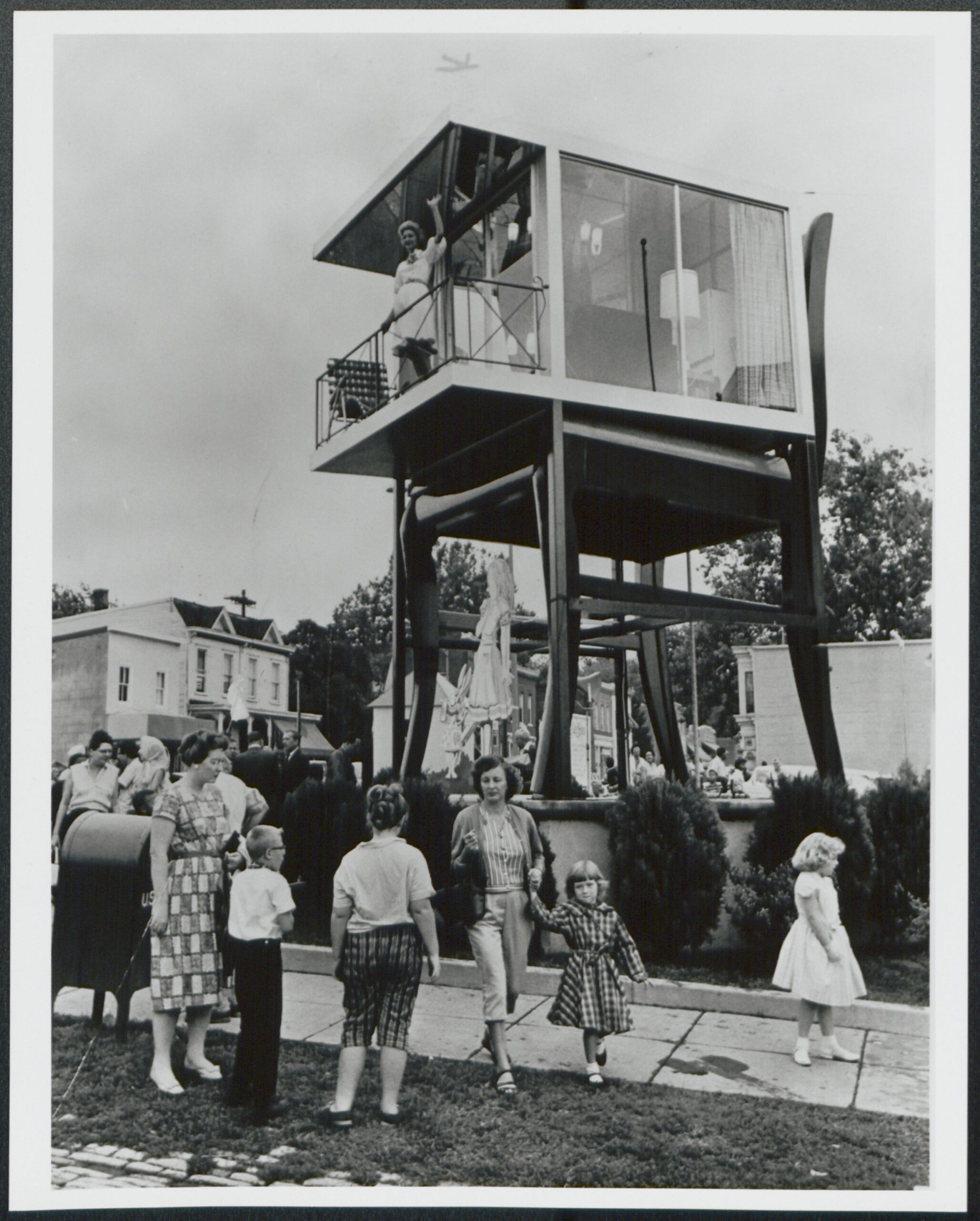
The chair itself has stood at 2101 Martin Luther King Jr. Avenue SE, once 2101 Nichols Avenue SE, since 1959. Nineteen and a half feet of mahogany brown, it is the thing you point at when you tell someone which corner of Anacostia you mean. It started as a furniture-store publicity stunt. Anacostia decided to keep it anyway.
Curtis Brothers Furniture and the Nichols Avenue strip
Curtis Brothers Furniture Company started in 1926, when three brothers pooled enough money for a $250 Ford Model T truck and went into the ice-hauling business. Furniture came later, as a sideline. By the mid-1950s the furniture had eaten the moving business, and Curtis Brothers had grown into one of the largest retail furniture operations in the region, headquartered at V Street and Nichols Avenue SE.
Nichols Avenue was Anacostia’s main commercial spine, with streetcars running down the middle of it and the Anacostia Bank a block up at 2021 Nichols. Curtis Brothers occupied the block-long showroom at 2101, three floors and a basement of sofas, dinettes, and mattresses. By 1959 four brothers were running the business. The one who dreamed up the Big Chair was Charles Wendell Curtis. When he died in 2007 at 82, the Post remembered him as “the man who brought the 19 1/2-foot-high mahogany chair to Anacostia in 1959 and created a lasting landmark.”
1959: the world’s largest chair, built in Bassett, Virginia
Curtis commissioned Bassett Furniture Industries down in Bassett, Virginia to build it: a Duncan Phyfe dining chair blown up to roughly eight times life size. Carved from African mahogany, it stood 19 feet 6 inches tall and weighed about 4,600 pounds.
Curtis Brothers billed it as the largest chair in the world, a claim contested from the day it went up and disputed by furniture towns ever since. It may not be the biggest today. In 1959 it was a genuine spectacle. Drivers slowed down. People drove out to Anacostia on a Sunday just to see it.
Lynn Arnold moves into the glass house, August 1960
A giant chair alone was not going to sell furniture forever, so in the summer of 1960 Curtis Brothers hired a glassmaker to build a ten-by-ten-foot glass house for the seat. Three walls were transparent, the fourth was black for privacy, and the ceiling was a mirror. The little apartment came furnished: curtains, a bed, a shower, a toilet, a television, a phone, a heater, an air conditioner, and a small balcony. The plan was to install someone in it, in plain view of the whole neighborhood, and see what happened to Sunday foot traffic.
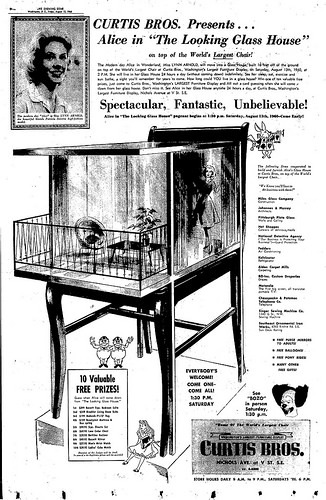
They found their tenant when a nineteen-year-old model named Lynn Arnold walked into the showroom to buy furniture. Arnold was the reigning “Miss Get Out the Vote 1960” for the Washington Junior Chamber of Commerce, married, with a young son. The managers made their pitch. Arnold talked it over with her husband, who was not thrilled, and said yes on one condition: keep it wholesome.
“I didn’t want to do anything like stand up there naked or in a bathing suit,” she told the Post years later. “They wanted a Cinderella figure; they didn’t want Marilyn Monroe. I figured I could pull this off without being branded a slut.”
On August 13, 1960, a forklift raised Lynn Arnold onto the seat of the Big Chair. She would live there for 42 days.
42 days in the sky
Life in the glass house settled into a rhythm. Arnold read, watched television, talked on an unlisted phone so friends could reach her without the whole city calling to check in, and waved to the crowds below. Meals and clean clothes rode up in a rope-and-pulley dumbwaiter that occasionally lost its balance and spilled its contents onto the parking lot. Her only regular visitor was her fourteen-month-old son, Richard, raised up whenever she asked. Everyone else stayed on the ground and looked up.
The Washington Post ran its first big feature the morning after she went up, headlined “Living in the Open.” Reporters and photographers kept coming back as the days stacked up, and by early September the story had gone national. On September 23, 1960, Arnold told the store she was “groundsick.” The forklift lowered her back down. She had earned about $1,500 for six weeks in the sky, more than most Washington families earned in three months at the time. Curtis Brothers, by any reasonable measure, earned considerably more than that in free advertising.
The chair outlasts the store
The glass house came down after Arnold left. The chair stayed, and Curtis Brothers kept adding it to every ad and every delivery truck. Around it, the neighborhood shifted. Arthur B. “Barney” Curtis, one of the founding brothers, died at his Suitland Road SE home in September 1973.
On January 12, 1971, the DC City Council announced it was renaming Nichols Avenue for Dr. Martin Luther King Jr., in time for a King birthday observance that Friday. The Big Chair’s address changed from 2101 Nichols Avenue SE to 2101 Martin Luther King Jr. Avenue SE without the chair moving an inch.
By the mid-1970s the retail furniture business had turned brutal, with discount chains undercutting old-line stores. In February 1975 the Post reported that Curtis Brothers Furniture Company had folded, its December 1974 sales down forty percent from a year earlier. The company that started with a $250 ice truck was done in less than fifty years. The chair kept sitting there. Different tenants moved in and out of the old showroom, and the chair, mostly ignored by owners, aged slowly through weather it was never built for.
2005: the rebuild
By the summer of 2005 the chair was in trouble. Water had gotten deep into the joints, and the mahogany was splitting. Anyone who looked closely could see it would not survive another Washington winter. That August a crew took it down, and for the first time in 46 years the corner of MLK and V looked like an ordinary intersection.
The Post ran Paul Schwartzman’s front-of-Metro elegy on August 28: “You Better Sit Down. The Big Chair’s Gone.” Longtime residents talked about growing up with the chair, about their parents pointing it out on Sunday drives, about seeing Lynn Arnold up in the glass house when they were small.
Curtis Investment Group, the descendant company that still owned the property, agreed to pay for a rebuild. Rather than source enough seasoned African mahogany to do it right again, they chose aluminum: same Duncan Phyfe silhouette, same 19 1/2 feet, engineered so it would never rot again. The new chair went up in April 2006, and Anacostia had its skyline back.
The chair today
Walk past 2101 Martin Luther King Jr. Avenue SE in 2026 and the chair looks the way it has looked for most of a lifetime. The old Curtis Brothers showroom is gone, and the lot behind it has cycled through other tenants. But the chair is right where it has always been, aluminum now, painted the same warm mahogany brown, still nineteen and a half feet tall.
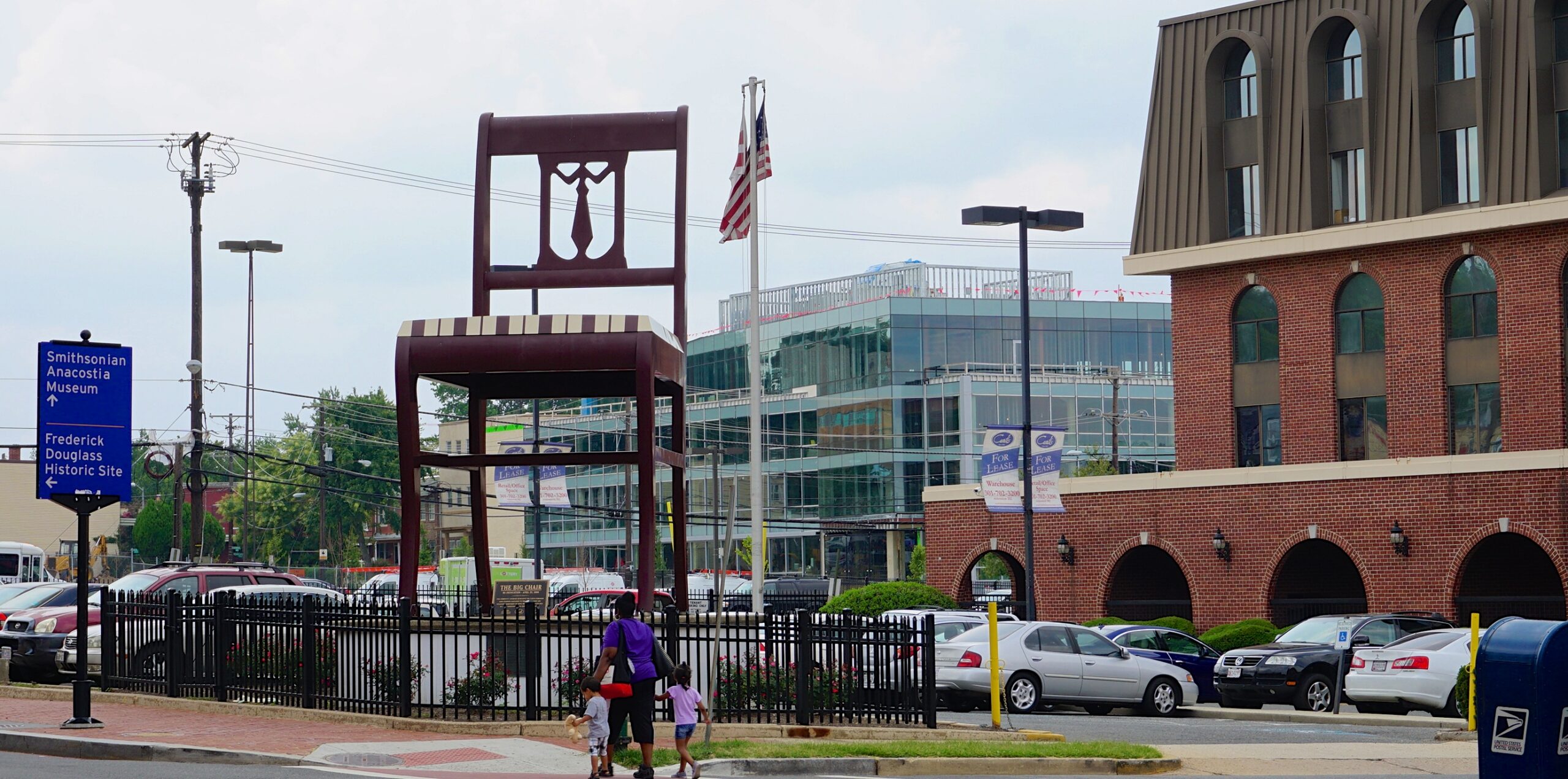
It gets photographed hundreds of times a week, used as a meeting point, a landmark, a shorthand for east of the river. Charles Curtis’s marketing gimmick from 1959 has outlasted the store that paid for it, outlasted Nichols Avenue as a name, and outlasted the mahogany itself.
Lynn Arnold went back to normal life after her six weeks in the glass house. Richard grew up. The forklift went back to work. And the chair kept sitting on the sidewalk, waiting for the next person to notice how absurdly tall it is.
For more on the neighborhood, see our pieces on why Anacostia is named Anacostia, the Anacostia Bank at 2021 Nichols Avenue one block up, and Grover Cleveland’s 1886 visit to Frederick Douglass at Cedar Hill. For another Washington publicity stunt that made the papers for weeks, see the piece on Suburban Gardens in Deanwood.