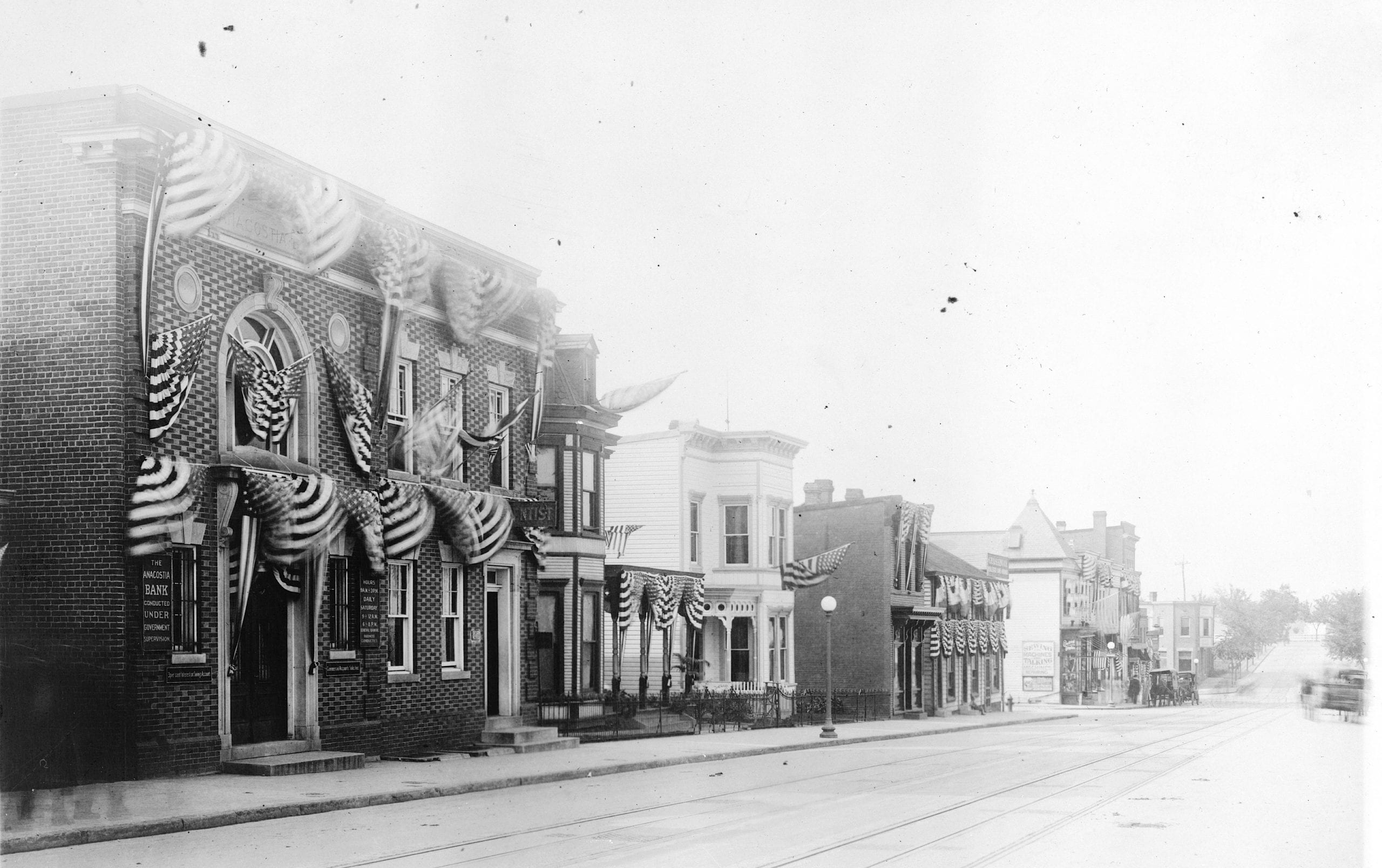
The Anacostia Bank opened for business in 1910 at 2021 Nichols Avenue SE, in a two-story red-brick building that had been put up in 1906. Eight years later, a National Photo Company photographer pointed a camera down Nichols Avenue and caught the bank dressed up in American flags and patriotic bunting for a wartime parade.
That photograph is this one.
A Parade in Wartime
1918 is when two kinds of parades were happening in Washington on repeat. Liberty Bond drives, which banks especially hosted and promoted, filled the streets roughly every few weeks through the spring and summer as the Treasury raised money for the war. Then on November 7, a mistaken armistice report sent more than 100,000 people into the streets. On November 11 the real armistice came, and the city celebrated again.
The bunting in the photograph could be for any of them. The decorations came out often enough in 1918 that the bank probably did not take them down between parades.
Look past the flags. Streetcar tracks run down Nichols Avenue in the foreground, connecting Anacostia to downtown across the 11th Street Bridge. A horse-drawn wagon is parked on the right. A few frame and brick buildings fill out the block behind the bank. This is a working-class streetcar suburb at war.
A Neighborhood Called Uniontown
The neighborhood itself was only about sixty years old in 1918.
It had been platted in 1854 as Uniontown, a for-whites-only subdivision on the east bank of the Anacostia River. The developers had picked up some of the first land east of the river ever made available to private buyers. They sold it in cheap 26-foot-wide lots to federal Navy Yard workers who could walk over the bridge to work. The subdivision didn’t quite go as planned. It went bankrupt in 1877, though the street grid it laid down was already there, and the name Uniontown mostly stuck until around 1886, when the Post Office renamed the place Anacostia.
Through all of it, Nichols Avenue was the main commercial street. It was named for Dr. Charles Henry Nichols, the first superintendent of St. Elizabeths Hospital, whose campus sat on the ridge above town. The avenue ran roughly north-south along the low flat at the foot of that ridge. You came off the 11th Street Bridge from Washington, turned south, and rode Nichols past the bank, past the drugstore, past the theaters and the hardware stores, and out toward Congress Heights.
Frederick Douglass lived at Cedar Hill for the last seventeen years of his life, on a hilltop several blocks east of the eventual bank site. He bought the house in 1878 from the estate of John Van Hook, one of the Uniontown subdivision’s original developers. Douglass died there in February 1895, eleven years before the brick building at 2021 Nichols went up. He never had an Anacostia Bank passbook. His neighbors, eventually, did.
What the Bank Did
The Anacostia Bank was not a branch of a Washington institution. It was a local bank, founded by local merchants and professionals for a neighborhood whose residents had to cross the river to do business with every other bank in the District. By 1910 Anacostia had enough population and enough commerce to justify its own.
The sign by the door read, in the sober prose of the period, “THE ANACOSTIA BANK. CONDUCTED UNDER GOVERNMENT SUPERVISION.” Banking hours were posted on the right-hand sandwich board. The second floor held offices. The bank vault was downstairs, in the two-story brick box designed to look as much as possible like a small-town bank in Ohio.
Here it is a few years after the parade photograph, cleaned up of its bunting and photographed for the record:
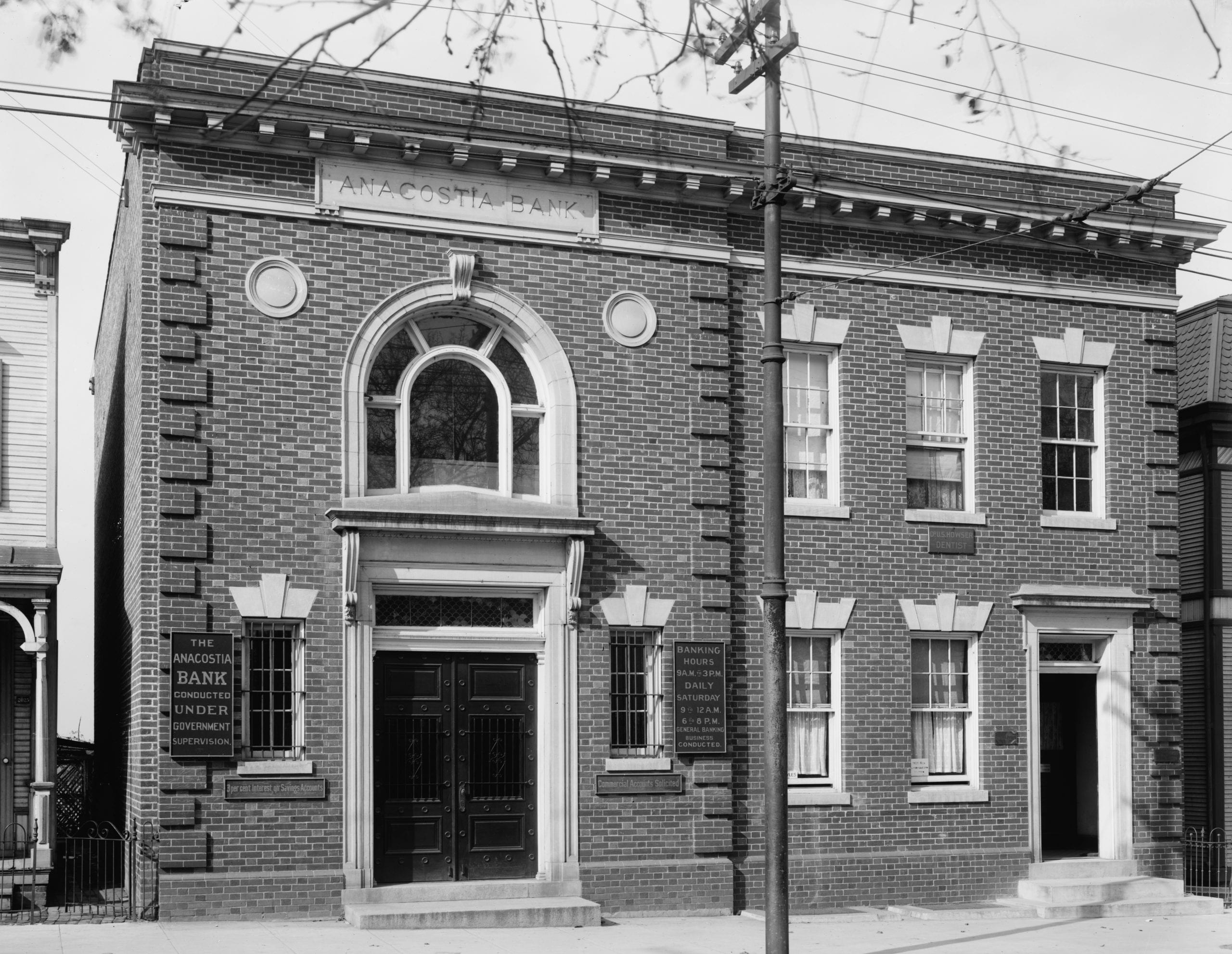
The arched entrance. The carved ANACOSTIA BANK lettering in the entablature. The cast-iron fence by the side entrance. The small sandwich sign promoting banking hours.
Growth, Merger, Vacancy
The Anacostia Bank survived the Depression, which many small neighborhood banks did not. After the Second World War it grew, opening six branches by 1960, including a final one at 4201 Wheeler Road SE. In January 1961 it merged with the much larger National Bank of Washington. The Anacostia Bank name disappeared.
The building at 2021 Nichols Avenue did not. Various tenants used it over the next several decades. In January 1971 the DC Council renamed the street in front of the bank: Nichols Avenue became Martin Luther King Jr. Avenue SE. The Big Chair, Anacostia’s best-known landmark, stands a short walk south on that same avenue. The address on the old deed became obsolete without the building moving an inch.
The 1906 brick facade is still there, protected now as a contributing structure in the Anacostia Historic District. In recent years the building has held temporary nonprofit offices, and it has also sat vacant. Its street has gone through the ups and downs of a commercial strip that the rest of the District spent most of the twentieth century quietly disinvesting from, and the twenty-first slowly reinvesting in. An 1886 letter from the Washington Post complained about “violence on the streets of Anacostia.” An 1892 real estate map showed a still-rural Anacostia with farmhouses and orchards where the streetcar suburbs would shortly stand. The 1918 photograph shows a neighborhood with an avenue, a bank, and a reason to hang flags.
The flags come down eventually. The bank comes down, in a sense, in 1961. The street name comes down in 1971. The building stays.
Cute..its right by the art gallery I go to…
Very cool!?