
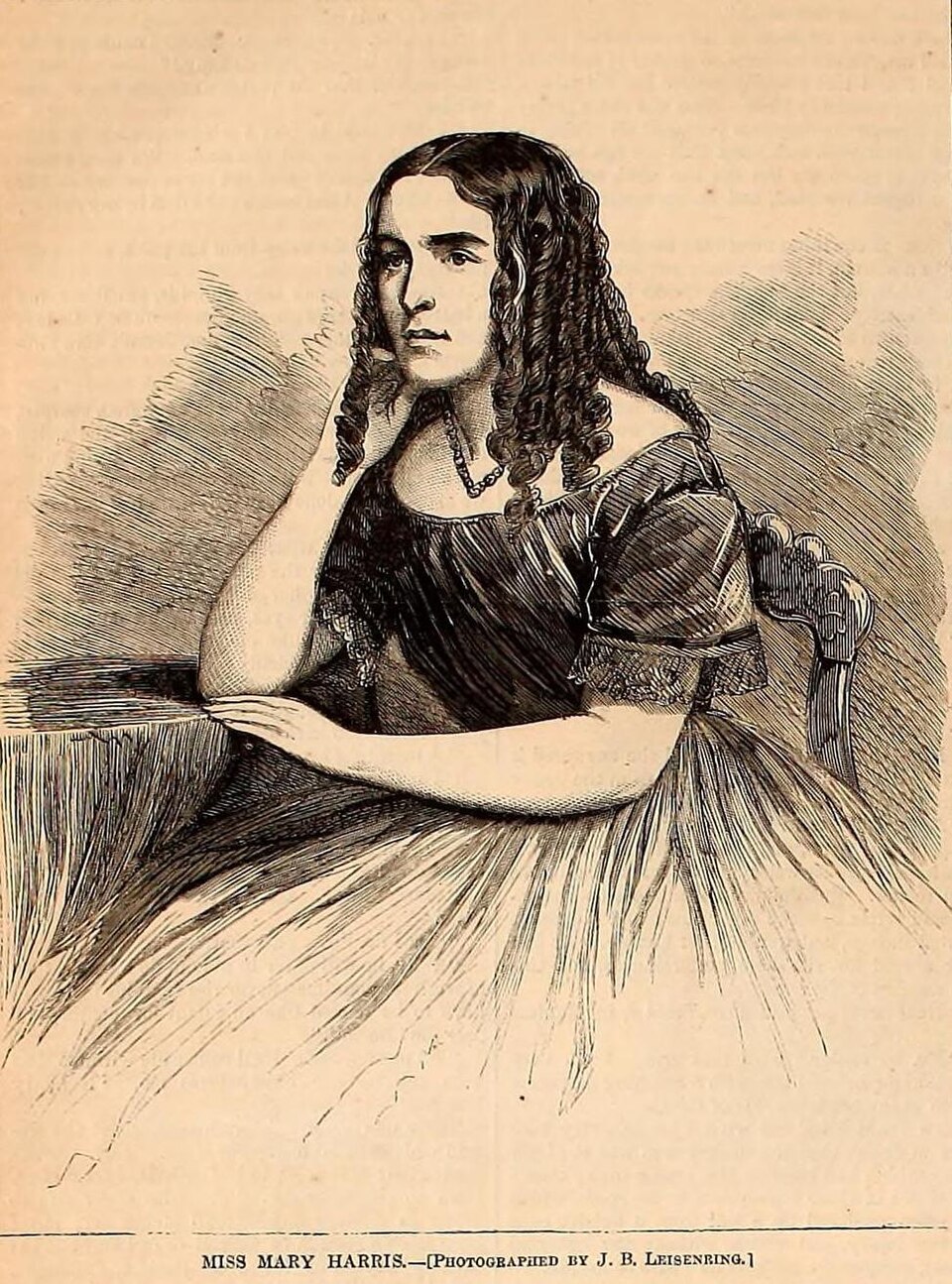
A young woman pushes open the door to the Comptroller of the Currency’s office, peeks at the clerks bent over their ledgers, and finds the face she came two days from Chicago to find.
It is the afternoon of January 30, 1865. Her name is Mary Harris. She is nineteen years old. She is carrying a small Sharps four-barrel pocket revolver. She closes the door, walks back into the hallway, and waits for closing time.
At 4 o’clock the man steps out of the office. He has gone three feet when she fires the first shot into his back. He turns, lets out a single word (“Oh!”), and stumbles toward the stairwell. She fires again. He falls. His coworkers run to him assuming he has fainted and carry him into a nearby room. He is dead in fifteen minutes.
Mary does not run. She drops the pistol back in her pocket, gives a false name to the police, and waits to be taken away.
Welcome to the strangest murder trial Washington saw during the entire Civil War.
A clerk in the Treasury, a hatmaker from Iowa
The dead clerk’s name was Adoniram J. Burroughs. He worked in the office of the Comptroller of the Currency, on the floor where the United States borrowed and counted the cash that was paying for the war.
He had come to Washington in the spring of 1863, applied for a clerkship at the brand-new Comptroller’s office, and married another woman that September on a 20-day leave of absence. His coworkers liked him. By every visible measure he was a young man on his way up.
What no one in the building knew was that he had spent seven years cultivating a teenager.
Adoniram Judson Burroughs first met Mary Harris in 1858 in their hometown of Burlington, Iowa. He was twenty-seven. She was twelve. She was the daughter of poor Irish Catholic immigrants. He was the son of a wealthy Baptist family with deep ties to the church.
By her early teens the visits had quietly tipped from friendly to amorous. Mary’s parents disapproved on every axis they could think of. Burroughs ignored them. In 1863 he asked her to come to Chicago and live with a friend of his, a woman named Louisa Devlin, while he sorted out a Union Army commission and his business prospects.
She went. Her family disowned her for it.
“With a cart-load of kisses I bid you adieu”
The Chicago correspondence read like a marriage in progress. Burroughs called her “Dear Little Mollie” and “Dear little Rosebud.” He wrote her gushing letters the prosecution would later try and fail to keep out of court. One sign-off read: “With a cart-load of kisses I bid you adieu.”
Then the letters stopped.
Mary did not learn for months that Burroughs had taken a job in Washington and married another woman. She learned by reading it in a Chicago paper. According to her later testimony, the news set off the first of what her doctors would call paroxysms, prostrating attacks of weeping and vomiting and a vacant, mechanical absence.
It got worse in September 1864. Mary started receiving letters in a disguised hand, signed by a stranger named “J.P. Greenwood.” He professed love. He asked her to meet him at a specific address in Chicago. She suspected the letters were Burroughs himself writing under an alias, trying to lure her into being seen at a brothel and destroy what was left of her reputation. She did not go.
Louisa Devlin’s sister Jane went instead, carrying a photograph of Burroughs. The madam of the house recognized him on sight. He had waited there the previous Friday for a Miss Harris and finally left when she did not appear.
Mary hired a Washington lawyer to sue for breach of promise. Then, in January 1865, she bought a pistol in Chicago and went to deliver the verdict herself.
The 4 o’clock shooting inside the Treasury Building
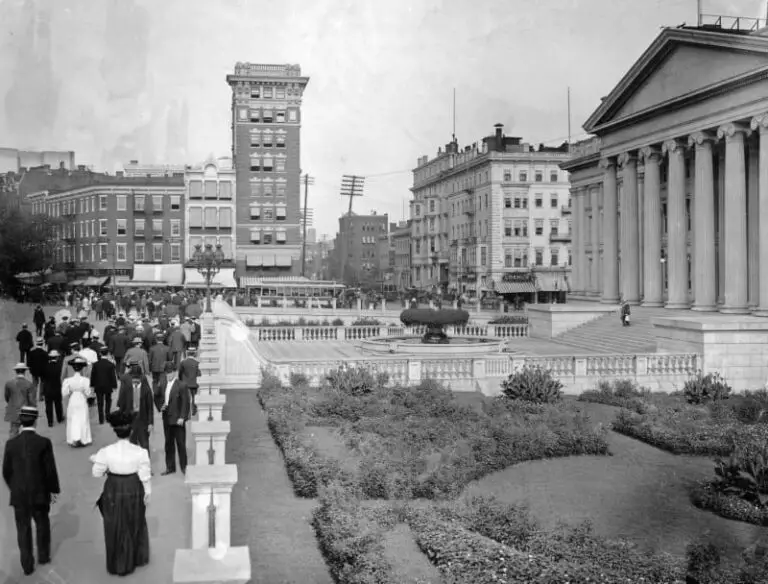
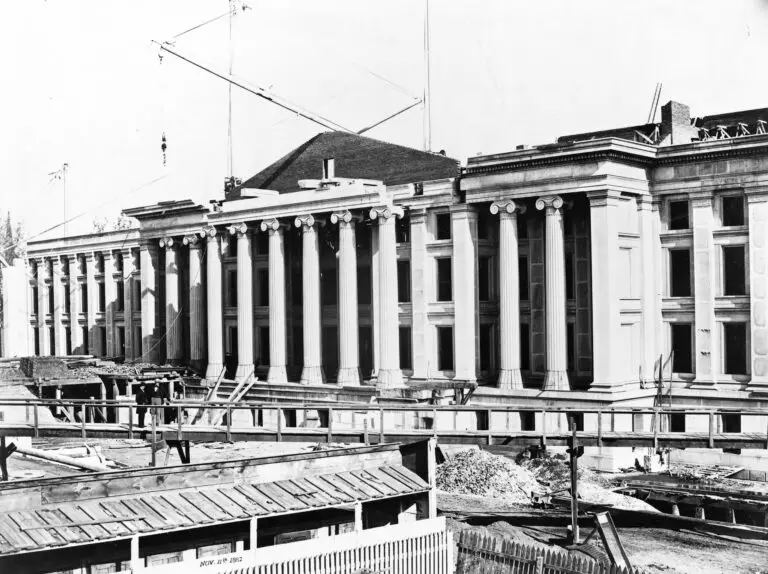
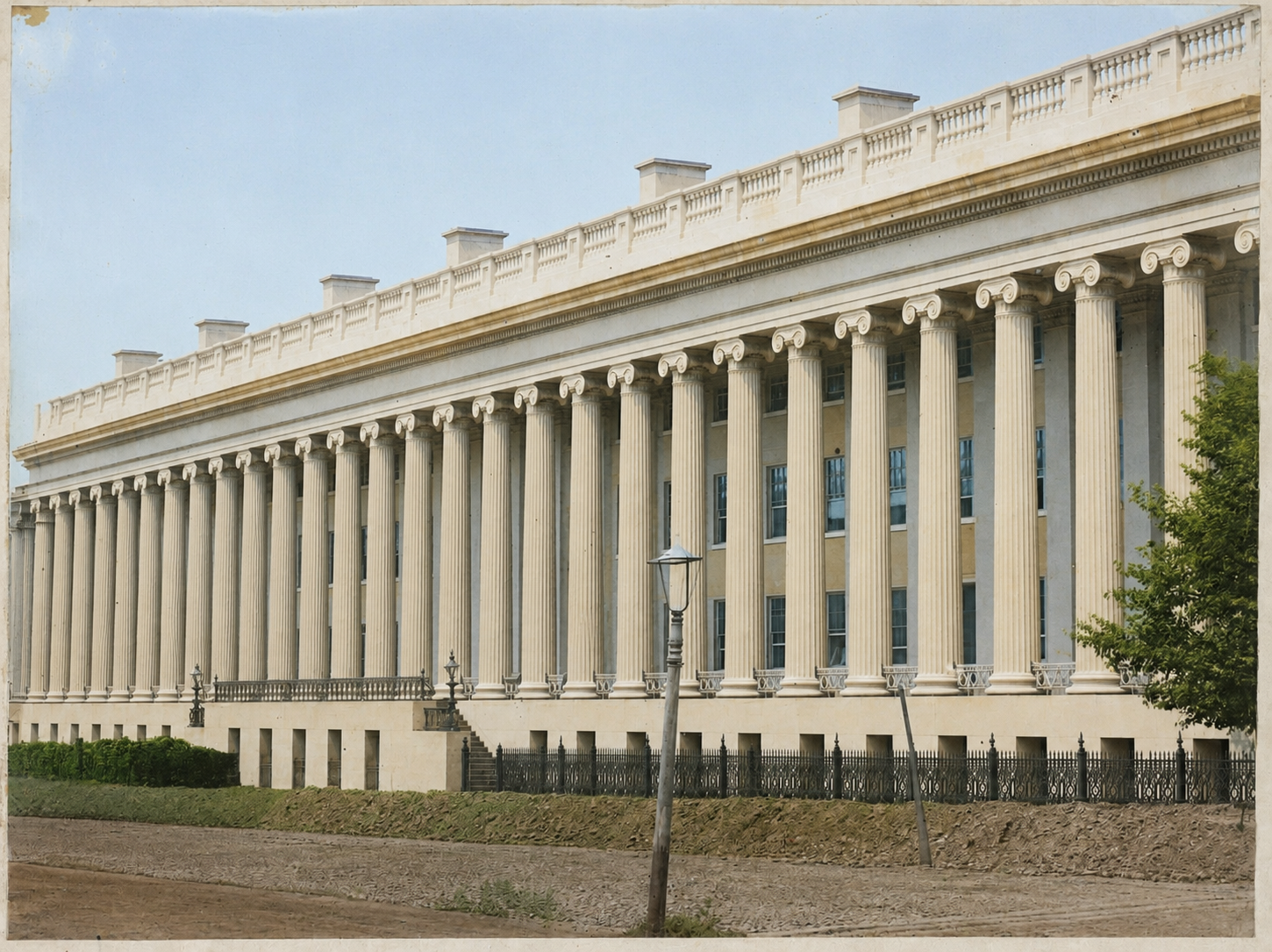
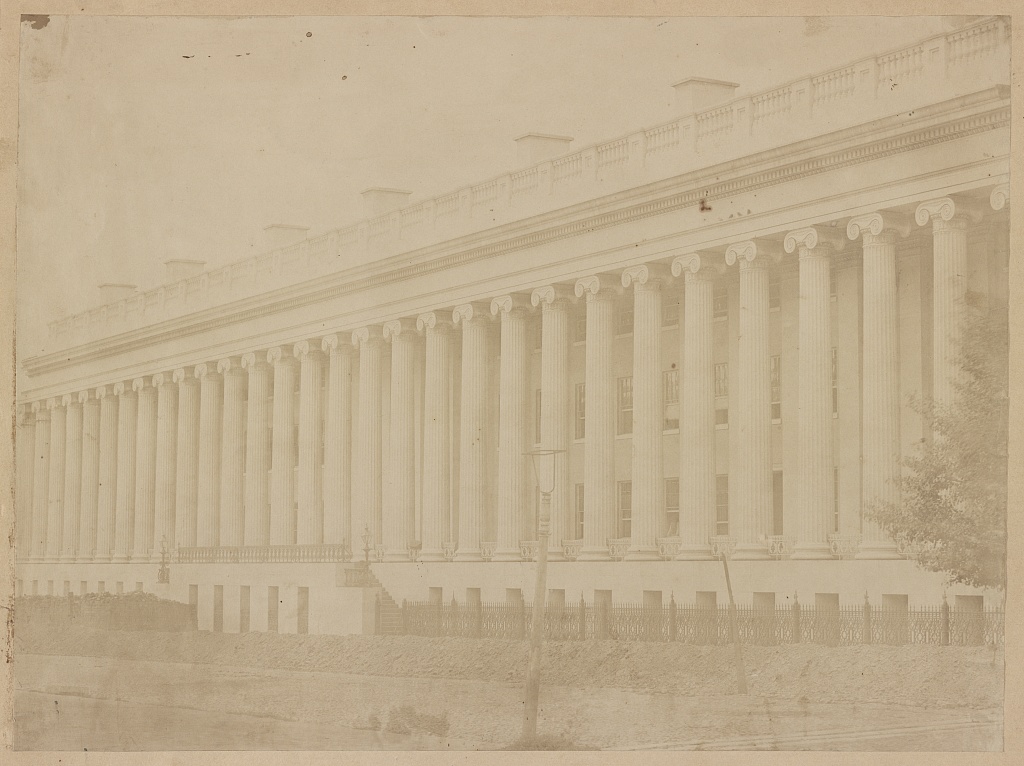
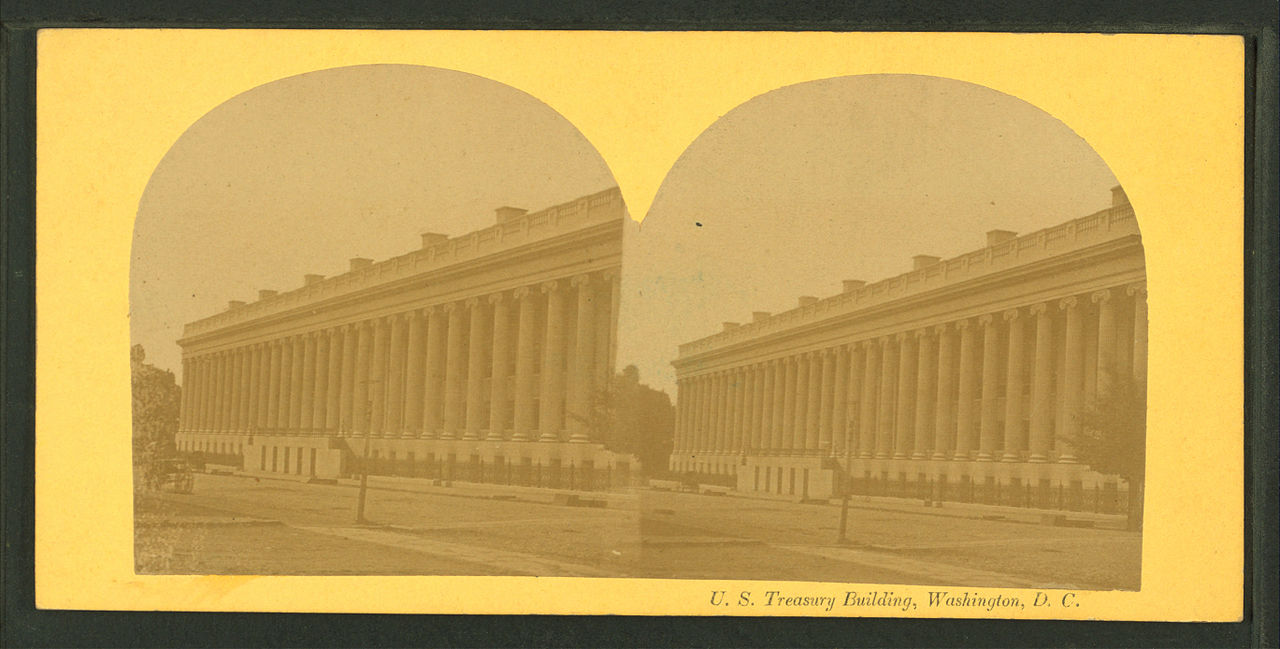
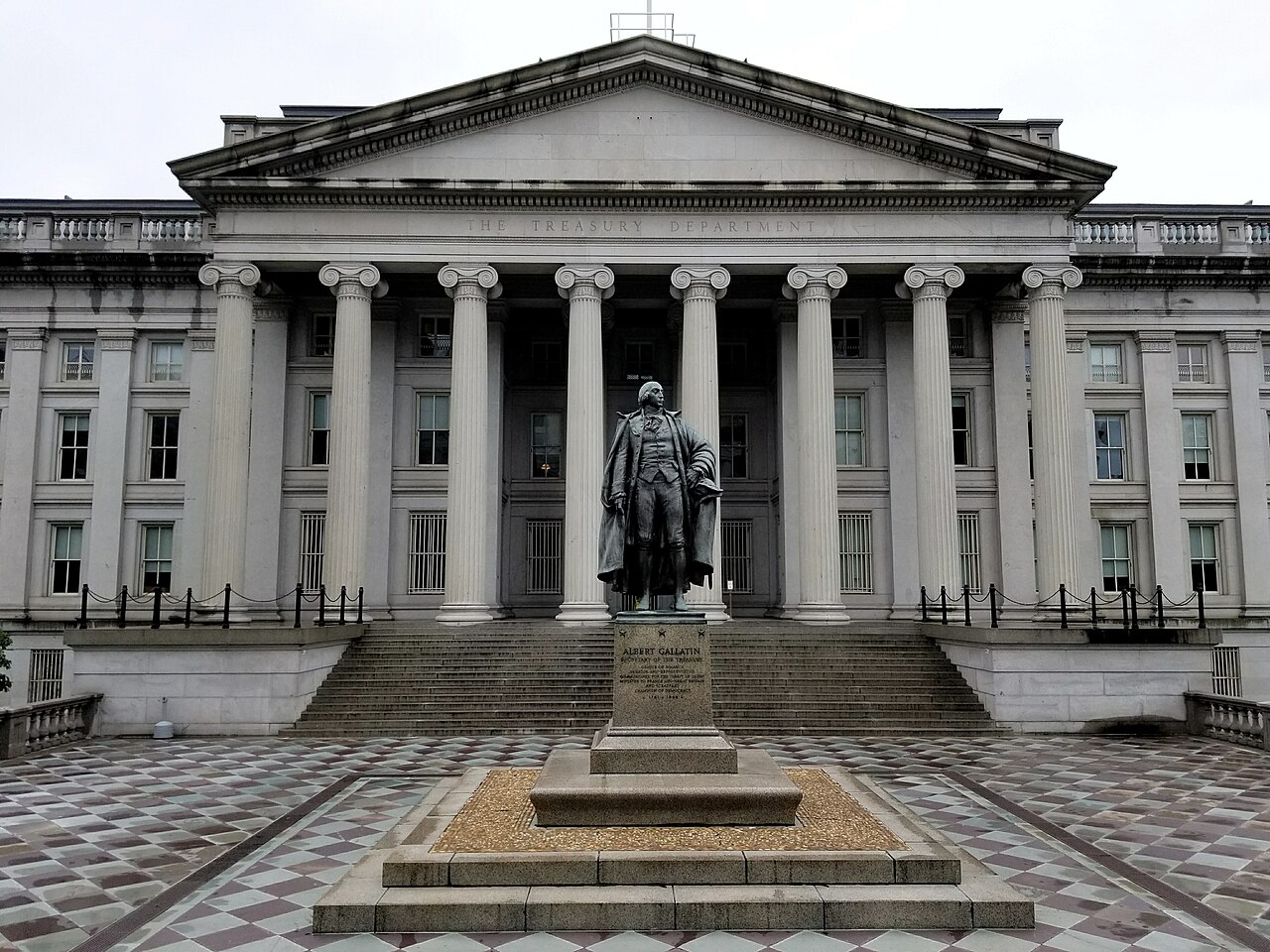
The Treasury Building in January 1865 was the largest office building in Washington. Robert Mills had designed it. Its colonnade was already the most photographed government facade in the country. The north wing was still under construction. The whole structure ran almost the entire block between 15th Street and the White House.
Inside, hundreds of clerks moved war money around. Among them was a small and increasingly visible cohort of women, the “Treasury girls,” whose presence was about to set off a separate Congressional scandal that same February. Mary Harris fit right in. A young woman walking the marble halls of the Treasury in the winter of 1865 attracted no attention at all.
That is how she got to the doorkeeper. She gave a name and asked for Mr. Burroughs. He consulted the employee book, found the entry for Adoniram J. Burroughs, and pointed her to the office of the Comptroller of the Currency upstairs.
She opened the office door, looked in, spotted Burroughs at his desk, closed the door, and waited.
At 4 PM he stepped into the hall. The first shot caught him just left of the spine. The second dropped him before he could reach the stairs.
When the police arrived she gave her name as “Louise E. Devlin, of Janesville, Wisconsin,” insisted she had been seduced into nothing, and made one strange, defiant declaration: “As God is my witness, I am virtuous!” By the time she reached the station the story had collapsed. She gave her real name. She was nineteen. She was from Chicago. She did not deny that she had come to Washington with a loaded pistol to kill the man.
The story tore across the country in two days. The Richmond Daily Dispatch carried a long item under the headline “Tragedy in Washington” on February 6. Frank Leslie’s Illustrated Newspaper ran an illustrated piece on the killing in its February 18 issue. Clara Barton, in town that week, closed her diary entry for January 30 with the line: “A Mr. Burroughs shot in the Treasury Building by one Mary Harris, alleged breach of promise.”
A defense team built for the courtroom of the century
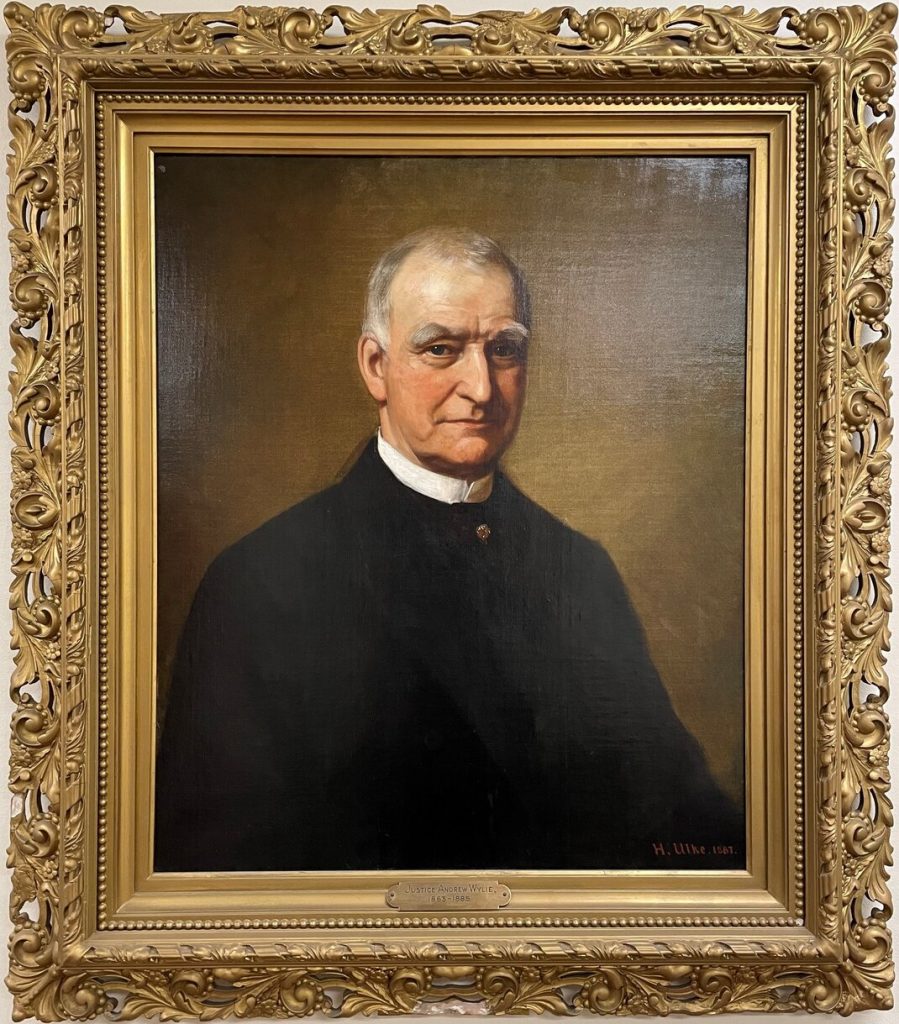
Mary sat in the Washington jail through the spring of 1865 while the country lost Lincoln. She watched it from her cell window as the war ended. Her trial finally began on Monday, July 3, before the Supreme Court of the District of Columbia, sitting as a criminal court. Justice Andrew Wylie presided. He had been appointed by Lincoln himself two years earlier.
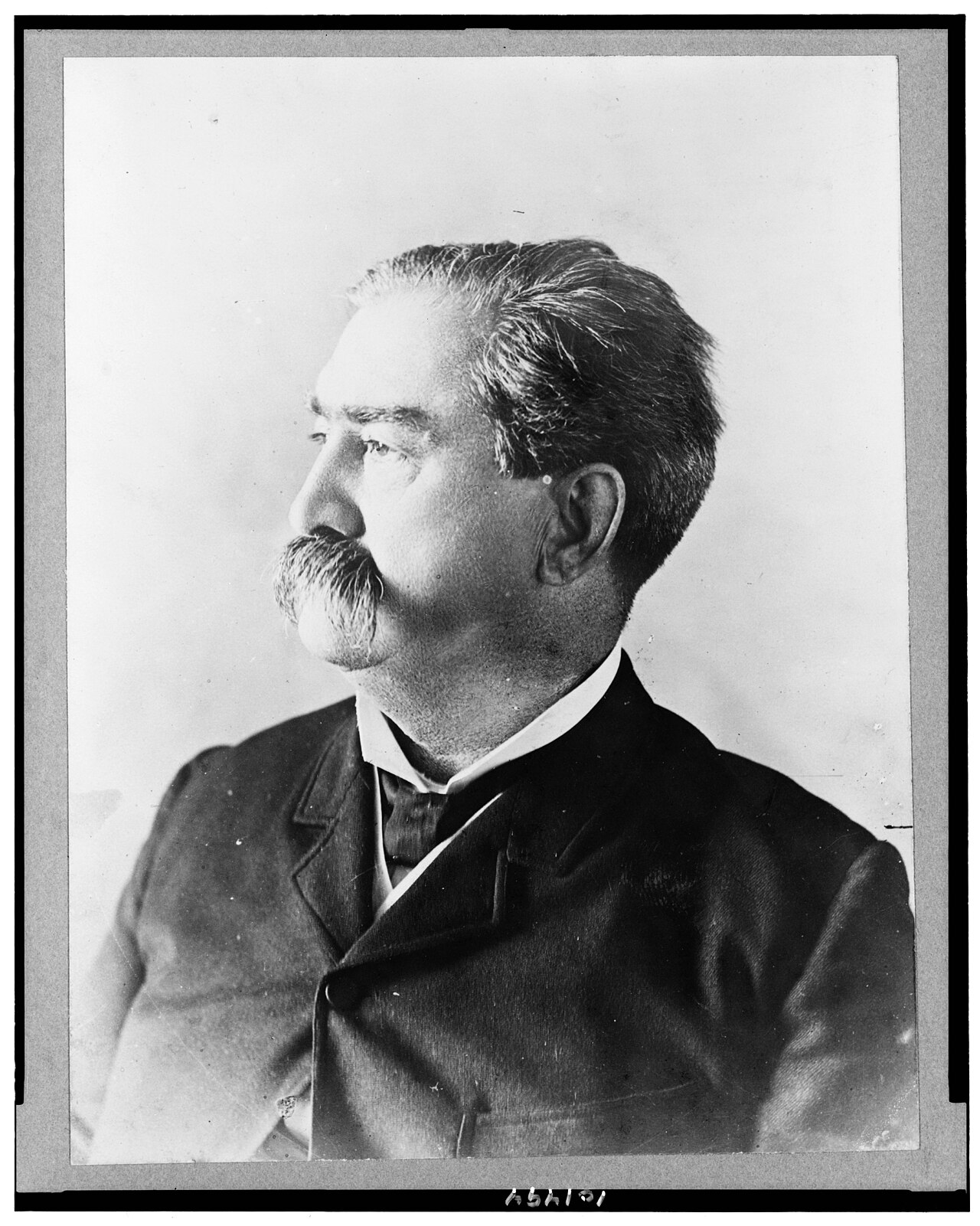
Her defense team was a rolling thunder of nineteenth-century courtroom celebrities. Lead counsel was Joseph H. Bradley of the District of Columbia, one of the best criminal defense lawyers in the country. He would two years later defend John H. Surratt against the charge of conspiring to murder the President.
Sitting next to him was Daniel W. Voorhees of Indiana, the “Tall Sycamore of the Wabash,” then a sitting Congressman and one of the great courtroom orators of the era. Filling out the team were Judge James Hughes of Indiana, Judge Mason of Iowa, and William Y. Fendall of the District.
The prosecution looked small by comparison. District Attorney E.C. Carrington opened the case with assistant Nathaniel Wilson at his elbow. He told the jury what no one would dispute. Mary Harris had armed herself in Chicago, traveled to Washington, walked into the Treasury Building, asked for the man at the door, and killed him.
Then Bradley stood up and changed what the trial was about.
The “paroxysmal insanity” defense, made up in real time
There was never any question that Mary fired the shots. Bradley and Voorhees conceded the act in their opening. What they argued was that Mary Harris had been driven temporarily out of her mind by Burroughs himself, and that the killing was the work of an episodic, seizure-like state the defense called paroxysmal insanity.
They built the case on two pillars.
The first was Burroughs’s own letters. Bradley got at least ten of them read aloud in court, the “Mollie” letters and the cart-load-of-kisses letter and all the rest, and watched the jury’s faces. The seduction story was no longer a rumor. It was on the record, in the dead man’s handwriting.
The second pillar was the medical theory, and this is where the trial made history. It would not be the last Washington murder to rewrite the law: a half century later the Supreme Court’s decision in a Kalorama triple murder began overhauling the rules on police confessions.
Bradley called Dr. Calvin Fitch as his first medical witness. Fitch testified, point blank, that “uterine irritability is one of the most frequent causes of insanity” in women, and that this kind of insanity came on in sudden, dispossessing fits triggered by emotional shock.
Six more physicians corroborated him, including Dr. Charles H. Nichols, the superintendent of the new Government Hospital for the Insane on the east side of the Anacostia, the institution Washington would later call St. Elizabeths. Phrenologists testified to her good moral character. Everyone Mary had ever lived with described the spells.
It was the first U.S. murder trial in which expert medical testimony supported a paroxysmal-insanity plea. The science behind it, the “uterine irritability” and menstrual mania and all the rest of the Gilded Age machinery of female pathology, has not aged well. But in the moment, in an 1865 Washington courtroom on the floor of an actual American jury trial, it worked.
Voorhees rose for the closing argument and spoke for hours. He told the jury they were looking at a girl whose mind had been deliberately broken by a man who was now sitting safely under the ground, beyond the reach of any remedy except the one his client had brought from Chicago.
The jury went out on July 19. They were back in about five minutes, by the official report of the court reporter, and they came back not guilty.
What happened next
The press reaction split the country. The New York World ran a famous line: “if she be insane, then are nine-tenths of all women crazy.” Papers from Boston to San Francisco echoed it. Letters to the editor warned that the verdict had effectively legalized jilted-woman homicide.
Mary herself did not get a clean break. She was acquitted, but the same court that freed her did not commit her to the asylum either. She drifted in and out of the Government Hospital for the Insane over the next eighteen years on her own. She lived for a stretch in Richmond, where, by one report, she worked as a milliner and “has apparently quite recovered from her insanity.”
Then, in November 1883, the case took its final, almost unbelievable turn.
Joseph H. Bradley married his client.
He was over eighty. She was about forty. Their wedding made the papers and bewildered everyone he knew. Bradley had stayed in touch with Mary through every committal and discharge of those eighteen years. When he finally proposed, his sons reportedly tried to talk him out of it. Mary said yes.
Bradley died four years later in 1887, and Mary Harris Bradley walked out of the public record for good.
The Treasury Building still stands
The Treasury Building Mary walked into on January 30, 1865 is still there. Most of it is older than the murder. Robert Mills’s east colonnade and central building had been finished by 1842. The south wing, by Ammi B. Young and Alexander H. Bowman, was completed in 1861, and Isaiah Rogers’s west wing in 1864, the year before the killing. The north wing facing Pennsylvania Avenue had not yet broken ground. It would rise between 1867 and 1869 under Alfred B. Mullett.
The east colonnade tourists photograph today from the back of the White House is the same Robert Mills colonnade clerks were walking past the day Burroughs died.
The office of the Comptroller of the Currency moved out of the Treasury Building a long time ago. The corridor where Adoniram Burroughs took the second shot is part of an administrative floor most visitors never see. There is no plaque.
What’s left is the paper trail. The Clephane trial transcript, a thick brick of court reporting published by W.H. and O.H. Morrison in 1865, sits in the Library of Congress Toner Collection. The Evening Star covered the verdict on July 20. Frank Leslie’s put a sketch artist in the corridor. And somewhere in the Bradley family papers, presumably, are the love letters Joseph wrote to the client he buried his rival in the law to defend.
For more Washington trials of the Civil War years and just after, see our pieces on Mary Surratt’s boarding house, now a Chinese restaurant on H Street, on Boston Corbett, the soldier who shot John Wilkes Booth, and on the 1869 Millie Gaines case, the Capitol Hill axe murder that seated DC’s first racially mixed jury.
For the long arc of the DC insanity defense, see our piece on Dallas Williams, the “Bad Man of Swampoodle” whose 1961 case exposed the broken machinery of the plea Mary Harris helped invent. The same questions of sanity and confession ran through the 1938 case of Robert Askins, the Howard chemistry student whose mental state was still being litigated in the 1950s.
We dug this one up with help from AI and checked it against the original records below. Here’s how we use AI.