Just before midnight on April 24, 1922, the basement furnace under the Forest Glen Trading Company sets the building off. A revolver in the post office discharges from the heat as the firefighters pull up. Five hundred gallons of kerosene stored behind the grocery explode around 2 a.m. The underground gasoline tank goes next.
The main telegraph wires linking Washington to Pittsburgh melt and go dead. Eight families flee into the dark. Damage runs about $65,000. The building is owned of record by Harry Wardman, the Washington developer who, by his 1938 death, would have a tenth of the city’s residents living in homes he built.
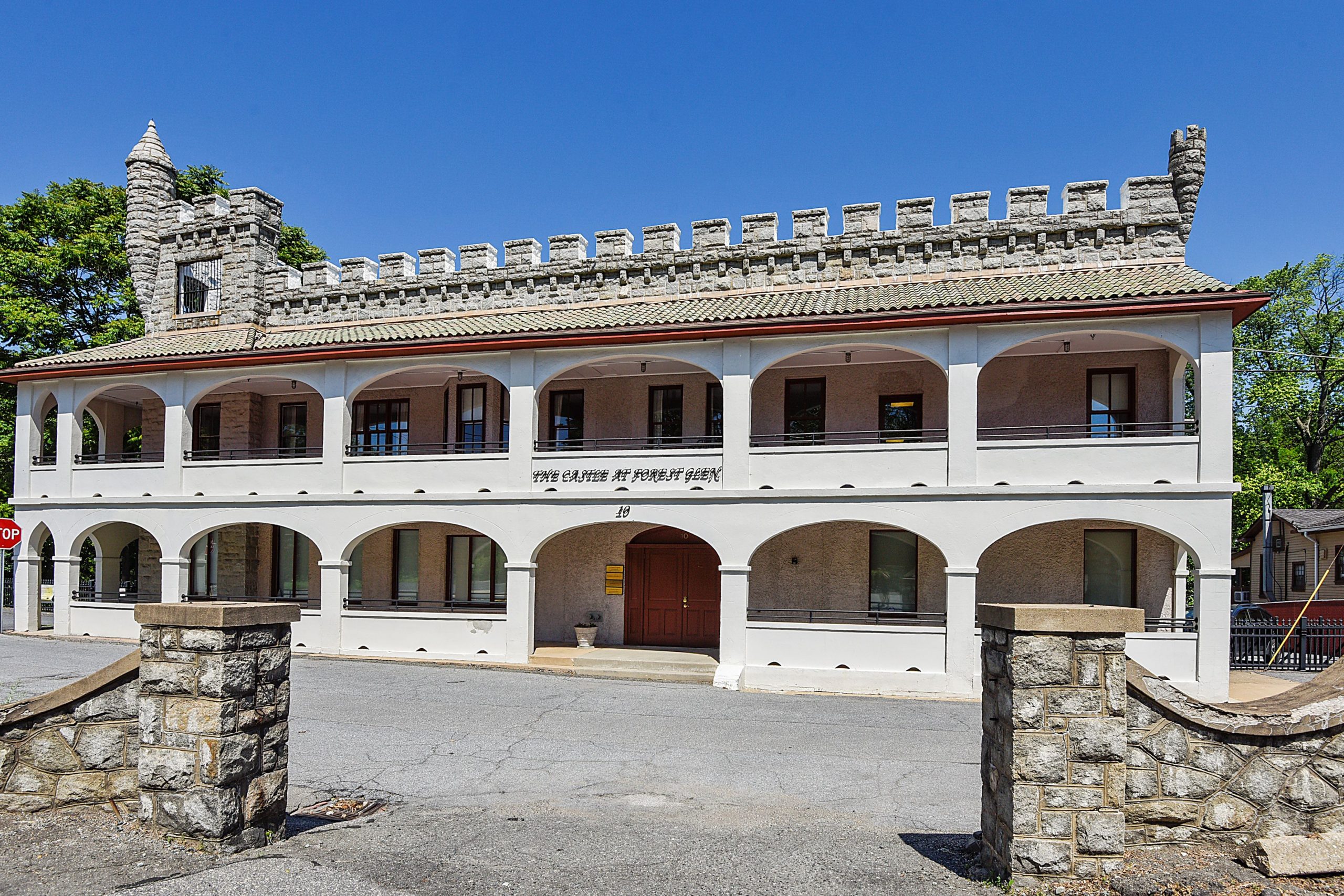
Almost everything 10 Post Office Road is today, the granite walls, the round turrets, the battlements that look like a movie set, came out of what was left of that night. This is the story of a building that was burned, sold for cheap, rebuilt as a fairy tale, and rented to a grocer, a bordello, a Hungarian restaurant, a rental-equipment magnate, and a senior-living newspaper, in that order.
The Forest Glen Trading Company and the store before the Castle
A general merchandise store stood on this site by at least 1883. That fact comes out of the Maryland Historical Trust’s 1987 architectural survey of the building, M:31-8-4, which traces the Montgomery County deeds back to Oliver and Mary Harr. The Harrs sold the store to George M. Wolfe and William P. Miller in 1900.
Wolfe bought out his partner in 1907. In 1912 he joined John A. I. Cassedy, who ran the National Park Seminary girls’ school across the B&O railroad tracks, to form the Forest Glen Trading Company. So begins the long entanglement between the Castle and the Seminary, which becomes important later when people confuse the two.
In 1915, Wolfe and Cassedy radically remodeled the old place. They enlarged it to roughly four times its original footprint, hung a tiled hip roof on it, and ran an eight-bay one-story arcade across the front. The ground floor held the grocery, the United States post office, and an ice cream shop.
Two apartments sat behind the grocery on the ground floor. Four more apartments upstairs rented for about $50 a month. For the next seven years this was Forest Glen, the address you went to when you needed flour or wanted to mail a letter.
The Trading Company sold the building to a buyer named Thomas L. Miller in January 1922. The deed was recorded on April 17. One week later, the fire came.
The 1922 fire that built the Castle
The Evening Star ran the fire across the top of page 1 on April 24, 1922 under the headline “8 FAMILIES FLEE FOREST GLEN FIRE.” The cause was an overheated basement furnace. The grocery proprietor was Israel Linhart. The Forest Glen postmaster was C. M. Miles. Eighty-four-year-old Mrs. Lavinia Davis was carried out of the ground floor by Postmaster Miles.
The Star’s lede put the awakening of the residents in a sentence:
Aroused from sleep shortly after midnight this morning by revolver shots, eight families…
Evening Star, April 24, 1922, p. 1.
The revolver shots were not a holdup. A loaded handgun stored in the post office had cooked off from the heat. Then the basement kerosene went up.
Five hundred gallons of kerosene, stored behind the store, exploded, throwing up a gigantic flame.
Evening Star, April 24, 1922, p. 1.
An underground gasoline tank belonging to a man named H. H. Bopst blew next. The heat severed the main telegraph wires linking Washington to Cumberland and Pittsburgh, cutting service for hours. Forest Glen had no fire hydrants in 1922. The Silver Spring volunteer department arrived inside ten minutes and pumped from a stream behind the building.
Rockville’s company came next and pumped from an abandoned quarry. Washington’s No. 22 engine drove out from the District under Lt. Basford to help. The Montgomery County Sentinel ran its own write-up four days later, putting the loss in the same neighborhood as the Star:
Property loss approximating $60,000 was sustained and eight families rendered temporarily homeless…
Montgomery County Sentinel, April 28, 1922, p. 3.
Why Harry Wardman owned the wreck
This is the marquee detail. The newspaper of record for the Forest Glen fire names Harry Wardman as the building’s owner. By 1922, Wardman was the most prolific residential developer in Washington, D.C.
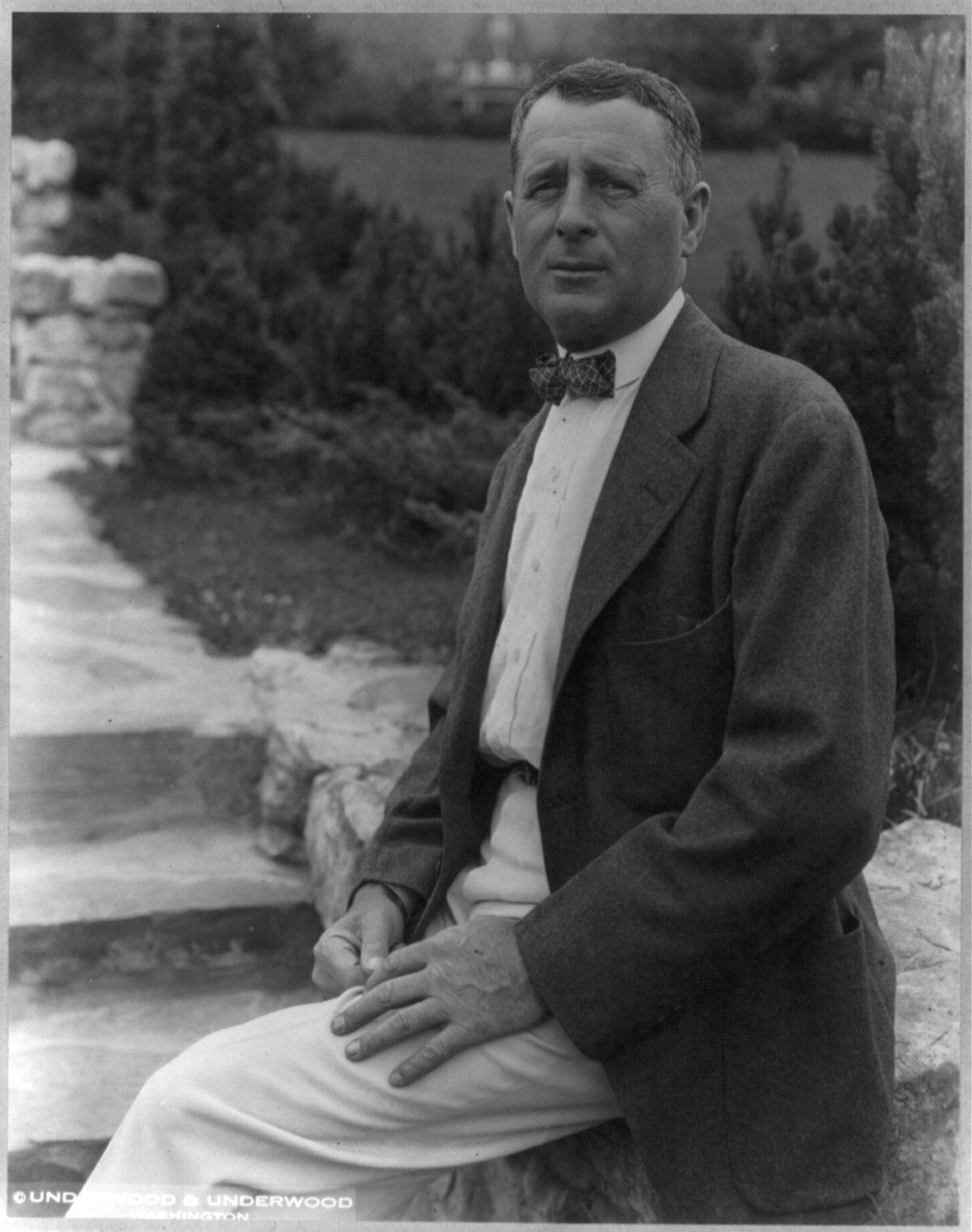
Thomas L. Miller had bought the building from the Trading Company in January 1922, but the deed had only just been recorded on April 17. The mortgage and the fire insurance ran through Wardman’s office. When the Star needed a name to print next to the smoking ruin, Wardman’s was on the paperwork.
Wardman built the Wardman Park Hotel, the Carlton, much of the rowhouse front of Columbia Heights, and roughly 4,000 dwellings around the District. By his death in 1938, an estimate widely repeated said one in ten residents of Washington lived in a Wardman building. We have written about a few of his projects, including the Northumberland Apartments on New Hampshire Avenue and his Woodley Park homes.
Wardman’s name does not appear in any of the post-fire deeds. Thomas L. Miller, badly underinsured, would dump the smoking ruin six weeks later.
Joseph Trees, Dr. Ament, and the granite rebuild
On May 31, 1922, Miller sold what was left to Joseph C. Trees and Dr. James E. Ament (deed 318/92, Montgomery County). Trees was a Pittsburgh oilman who had made his money in the Bradford and Caddo fields. Dr. Ament had succeeded John A. I. Cassedy in 1916 as president of the National Park Seminary.
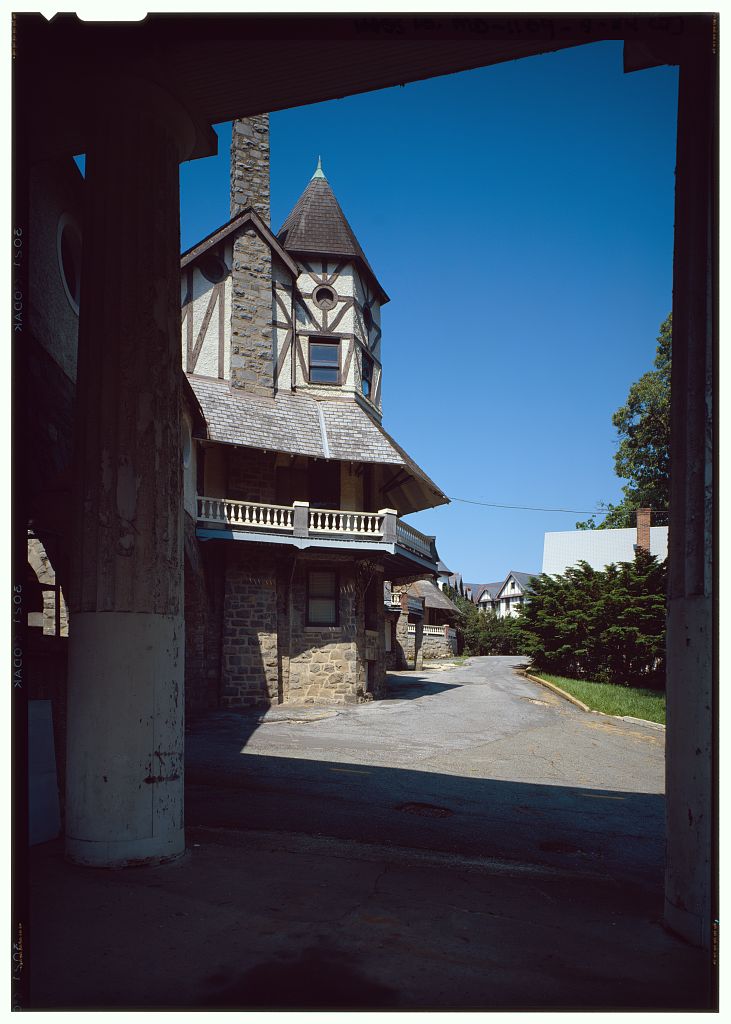
Under Ament’s hand the rebuild went theatrical. The south end of the burned arcade came down. The southern corner, the southwest elevation, and chunks of the northwest came back up in granite. Granite turrets and battlements went on the roof. A triangular park out front was walled in granite with urns and iron chains.
Property assessments jumped from $35,000 in 1922 to $50,000 by 1926, by which date the work was done. Ament renamed the building Glen Castle Apartments. Polk’s Directory for 1927-28 lists six families in residence.
And here is the cosmic punchline. Mr. Wolfe, the same George M. Wolfe of the original Trading Company, came back as the on-site building manager. By then he had become the head of the purchasing department and superintendent of grounds at the Seminary. The Castle stayed inside Cassedy’s old orbit for another quarter century.
Brickley’s Castle Inn Hotel, 1941
In 1941, Ament’s widow sold the Castle to John A. Brickley, a Washington real-estate executive, for a price the Montgomery County deed records (872/93). Brickley turned the building into the Castle Inn Hotel.
His timing was specific. The U.S. Army was about to take over the National Park Seminary as the Walter Reed Army Convalescent Center for soldiers wounded in the war. Brickley figured families coming up to visit recovering boys at Forest Glen would want a room near the rail station. He installed a restaurant, a barber shop, and a dry cleaner on the ground floor and converted the upstairs into hotel rooms.
Brickley sold the building in 1952. Between his sale and the Hungarian restaurant arriving downstairs around 1961, the Castle picked up its bordello reputation.
The second-floor bordello and the Walter Reed convalescents
The originating source for the Castle’s bordello chapter is Charles Fenyvesi’s “Beltway Gothic” feature in the Washington Post Magazine on November 21, 1982. Fenyvesi got it from Herschel Shosteck, a Forest Glen native who rented the granite turret as office space for his marketing consultancy.
In the 1940s, the castle’s second story was a bordello servicing the soldiers recuperating at the nearby Walter Reed Medical Center.
Charles Fenyvesi, Washington Post Magazine, November 21, 1982, p. SM8.
Shosteck told Fenyvesi about amputees fighting over the women with their artificial limbs. The story carried into local memory under a label John Kelly later picked up for his March 4, 2018 Answer Man column in the Washington Post, talking to longtime Chevy Chase resident Andrea Sherman:
the Hungarian Whorehouse.
Andrea Sherman, quoted by John Kelly, Washington Post, March 4, 2018, p. C3.
The bordello and what came after it on the ground floor together gave the building both halves of that nickname. The MHT survey from 1987 does not confirm the bordello story (architectural historians generally do not), but it does not contradict it either, and Fenyvesi’s reporting is the primary record.
Corvin’s Hungarian Castle, around 1961 to 1965
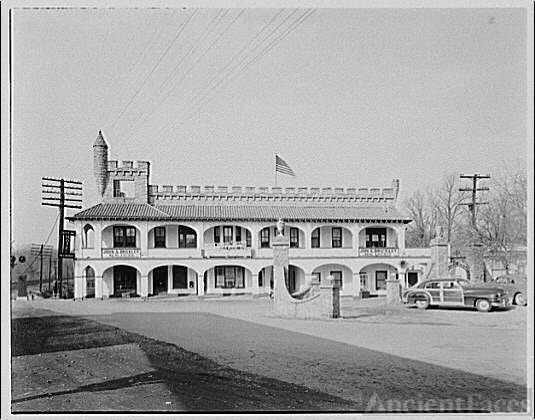
Around 1961, a Hungarian restaurant opened on the ground floor. Les Megyeri, a retired DC lawyer who was a regular customer, told John Kelly in 2018 it was called Corvin’s Hungarian Castle. The name came from the Corvin movie theater in Budapest, where students and workers had fought back against Soviet tanks in the failed 1956 uprising.
Many of Corvin’s customers were 1956 émigrés. Megyeri’s two-sentence summary for the Post is hard to top:
He created a Hungarian atmosphere, with a lot of drinking.
Les Megyeri, quoted by John Kelly, Washington Post, March 4, 2018, p. C3.
A fire in 1965 seems to have shuttered the restaurant.
John Kelly, Washington Post, March 4, 2018, p. C3.
The MHT survey confirms a second damaging fire in 1965, the second the Castle had suffered in 43 years. Fenyvesi’s 1982 piece adds, but does not name, the additional note that the proprietor “later died in a plunge from a window.” No inquest record has surfaced yet for that story, so it stays in the Post’s reporting with the Post’s attribution.
John T. Doran Sr. converts the Castle to offices, 1967
In 1967, John T. Doran Sr. bought the Castle. Doran was a Georgetown grad from the School of Foreign Service class of 1949 and a Merchant Marine Academy alumnus, born in 1923 and raised in the DC area. In 1950 he had founded Rental Tools & Equipment Co. out of a house in Silver Spring, leasing earth-moving and concrete gear to area contractors.
By 1967, his company was growing into the 26-location regional rental empire that would later merge into United Rentals. Doran also founded Equipment Development Co., or EDCO, a paving and surface-equipment manufacturer. He bought the Castle, gutted the interior, and put sheet rock walls in for offices.
The MHT survey lists him as the owner of record in 1987 via Rental Tools & Equipment Co.’s Bladensburg address. Doran died in 2013 at age 90, in Solomons, Maryland. Rental Equipment Register called him a “Rental Industry Pioneer.”
The Beacon era
At one point in the office era, the Castle housed staff of The Beacon, the free monthly aimed at readers aged 50 and over. Stuart and Judy Rosenthal founded the paper as Beacon Newspapers, Inc. in 1989. The Beacon is now headquartered in Kensington.
A senior-living publication tenanting a building that had been a 1940s bordello and a Hungarian restaurant that the DC police kept raiding is the kind of layered tenant arc the Castle specializes in.
The LLC ladder: Castle LLC, Thompson Family Properties, FBS Realty, 10 Post Office Rd LLC
The Maryland State Department of Assessments and Taxation lists three recorded transfers since 2002. Castle LLC sold to Thompson Family Properties LLC on September 27, 2002, for $1,010,000. Thompson Family Properties LLC sold to FBS Realty LLC on July 16, 2015, for $2,250,000. FBS Realty LLC sold to 10 POST OFFICE RD LLC on January 27, 2021, for $2,607,500.
Patrick Dunn was identified by Bethesda Magazine in June 2018 as one of the building’s owners, having bought into it in 2002. A 2018 listing at $3.3 million did not close at that price. It went for less in early 2021. The 2002 Thompson Family Properties name sits behind the Kathleen and Jerry Thompson ownership Kelly’s 2018 column reported on.
Not the English Castle at the National Park Seminary
This is the place to make the disambiguation explicit, because every other Forest Glen castle story online conflates the two buildings.
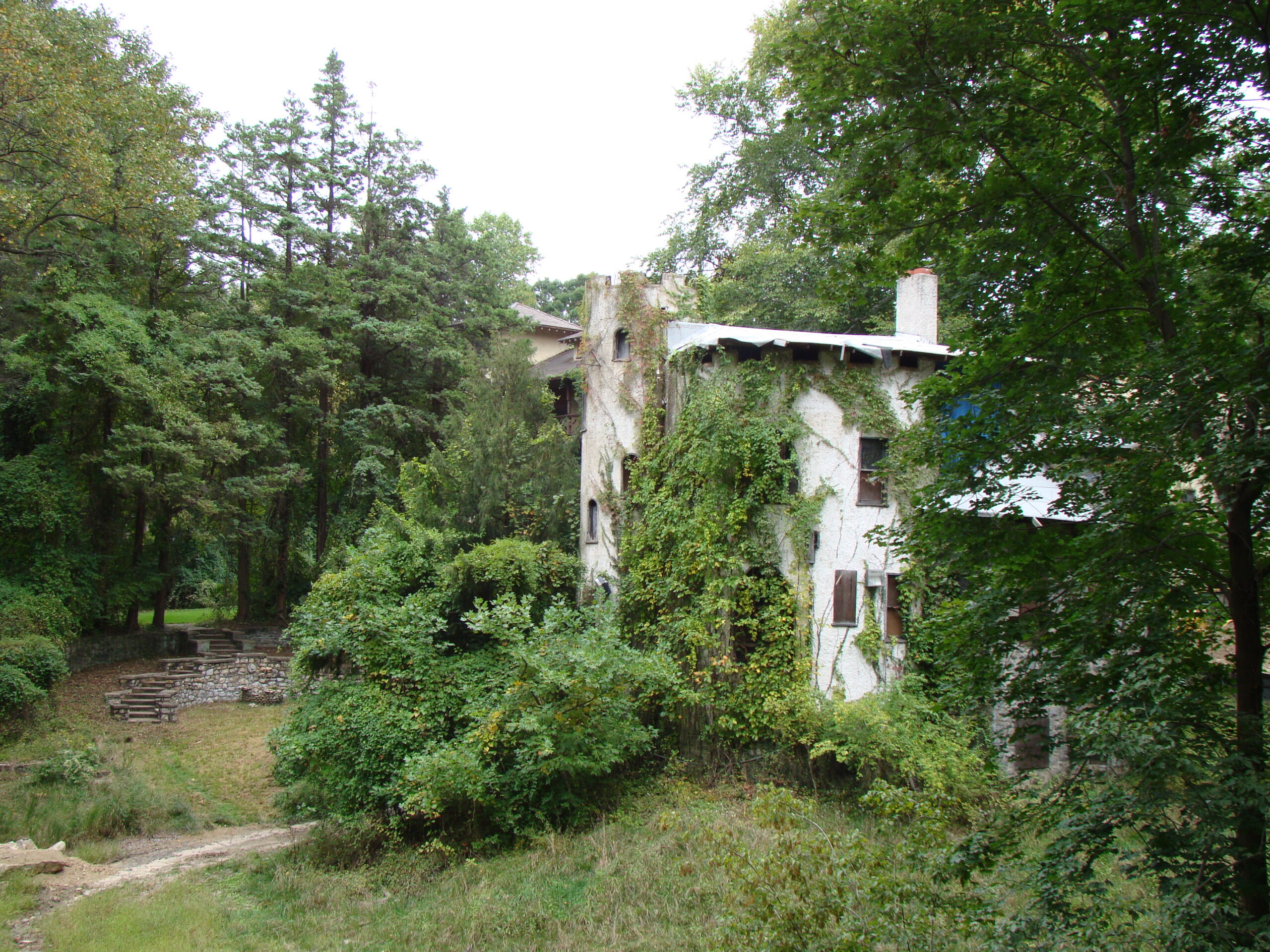
The Castle at 10 Post Office Road is a three-story commercial block sitting on a flat lot at the foot of the B&O railroad tracks. The Pi Beta Nu sorority house at the National Park Seminary, the so-called English Castle, is a small round stuccoed clubhouse with a drawbridge across the wooded glen, about half a mile away across what is now the Capital Beltway. Different buildings. Different builders. Different stories.
Both happen to be called “the Castle.” Both were owned at points by people connected to John A. I. Cassedy or his successor Dr. James Ament. That is the entire overlap. The Pi Beta Nu castle was built as a sorority clubhouse in 1904, with a second tower added in 1921. The 10 Post Office Road castle was built as the rebuild of a burned grocery store in 1922 to 1926. They are not the same place.
Still standing at 10 Post Office Road
Today the Castle still stands on the corner of Post Office Road and Forest Glen Road in Silver Spring. The granite battlements are still up there. The seven-bay arcade is still there. Pacci’s Trattoria is next door at 6 Post Office Road. The Forest Glen Metro station is about a mile away.
The Maryland SDAT card lists the building as 12,090 square feet on a 25,822 square foot parcel, three stories, Class C office, with a “Primary Structure Built” date of 1969 that almost certainly reflects Doran’s interior gut renovation rather than the original fabric. The 2018 listing brochure said the tenants included a law firm, a chiropractor, a physical therapy practice, and a hair salon.
Someone is filing paperwork right now under the same battlements that went up over the kerosene rubble in 1922. The Castle is one of the more honest old buildings in Montgomery County, in that it openly wears every chapter on its outside. You can drive past it and see all of them at once.
We dug this one up with help from AI and checked it against the original records below. Here’s how we use AI.