
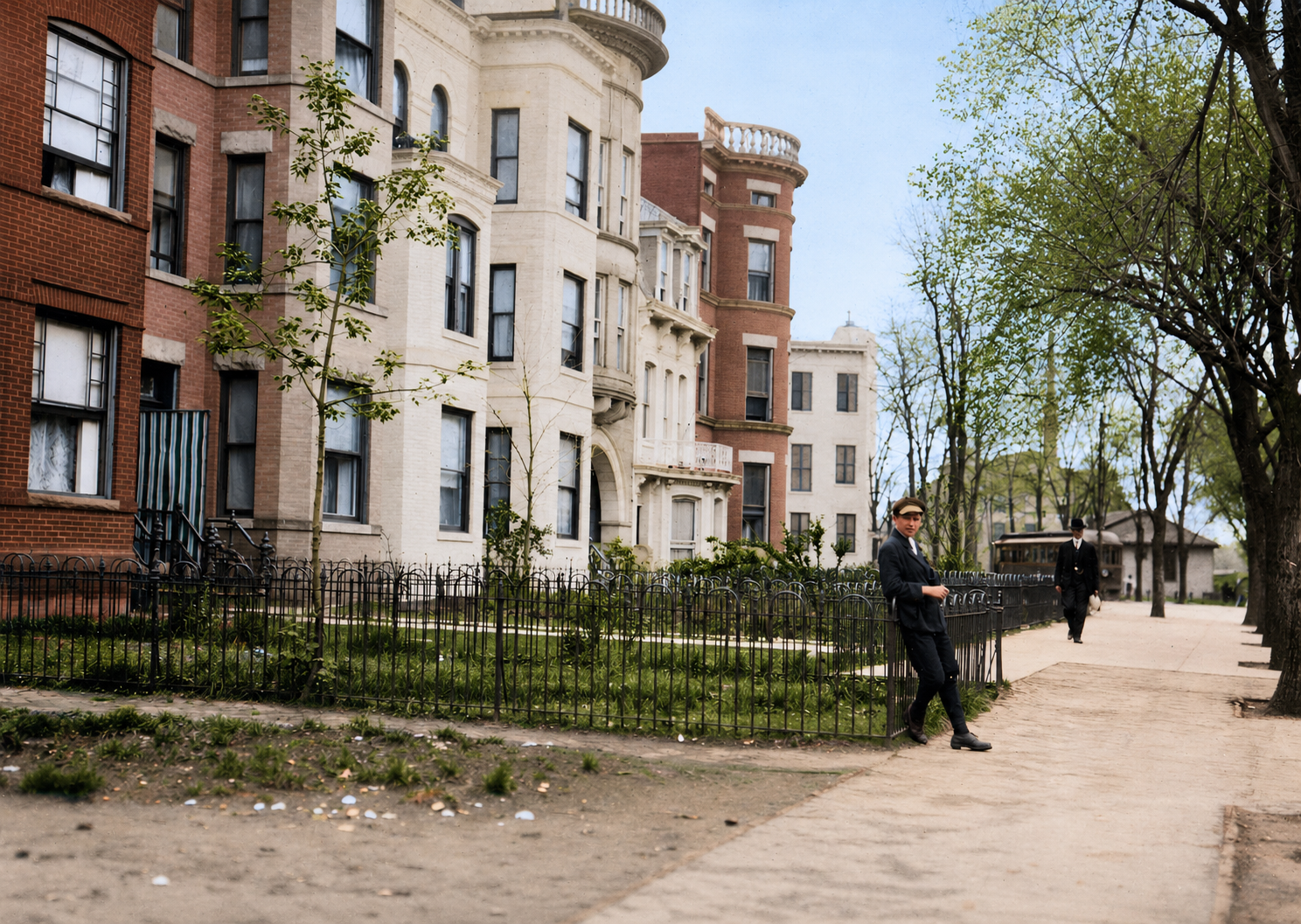
“To fish the body of a murdered man or woman out of the canal was an event so common that it evoked very little comment.”
That line ran in the Morning Times of Washington on December 1, 1895, in a Sunday feature that asked veteran policemen what life had been like on the Murder Bay beat. The bodies the officers were talking about came out of the old Washington Canal, the open sewer that ran along what is now Constitution Avenue NW. Most of those bodies were never identified.
That is the whole problem with the canal as a source for a crime post. The actual named dead from Washington’s worst slum are not in the canal, because the people the police could put a name to had usually been killed in the alleys above it.
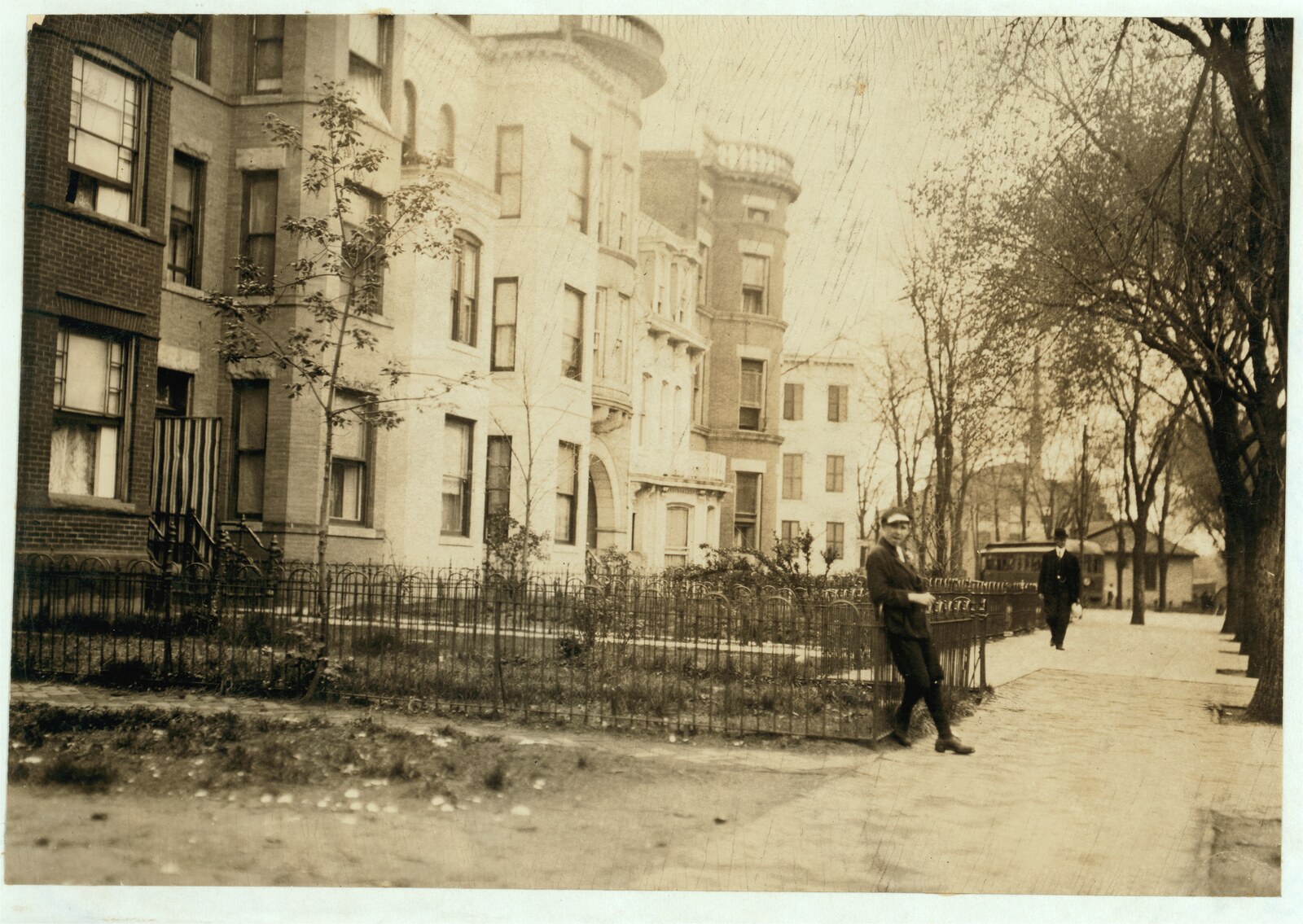
So this is a roundup of the named ones. Five forgotten people, pulled out of the OCR of the Evening Star and the Daily National Republican and the Morning Times, who got robbed, slashed, shot, or stabbed in Murder Bay between 1865 and 1868. None of them have a Wikipedia entry. Most have not been written about in 158 years.
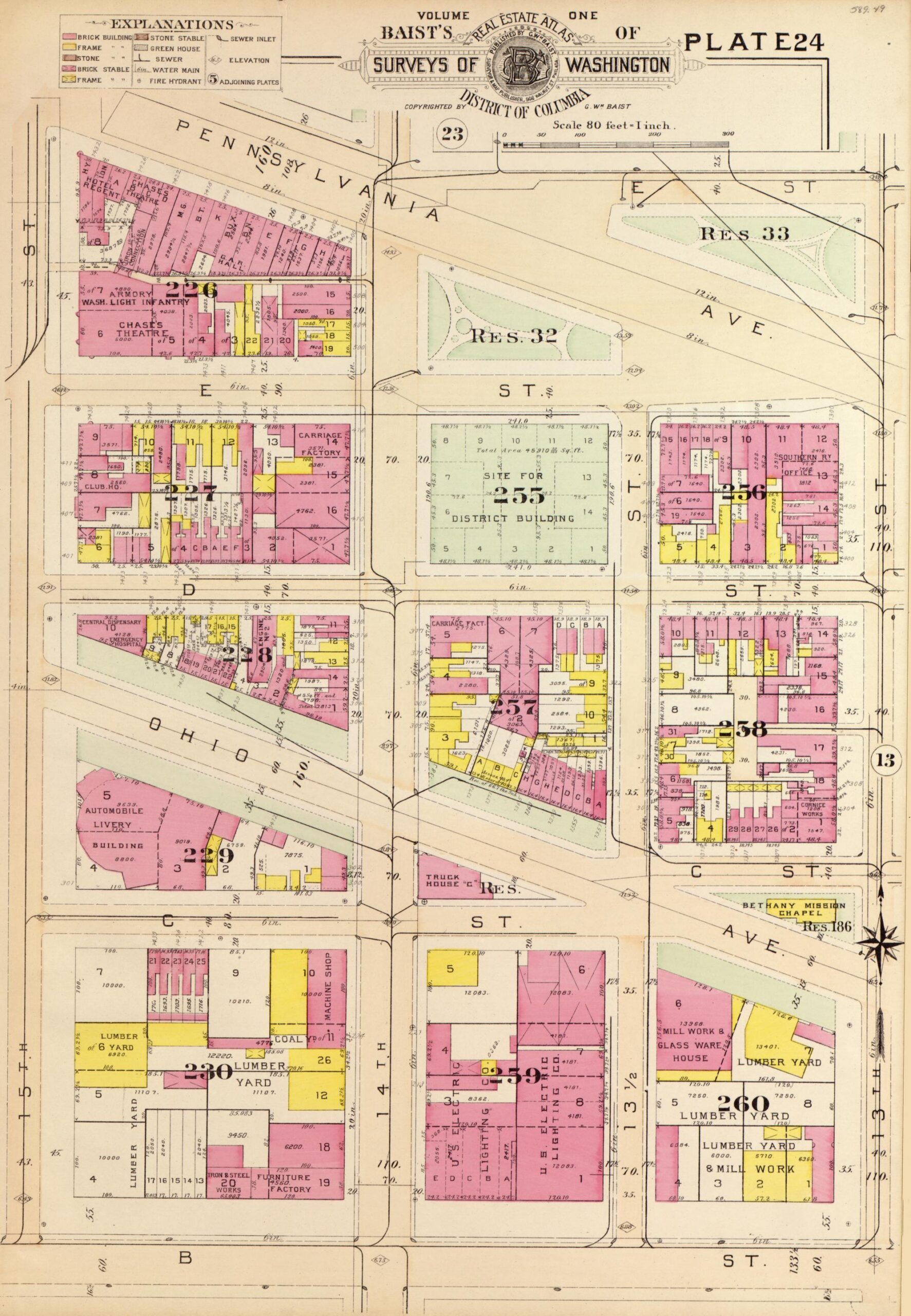
If you don’t know what Murder Bay was, we already wrote the overview. The short version: it was a Civil War contraband settlement that exploded into a 500-shanty slum and red-light district between roughly Pennsylvania Avenue NW, Constitution Avenue NW, and 13th to 15th Streets NW.
By the late 1860s the police were calling it “Hooker’s Division” because General Joseph Hooker’s troops had been quartered in the same blocks. The fuller orientation lives in our earlier post, Washington’s Rough-and-Tumble Lost Neighborhood of Murder Bay. Read that first if you want the district color. This post is the cases.
March 1865: The Iroquois peddler
The earliest case we can fully name is not a homicide. It is the robbery of a man called Samski On-a-tor, who described himself to the Evening Star as an Iroquois Indian making a living selling beadwork “such as is made by the Iroquois squaws.” On March 16, 1865, On-a-tor walked into Murder Bay on a peddling tour. The Evening Star of March 17 picked it up:
There he fell into company with the roughs, white and colored, who infest that notorious locality, and being of a social disposition, he indulged in the firewater freely, treating the colored girls until he got intoxicated. Some of the colored men seeing the Indian there, and the favor with which the colored girls regarded him…
The story is run-of-the-mill for the neighborhood. The reason it matters is that On-a-tor’s name made it into the paper at all. The vast majority of robbery victims in Murder Bay were transients whose names the Star did not bother to write down. On-a-tor’s only made it because the reporter found the Iroquois angle worth a paragraph.
November 1865: The boy Simons in Virginia Sharp’s alley
The first named homicide victim is a young man identified in the Evening Star only as Simons. The killing happened on the night of November 24, 1865, in the alley behind Virginia Sharp’s house in Murder Bay. The Evening Star reconstructed the inquest testimony eight months later, on July 18, 1866:
On the night of [the 24th] of November, the girl, Virginia Sharp, came to her home in Murder Bay, was met at the alley of her premises by a short, thick-set dark man, called Lucas, who obstructed the alley. She asked him to move, and he refused. The boy Simons was standing by, and told Lucas to let the girl in. He again refused; and Simons remarked “I’ll make you,” and went to take hold of Lucas. A scuffle ensued, and Lucas fired two shots, one of which took effect in Simons’ abdomen, and caused his death a day or two afterwards.
Justice Thompson held Lucas for a hearing the following Saturday. Six days after that, on July 24, 1866, the Star reported that a second man, Elijah Cyros, had been hauled in for the same killing.
The witnesses wavered. Samuel Washington, sworn in, “after looking at the prisoner from head to foot shook his head doubtfully, and remarked in a low tone, ‘I don’t think that’s the man.'” The prisoner stood up to speak. The justice ordered him to sit down. The witness turned back to the justice and said, “That’s him, sir! That’s the man!”
The Evening Star did not follow the case to verdict. It rarely did. The shooting itself, eight months gone, was the only piece worth telling.
November 1865: “It was his daughter’s”
A few days before Simons was shot, a man whose surname comes through in the Star’s OCR as Meeks climbed into a hack at 15th Street. A man named Lambert was running a scheme out of the cab. The Evening Star ran it on November 20, 1865:
The hackman drove to a restaurant, and a glass of liquor, which the complainant believes was drugged, was brought to him. He drank it, but it had no stunning effect. Three men then got into the hack, which was driven past his boarding-house, and down 15th street to Murder Bay, where he was robbed by the driver and his fellow-passengers. Lambert tried to get a watch from complainant, but he clung to it, and said it was his daughter’s, and he would only part with it with his life. Lambert drew a knife and threatened to cut Meeks’ arm off if he did not give up the watch, but the complainant held it.
The complainant kept the watch. He also kept his head clear enough to memorize the cab number. Sergeant Skippon picked Lambert up that Saturday. Justice Thompson jailed him for court. Three accomplices, including a boy from Canterbury Hall called Jerry, were arrested over the next several days.
No reader of the Star in 1865 needed the geography spelled out. Murder Bay was the end of the line for the hack scam: a place a driver could deliver a drugged fare and know that nobody passing in the street was going to interfere.
August 1866: A razor across Minerva Carr’s face
The earliest case in this roundup that does not end in a body and does not depend on a wavering witness is the assault on Minerva Carr. The Evening Star of August 30, 1866 carried the arrest:
Last night, Officer Frazier arrested Orinstead Holmes, colored, for assault and battery with intent to kill Minerva Carr, colored. It appears in evidence before Justice Bates that the accused, some two weeks since, in Murder Bay, attacked the complainant and cut her across the face with a razor, inflicting an ugly gash. He left the city, but the wound not having resulted fatally he returned, and was again found in Murder Bay.
Carr survived. Holmes came back. That second decision is the one the Star found most worth recording. Holmes evidently believed Murder Bay was a place a man with a warrant could re-enter unbothered, and for a while he was right. When Frazier finally collared him at a house there, Holmes played docile, walked to the head of a flight of stairs, and tried to throw the officer down them. They fell together. Frazier’s hand was cut in several places. Holmes was committed to jail for court.
Two things show up across these 1865 and 1866 cases that the overview post can only generalize about. One, the police did go into Murder Bay. The neighborhood was not a no-go zone. Two, the same men kept getting arrested there because they kept coming back. The district was small enough that an officer like Frazier knew which house to try.
January 7, 1868: Gabriel Thornton at 14th and Pennsylvania
The most fully documented homicide in this batch is the killing of Gabriel Thornton. He lived on C Street, near 13½. On the night of January 7, 1868 he was walking home from a small church in Murder Bay with two friends, Maria Henderson and Spencer Smith. The Evening Star ran the full account on January 8 under the head “Homicide in the Second Ward, Arrest of the Perpetrator”:
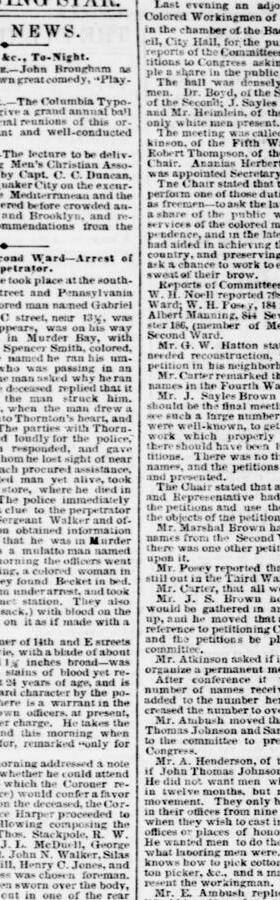
Last night a homicide took place at the southwest corner of 14th street and Pennsylvania avenue, in which a colored man named Gabriel Thornton, living on C street, near 13½, was killed. Thornton, it appears, was on his way from a small church in Murder Bay, with Maria Henderson and Spencer Smith, colored, and at the point above named he ran his umbrella against a man who was passing in an opposite direction. The man asked why he ran against him, and the deceased replied that it was accidental, and the man struck him. Thornton struck back, when the man drew a knife and plunged it into Thornton’s heart, and immediately ran off.
The cops chased him toward the White Lot, the open ground south of the White House, and lost him. Thornton was carried into Kidwell’s drug store. He died there in about five minutes.
Sergeant Walker and officers Leach and Wilson worked the case fast. They got a description, and within hours had decided the killer was “a mulatto man named James Beckett” and that he had gone back into Murder Bay. The next morning the officers walked to a house belonging to a colored woman named Jane King and took Beckett out of it.
They found a gray sack coat with blood on the sleeves and a cut in the cloth where a knife had passed through. At the northwest corner of 14th and E Streets, a few yards from the murder scene, they found the weapon, “a heavy bowie, with a blade of about six inches in length and one and a half inches broad,” still spotted with blood.
The Star added one detail that gives the whole episode its texture:
He takes the matter quite coolly, and this morning when asked what he was in jail for, remarked only, “for killing a man.”
Beckett was 24 years old. The Georgetown justices, the Star noted, were already holding a warrant for him on a separate charge.
The canal, the ash dumps, and what the policemen meant
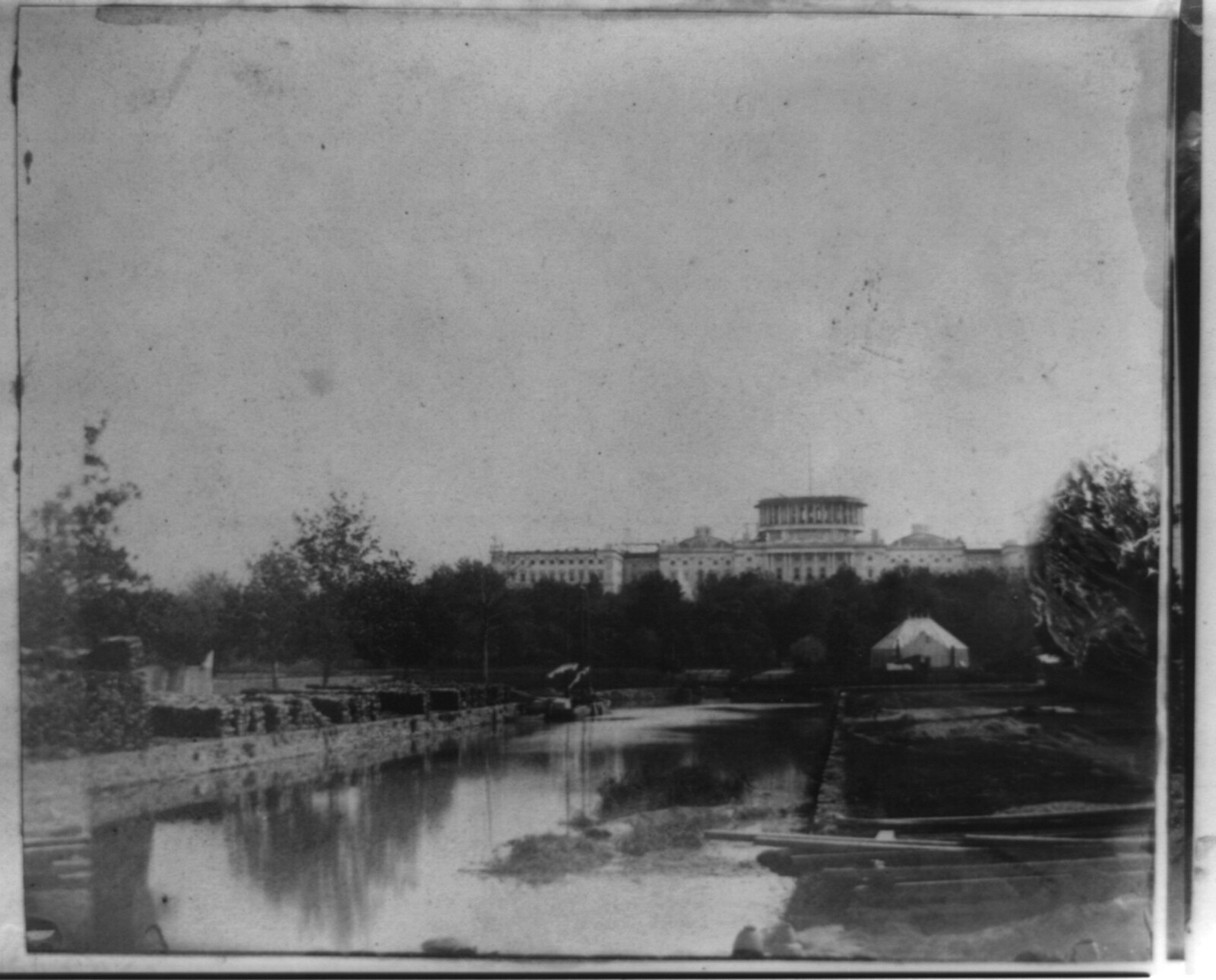
Secondary accounts of Murder Bay have circulated a paraphrase, often attributed to the Washington Post, that men went into Murder Bay and “were not heard of again until their bodies were discovered in the canal or found buried in ash dumps.” That line as a sentence does not appear in the most-cited piece, the Post’s long July 8, 1888 retrospective called “Story of Murder Bay.” What that article does say is closer to the bone in a different way:
The darkest crimes known in the criminal annals of the city were committed. Of those sections probably the worst was Murder Bay, which was located between Ohio avenue and the old canal that ran along a little south of B street. It consisted of rows of little frame shanties occupied mostly by negroes, but with a sprinkling of whites of the worst character. There were no pavements in this locality. The water soaking through from the canal kept the ground continuously wet, and the feet of the people passing churned the soft ground into black and odorous mud.
That is the canal as ground condition more than dumping channel. The dumping-channel framing is the 1895 Morning Times retrospective, where veterans of the police force said that pulling a corpse from the canal “evoked very little comment.” When a body had no friends to claim it, no inquest of any consequence followed.
What the canal did produce was disease. The night of April 25, 1866 the Daily National Intelligencer reported “the sudden illness of seven contrabands, and the speedy death of two of the number” in Murder Bay. The paper traced it to fish from the canal, “so filthy a basin” that the wonder was not that people died but that more did not:
Murder Bay is a terror to the city, not only because of the crime emanating thence, but on account of the filthiness of the locality and of its inhabitants.
The canal was filled in over the next twenty-five years and roofed over with B Street. B Street is now Constitution Avenue NW. The locality survived the canal by decades.
What sits there now
If you stood at 14th and Pennsylvania Avenue NW today and looked southwest, you would be looking through the Ronald Reagan Building, the Internal Revenue Service headquarters, and the Department of Commerce. The site of Gabriel Thornton’s murder, where the umbrella brushed the wrong man on a January night in 1868, is now somewhere inside the federal complex called Federal Triangle.
The federal government bought up the entire neighborhood between 1928 and 1934, tore the last shanties and saloons down, and built the triangular block of agencies that runs from the Capitol almost to the White House. The fuller story of that buyout lives in our Federal Triangle history post.
The Washington Canal, the body-disposal channel of the 1860s, was filled in and graded over and topped with one of the federal city’s grandest ceremonial avenues. You drive over it now on the way to the Lincoln Memorial.
The five people in this post still belong to the place. The grid of streets they lived and died in is gone. Their names are not.