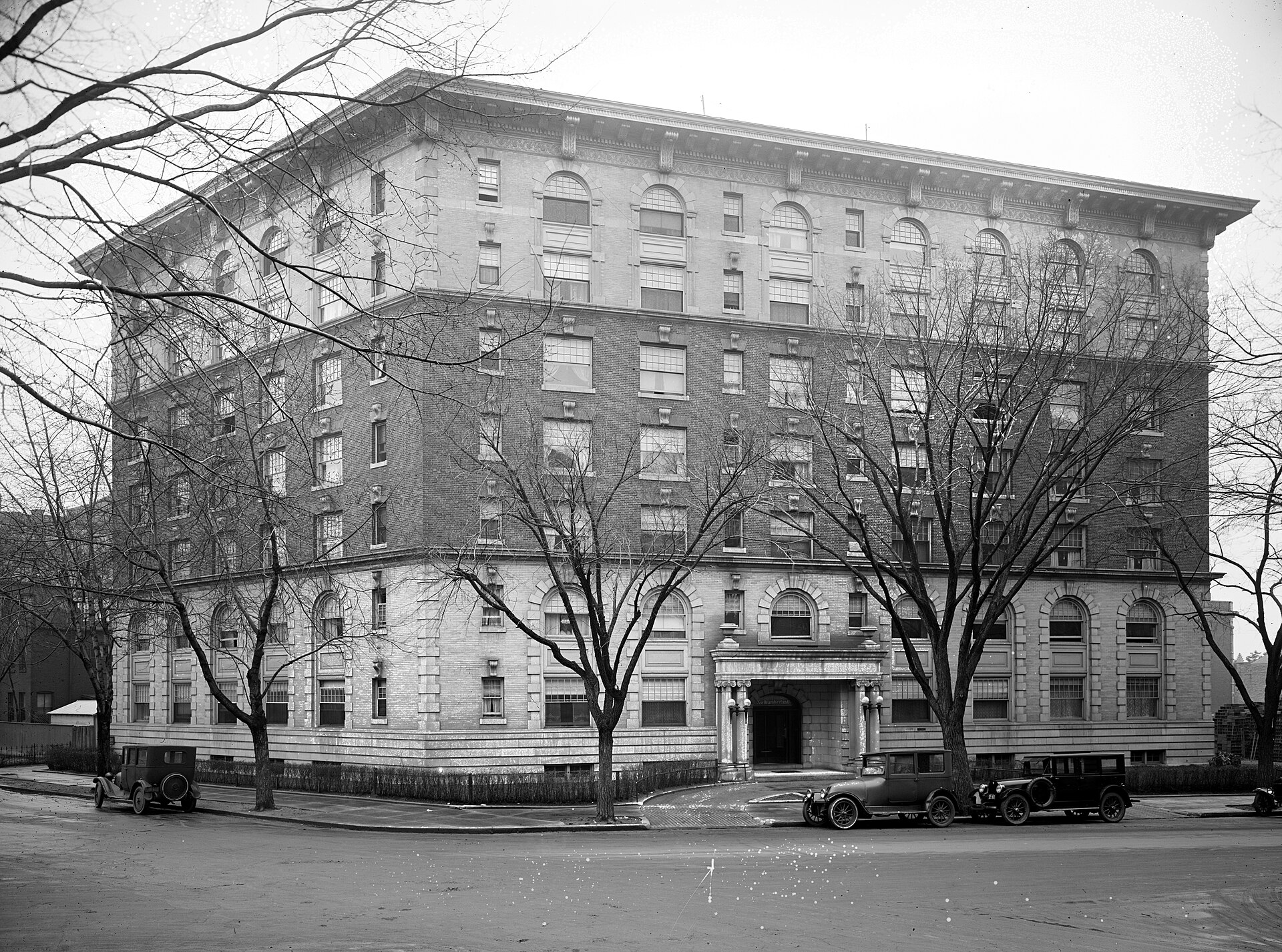
Walk through the front doors of the Northumberland and you are standing in one of only about fifteen interior spaces in all of Washington that the city guards as a historic landmark.
Not the building. The lobby. The room itself.
That tells you most of what you need to know about 2039 New Hampshire Avenue NW. It is a place that has barely changed since 1910, and the people who live there have spent a century making sure it stays that way. During the 1968 riots, when 14th Street was burning two blocks to the east, residents climbed onto the roof and poured water to keep the flying cinders from catching.
Harry Wardman builds his name in England
The Northumberland went up in 1909 and 1910, the work of the most relentless builder Washington has ever seen. Harry Wardman put up so many rowhouses and apartment buildings across the city that he was once said to have housed more Washingtonians than anyone alive. His stamp is all over the city, from apartment houses like this one to the rowhouses he built up in Woodley Park.
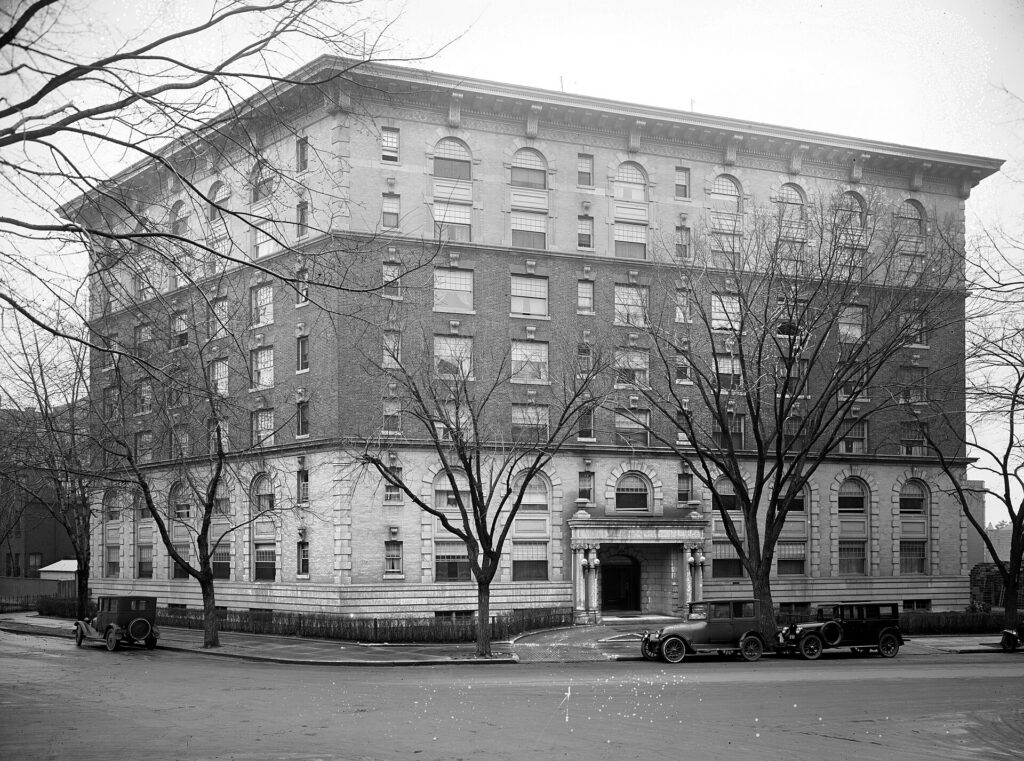
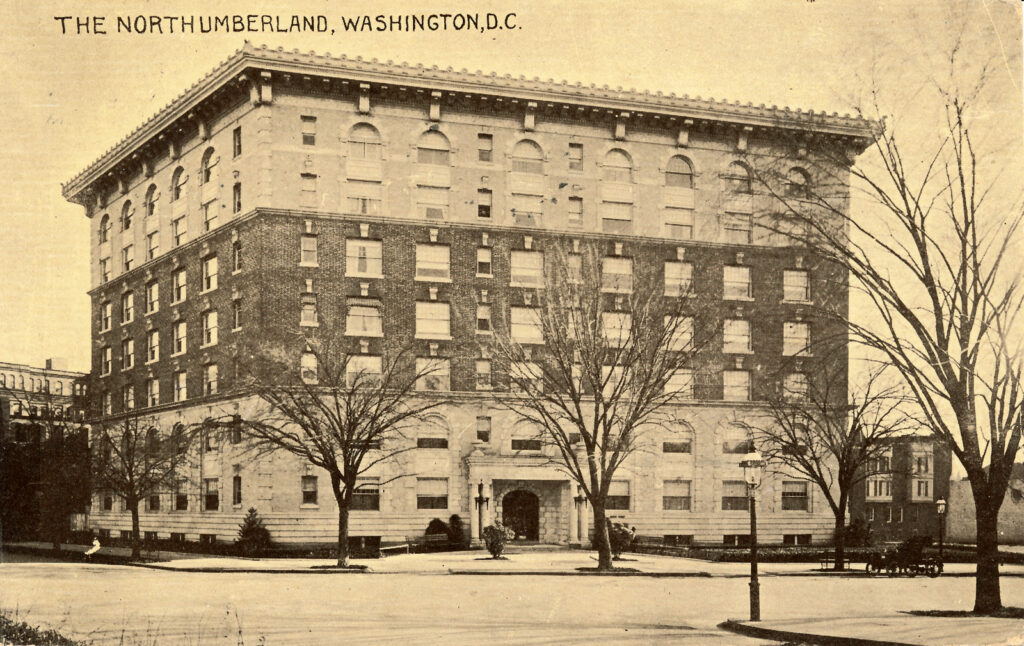
The architect was Albert H. Beers, Wardman’s go-to designer, who had come to Washington around 1903 after a long run in Bridgeport, Connecticut. Beers gave the building an eclectic classical face, red and white brick over a base of Indiana limestone, with a recessed entry framed by Ionic columns that stands sixteen feet high and more than twenty-two feet wide.
Wardman named it after Northumberland, the county in England where he was born.
The lobby is the showpiece. It runs 44 by 26 feet, rises 13 feet, and holds two facing fireplaces, each more than six feet tall and nine feet wide. The walls and columns are finished to look like warm Siena marble. At the first stair landing, three curved stained-glass windows carry the building’s monogram, the letter N.
A luxury address on the Avenue of the Presidents
The timing was deliberate. The Northumberland sat one block east of 16th Street, just south of Meridian Hill, in a stretch that the formidable Mary Foote Henderson was trying to turn into Washington’s grandest residential boulevard. For a while people even called 16th Street the Avenue of the Presidents.
Well-to-do Washington moved in fast. Among the early residents was Major Richard H. Sylvester, the city’s superintendent of police and a man later remembered as the father of modern police professionalism.
Sylvester ran his building the way he ran his department. As the Washington Post reported in September 1910, the tenants had been losing sleep to a pre-dawn racket in the alley out back.
Ice men have been in the habit of rattling up to the back entrance and chopping ice for their customers. Milkmen have been banging their bottles, laundrymen bumping their baskets, and grocery men dumping boxes off their wagons. As a result of the various activities of these energetic tradesmen, pandemonium reigned just about the time some of the tenants were most enjoying their sleep.
After one rude awakening, Sylvester had an officer posted behind the building to keep the deliverymen away before 8 a.m. Problem solved.
The numbers behind the building
Wardman almost never held a building for long. His money, the Washington Times once explained, was always active. He took profits and moved on.
By March 1914 he had sold the Northumberland to William J. Kehoe. The Washington Post laid out the figures on March 18.
The Northumberland apartment, a seven-story structure at New Hampshire avenue and V streets northwest, valued at about $375,000, has been sold by Harry Wardman to William J. Kehoe. The apartment occupies a lot with 130 feet on New Hampshire avenue, and 115 feet on V street. About 17,000 square feet is contained in the property. The rentals are said to aggregate $39,300 a year. The building contains 63 apartments.
It changed hands again the next year, swept up in a 1915 deal that traded it against the old Dewey Hotel. The building was a moneymaker, and money kept moving it around.
1920: the tenants buy the building
The most important year in the Northumberland’s history is 1920, the year it stopped being someone’s investment and became its residents’ home.
Developers Clarence Calhoun and James Sharp converted the building into a cooperative, selling the apartments to the people living in them. The Washington Post announced it on October 10, 1920.
The sale of the Northumberland apartments, New Hampshire avenue and V street northwest, to the “Northumberland Apartments, Inc.” has been announced by the Union Realty Corporation, Evans building. The purchasing company will dispose of individual apartments on the cooperative plan. C. C. Calhoun and James Sharp made the sale.
The Northumberland is a seven-story, modern, fireproof building, containing 69 apartments, varying in size from two to seven rooms. It was built about nine years ago.
The sales pitch leaned on simple arithmetic. A 1921 ad in the Washington Times, placed by the same Union Realty Corporation that ran the deal, told renters a stockholder paid just $3.75 a month for each $1,000 of stock, then asked the obvious question: why pay high apartment rents when you can pay your share of actual cost?
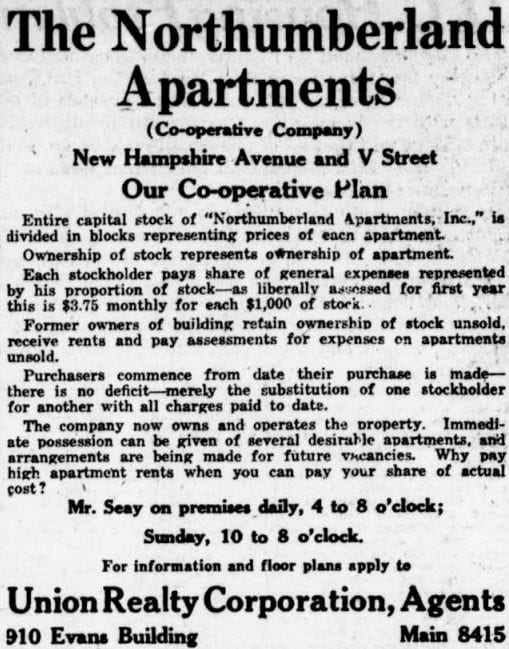
Co-ops were still an experiment in Washington in 1920. The city’s first, the Concord, had gone up at New Hampshire Avenue and Swann Street back in 1892 and would later be demolished. A developer named Allan Walker was pushing his “Walker plan” to convert apartments into co-ops, and a wave of buildings followed his lead that year.
Most of those 1920s co-ops did not survive the Depression. Unable to make their mortgage payments, they collapsed. The Northumberland did not just hang on. Its staff got raises, the building got improvements, and at one point the monthly assessments were dropped entirely. During World War II, the board minutes record discussions about what to do if German bombs ever fell on Washington.
Today the Northumberland is the second-oldest cooperative in Washington and the oldest one that has been continuously self-managed. The residents run it themselves, and they always have.
The man who clerked for Lincoln’s war secretary
The building’s early residents carried whole histories through its doors. One of them was Charles F. Benjamin, who died in his Northumberland apartment on May 5, 1915. His obituary ran in the Washington Post the next morning under a headline that read like a life.
Born in London, England, He Served at Gettysburg and as Aid to Secretary Stanton.
Benjamin was born in London around 1842 and came to America as a boy. When the Civil War broke out he enlisted at eighteen in the Fifty-fifth New York Volunteers, was wounded at the Battle of Fair Oaks, and was at Gettysburg with the adjutant general of Meade’s army. Soon after, he was transferred to the War Department, where he became confidential clerk to Edwin M. Stanton, Abraham Lincoln’s secretary of war.
He went on to graduate from Georgetown University Law School while still in government service, helped found the Perpetual Building Association, and served as its president. He had lived in Washington for more than fifty years.
Who lived here in 1920?
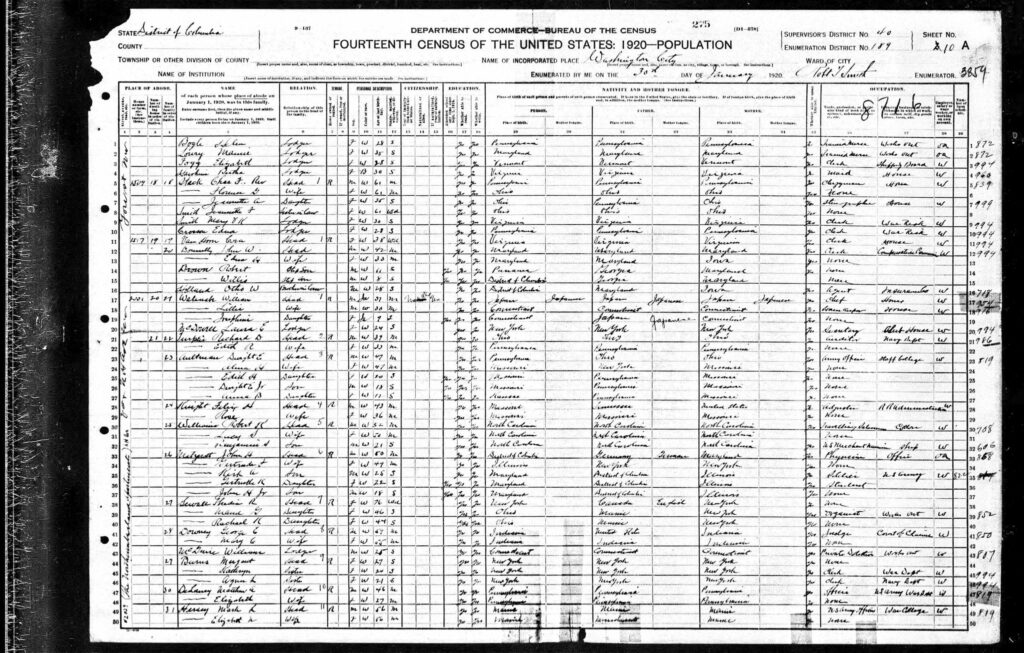
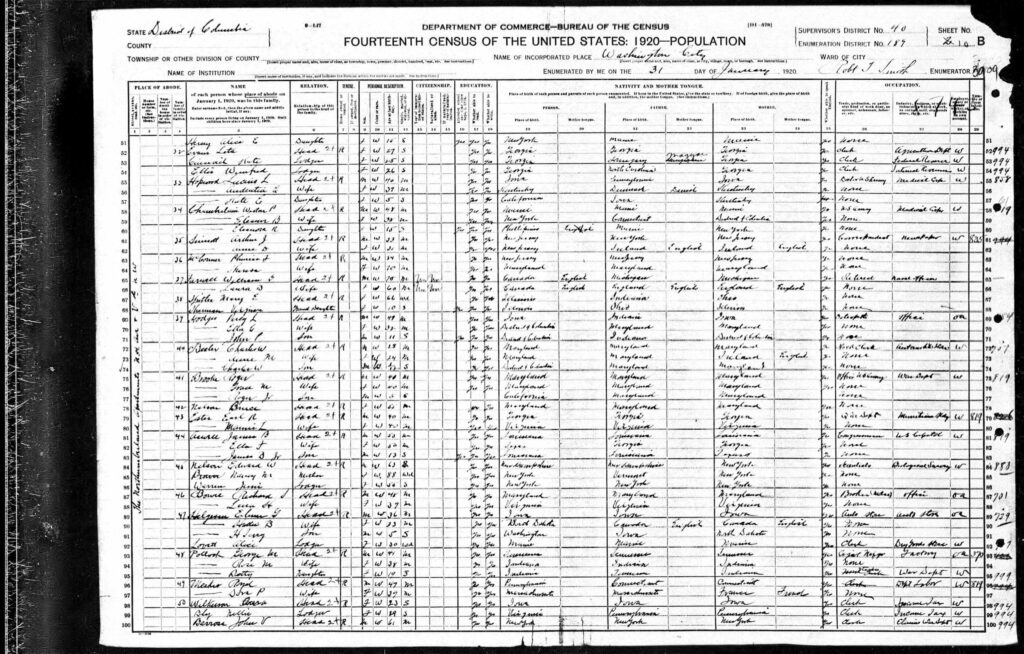
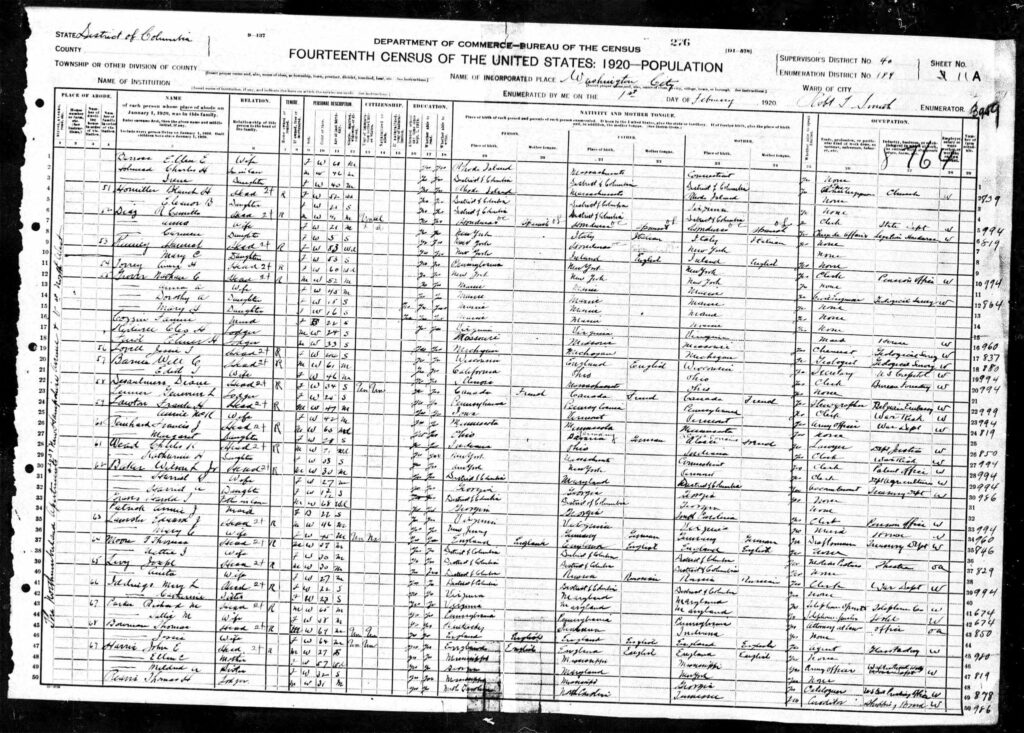
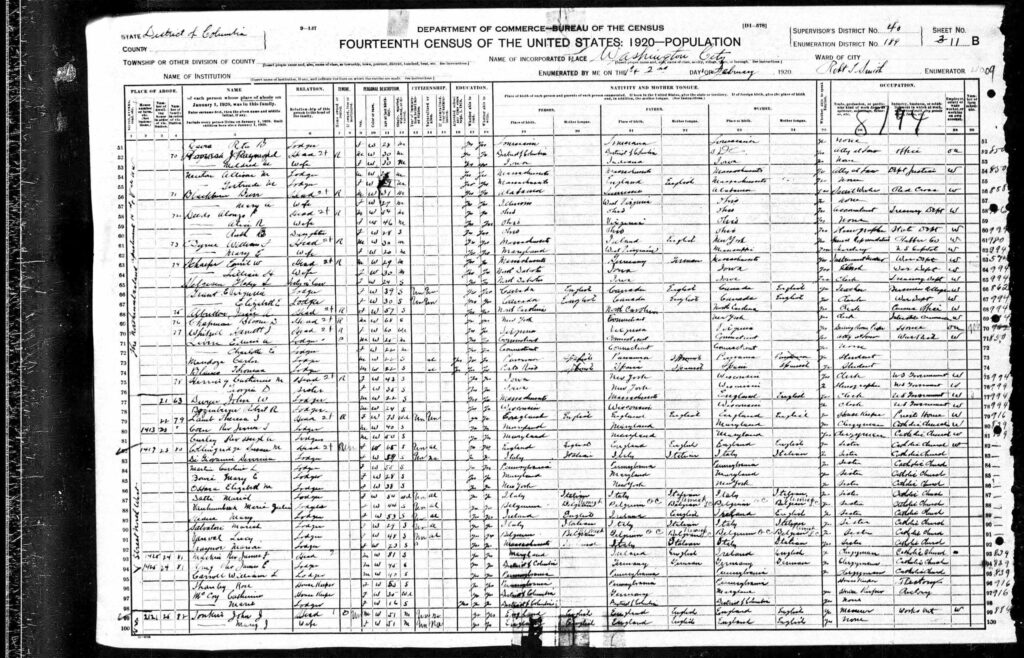
Benjamin was one name among dozens. When census takers walked the Northumberland in February 1920, they filled page after page with the building’s households, and the list reads like a cross-section of official Washington.
One apartment belonged to James B. Aswell, a Democratic congressman from Louisiana, who lived in the building with his wife Ella and their young son, James Jr. Another was home to the Reverend Charles F. Mack, a clergyman whose daughter Jeannette worked as a stenographer.
The building also housed trained nurses like Helen Boyle and Minnie Lowry, and Cora Van Horn, a woman running her own household and working as a clerk.
Most residents were government clerks, the people who actually ran the War Department and the Treasury, with a newspaper correspondent, a naval clerk, and a couple of real estate men in the mix. Their birthplaces spanned the country and beyond, from Pennsylvania and Ohio to Iowa and Vermont, with servants and residents born in Ireland, France, and Japan. Here is that snapshot, straight from the federal census.
A preservation time capsule
By the late 1970s, the neighborhood that had declined for decades was being rediscovered, and so was the Northumberland. The District named the building a landmark in 1978, and its exterior was listed on the National Register of Historic Places on March 25, 1980.
What charmed people was how little had changed. A 1978 Washington Post feature described the resident manager, Elsie H. Anderson, who received the mail each day, placed it in a wicker basket that had served the same purpose for forty years, and personally delivered it to every apartment.
The original parquet floors are still there. So are the built-in wall safes, the faux fireplaces installed in each unit to make an apartment feel like a house, and the chandelier-style fixtures. The one big change to the outside was small: the decorative crest that once crowned the roofline came down around 1920.
Hollywood noticed, too. The Northumberland appears in Francis Ford Coppola’s Gardens of Stone and in Broadcast News, both from 1987, and again in 1994 in Clear and Present Danger, where a character lived in the building. In 2009 the District gave it an Award for Excellence in Historic Preservation.
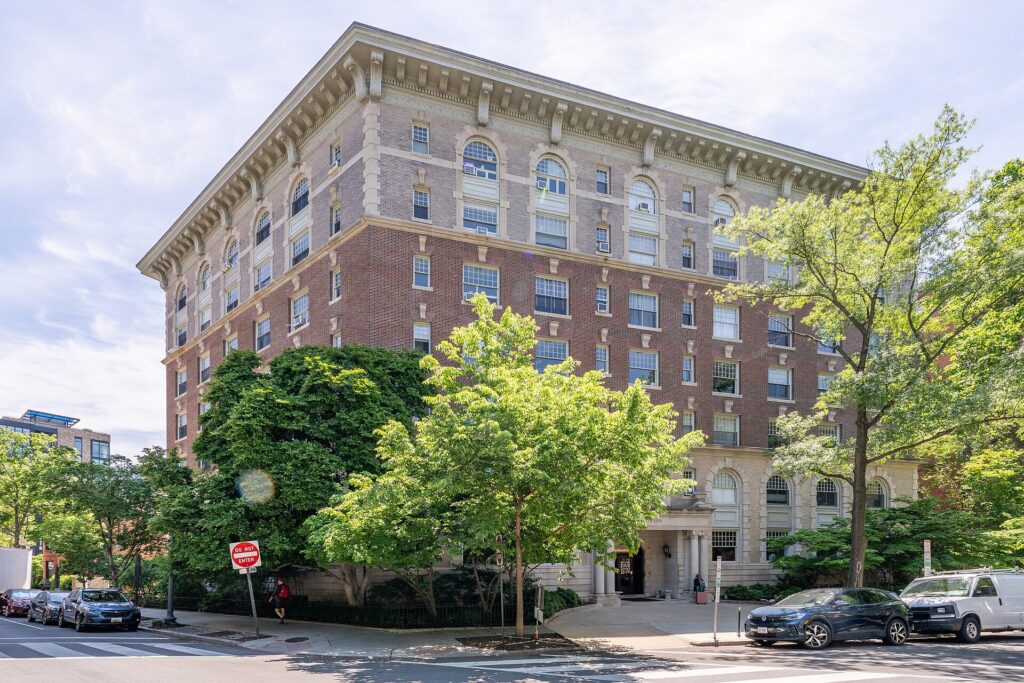
More than a century after Harry Wardman put it up and walked away, the Northumberland is still standing exactly where he left it, still run by the people who live inside it, still one of the best-preserved pieces of early Washington you can walk into today.
We dug this one up with help from AI and checked it against the original records below. Here’s how we use AI.