
We love it when a reader points us at something hiding in plain sight. A GoDCer wrote in this week asking about the Flour Mill, the condo and office complex at 1000 Potomac Street NW in Georgetown, and whether there was a story buried in it.
There is. That building was the last working mill in Georgetown. And it started life as a cannon expert’s cotton factory.
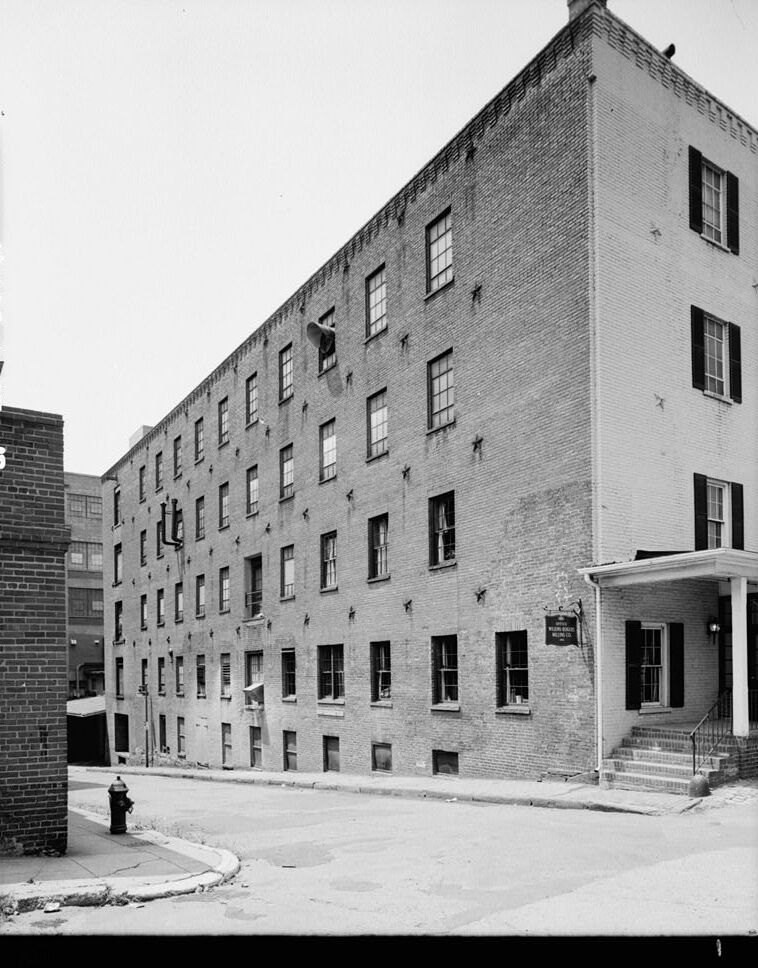
Here is the part that makes it timely. As we dug in, we found the Flour Mill is about to change yet again. A development team has filed plans to turn its offices into 135 homes. So this is really a story about a building that keeps reinventing itself, one century at a time.
Who was Colonel George Bomford?
George Bomford was born in New York City in 1782 and made his name in the Army as an ordnance expert. He rose to chief of ordnance in 1832 and invented the Columbiad, a heavy seacoast gun he named after Joel Barlow’s epic poem.
He also married Barlow’s sister-in-law and bought the famous Kalorama estate from the poet’s widow’s estate. By the 1830s Bomford was a man of means and a serious player in Georgetown business.
Milling was big business in Georgetown back then. Heavy industry ran the whole waterfront, from the Godey lime kilns upriver to the wharves that generations later gave way to nightspots like the Bayou. After 1831 the new Chesapeake and Ohio Canal gave the local mills a reliable 30 to 35 foot fall of water to run on. Bomford built a flour mill near the foot of the market house, probably around 1832.
A flour mill burns, and a cotton factory rises
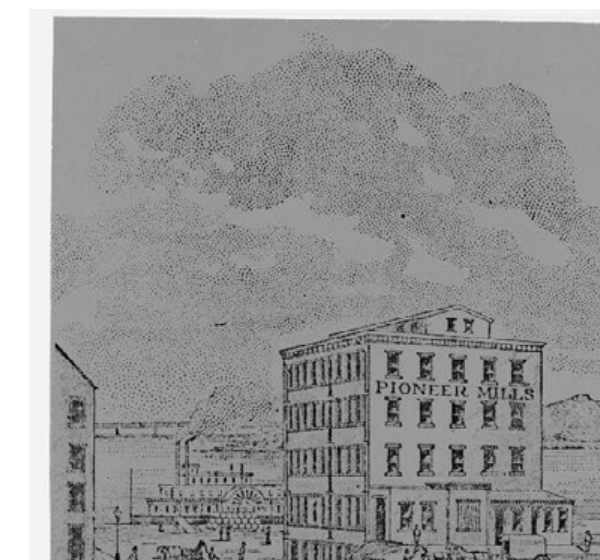
In September 1844 that big merchant mill burned to the ground. The next spring, Bomford rebuilt on the ruins. But he did not put up another flour mill.
He built a cotton factory instead, and it went into operation in 1847. The developers behind today’s project still date the historic core building to that year and call it the Pioneer Mill.
Why cotton? One early account says Bomford figured a cotton factory would employ more of the town. Another, by historian Corra Bacon-Foster, points to a simpler reason: grist milling was crowded, and cotton mills were booming elsewhere. Georgetown even waived his taxes to help.
He constructed an immense water wheel and erected a four story building on the site in which he placed three thousand spindles and one hundred looms. The mill provided employment for more than one hundred men and women.
It did not pay off. The outlay swamped the returns, and Bomford was soon, in Bacon-Foster’s words, “seriously embarrassed.” He had to sell Kalorama to settle his debts.
She wrote that he “never recovered from his reverses, but died broken hearted.” He died in Boston in March 1848 while watching heavy guns being cast, and was buried in the Kalorama vault beside Joel Barlow.
Back to flour, and the rise of Washington Flour
In 1850 the factory was sold to Thomas Wilson of Baltimore, who kept it spinning cotton until the Civil War choked off the supply. In 1866 a local businessman named A.H. Herr bought the building and turned it back into a flour mill, enlarging it in 1883.
For the rest of the century it was known as the Pioneer Flour Mill, run by Herr and a string of partners. George Cissel and Company held it from 1892 to 1916. Then the Wilkins-Rogers Milling Company bought it.
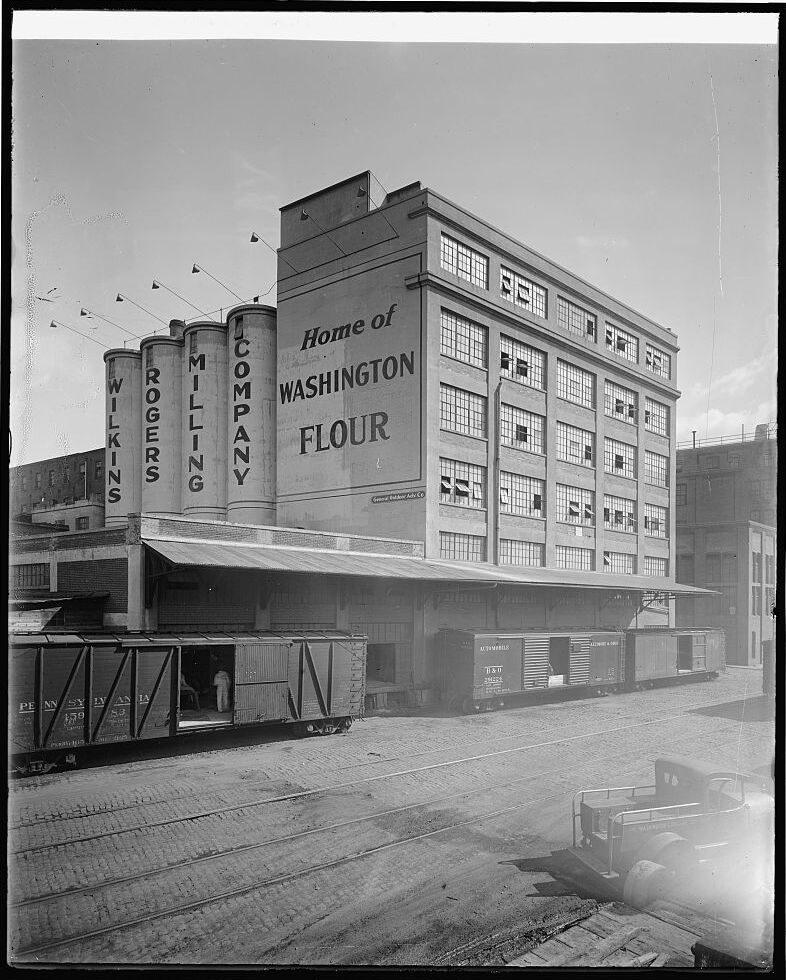
Wilkins-Rogers sold its flour under the “Washington” brand. A second, larger mill building went up next door in 1922, and its silos and brick wall announced the place to the whole waterfront: “Home of Washington Flour.”
The last mill in Georgetown
The Washington Post had already cast it as a survivor. A February 1940 feature ran under the headline “Lone Flour Plant Grinds on Canal,” a nod to the days when a whole row of mills lined the waterfront and this was the one still turning.
By 1967, when the Historic American Buildings Survey came through to photograph the place, Wilkins-Rogers was still running it as a working flour mill. The survey flatly called it the only old mill left in Georgetown.
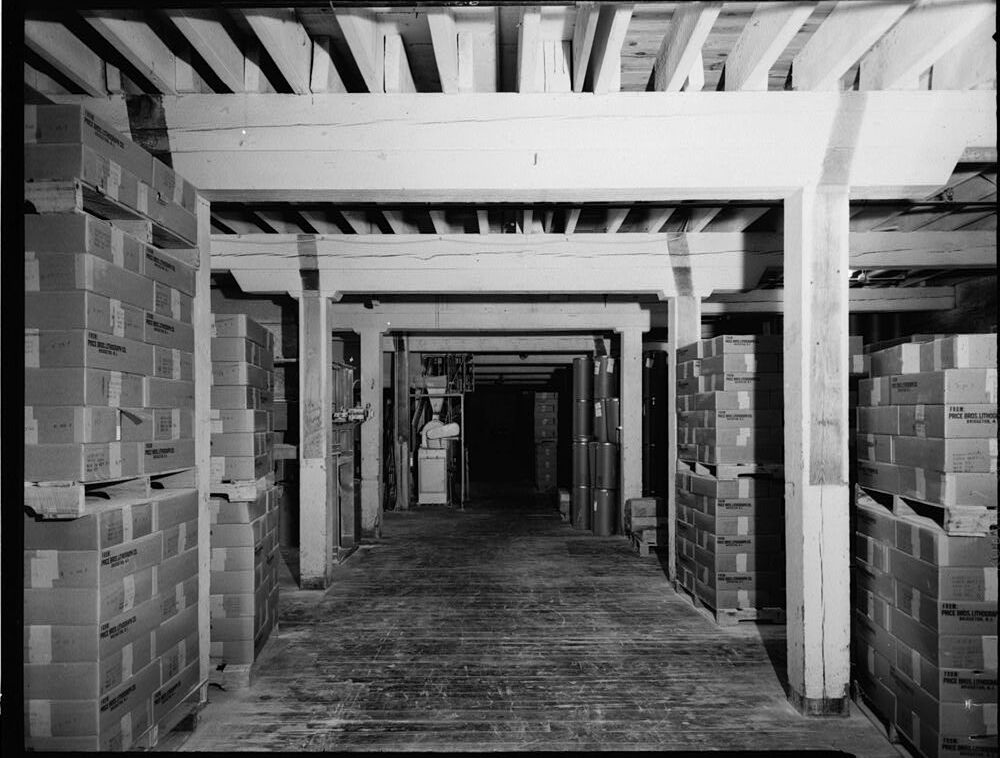
Two years later the run ended. In 1969 Wilkins-Rogers moved out to Ellicott City, Maryland, where it still mills Washington flour today. After more than a century, Georgetown’s milling era was over.
In 1973 the old mill was added to the DC inventory of historic sites, and it sits inside the Georgetown Historic District. By then the Whitehurst Freeway had already been driven past the lower edge of the complex.
From mill to offices to condos
In 1980 Weissberg Development Corporation folded the two old mill buildings, Bomford’s 1840s brick mill and the 1922 concrete one, into an office and condominium complex wrapped around a plaza. Remarkably, the brick exterior of the old mill survived almost unchanged.
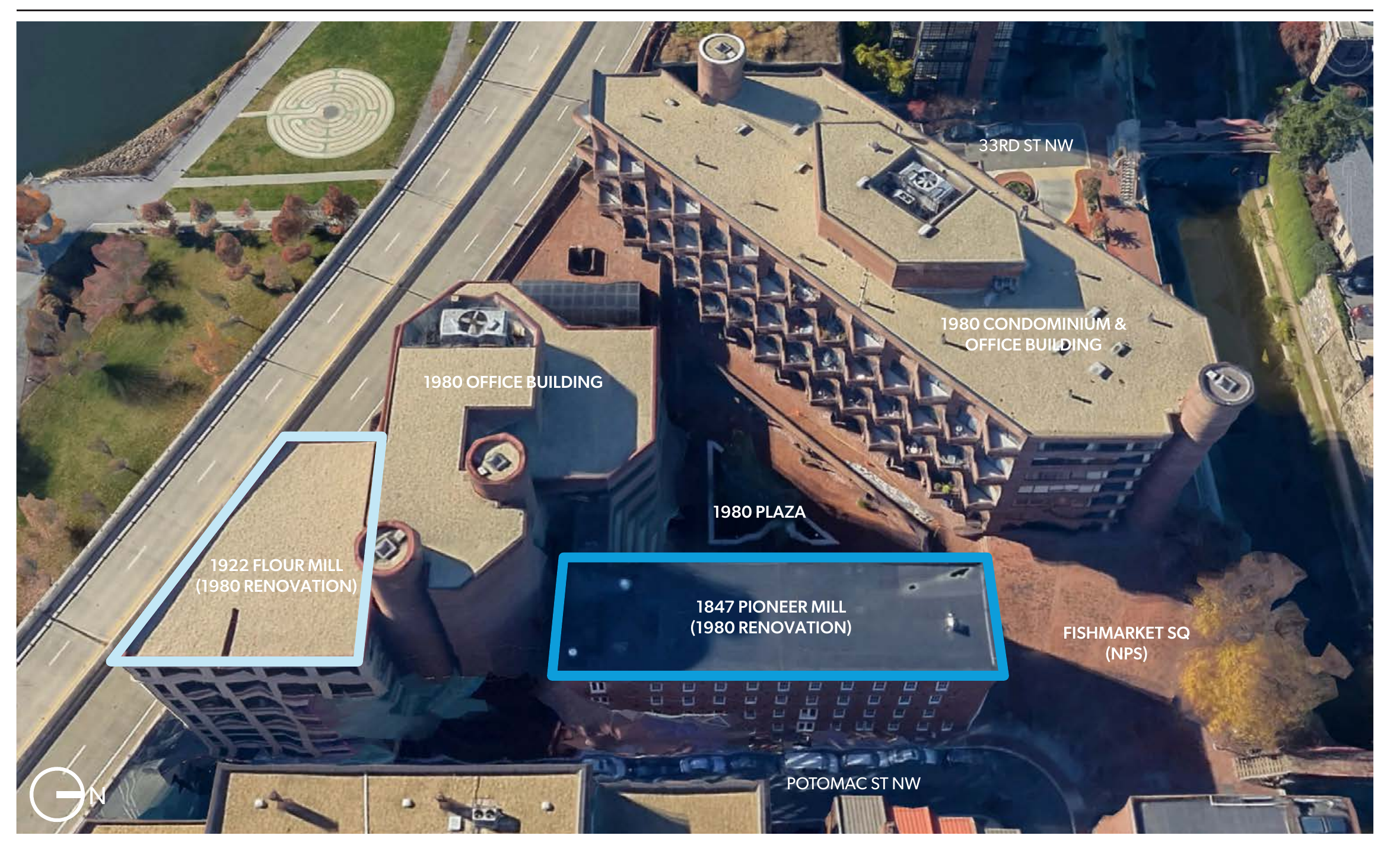
That is why the place reads like a layer cake from above. The 1847 Pioneer Mill, the 1922 flour mill, and the 1980 additions all sit shoulder to shoulder, each from a different chapter of the same address.
The conversion won design awards, and the offices proved valuable fast. In January 1982 the Washington Post reported that the office building in the “award-winning Flour Mill complex” had sold to a European investment group for just under $20 million.
What the Flour Mill is becoming
Now comes the next chapter. In October 2024, Related Fund Management and Network Realty Partners bought the office buildings with a residential conversion in mind.
In May 2025 they filed a concept submission with the Old Georgetown Board, designed by Studios Architecture. The plan turns the offices into roughly 135 homes across the four buildings, including two office floors of the west building that already holds condos. About 8,000 square feet of retail would line Potomac and Water Streets.
The proposal keeps and restores the historic mills while reworking the rest. It adds a new glass entry and canopy on Potomac Street, new penthouses, a porch facing Fishmarket Square, and a redesigned garden plaza.
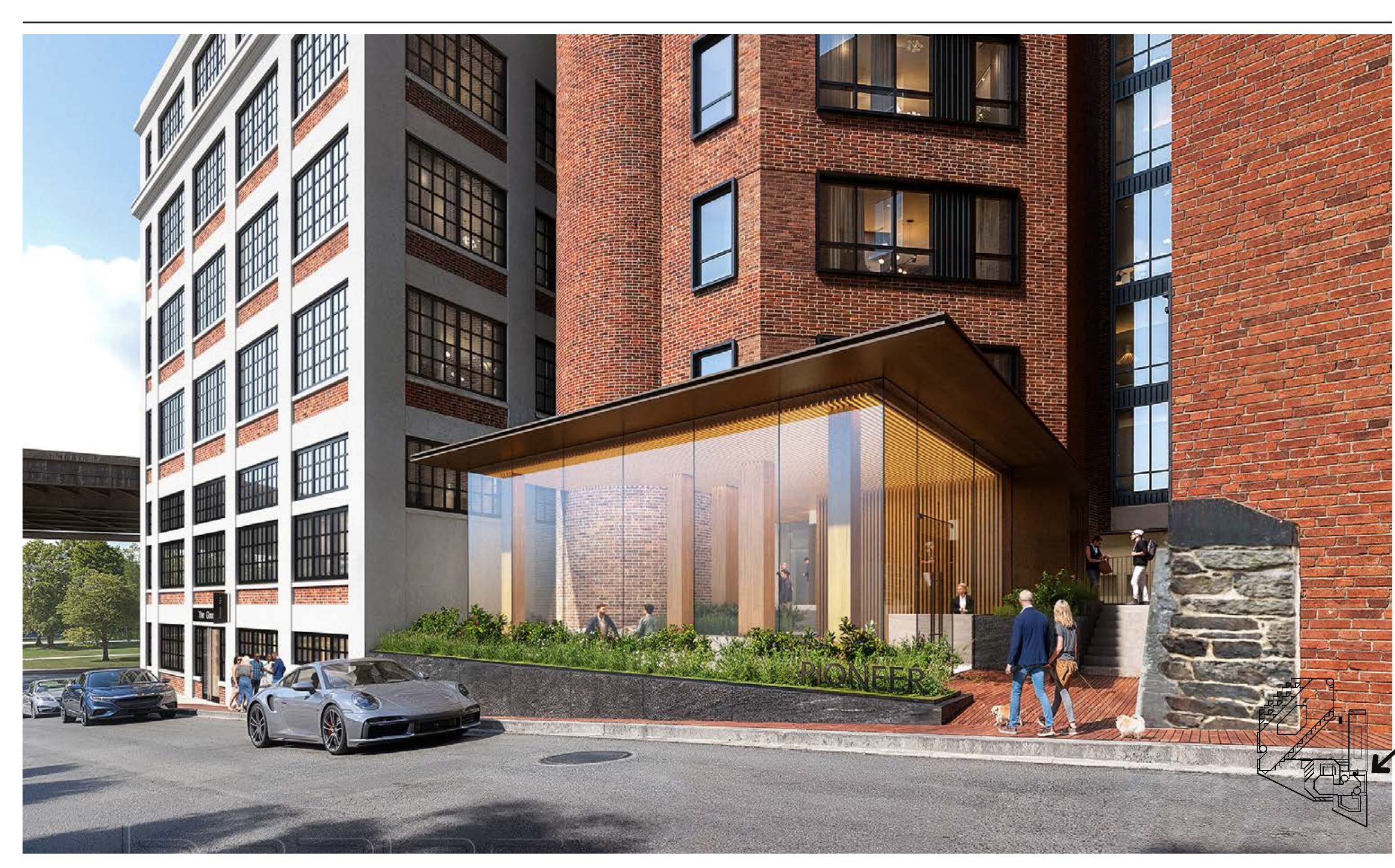
So the story goes on. A flour mill, then a cotton factory, then a flour mill again, then offices, then condominiums, and soon a building full of homes. The Flour Mill has spent nearly two centuries refusing to stand still, and our thanks go to the reader who asked what its story was.