
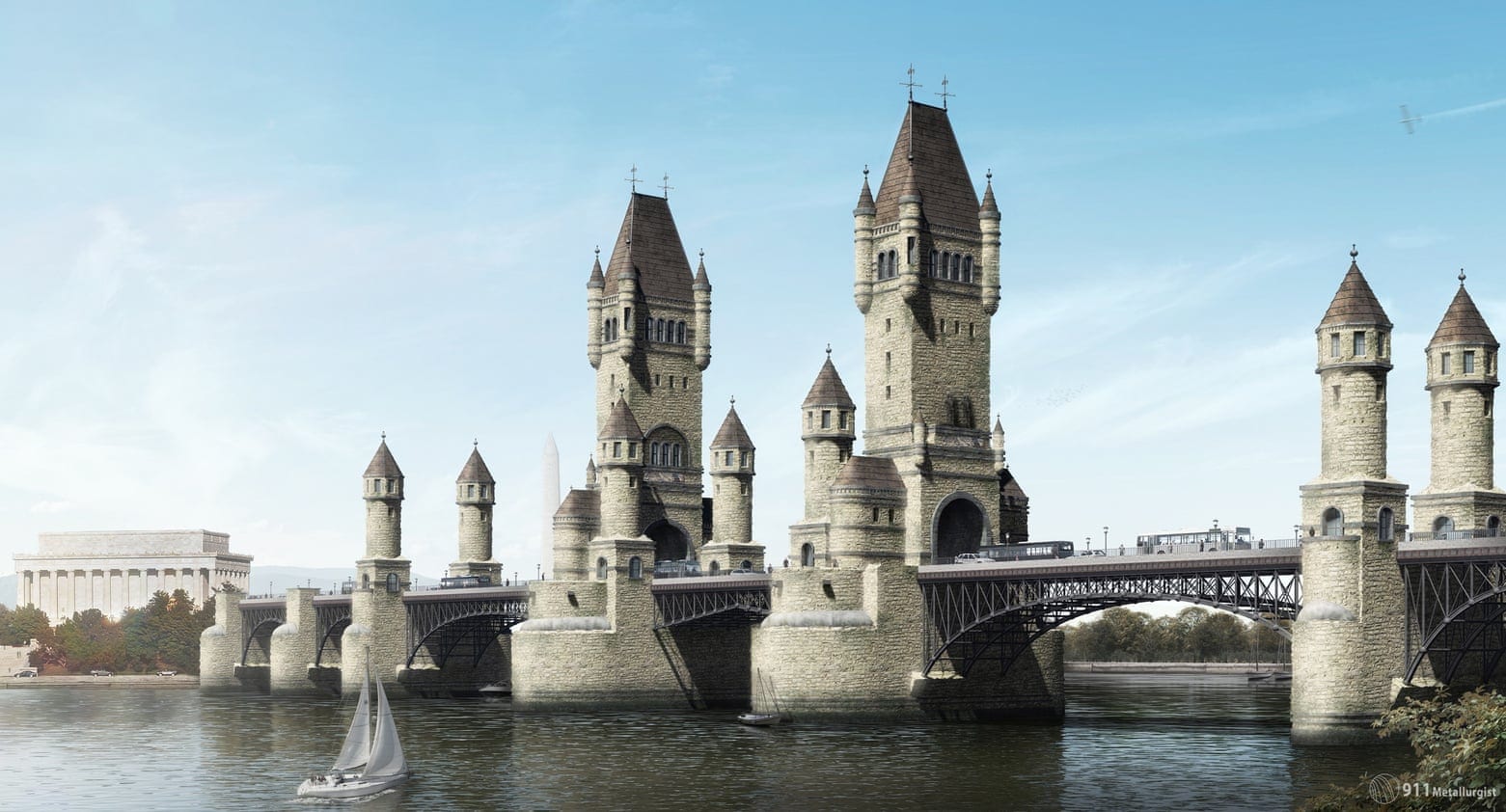
In 1887, Congress nearly voted to build a medieval granite fortress across the Potomac River in honor of Ulysses S. Grant. The colorized rendering above shows what it would look like today: a structure nearly a mile long, with square and round towers, turrets, grand arches, and a drawbridge over the main channel. Nothing like it had ever been proposed in the United States.
Grant had died less than two years earlier, on July 23rd, 1885, and Congress was looking for a fitting memorial. A bridge made particular sense. It would connect Washington to the grounds of Arlington National Cemetery, where fifteen thousand Union soldiers lay buried, men who had served under Grant in the Civil War he helped win.
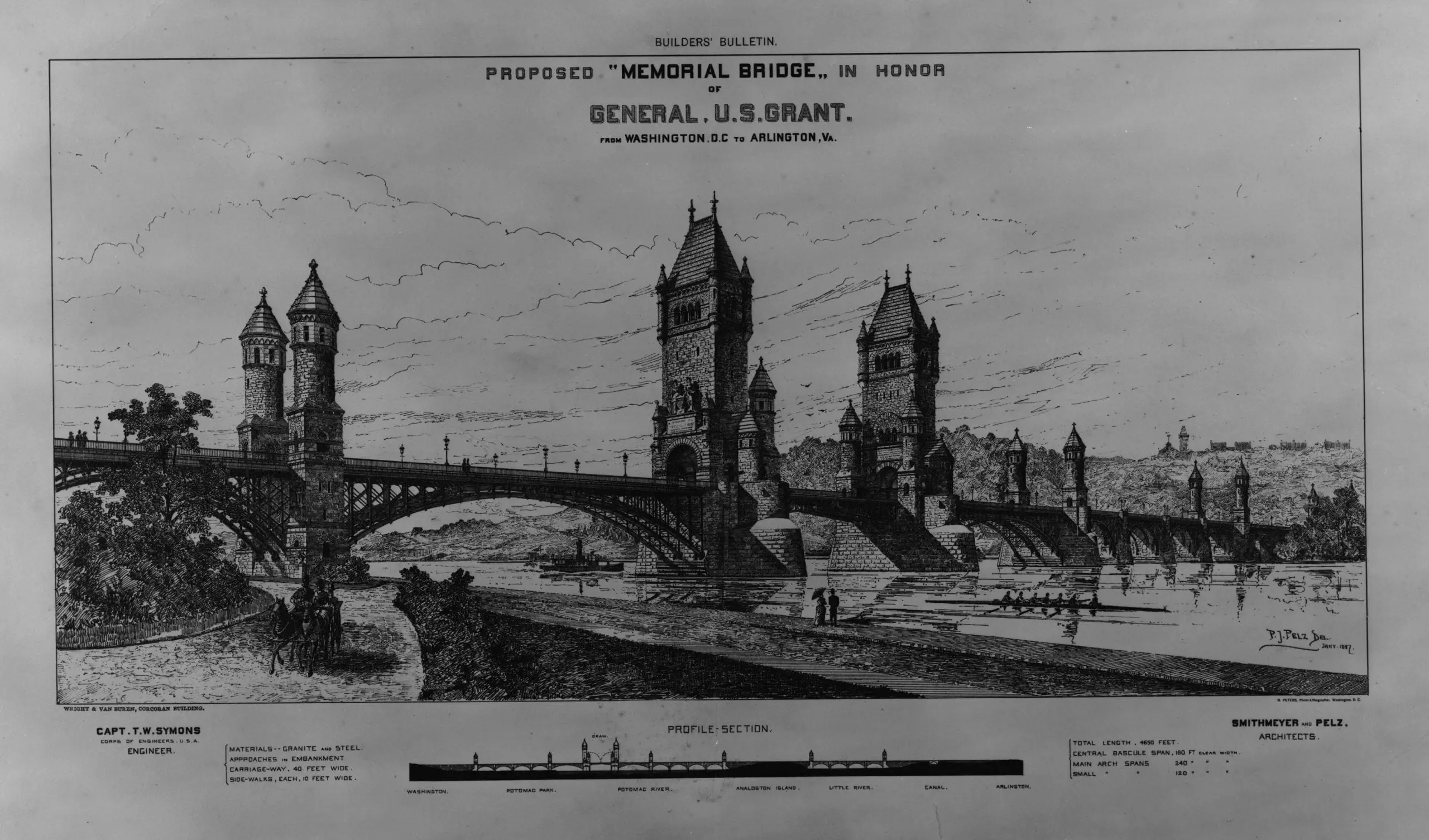
The bill was introduced in the House by Mr. Curtin of Pennsylvania and referred to the Committee on Public Buildings and Grounds. The architects were Smithmeyer and Pelz, the same firm then deep into designing the Library of Congress, and the engineer was Captain Symons of the Army Corps of Engineers. Here is what the Baltimore Sun reported on February 12th, 1887.
The Grant Memorial Bridge. – There has been sent to us from Washington an admirably engraved representation of the memorial bridge which it is proposed to construct across the Potomac from Washington to Arlington, in honor of Gen. U.S. Grant. A bill to carry the proposition into effect was introduced in the House of Representatives on Wednesday last by Mr. Curtin, of Pennsylvania, was read twice, and referred to the committee on public buildings and grounds. According to the plans submitted by Captain Symons, of the United States corps of engineers, and Architects Smithmeyer and Pelz, the starting point of the bridge on the Washington side would be Observatory Hill, near the foot of New York and New Hampshire avenues, and thence across the Potomac to some point near Arlington, as may ultimately be determined upon by a commission, to be composed of the Secretary of War, the chief justice of the United States, the engineer-in-chief of the United States army, and one member of the Senate and another of the House, to be chosen by the respective presiding officers of those bodies. The preamble to the bill declares it to be “the desire of the people of the United States that a monument of imperishable material should be erected in honor of its greatest soldier of a design suitable to commemorate his distinguished services;” and that the most appropriate design is a grand monumental bridge to connect Washington with the sacred grounds of Arlington, where fifteen thousand Union soldiers lie buried. The object of the bridge appears to be to afford easy access to the thousands who go to Arlington from year to year to scatter flowers on the graves of those who lost their lives in defense of the Union. The bridge it is proposed to build for this purpose, as represented by the engraving of it, is what might be called a medieval structure of granite and steel, with square and round towers and turrets, arches of different spans, and a drawbridge over the main channel to admit the passage of vessels. Its total length, including the approach, is to be 4,650 feet, or 630 feet less than a mile. The carriage-way is to be forty feet wide and the sidewalks each ten feet wide. The main arch spans are to be 240 feet in the clear, the bascule span 160 feet and the smaller spans 120 feet each. No such elaborate and imposing structure of the bridge kind has ever been built or even contemplated before in the United States, and its resemblance to the causeway of a great fortress, approached by a series of fortified outworks, is kept up by the bold arches spanning the roadway and their supporting towers and turrets. Although the cost of such a work of the strength and elaborateness proposed is not given, it must necessarily be very great, for to simply commence the construction of the bridge the bill calls for an appropriation of half a million of dollars.
Half a million dollars just to begin construction. That is roughly $16 million in today’s money, and it was only the starting appropriation. The full bridge would have cost considerably more.
The chosen starting point on the Washington side was Observatory Hill, near the foot of New York and New Hampshire avenues, crossing to a point near Arlington to be determined by a commission. Arlington Memorial Bridge, which finally opened in January 1932, crosses the same water at nearly the same location.
The designs
The 1887 Smithmeyer and Pelz proposal was just the beginning. Over the following two decades, engineers and architects kept returning to the same Potomac crossing with competing visions for what it should look like.
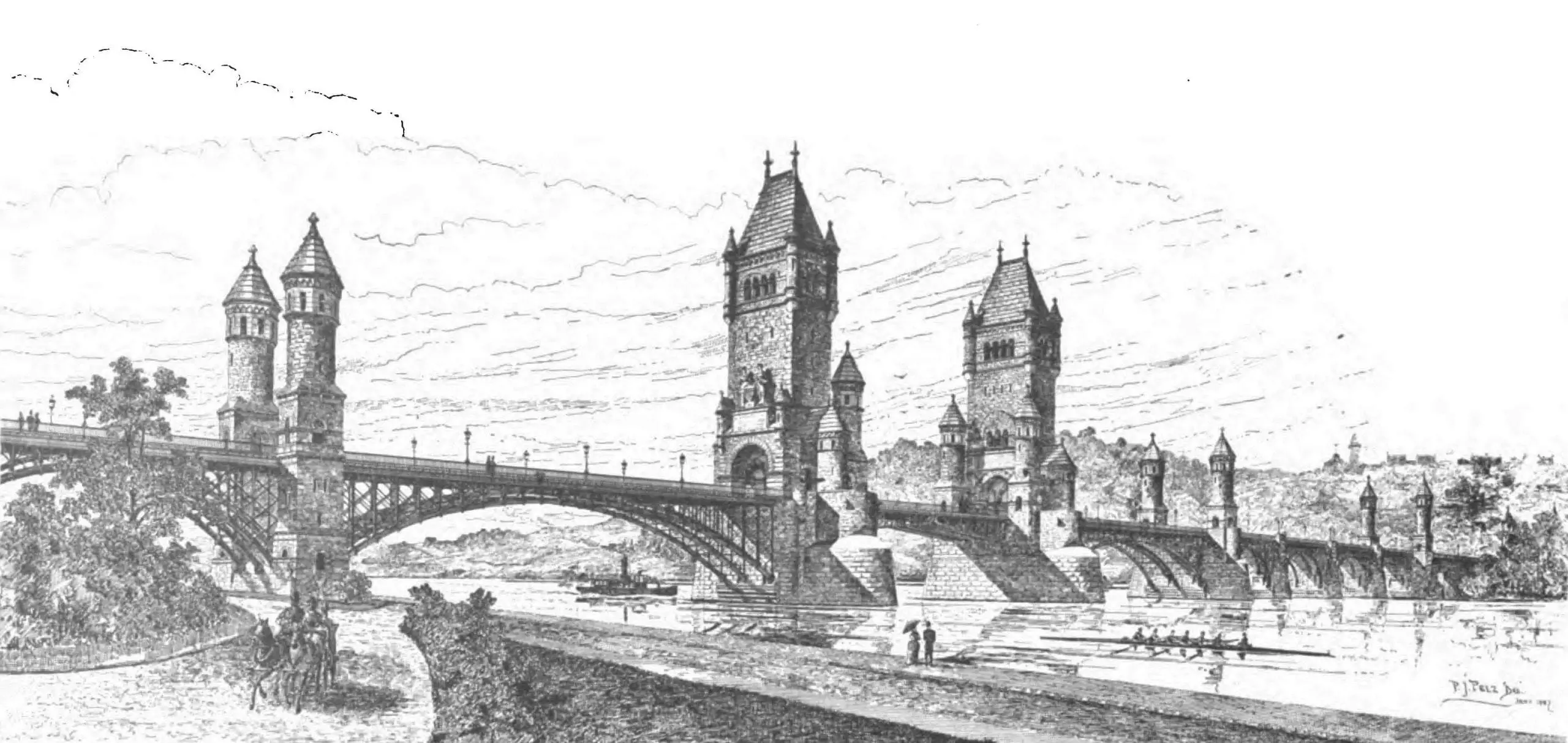
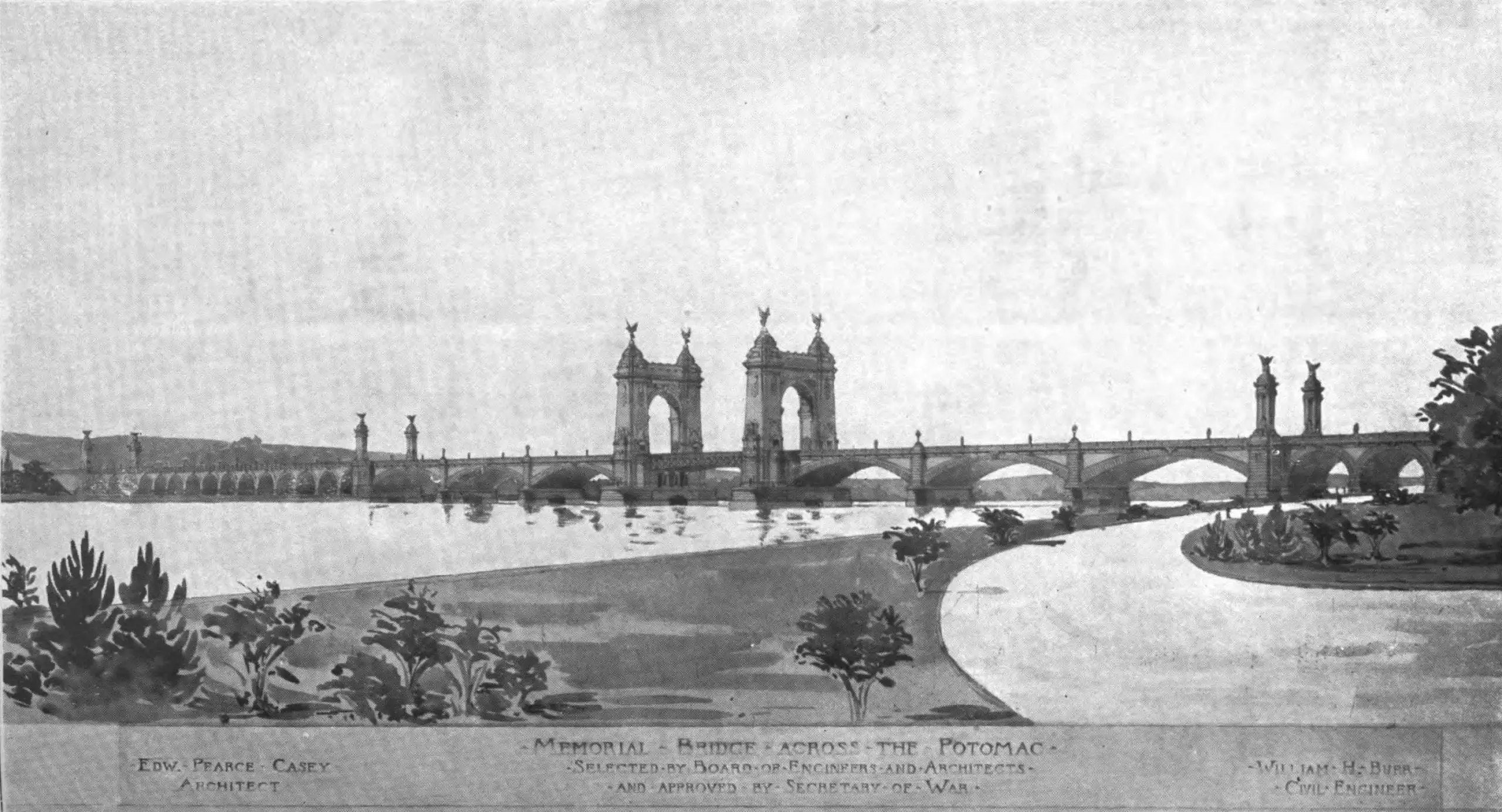
The Pelz design makes the Baltimore Sun’s description vivid: a medieval structure of granite and steel, with towers and turrets that look less like a bridge than a river fortress. By 1901, the aesthetic had shifted considerably. Edward P. Casey and William H. Burr submitted a new design that year, which the Secretary of War formally accepted. It was never built.
By 1906, the project was dying
The 1887 bill stalled in committee. The 1901 design, though accepted by the Secretary of War, was never funded. By July 1906, a Baltimore Sun correspondent filing from Washington was writing the project’s quiet obituary.
The proposed Memorial bridge across the Potomac river joining the North and the South is among the most pretentious of the prospects planned. There was a strong agitation in favor of the erection of this bridge several years ago, the idea being to have great arches in honor of Lincoln and Grant and other notables of the Civil War. The bridge is proposed largely as a memorial to Lincoln, for whom there is no proper monument in Washington. There are two Lincoln monuments here, one a candle-like marble shaft of old-fashioned design in front of the City Hall, and the other a bronze memorial in Lincoln Park, representing Lincoln beside a kneeling negro. Both of these statues are modest and well meant, but neither is adequate nor appropriate. Congress came near ordering the erection of the Lincoln Memorial Bridge a few years ago, but the agitation has since then subsided. The stonecutters of America have given a large stone to be placed as the corner-stone of this bridge whenever it is erected, and this great plinth has for several years rested on the inclosed Government lot adjoining the Lafayette Square Theater, opposite the Treasury Department. The memorial bridge project has probably been postponed indefinitely by the erection of the two new steel bridges across the Potomac.
Baltimore Sun, July 30th, 1906
Something had also shifted in how people were framing the project. By 1906 the bridge was being discussed primarily as a Lincoln memorial, not a Grant memorial, the correspondent noting there was no adequate Lincoln monument in Washington. That would eventually be addressed when the Lincoln Memorial opened in May 1922, on the same stretch of Potomac waterfront where the Grant bridge had once been proposed.
And that stonecutters’ cornerstone is a remarkable detail. The stonecutters of America had already cut and donated the thing. It sat in a government lot near Lafayette Square, opposite the Treasury Department, for years. Nobody came for it.
The 1887 proposal was the first of nine major designs floated for this Potomac crossing over a span of nearly fifty years. We’ve traced the full 140-year fight to build Memorial Bridge, from the medieval fortress proposal through to the bridge that finally opened in 1932.
That looks really cool. What happened to it?
The idea was revived by the McMillan Commission in 1901, but was eventually abandoned in favor of the more consensus and reconciliationist sentiment of the Arlington Memorial Bridge, which was proposed in 1901 but only completed in the late 1920s because Northern members of Congress remained enamored of the “Grant Memorial Bridge” concept.
President Warren G. Harding became trapped in a traffic jam on Highway Bridge (down the Potomac from the site of the proposed bridge) and was almost late to the ceremony when the Tomb of the Unknown Soldier was dedicated in November 1921 and drove a bill to finance the bill through Congress a year later.
Gotta disagree; the thing looks awful, IMHO. Who was supposed to live in the two castles/turrets/whatever on the bridge?
I’m not sure about your comment” “another former president lost out getting a memorial here in D.C”. The Grant Memorial sits at the base of Capitol Hill….
Phantoms of the Opera and other ghouls. Maybe they’re just for decoration.
My guess is that they would hold the mechanisms for the drawbridge.