
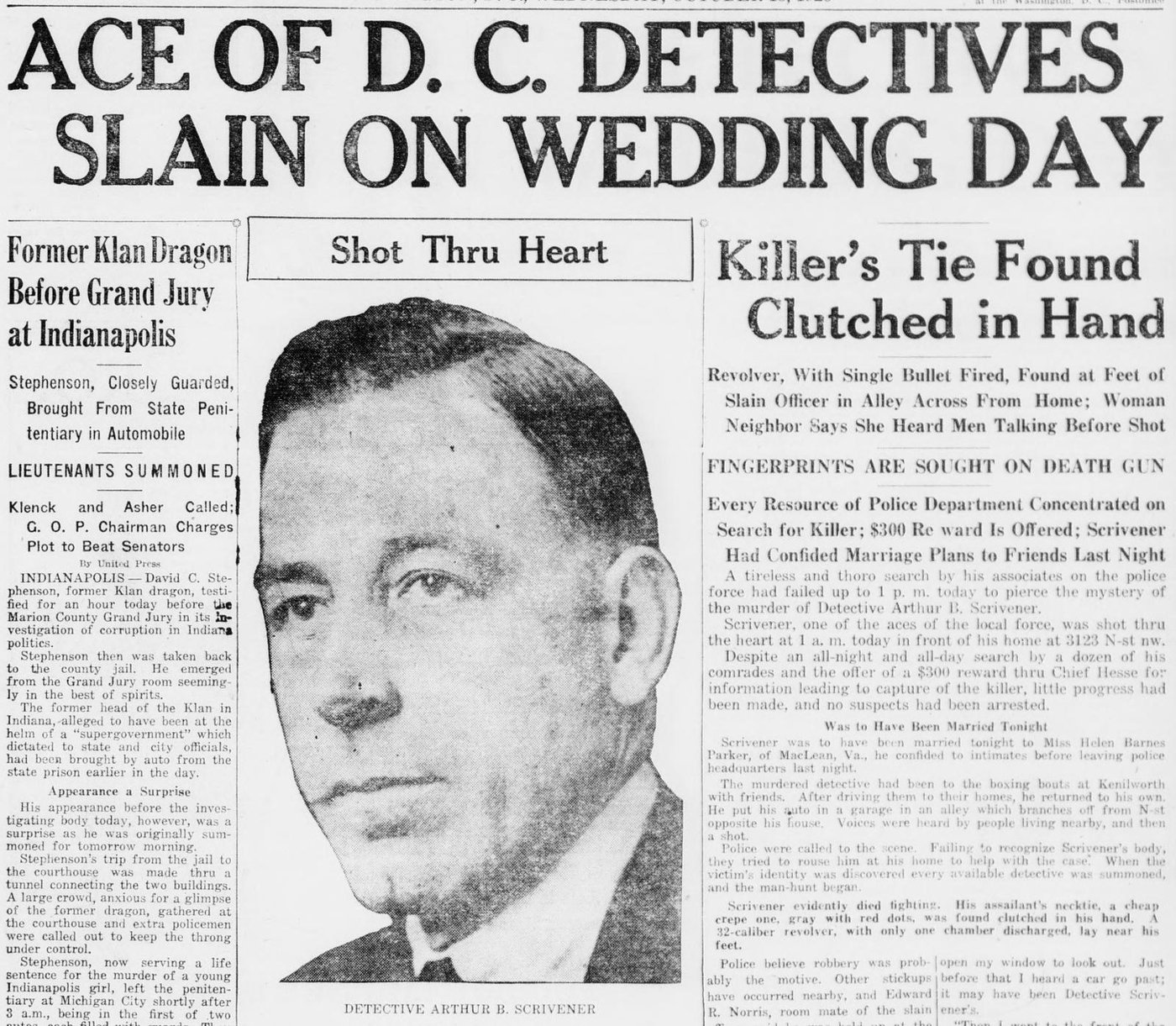
Detective Sergeant Arthur B. Scrivener was supposed to get married on the night of October 13th, 1926. Instead, shortly after 1 a.m. that morning, he was found dead at the mouth of an alley on N Street in Georgetown, a bullet through his heart and a torn gray necktie clenched in his right hand.
Two official bodies ruled on how he died. A coroner’s jury said murder. Three years later, a grand jury said he shot himself.
Nobody was ever charged, and Washington never agreed on the answer.
We went back to the papers. The Evening Star, the Washington Times, the Washington Daily News and the Washington Post covered the Scrivener case almost daily, and the story they tell is stranger than the legend.
“I’ll Grab Something From Him”
Scrivener had a line he liked to repeat to other detectives. The Evening Star printed it on its front page the afternoon he died:
“If anybody ever gets me,” he often said, “I’ll grab something from him to give the boys a lead to work on. It may be only a button, but I’ll get something.”
The Star’s headline: “Slain Detective Kept Word to Get Clue to Murderer.” The necktie in his fist looked like exactly that clue. The Daily News went bigger: “Ace of D.C. Detectives Slain on Wedding Day.”
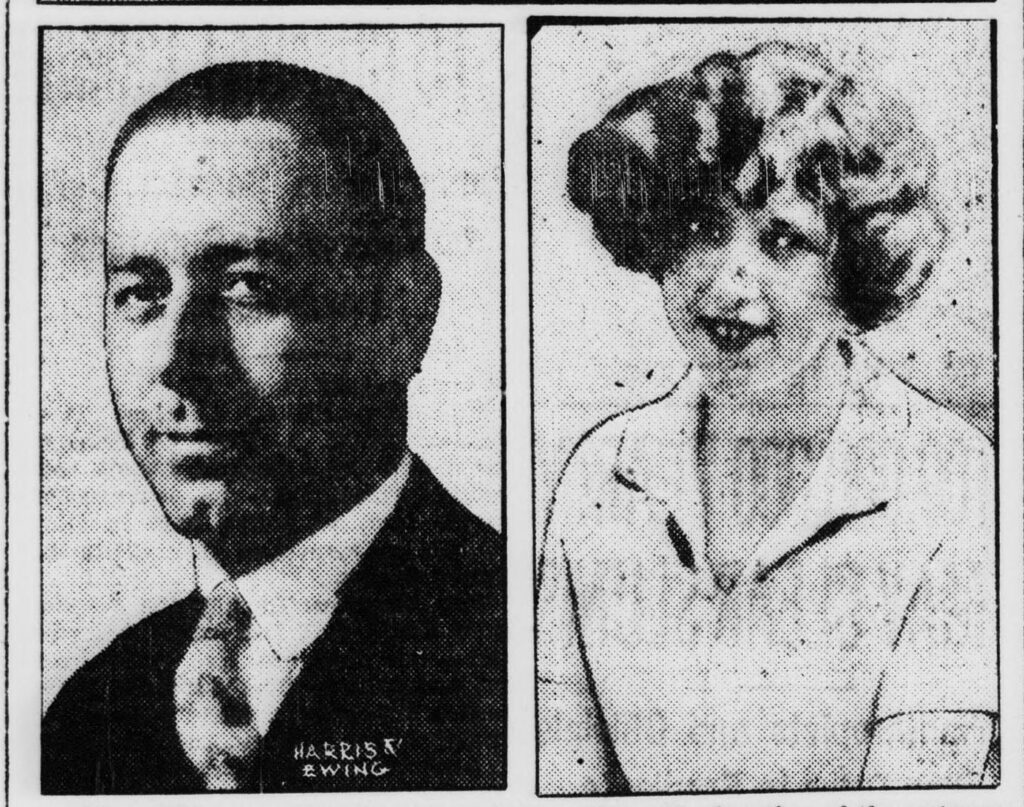
Who Was Arthur Scrivener?
Arthur Beverly Scrivener was born July 9th, 1889, at Rock Enon Springs in Frederick County, Virginia. Virginia’s birth register lists his parents as Turner A. and Emma Scrivner. The 1900 and 1910 censuses show the family farming in Frederick County, outside Winchester.
He taught school, then came to Washington and ran a streetcar for the Capital Traction Company. He joined the Metropolitan Police on January 18th, 1912, walking a beat in Georgetown’s Seventh Precinct, and was promoted to detective sergeant on September 1st, 1918.
On August 19th, 1920, he chased down escaped convict Thurman Brown in a running gun battle. Scrivener took a bullet in the arm and brought Brown in alone.
The Daily News recorded the exchange. Brown: “If you come a step nearer, I’ll kill you.” Scrivener: “I’m coming in.”
The Daily News called him the “Beau Brummel” of the force. He guarded visiting dignitaries and the principals in the Teapot Dome hearings. Friends called him “Mitt.”
Police chief Maj. Edwin B. Hesse put it this way:
“He was by far the most courteous man on the force. I was never ashamed to send him to any one, ambassador or tramp. He was fearless and by his death the department has lost one of its best men.”
For 12 years he had roomed with Mr. and Mrs. Matthew J. Walsh at 3123 N Street NW, a brick row house half a block east of Wisconsin Avenue. Mrs. Walsh told the Times, “He was just like a member of the family.”
The 1920 census backs that up. On January 10th, 1920, the census taker listed “Arthur Scrivenor,” 30, single, born in Virginia, as a lodger at 3123 N Street. His occupation: detective.
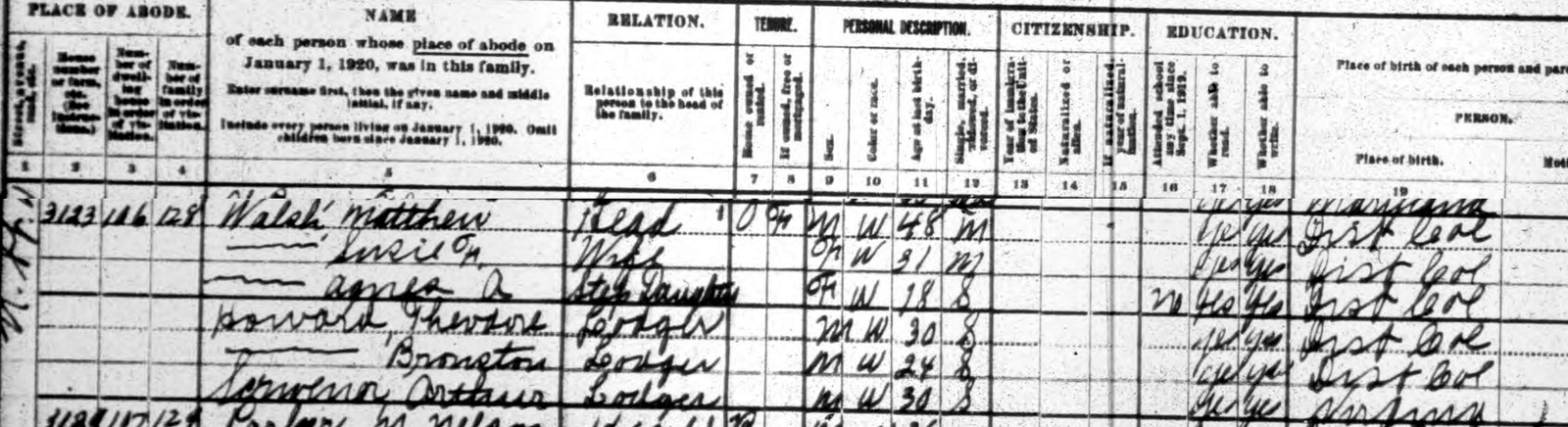
Matthew Walsh, 48, owned the house and worked as a horseshoer with his own shop. The same census sheet lists the Doerings across the street at 3128: Ellen V. Doering, 74, her son Robert and her daughter, listed as Katherine. Six years later, it was Catherine who heard the groans in the alley and Robert who called the police.
The Last Night
On the afternoon of Tuesday, October 12th, Scrivener picked up his fiancée, Helen Barnes Parker, 19, a clerk at the U.S. Railroad Administration, and drove her home to the Langley area of McLean, Virginia. He gave her a diamond engagement ring and showed her the wedding band.
The wedding was set for 8 p.m. the next night at the home of Rev. Dr. Earle Wilfley, 1438 Harvard Street NW. Parker told the Star what he said as he left:
“He put his arm around me and kissed me, and said: ‘I’ll see you tomorrow at 7 o’clock, Baby.’ They were his last words.”
That evening he went to the boxing bouts at Kenilworth with Detectives Edward J. Kelly and Thomas Sweeney, then ate a late meal at the Occidental Hotel. He dropped Sweeney off, sat a few minutes with Kelly outside Kelly’s home near 14th and U Streets, and left him about midnight.
Around 12:20 a.m., neighbors Joseph and Ethel Brannan stopped him near Wisconsin Avenue and N Street to talk about a speeding ticket. He joked he’d get Brannan 30 days. Asked later if he seemed despondent, Ethel Brannan said, “No; he was jolly.”
They were the last people known to have spoken with him.
The Alley Off N Street
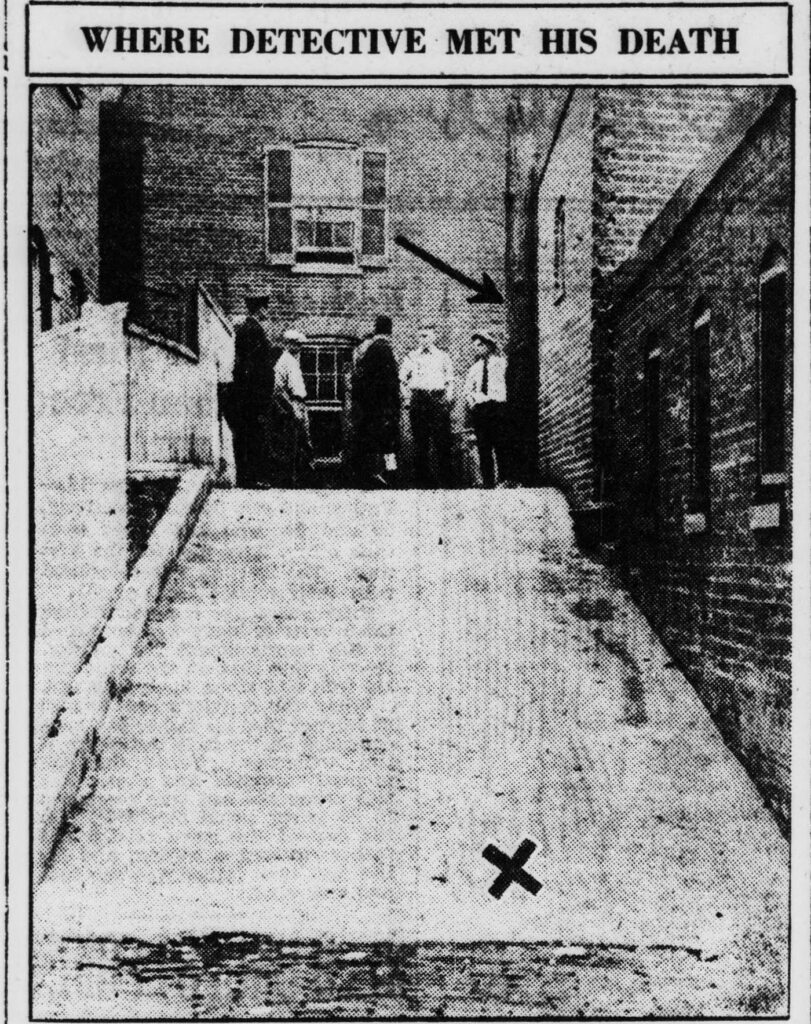
Scrivener kept his car in a garage tucked behind the houses on the south side of N Street, reached by a narrow alley directly across from the Walsh house. The alley ran beside 3128 N Street, then turned toward the garages.
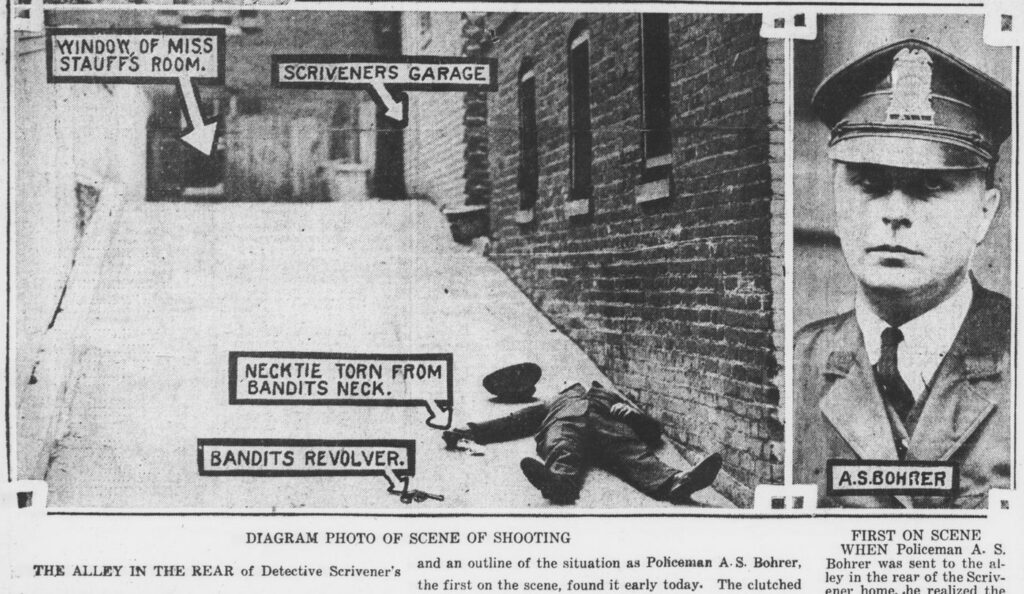
Mrs. Annie E. Stauff, 84, lived at the Home for Aged Women at 1255 Wisconsin Avenue. Her bedroom window faced the alley. She told the Daily News what she heard that night:
“I thought it was unusual at that time of the morning and I listened… Then it seemed they walked down the alley and immediately afterward I heard the muffled report of a pistol. I became frightened and closed my window.”
Catherine Doering, whose house at 3128 N Street sat right beside the alley, heard groans and woke her brother Robert, who called the Seventh Precinct. Policeman A. S. Bohrer found a man on his back near the mouth of the alley, arms outstretched. He didn’t recognize him.
Bohrer crossed the street to 3123 to wake Scrivener for help. Scrivener’s roommate, Edward R. Norris, came back with him and identified the body.
The Necktie and the Gun
A .38 revolver lay at his feet with one chamber fired. Its serial numbers had been filed off the barrel, the butt and the plate under the grips. Only three digits survived on the cylinder, and Bureau of Standards acid baths couldn’t bring back the rest, while Scrivener’s own revolver was still in its holster.
The tie was gray, still knotted in a four-in-hand, and torn at the back. The Star called it silk and wool; the Daily News called it cheap gray crepe with red dots. Its loop was small, sized for a 12 or 14 collar, and the Star asked whether it belonged to “a boy, a woman or thin-necked man.”
The rewards climbed to $2,800: $300 from the Police Department, $1,000 apiece from two newspapers and $500 from an anonymous businessman. Detectives questioned soldiers, held a man with a fake badge and chased a cab driver’s tip about a bloodied passenger. Every lead died.
A Rose From the President
Rev. Wilfley, who was supposed to marry the couple, led the funeral instead at the Walsh house on October 15th. Six detectives carried the casket out to a motor hearse while uniformed police came to attention.
He was buried October 17th at Mount Hebron Cemetery in Winchester. The Star counted 2,500 people. The Daily News reported a rose from President Calvin Coolidge in his coat lapel, and the Washington Post led with it: “Coolidge Honors Bier of Scrivener With Single Rose.”
Inspector William S. Shelby gave the Elks’ eulogy:
“With a characteristic smile and a cheery wave of his hand, Arthur Beverly Scrivener has walked from us through the shadows. He is not dead. He is just away.”
The Police Turn to Suicide
On October 24th, the Star raised the idea of suicide on its front page: 200 pounds of jerking weight had failed to tear a similar tie, and the loop looked too small for a grown man’s neck. Detectives first rejected it. By the next day, the Star reported, they were “inclined to consider suicide more and more tenable.”
On October 30th, police leaders went public.
The gun was a Harrington & Richardson .38, the same make Det. George Darnall had given Scrivener that summer, though Darnall couldn’t positively identify it. Cheap German cartridges like the ones in the gun turned up in his headquarters locker. And the death tie was of the same “family” as a blue tie with red dots that Scrivener had given his landlord, Matt Walsh.
Then came the personal details: the diamond ring he gave Parker had just been returned to him by his previous fiancée, nurse Catherine Markey. The wedding had been moved repeatedly, and an out-of-town prisoner trip he cited as the reason had never been ordered. The hotel reservation he described was never made.
Markey said that when she gave the ring back on October 11th, he was nervous and kept tossing the gear-shift knob from hand to hand. She testified to his parting words:
“Well, Catherine, I am not married yet, and God knows what will happen.”
The physical evidence pulled the other way.
On October 27th, under Coroner Nevitt’s supervision, test shots were fired into Scrivener’s own overcoat on the morgue dock. The burn that best matched the fatal one came from about 10 inches away.
More tests followed under an Army small-arms expert. The Washington Post’s November 2nd headline: “Scrivener Not Suicide, Experiments Indicate.”
Verdict One: Murder
Coroner J. Ramsay Nevitt held the inquest on November 16th and 17th in the board room of the District Building, because the morgue was considered unsafe. About 250 spectators packed in.
Mrs. Stauff, her voice so feeble the jurors stood in a circle around her, said two men had followed Scrivener down the alley. Deputy Coroner Joseph D. Rogers testified, “Scrivener must have dropped in his tracks. He couldn’t have taken two steps.” The police were not allowed to put their full suicide theory before the jury.
The jury went out at 1:07 p.m. on November 17th and came back 10 minutes later. Scrivener, it found, died from “a bullet fired from a pistol held in the hand or hands of persons other than himself, unknown to the jury.”
The police weren’t persuaded. The next day’s Washington Times headline: “Cops Stick to Suicide Theory.” Maj. Hesse told the Daily News, “As far as discovering a murderer goes, we are just where we were the morning the body was found.”
DC detectives of that era didn’t always handle big cases cleanly. See the Kalorama triple murder of 1919, whose coerced confession went all the way to the Supreme Court.
1929: The Scrivener Case Reopens
Fast-forward to October 14th, 1929. That morning, Scrivener’s parents in Winchester wired Virginia’s senators asking for a new investigation. Sen. J. Thomas Heflin of Alabama took the message to the Senate floor during an attack on the DC police over the McPherson case:
“…a bright, fine policeman Scrivener, was murdered in this city and this same bunch that covers up crime so rapidly, said he committed suicide.”
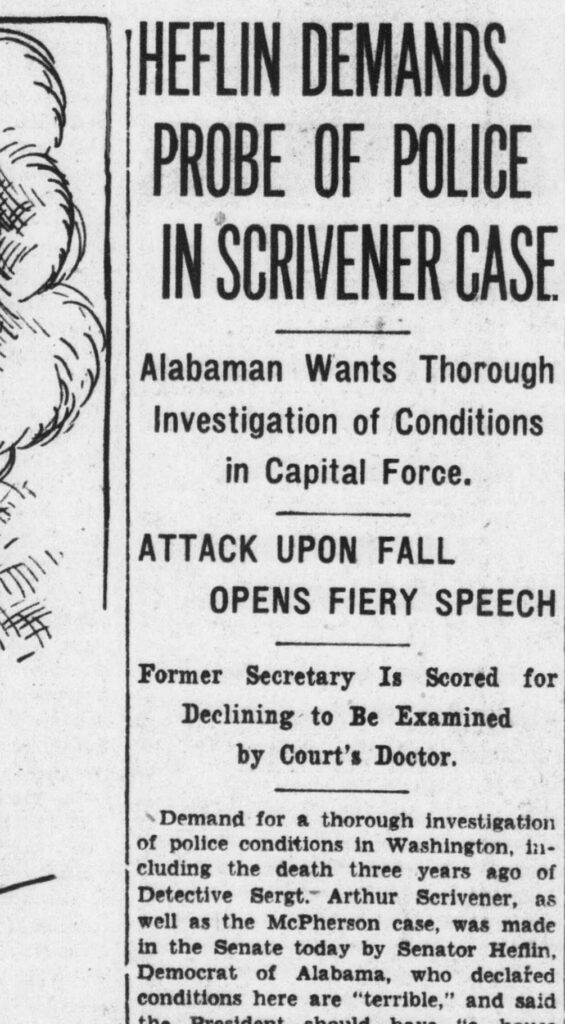
Sen. Cole L. Blease of South Carolina promised a Senate subcommittee would take it up: “I intend to show who murdered him.” The father also wired Virginia Gov. Harry F. Byrd.
Then the Washington Times broke a twist. Helen Barnes Parker, the fiancée, had married John F. Maragon, a former federal narcotics agent who had been Scrivener’s friend. In 1926, papers reported that Scrivener had pulled his endorsement of Maragon at a bank after a falling-out. Maragon denied any quarrel with “his best friend,” and wired from Miami that he’d been in Florida for weeks.
The 1930 census found John and Helen Maragon living in Berlin, Maryland, on the Eastern Shore.
Now Maragon talked. According to the Times, he said Scrivener had been investigating the “shady liquor transactions” of a high police official. In December he told the Star the subject was “the diversion of liquor from the police headquarters property room.”
He also accused Lt. Edward J. Kelly, Scrivener’s old partner, of coaching Parker before the inquest. Kelly testified before the grand jury for nearly two hours, longer than any other witness, and was never charged in the case.
This was Prohibition Washington, where the line between police and bootleggers could get blurry. We’ve written about one wild police battle with a rum car from the same era.
Verdict Two: Suicide
U.S. Attorney Leo A. Rover put the case before a District grand jury from December 2nd to December 18th, 1929. More than 60 witnesses testified. The Justice Department compared about 1,400 fingerprints with a partial print on the side of the gun and reportedly found no match.
One woman told Rover she suspected her own husband, who she said came home without a necktie the morning Scrivener died. He denied it. When it came to identifying the tie, she couldn’t, and the Post reported her story “exploded”: “Woman Fails to Point Out Scrivener Tie.”
Bureau of Standards tests put before the jury found that ties “invariably broke next to the knot.” Scrivener’s had broken at the back. On December 18th, foreman James N. Fitzpatrick Jr. handed Justice Peyton Gordon the report:
“After an extensive investigation, hearing and deliberation, the jury finds that Arthur Scrivener came to his death on the morning of October 13, 1926, from a bullet wound inflicted by himself.”
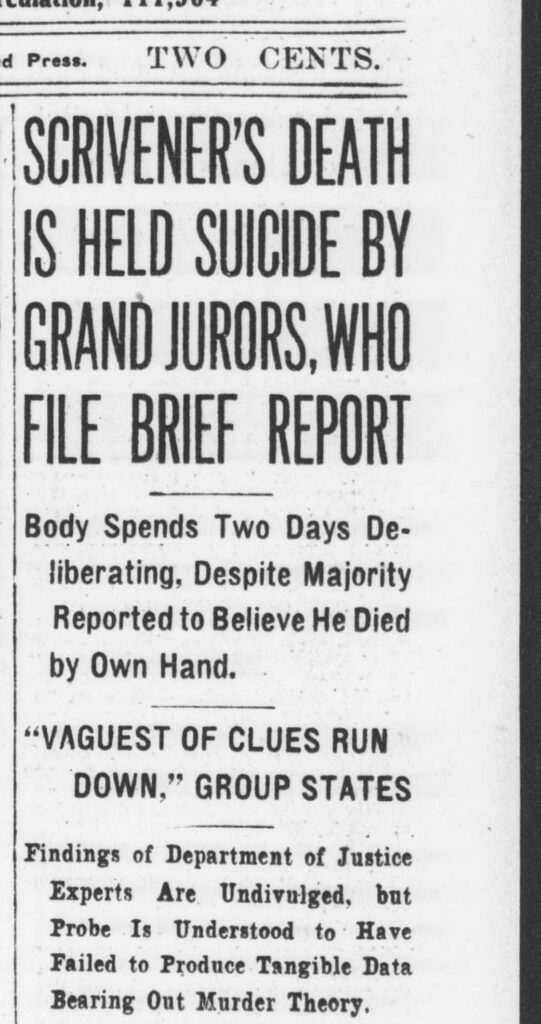
The Star reported the jury deliberated nearly two days, with several members insisting the evidence showed murder. The Star said the report indicated “insufficient evidence” for the liquor-theft charges. The next morning’s Post called it: “Scrivener Case Ends With Suicide Verdict.”
That’s where the official record stops. One jury heard a witness describe two men following him into the alley and said murder. Another heard about the tie, the gun and the shifting wedding plans and said suicide.
You can still find people who argue either side.
What Became of John Maragon
Maragon’s name came back into the headlines 20 years later. A onetime Kansas City bootblack, he had become, in the Star’s words, “an influential Washingtonian with White House connections,” and a central figure in the Senate’s 1949 “five percenter” investigation into influence peddling.
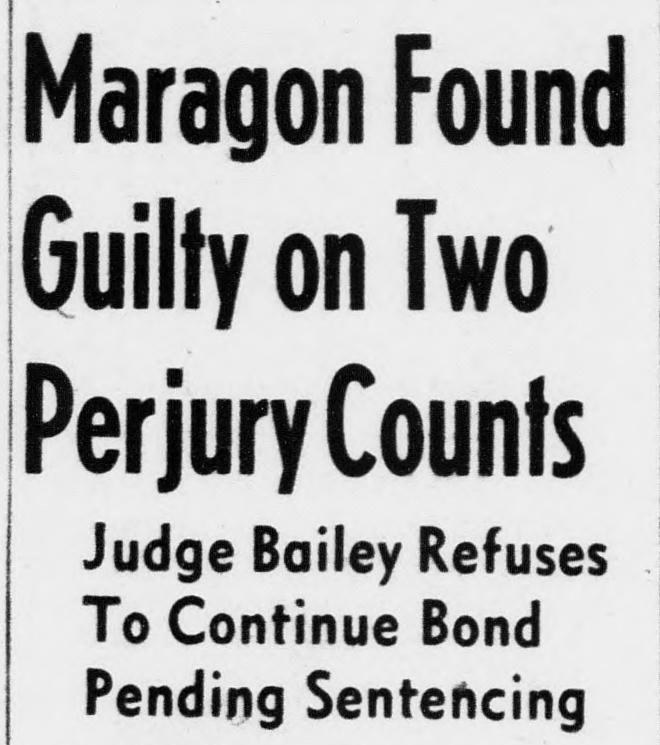
On April 26th, 1950, a District Court jury convicted him on two counts of lying to Senate investigators. He was sentenced to 8 months to 2 years, and in May 1951 the Supreme Court declined to hear his appeal.
Columnist Drew Pearson hadn’t forgotten 1926. Profiling Maragon in 1947, he wrote that Maragon “was questioned regarding the death but established an alibi.”
What’s There Today
Almost all of it. Georgetown’s house numbers have been stable since Gay Street became N Street in 1895 (here’s an 1874 map with the old street names). The 1919 Baist atlas shows the block nearly as Scrivener knew it.
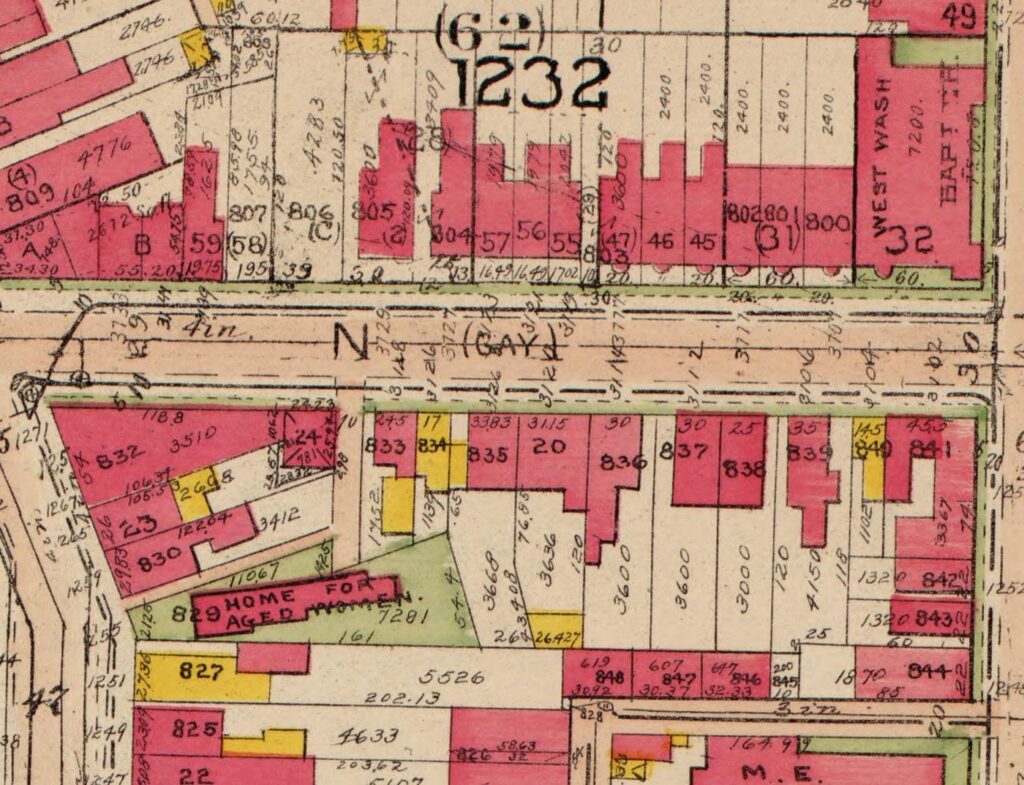
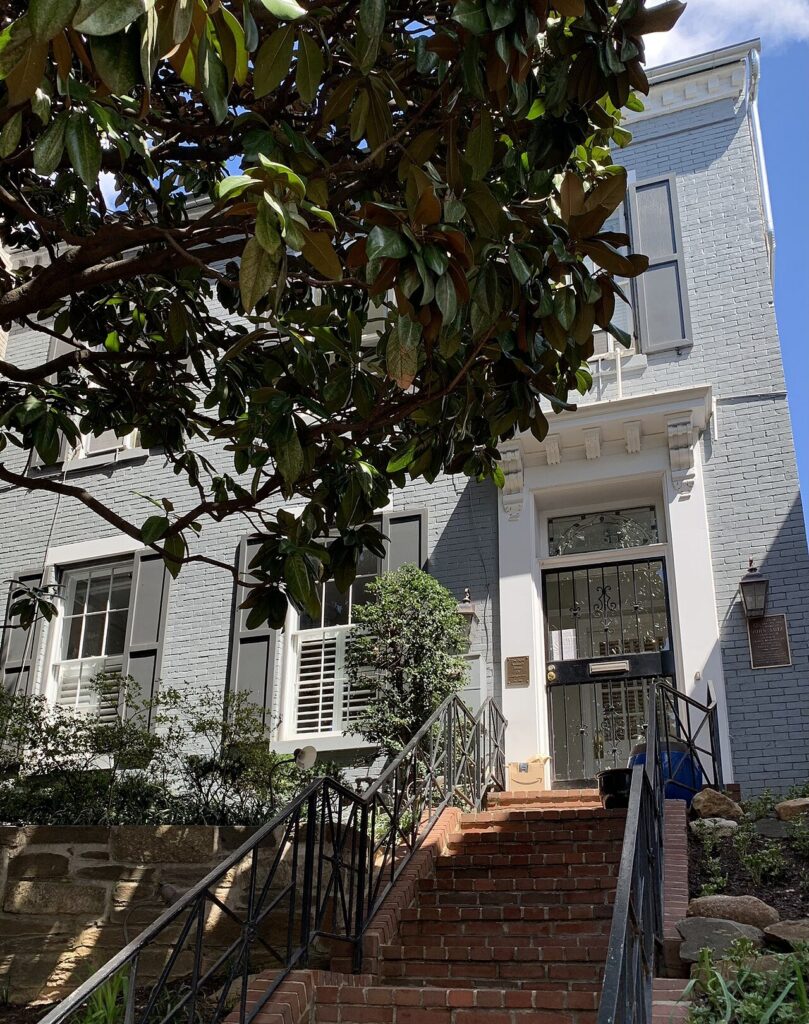
The Walsh house at 3123 N Street NW still stands. A 1928 quitclaim deed in the District’s land records puts it in the names of Matthew and Susie Walsh.
So does 3128 across the street. The opening beside it is still there too, now a private paved drive into a parking court. DC’s current alley maps don’t show a public alley there.
Mrs. Stauff’s home at 1255 Wisconsin Avenue, the John Lutz House, dates to about 1756. It has housed older women since 1867, when the Female Union Benevolent Society of Georgetown took it over, and today it’s the Aged Woman’s Home of Georgetown.
For more of Washington’s darker history, see five forgotten murders in Murder Bay.