
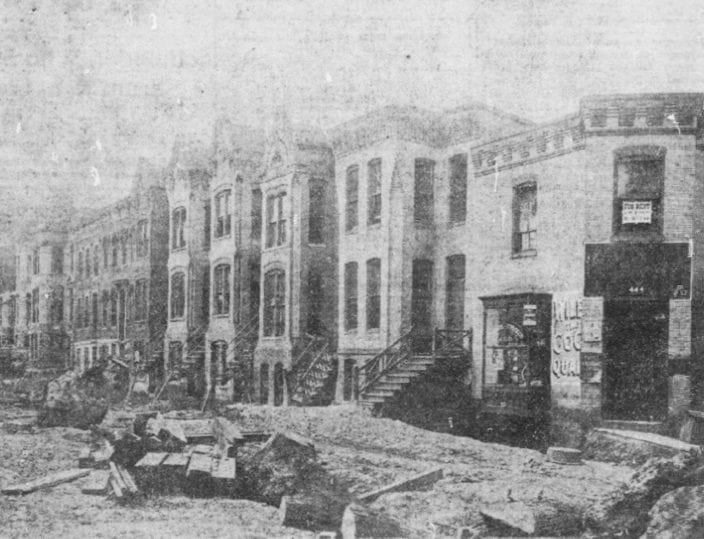
Every morning, thousands of people grab coffee inside Union Station without knowing they are standing in the middle of a neighborhood that the railroad wiped off the map.
It had a name. Swampoodle. And for about sixty years it was one of the roughest, most Irish, most talked-about corners of Washington, DC. It had rivals for that reputation, chief among them Murder Bay, the violent district just east of the White House.
Then the trains came. The city cleared block after block of houses, scattered the families who lived in them, and poured a marble palace over the top of the whole thing. Today almost nobody in DC has heard of the place. There is no sign. There is no marker on the concourse. The word does not appear on a single street blade.
We dug into the Library of Congress, the digitized run of the Evening Star, and the old real-estate atlases to put the whole story back together. Here it is.
Where was Swampoodle in Washington DC?
Swampoodle sat just north and east of the Capitol, on the low, wet ground around North Capitol and H and I Streets. The boundaries were always fuzzy, which is part of the charm. Locals knew where you were when you were in it, and that was enough.
When the Evening Star looked back on the neighborhood in July 1909, it drew the lines this way: the territory bounded by 2nd Street NW and 2nd Street NE, between F and K Streets. Earlier the patch had stretched a little farther, with fingers of Irish settlement following the creek northeast toward Florida Avenue.
The same ground had gone by another name before the Irish took it over. The Star noted that the high part near Judiciary Square was “for many years known as English Hill, though the large majority of the residents were of Irish birth or descent.” Swampoodle was the low part. English Hill was the dry part. The line between them was a creek.
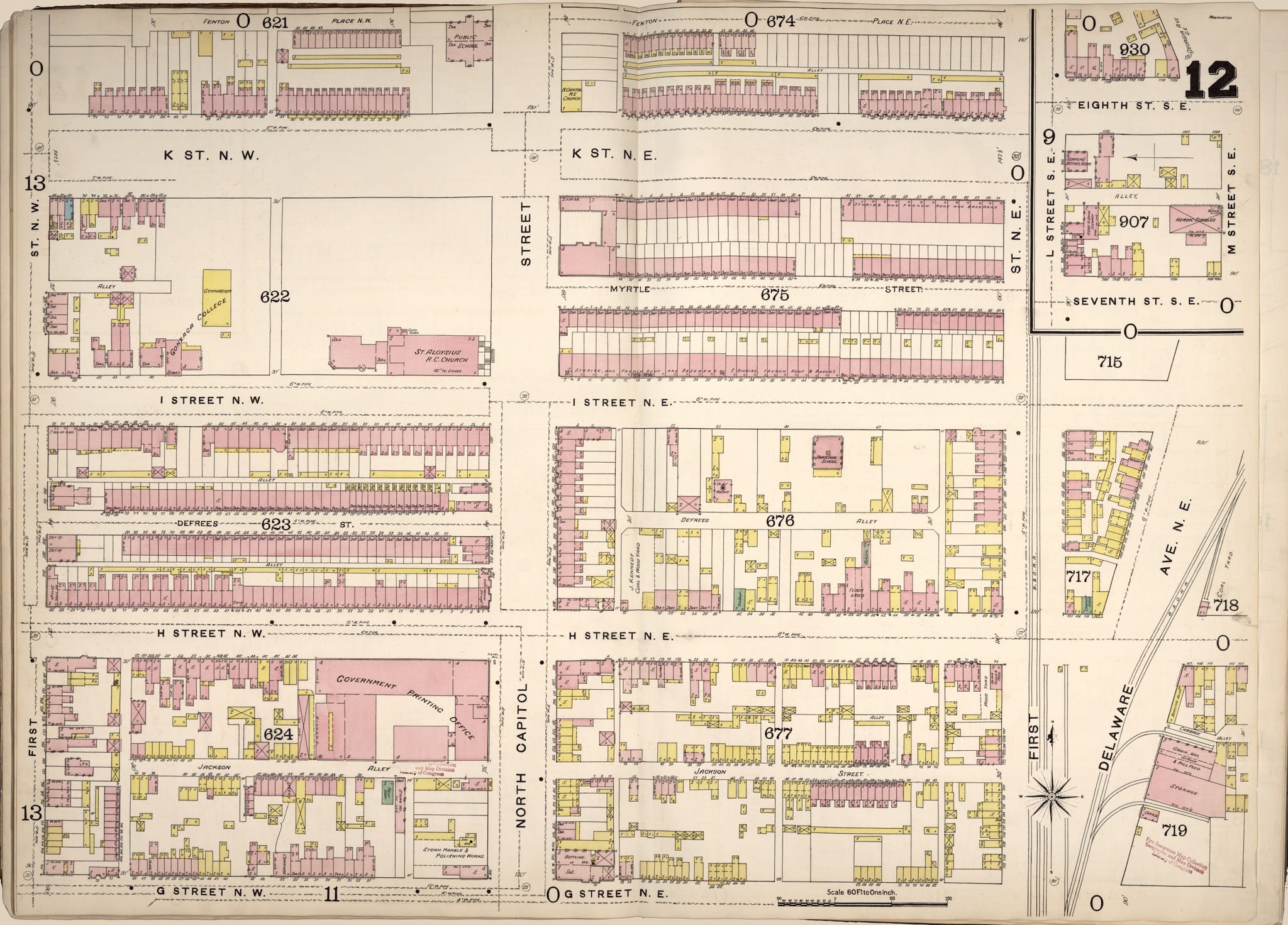
If you want to stand in Swampoodle today, go to NoMa. The Government Publishing Office, Gonzaga College High School, and St. Aloysius Church all sit on what used to be Swampoodle blocks. So does the Union Station parking garage.
The origin of the Swampoodle name
Here is the part every other website gets fuzzy on, so let’s be careful.
The story you will read everywhere is that a newspaper reporter coined “Swampoodle” while covering a moment at St. Aloysius Church, looking out at the swamp and standing water of Tiber Creek and calling the place a mess of puddles. The name stuck. There is real period evidence for it. The trouble is the date.
The markers and the websites pin the coining to the church’s groundbreaking in 1857. The Washington Post’s own history of the neighborhood tells it differently.
On January 1, 1922, the Post ran a full-page Sunday retrospective by Denis A. Lane, “Story of the Passing of Historic Swampoodle,” looking back on the Irish quarter the railroad had just wiped out.
That account traces the name to an old-time reporter who, writing up the dedication of St. Aloysius in 1859, described the ground around the new church as so much swamp and puddle. The dedication, not the groundbreaking. 1859, not 1857.
Two years apart, same swamp, same reporter’s eye, and even the Post could not keep its own founding legend straight. We never turned up the original 1850s clipping, in the Post or anywhere else, so the reporter’s name and the exact day stay fuzzy. The swamp and the puddles do not.
Washingtonians were still explaining the name the same way years later. The Evening Star, in an April 1906 feature on the growth of the city, put it plainly:
Interspersed over the landscape, too, were marshes and bogs, and on the site of the government printing office and the new union railroad station a great waste of swamp land, which gave to that locality in later years the cognomen of “Swampoodle.”
Swamp plus puddle. A waste of swamp land. The geography wrote the name.
By the early 1880s the word was so familiar that papers used it for a punchline. One 1881 squib in the National Republican joked that the gaslight in Swampoodle was so bad that people walked straight into the lamp posts without seeing them. Dark, low, wet, and Irish. That was the reputation, and the neighborhood earned it.
Tiber Creek and the swamp that named a neighborhood
Tiber Creek is the silent character in every Swampoodle story.
It was a real stream, sometimes called Goose Creek, draining the ridge up around Florida Avenue down through the low ground between today’s North Capitol and First Streets and out toward the Potomac. It flooded. It pooled. It turned the streets to mud every time it rained.
In the 1870s, under the public-works blitz of Alexander “Boss” Shepherd, the District solved the creek the way Washington solved most things. It buried it. The stream went into a brick sewer running down the line of North Capitol Street, roughly twenty feet across in places. The water that had named the neighborhood disappeared underground, where it still runs today, under the train tracks.
The famine Irish who built Washington
The people who filled Swampoodle were refugees.
And there were a lot of them. When the Washington Post looked back on the place in 1922, it figured the old neighborhood had been Irish almost to the last family.
They came out of the Great Famine of 1845 to 1852, the potato blight that killed roughly a million people in Ireland and pushed a million more across the Atlantic. Many landed first in New York, Boston, or Baltimore, then drifted down to Washington in the late 1840s and 1850s for the one thing the capital always had: construction work.
There was plenty of it. The Capitol dome. The Post Office. The buildings going up along the Mall.
And right at the edge of Swampoodle, in 1856, a printer named Cornelius Wendell put up a large printing plant on H Street between North Capitol and First. Congress bought the place and turned it into the Government Printing Office in 1861.
Suddenly the neighborhood had a giant federal employer within walking distance, and Irish Swampoodle had steady paychecks setting type and hauling paper for the United States government.
They built churches and schools too. In 1857 the Jesuits broke ground on St. Aloysius Church, and on October 16, 1859 they dedicated it with President James Buchanan in the pews.
The architect was an unlikely one: Father Benedict Sestini, a Jesuit mathematician and astronomer from Georgetown, who designed a restrained Renaissance Revival church at a moment when everyone else was building Gothic. Above the main altar he hung a painting by Constantino Brumidi, the same artist who painted the great fresco inside the dome of the US Capitol.
The pulpit had a star too. Father Bernard Maguire, twice president of Georgetown and one of the most famous Catholic orators in the country, served as pastor of St. Aloysius and preached there regularly until he retired in 1875. People came across the city to hear him.
Gonzaga College High School, founded in 1821, moved onto the same square in 1871. Between the church, the school, and the printing office, the famine Irish of Swampoodle had a backbone.
A place to fear: crime in old Swampoodle
The rest of Washington did not come to Swampoodle to hear sermons. It mostly stayed out.
The 1909 Evening Star retrospective, written when the neighborhood was already dying, did not sugarcoat it. The “Poodle,” it said, “was a place of mystery, a place to fear, a place to avoid.” Police went in “squads of six and eight to seek one man.” The dog catcher would not enter without a police escort.
The reputation was national, and the Washington Post fed it for decades with police-blotter items that read like dispatches from a war zone. Take the morning of October 20, 1879, when a Swampoodle tough named Morris Connors tangled with the law:
Morris Connors, a notorious Swampoodle thief and rough, tumbled out of a restaurant on G near North Capitol street at 9 o’clock yesterday morning in an outrageous condition from the effects of liquor. Officer G. W. Cooper attempted to arrest him, but was violently assaulted by his two sisters, Johanna and Julia, who pelted and pounded him with stones.
It took a lieutenant and three more officers to haul in Connors and his stone-throwing sisters. We told Morris Connors’s whole colorful story, including his stint on a local amateur ball club called the “Drop Deads,” in an earlier post.
Or take the night three locals went looking for a fight, as the Post reported on January 21, 1895:
Two plumbers and a plasterer went outside of “Swampoodle” Saturday night to find trouble. They found quite a large quantity of it about 3 o’clock Sunday morning, and incidentally learned that among the policemen of the First precinct are a number of expert sprinters.
The whole chase, complete with Officer Sprinkle collaring a plumber at Ninth and G, is worth reading in full.
The saloons had names, and the Post knew them. A September 1895 item set a brawl at a bar called Grab All’s, planted in the heart of Swampoodle, where a man swung so hard he dislocated his own shoulder.
For all that, the neighborhood’s own people pushed back on the bloodthirsty legend. Major Richard Sylvester, the city’s superintendent of police, told the Star that the worst of it was exaggerated:
This district was not the resort of thieves nor was there any criminal element there. There was a great deal of fighting among the different factions.
Factions is the honest word. Swampoodle’s brawling ran along ethnic and racial lines, and the neighborhood could be ugly and violent toward Black Washingtonians and, later, toward Italian newcomers. It was a poor, crowded, hard place, the kind Washington produced more than one of.
If you want the company it kept, we have written about Murder Bay, the vice district that once festered where the Federal Triangle stands, and Hell’s Bottom, the notorious quarter up around 12th and Q.
Swampoodle Grounds and a rookie named Connie Mack
Swampoodle also had a ball field, and it gave baseball one of its giants.
On the southern edge of the neighborhood, on the block bounded roughly by North Capitol, Delaware Avenue, F, and G Streets NE, sat a ballpark officially named Capitol Park. Nobody called it that. Everybody called it the Swampoodle Grounds. From 1886 to 1889 it was home to the Washington Nationals of the National League.
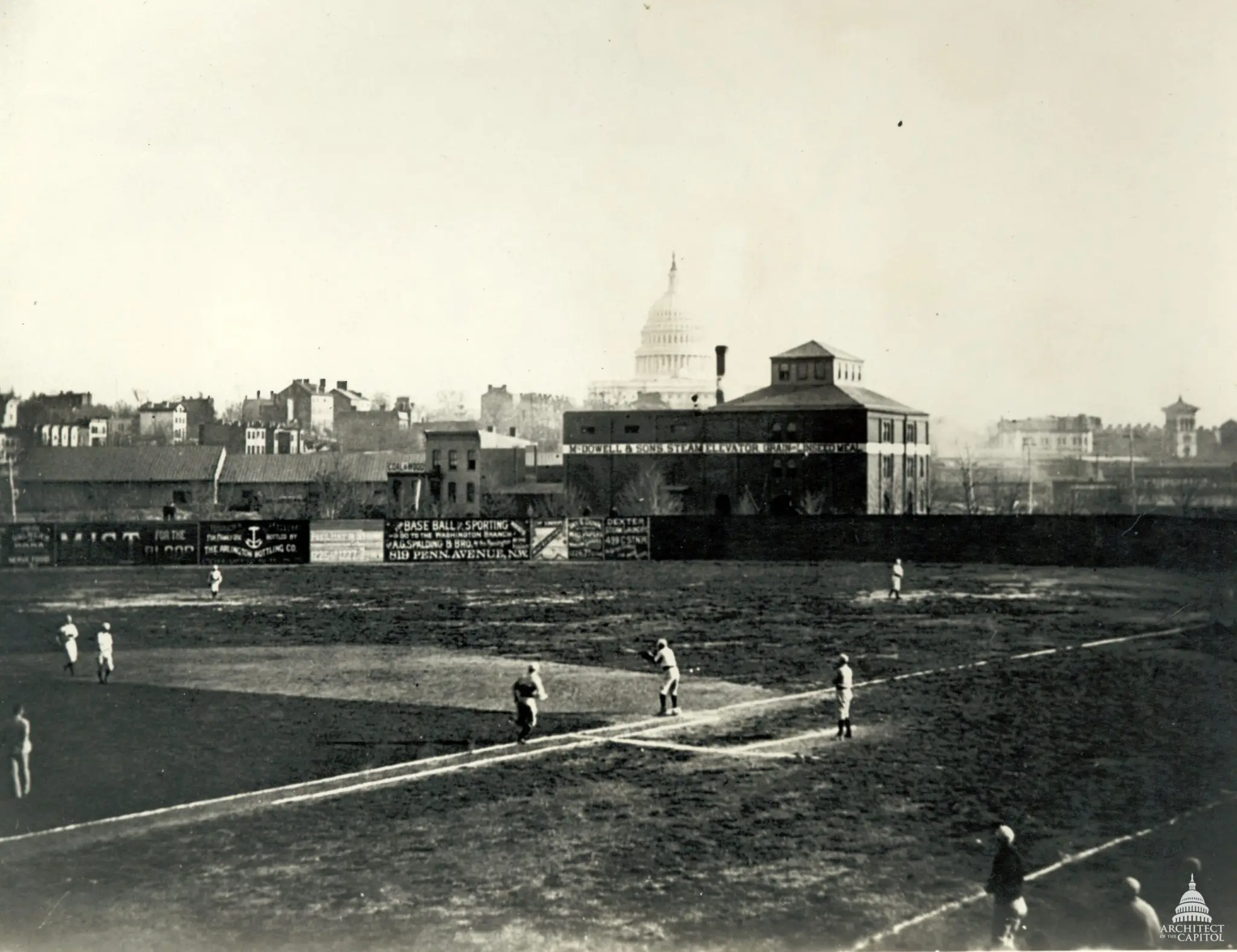
On September 11, 1886, a skinny 23-year-old catcher made his major-league debut there, and the Nationals beat Philadelphia 4 to 3. His name was Connie Mack. He would go on to manage the Philadelphia Athletics for half a century and become one of the most important figures in the history of the sport. He started here, on a swampy lot in Irish Washington.
There is a whole separate story in the Swampoodle Grounds, the puddles in the outfield, and the ballclub itself, and we will give it the standalone post it deserves. For now, just know that the ground under part of Union Station once heard a crowd roar for the home team.
The Italians arrive
By the 1890s a second wave was washing into Swampoodle, and it was not Irish.
Italian immigrants began settling among the Irish, some of them housed at first in temporary work camps near the rail lines. The Irish, who had spent forty years making the neighborhood theirs, did not love the company, and the two groups clashed. Their old neighborhood, the Irish felt, was being taken from them.
The Italians stayed, and put down roots that outlasted Swampoodle itself. Their parish, Holy Rosary, was founded in 1913 and built its church at Third and F Streets NW, where it still serves as the heart of Italian Catholic Washington. The corner that the Irish had wrested from the swamp became, for a while, the closest thing the city had to a Little Italy.
Swampoodle, Union Station, and the erasure of a neighborhood
The thing that killed Swampoodle was a map.
In 1901 and 1902 the Senate Park Commission, the famous McMillan group, sat down to rewrite the plan for monumental Washington. Daniel Burnham, Frederick Law Olmsted Jr., Charles McKim, and the sculptor Augustus Saint-Gaudens decided that the two ugly railroad stations cluttering the Mall had to be consolidated and moved. The new one would go north of the Capitol, on the site of Swampoodle.
The Union Station Act of 1903 made it official. Burnham got the design commission.
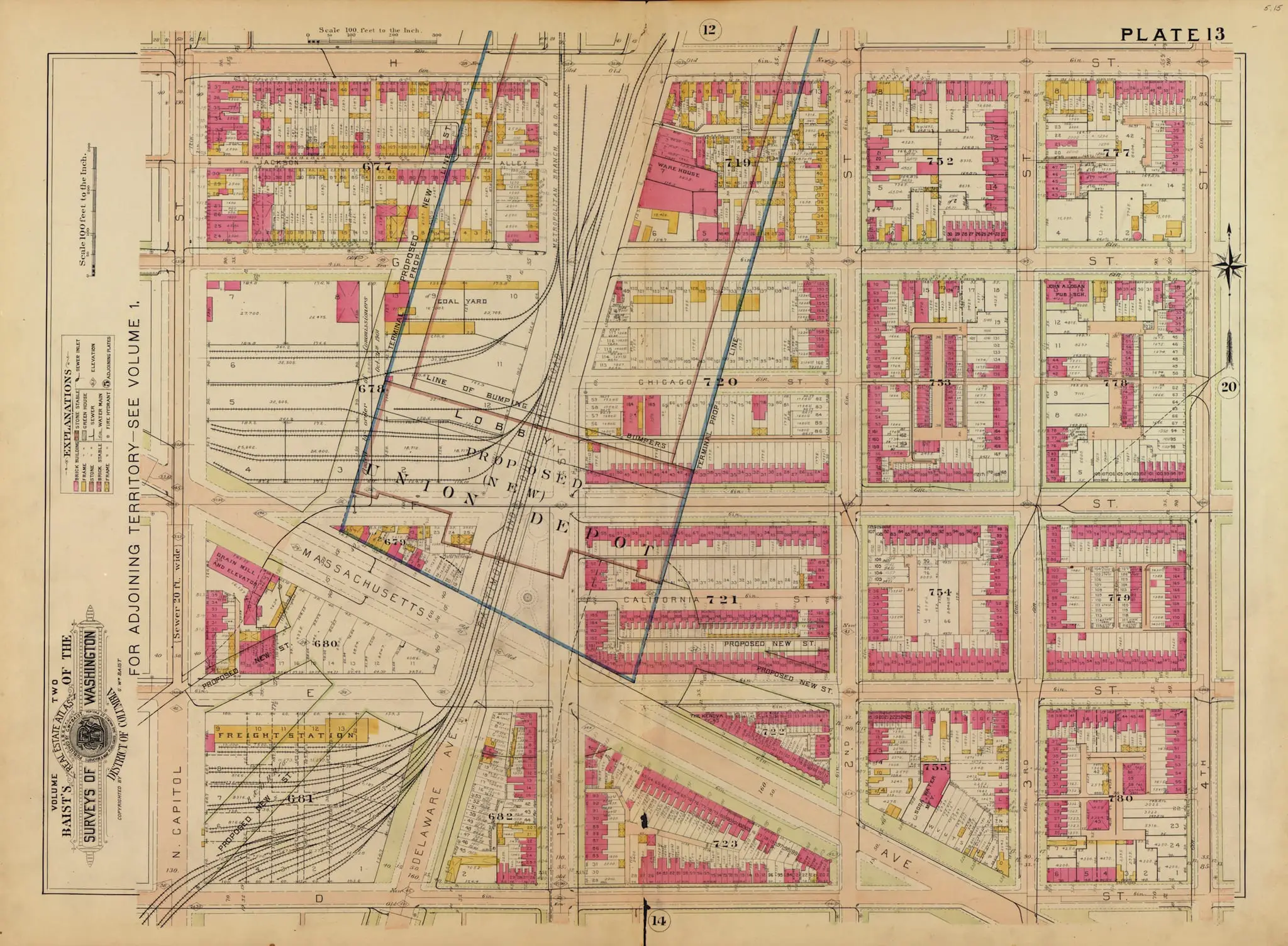
And that same year the G. W. Baist real-estate atlas of Washington came out with one of the most chilling images in DC’s cartographic history. Plate 13 shows the existing Swampoodle street grid in pink and yellow, with the footprint of the not-yet-built station drawn over it in blue ink, labeled “PROPOSED UNION DEPOT.”
Every block and every house under that blue ink was condemned. We have shared that 1903 map and the 1888 Sanborn map of the neighborhood before.
The Washington Post watched it go. In November 1903 the paper ran a piece headlined “Bad Joint and Bad Liquors,” reporting that the original stamping grounds of the Swampoodle Rangers, the local street gang, were disappearing. The old saloons and rough corners were coming down to make room for the new Union Station, its grounds, and its tracks.
The name outlived the place. In 1958 the Evening Star hung it on a man born after Swampoodle was gone: Dallas Williams, the Bad Man of Swampoodle.
Construction began in 1907. Block after block came down. Delaware Avenue, the main north-south street of Swampoodle, was buried under the rail yards and never came back.
The Irish laborers who had built so much of official Washington now watched their own homes razed for a railroad station. Some of them helped build the thing that displaced them.
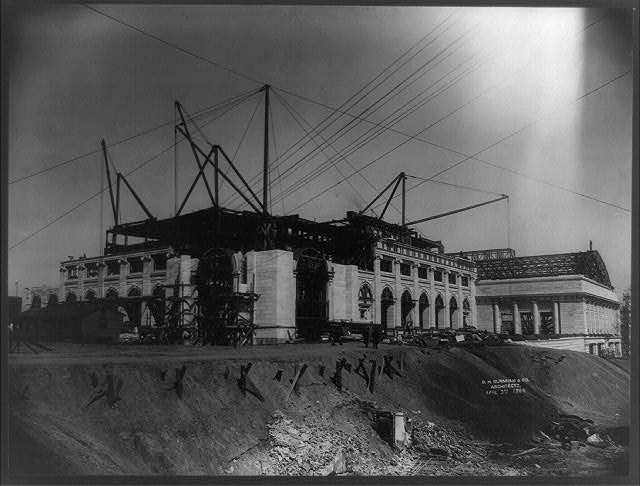
The station opened to trains in 1907, and Burnham’s white marble and granite headhouse, the largest of its kind in the world at the time, rose where the rowhouses had stood. The Columbus Fountain went in out front in 1912. Tiber Creek’s old sewer stayed exactly where it was, and the tracks ran over the top of it.
St. Aloysius Church and what’s left of Swampoodle
Here is the good news.
The famine Irish scattered, but they did not vanish, and neither did everything they built.
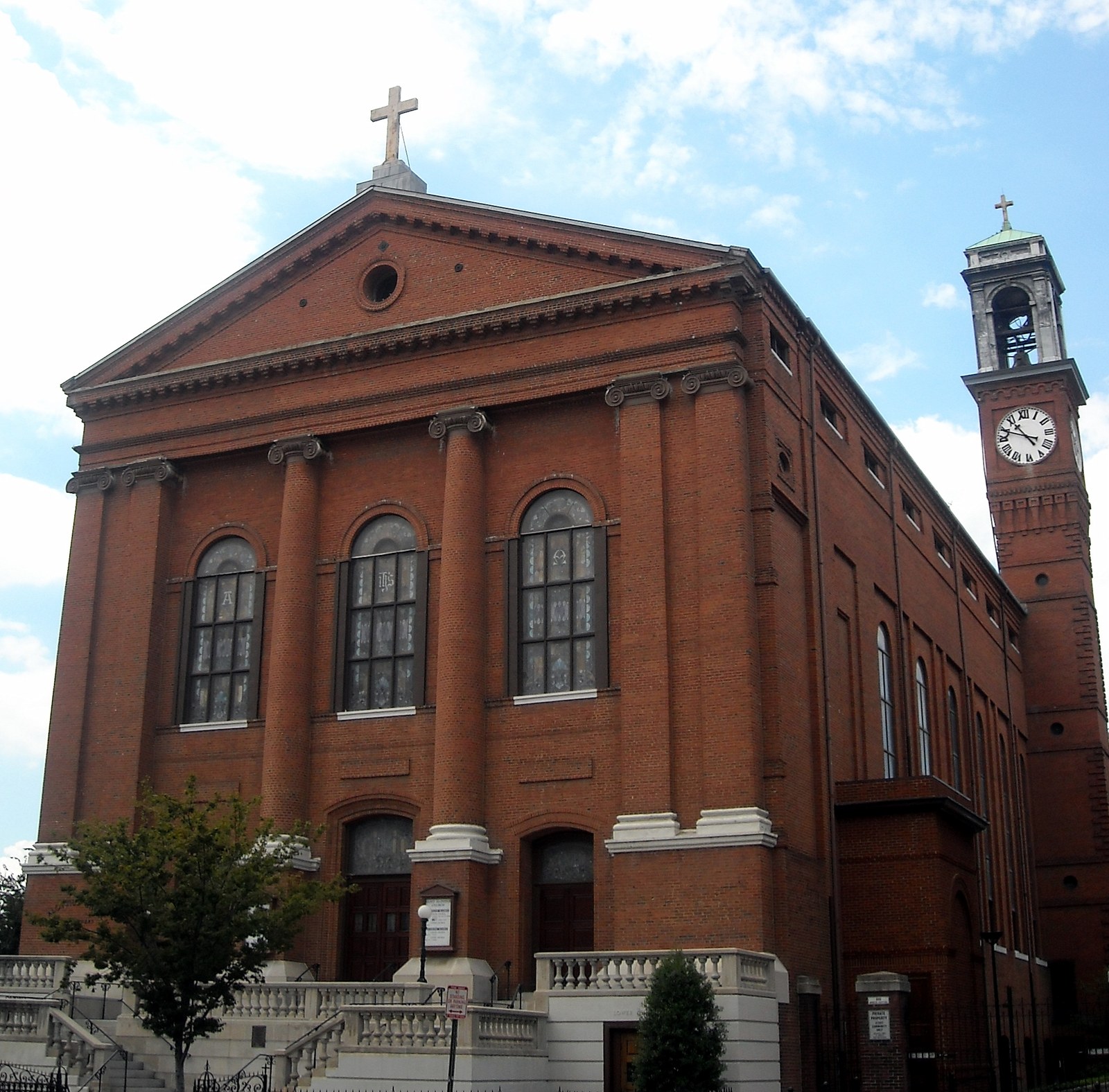
St. Aloysius Church still stands at 19 I Street NW, right where the Jesuits put it in 1859. The Brumidi painting is still over the altar. Gonzaga still teaches high school boys on the same square it moved to in 1871. You can walk to all of it from the Union Station Metro in five minutes.
The neighborhood around it got rebranded. Since about 2007, the surviving blocks north of Massachusetts Avenue have been marketed as NoMa, a developer’s contraction with no swamp and no puddle in it. The new name has no idea what it is sitting on.
But the church knows. Stand on I Street, look up at that odd Renaissance front, and you are looking at the last tall thing the people of Swampoodle left standing. Everything else is under the trains.
We dug this one up with help from AI and checked it against the original records below. Here’s how we use AI.