
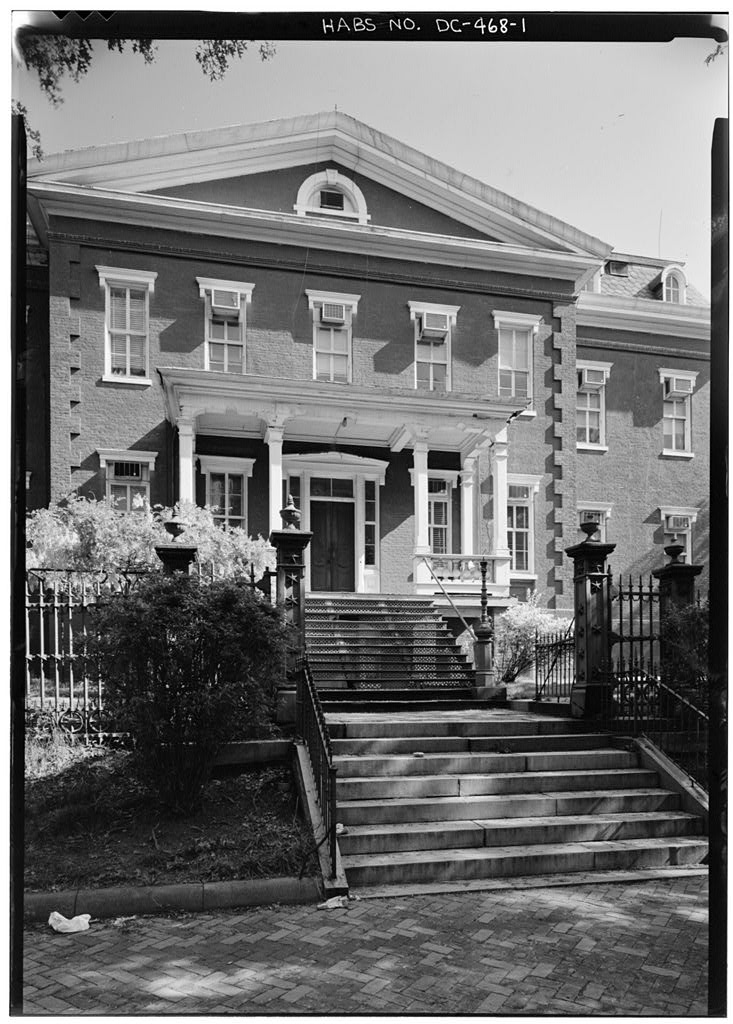
Abraham Lincoln signed off on a naval hospital for Washington in March 1864. By the time it opened its doors, on October 1, 1866, the war it was built to serve had been over for a year and a half.
That is the whole story of the Old Naval Hospital in one sentence. It arrived late, it was declared obsolete almost immediately, it spent most of the next century looking for something to do, and it somehow outlived every grander plan that was supposed to replace or pave over it.
Today it sits at 921 Pennsylvania Avenue SE, freshly restored, wrapped in its original iron fence, and busier than it ever was as a hospital. We know it now as the Hill Center. Here is how it got there.
A hospital for a war that was already over
The Navy did not have a real hospital in Washington when the Civil War started. It had improvised one, leasing wards at the Government Hospital for the Insane, the institution we now call St. Elizabeths, to handle the overflow.
It needed the room. Over the course of the war the Navy ballooned from a peacetime force of roughly 8,500 men to more than 51,000.
So on March 14, 1864, Lincoln signed an act of Congress that set aside money “for erecting naval hospital at Washington City.” The first appropriation was a modest $25,000.
The site made sense. The land sat a few blocks from the Navy Yard and the Marine Barracks, and the federal government already owned half of it. Two of the four lots had come to the government back in 1821, transferred from the estate of Louis DeBlois, a Navy purser who, the records gently note, died with his books out of balance.
That $25,000 did not last. By the time the building was finished the bill had reached $115,000, land included, which is the kind of overrun that feels timeless.
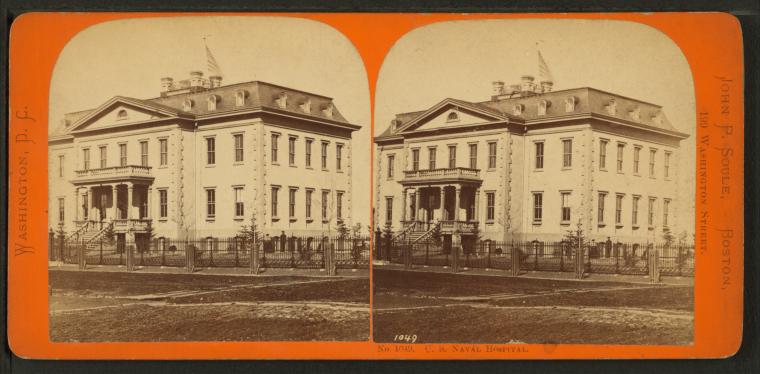
Construction wrapped in July 1866. The first patients, one sailor and six Marines, were admitted that October, eighteen months after Lee surrendered at Appomattox. A building meant for the wounded of a great war opened to find the war already filed away in the past tense.
The first patient
The first man through the door has a name and a remarkable history, which is more than most opening-day patients can claim.
Benjamin Drummond was 24 years old, listed on his admitting ticket as “Ordinary Seaman, Colored.” His wound was nearly four years old by the time he arrived.
In January 1863 Drummond was serving aboard the USS Morning Light, a sailing ship on blockade duty off Sabine Pass, on the Texas coast. On the 21st, two Confederate “cotton-clad” steamers came out and opened fire. Sharpshooters cleared the deck, the Morning Light struck her colors, and Drummond took a bullet in the leg. The Confederates burned the ship two days later.
He was taken prisoner, escaped after seven months, and reenlisted. His next posting was the USS Squando, a monitor patrolling Charleston Harbor, where the war had begun.
Then the old leg wound reopened. He was set ashore, parked briefly at that same temporary hospital inside the insane asylum, and then admitted to the brand-new Naval Hospital the day it opened. He was discharged in March 1868 with a fifty percent disability rating. The pension, four dollars a month, came later, in 1872.
The first patient to die there did not last the week. Marine Private Charles Straib, 20 years old and a native of Germany, died on October 5, 1866, of typhoid fever. Five days into the hospital’s life, it had recorded its first loss.
Nobody knows who designed it
Here is a small mystery for an officially documented federal building: no one knows who drew it.
The original plans have never been found. The name of the architect is lost, and so is the name of the contractor who built it. What survives are the monthly progress reports filed during construction by Ammi B. Young.
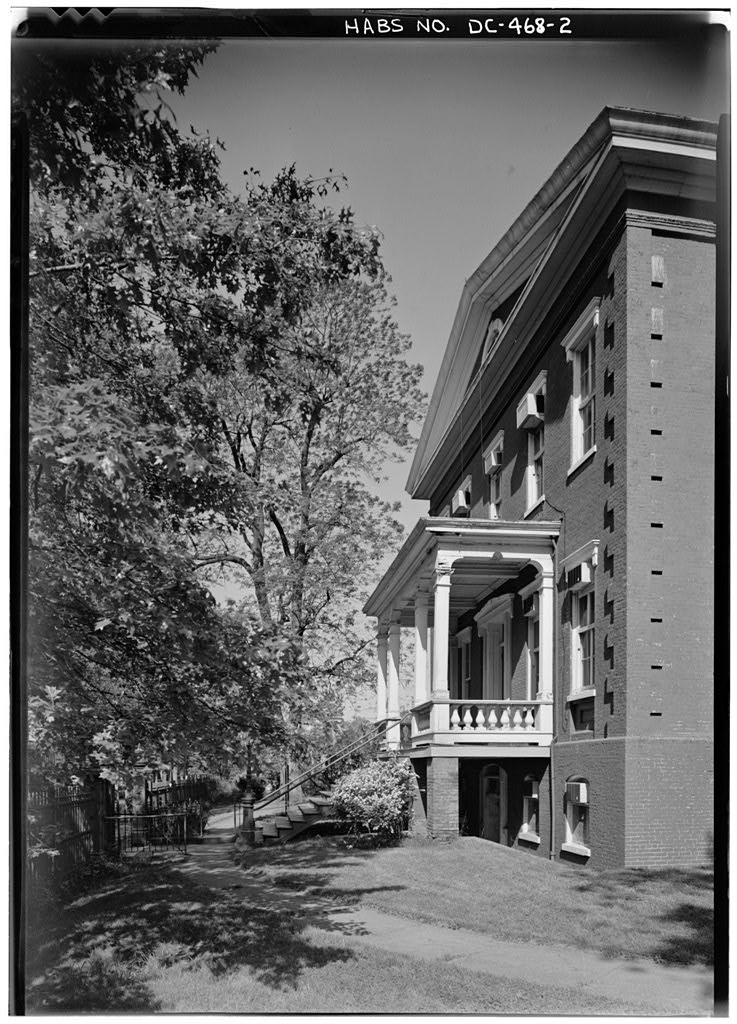
Young is a name worth pausing on. He had been the first Supervising Architect of the Treasury, from 1852 until 1862, the man responsible for a wave of fireproof Italianate custom houses and post offices built across the country with masonry walls and cast-iron guts. The Old Naval Hospital is squarely in that family: Italianate, brick, restrained, with a central pavilion and a low porch. Young was off the Treasury payroll by the time it went up, but his fingerprints are all over the style.
What we can date precisely is the fence. The wrought iron surrounding the grounds was cast at the local foundry of F. & A. Schneider, whose name is still stamped on some of the parts, and it appears in the earliest known photograph of the building, taken around 1870.
Old before its time
The hospital had barely opened before Washington started trying to get rid of it.
In 1876, ten years in, Congress directed the Secretary of the Navy to figure out “the best method of making sale” of the naval hospitals at Annapolis and Washington, and to close them within the year. That did not happen, but the sentiment lingered.
By 1903 the Navy had stopped being polite about it. A report by the Secretary of the Navy described the place in terms no facilities manager wants to read:
Antiquated and insufficient, and conforms in no respect to the conditions of modern hospital requirements.
Congress put up $125,000 for a replacement.
That replacement rose on high ground over near the State Department, and everyone started calling it the New Naval Hospital. Which left this one, by simple subtraction, as the Old Naval Hospital. The name stuck for good.
The new hospital opened in 1906, and the patients followed. (The New Naval Hospital had its own short career, replaced in turn by Bethesda in 1942.)
The old building did not sit empty for long. From 1907 to 1911 it housed the Hospital Corps Training School, where sailors learned nursing, hygiene, and anatomy. Then that moved out too. The grounds, it turned out, were too small for the students to run their drills.
The 1927 map and the avenue that never came
This whole post exists because a loyal GoDCer named Michael sent me a wonderful old map, and I am glad he did.
It is a Navy facilities map titled “Map of Naval Hospital Washington, D.C. Showing Conditions on June 30, 1927.” Printed, then hand-colored and annotated. And sketched right across the property, in someone’s careful hand, is a “Proposed Extension of New York Avenue,” along with a “Future Building Line.”
Neither happened. The avenue was never run through the grounds, and the future building line stayed in the future.
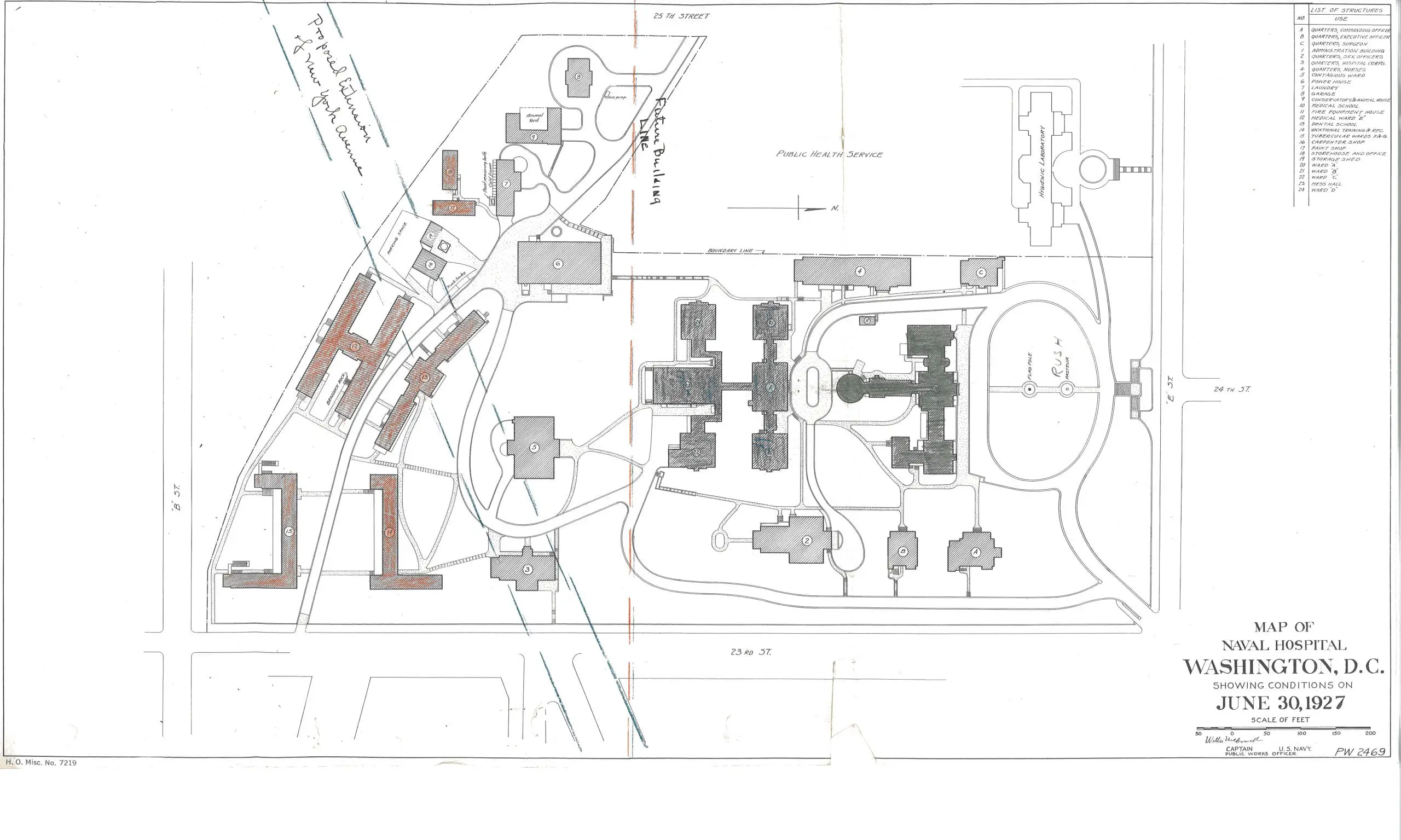
If you have spent any time around Washington’s history, that “proposed and never built” stamp will look familiar. The city is paved, so to speak, with avenues, freeways, and grand civic schemes that lived only on paper. We have written before about the 1967 map of DC highways that were never built, and this little 1927 sketch belongs to the same tradition. Washington plans relentlessly. It builds selectively.
From veterans’ home to police-dog school
For its longest single chapter, the Old Naval Hospital was not a hospital at all.
In 1922 it was leased, for one dollar a year, to the Temporary Home for Union Ex-Soldiers, Sailors and Marines. Run by the Grand Army of the Republic, the Civil War veterans’ organization, it was essentially a hostel for old soldiers who had come to Washington to press their pension claims. A veteran in good behavior could stay up to ten days, provided he pitched in on the cleaning.
The men aged, the wars receded, and the building wore on. It also kept hosting near-misses with bigger plans.
The Navy declared the property surplus around 1960. In 1963 it passed to the District of Columbia, the Temporary Home was evicted, and the building entered its strangest stretch of all. For a while the District used the grounds to train police dogs. After that, city anti-poverty programs moved in, and at one point it served as the headquarters for the campaign that won the Martin Luther King, Jr. national holiday.
Right next door, by the way, once stood Tunnicliff’s Tavern, whose tower you can spot beside the hospital in old photographs before it was torn down in the 1930s. The hospital outlasted that too.
By the late 1990s the building was effectively abandoned. A publicly owned landmark, blocks from the Capitol, slowly going to rot.
Rescue and rebirth
In 2000 a small group of neighbors decided they had watched the decay long enough and formed the Friends of the Old Naval Hospital. Their goals were simple: get it restored, get it a sensible long-term tenant, and dig up its history.
There was nearly another detour. Around the same time, Mayor Anthony Williams convened a commission to find Washington an official mayor’s residence, and the Old Naval Hospital was one of the buildings considered. That plan went elsewhere and then fell apart entirely by 2003. Another grand idea for the building, filed next to the 1927 avenue.
In 2002 a broader coalition organized the Old Naval Hospital Foundation and built a plan to reuse the place as a center for learning and community life. The city accepted it in 2007.
The restoration took a little over eighteen months and about ten million dollars. It brought the building back to its original appearance and colors, restored the Schneider fence, and quietly slipped in some twenty-first-century guts, including a full ADA retrofit and a heating and cooling system fed by 32 geothermal wells.
On November 19, 2011, the Old Naval Hospital reopened as Hill Center.
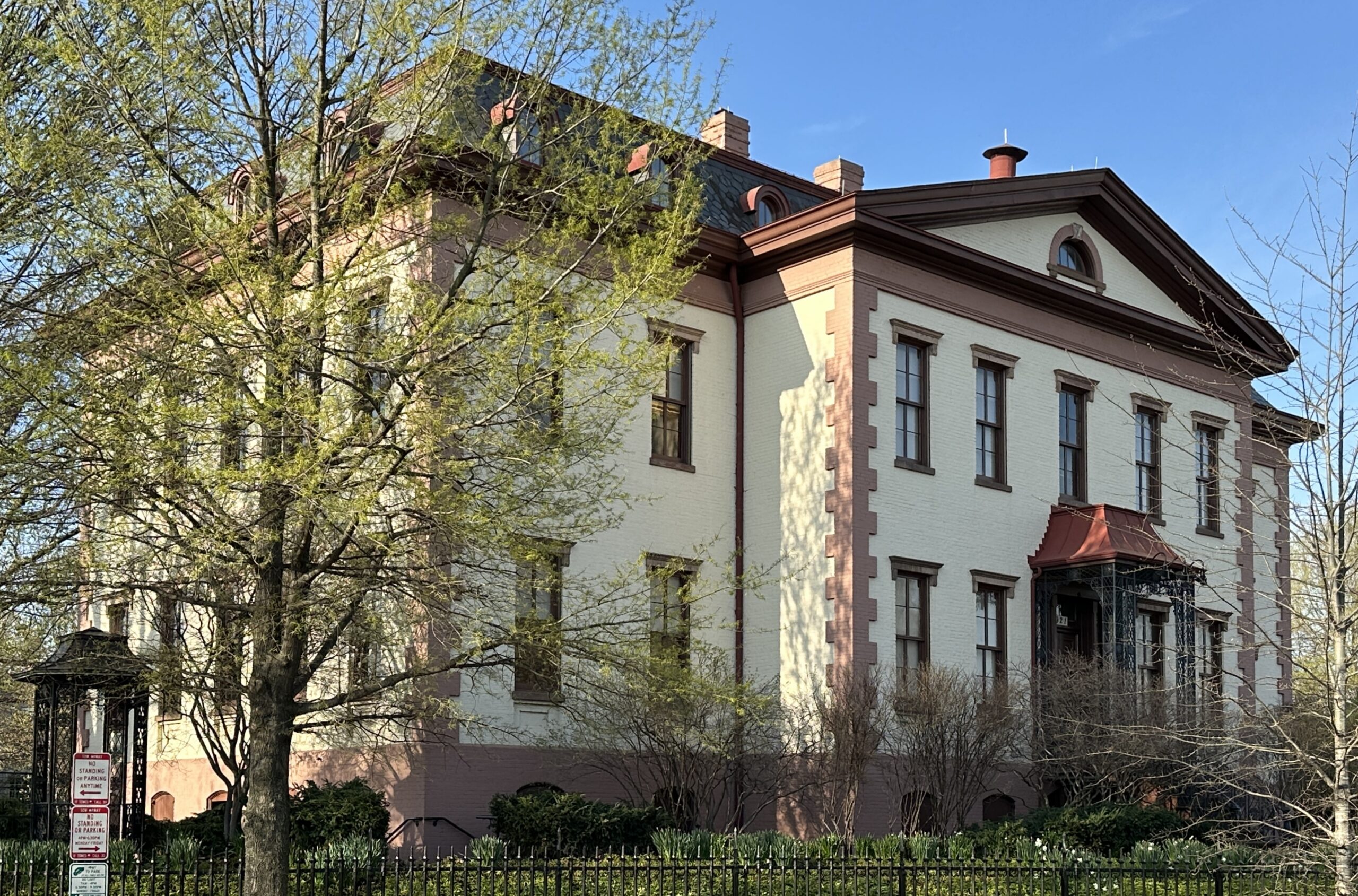
A century and a half after Lincoln signed for it, the building Washington kept trying to sell, replace, or build over is finally, reliably full. The war it was meant for never showed up. The crowds eventually did.
This is now the home of the Bureau of Medicine and Surgery (the Navy Surgeon General’s Office, essentially). And looking at Google Earth, the layout of the buildings has not changed much since 1927.
The map is disorienting because north is to the right and 23rd Street is at the bottom, instead of on the left. Presumably all the buildingson the left were World War I “tempos,” because no trace of them remains. Aside from the Institute of Peace, all that land is taken up by approaches to Roosevelt Bridge. Tradition has it that the campus, once the home of the Naval Hospital and Naval Observatory, is now home to a super-secret intelligence agency. It has been heavily secured for the past 40+ years. It would be nice to see the excellent city views from inside the compound, but casual visitors are not allowed.
I like that it includes a special place for Braddock Rock