Most people on Capitol Hill have walked past Tunnicliff’s Tavern at 222 7th Street SE without thinking twice about the name. It is a Capitol Hill institution, across from Eastern Market, and the kind of place where you go for a burger and a beer after a long Saturday at the flea market.
The name on the sign is older than the building, older than the neighborhood as we know it, and older than the United States Capitol itself.
The real Tunnicliff’s was Washington’s first hotel. It opened on Pennsylvania Avenue SE in October 1796, four years before the federal government even moved to town.
The building survived for 135 years and was finally torn down in 1931 to make way for a gas station. The man behind it was an Englishman who ran two hotels, lost his wife, sold everything, and then, in the words of an 1853 historian, “sunk into oblivion.”
An Englishman with a hotel on Pennsylvania Avenue
The street grid was barely a sketch in 1795 when a real estate speculator named John Nicholson started flipping lots in the new federal city. One of those lots, just off Pennsylvania Avenue SE between 8th and 9th Streets, had a thirty-six-foot square brick house on it with a few outbuildings. Nicholson sold it to a Philadelphia investor named John Ashley.
The man who handled the paperwork was William Tunnicliff, an Englishman by birth who appears to have negotiated his own lease on the building as part of the deal.
In October 1796, Tunnicliff opened the Eastern Branch Hotel inside that brick house. The name came from the Eastern Branch of the Potomac, what we now call the Anacostia River. Pennsylvania Avenue at the time was the road that ran from the Eastern Branch ferry to the unfinished Capitol, which made the location something close to ideal.
There were only about six hotels in the whole city. Tunnicliff’s quickly became the most prominent of them.
A ball, a president, and a move closer to the Capitol
Two months after opening, the Eastern Branch Hotel hosted the Washington Dancing Assembly’s first ball in December 1796. It may have been the first ball ever held in the new capital city.
Tunnicliff also hustled. While running the hotel he sold “Fleecy Hosiery” out of the same building. An ad he placed in The Washington Gazette on January 25, 1797 read like this:
Those who consult their health and comfort at this season of the year are informed that the Subscriber has a number of articles such as Socks Ancle Socks Night Caps Gloves Stockings Drawers and Shirts All of which he will sell cheap at the Eastern Branch Hotel.
WILLIAM TUNNICLIFF, Washington, Jan 25 1797.
Socks and ankle socks, sold from the lobby of the city’s most prominent hotel. That is exactly the kind of detail I love about early Washington.
The hotel ran well enough, but Tunnicliff could see what was coming. The federal government was about to move down from Philadelphia. Maryland Avenue was being designated as the new post road, which would pull stage traffic north of the Capitol and away from his front door. Pennsylvania Avenue was the wrong street for what was about to happen.
On May 21, 1799, Tunnicliff announced in the papers that he had opened a new house. The Washington City Hotel, almost always just called “Tunnicliff’s,” stood on the southeast corner of 1st and A Street NE, in what is now the footprint of the Supreme Court.
It was a three-story red brick building with extensive stabling in the rear for the coaches arriving daily from Baltimore. The front on A Street was ornamented with free stone from the same quarries used to build the White House and the older parts of the Capitol.
It was the right move. In the summer of 1800, before the unfinished President’s House was habitable, John Adams came to Washington and stayed at Tunnicliff’s. On June 13, 1800, he wrote to Abigail:
I like the seat of government very well and shall sleep or lie awake next winter in the President’s house. Mr Marshall and Mr Dexter lodge with me at Tunnicliff’s City Hotel very near the capitol. The establishment of the public offices in this place has given it the air of the seat of government and all things seem to go on well.
The Mr. Marshall in that sentence is John Marshall, Adams’s Secretary of State, about to become the fourth Chief Justice of the Supreme Court. He took rooms at Tunnicliff’s that same year.
What happened to Tunnicliff across the nineteenth century
Tunnicliff’s run as a hotelier was short. His wife died in August 1804. Days later he and his business partner George Walker sold the Washington City Hotel to a New Jersey innkeeper named Pontius Stelle. Tunnicliff dropped out of the hotel business entirely. Where he went is one of those holes in the record that the historian William S. Forrest, writing in 1853, summed up beautifully:
Sunk into oblivion, with numberless unchronicled events, in the wide and deep ocean of the past.
Translation: nobody knows.
The two buildings he left behind kept going in opposite directions.
The Washington City Hotel had a wild afterlife. After the British burned the Capitol in August 1814, a stock company of local citizens, worried that Congress would abandon Washington altogether, threw up a brick building next door and annexed Tunnicliff’s old hotel as a wing.
Congress used the new combined building as a temporary Capitol from 1814 to 1819. After that it was known as the Old Brick Capitol. It became a private school, then a boarding house where former Vice President John C. Calhoun died in 1850.
During the Civil War it served as the Old Capitol Prison, holding Confederate spies and prisoners of state, including Rose Greenhow and Belle Boyd. In 1932, what was left of the building, including the remains of Tunnicliff’s old hotel, was torn down to clear the site for the new Supreme Court.
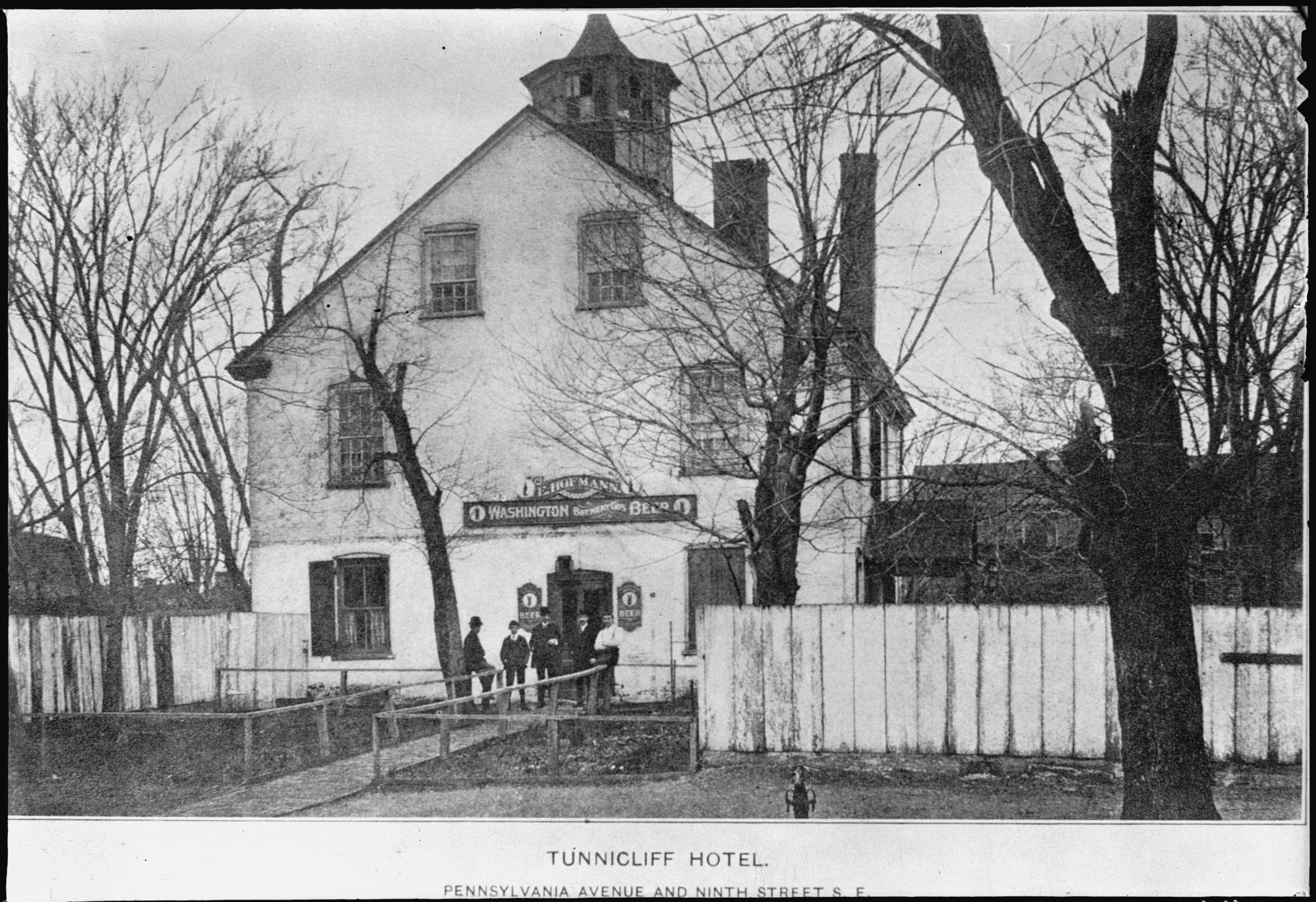
The Eastern Branch Hotel on Pennsylvania Avenue had a quieter ride. After Tunnicliff left, it cycled through owners. In 1821 a Yorkshire-born master shipbuilder at the nearby Navy Yard named Captain William Easby bought it at public sale, named the property “Warwick,” and lived there for years before renting it out.
By the late 1800s the building was running as a saloon and boarding house, with a beer garden featuring beer from Washington brewer E. Hofmann. It also did a stint as an auto garage and a storage house.
I should say something about the word “tavern” here. The historian Stephen Hansen, who has written the most thorough account of Tunnicliff’s, is careful to point out that both Tunnicliff establishments were hotels, not taverns.
The “tavern” label seems to have attached itself later, partly because the Pennsylvania Avenue building spent years as a beer garden, and partly because the modern restaurant on 7th Street uses that word. The man himself ran hotels.
The 1929 photograph of a building still standing
By the time the photograph below was taken in 1929, the Eastern Branch Hotel had been everything except a hotel for more than a century. It was an aging brick pile on the south side of Pennsylvania Avenue between 8th and 9th, sandwiched between newer construction, with the wear of a hundred and thirty-three years on its face.
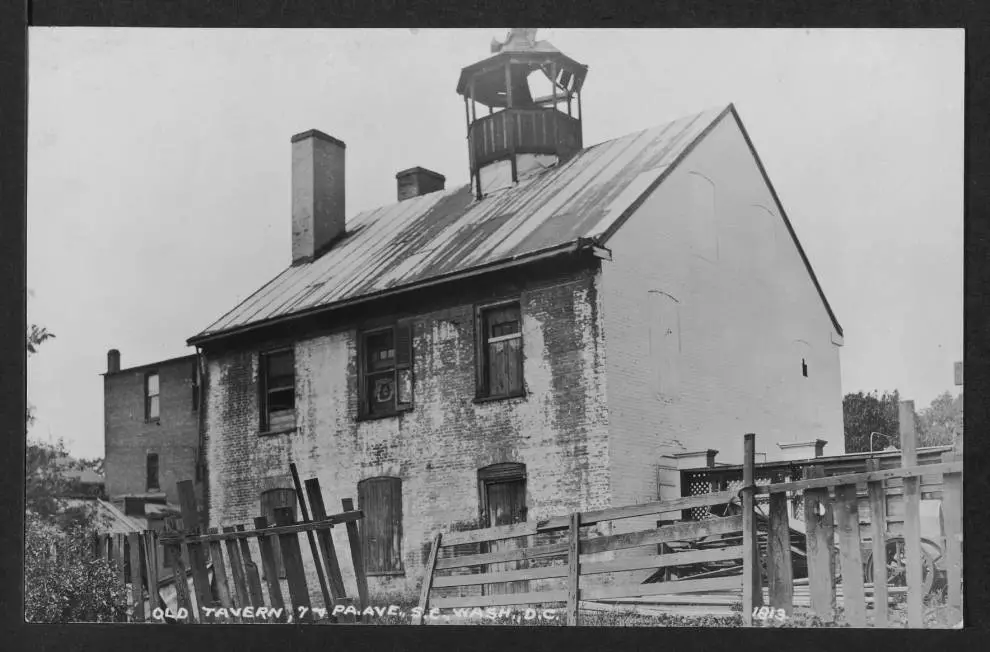
Two years later, in 1931, it was knocked down and replaced with Distad’s Service Station. A gas station still stands on the site today.
Capitol Hill’s modern Tunnicliff’s
This is where I should clear something up. The Tunnicliff’s Tavern you can walk to today at 222 7th Street SE, across from Eastern Market, is not the same establishment. It is not in the same building. It is not even on the same street, and there is no documented family line connecting it to William Tunnicliff.
The modern Tunnicliff’s has been open at 222 7th Street since the early 1980s. The restaurateur Lynn Breaux took it over in 1988 and ran it for thirteen years before moving on to lead the Restaurant Association of Metropolitan Washington. The current owners keep the name as a tribute to the man who opened the city’s first hotel a few blocks south.
It is a nice touch. It also tends to confuse people, because the name on the awning suggests a continuous lineage that does not actually exist.
So when you walk past Tunnicliff’s on 7th Street, you are walking past a Capitol Hill bar with a borrowed name.
The real Tunnicliff’s was a brick house on the south side of Pennsylvania Avenue, opened by an Englishman who sold socks out of the lobby, hosted John Adams a few blocks away, and then disappeared from the record so completely that even his nineteenth-century chroniclers had to admit they had no idea what became of him.
The original building lasted longer than the man’s memory. The name on 7th Street is the only thing left.
Not the original. The original was torn down after the War of 1812 to make room for the Brick Capitol.