Walk past 918 F Street NW today and you see a six-story brownstone event venue. Wedding receptions on the second floor. Corporate offsites on the fifth. Quiet most weekday afternoons.
That same address has, over the last 136 years, housed a Civil War general drawing up an irrigation scheme for the Colorado River, the founder of the Wall Street Journal, a real estate man who eloped with a 20-year-old, $30,000 in stolen diamonds, the largest illegal gambling operation in downtown Washington, and the headquarters of a daily-deals startup that was once worth $6 billion and now doesn’t exist.
The alley beside it is the one John Wilkes Booth limped down after he shot Lincoln.
That’s the building.
A Romanesque Pile by Glenn Brown
The building went up in 1890. Six stories of brownstone in the Richardsonian Romanesque style, designed by a Virginian named Glenn Brown.
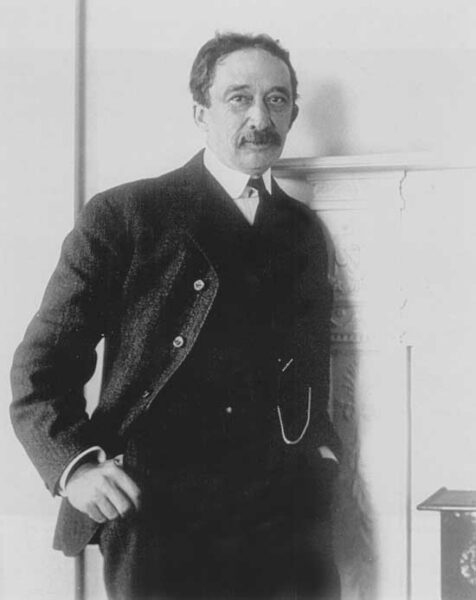
Brown was 36 when he drew it up. Educated at Washington and Lee and then MIT, he ran a Washington practice for forty-five years and would later serve as secretary of the American Institute of Architects from 1898 to 1913. He pushed hard for the 1901 McMillan Plan that rebuilt the National Mall. Other Glenn Brown buildings you have walked past without thinking about it: the Beale House at 2301 Massachusetts Ave (now the Egyptian ambassador’s residence), 1732 Massachusetts Ave (now the Embassy of Chile), and the Dumbarton Bridge over Rock Creek with the four bronze buffalo at the corners.
918 F Street was built for the National Union Fire Insurance Company. They moved in from 643 Louisiana Ave NW in 1891 and held the title until 1946. Then a woman named Arlene M. Andrick bought it and immediately turned around and deeded it to a corporation called 918 F Street Inc. Three years later they sold it to George Wasserman, who held it until 1956. George’s Radio and Television, Inc. bought it next. After that came Allan H. Saturn, then Hood and Parsons Enterprise (who picked up the Atlantic Building next door at 930 F at the same time), and finally, in November 1978, Douglas Development.
Douglas still owns it.

The Alley Booth Hobbled Down
Worth getting this one out of the way first. The alley running along the east side of 918 F Street is the alley John Wilkes Booth used to flee Ford’s Theatre after shooting President Lincoln on the night of April 14, 1865. He had stashed his horse in a stable behind the theatre. The fastest way out was through the back, into the alley, and gone.
The building wasn’t there yet. Glenn Brown didn’t design it for another twenty-five years. But the alley was, and the assassin used it.
Charles Dow and the Irrigation Scheme
Some serious names sat down at 918 F Street in August 1894. The Colorado River Irrigation Company had a vision: irrigate the land from San Diego County down through Baja California using the Colorado River, which they claimed was an inexhaustible source of water. They said they would have a canal finished within two years.
The Washington Post covered the directors’ meeting on August 4, 1894.
A meeting of the directors of the Colorado River Irrigation Company was held at the Washington office of the company, 918 F street, yesterday. Gen. L. A. Grant, ex-Assistant Secretary of War, presided. James H. Beatty, president N. W. Transportation Company, Larnia, Canada., C. H. Dow and T. J. O’Donnell, of Denver, Colo.; P. J. McLean, of New York, and John C. Beatty, of Boston, were also present. James Linton, Providence, R. I., and T. H. Taylor, secretary and treasurer Riordon Paper Mills, Merilton, Canada, were elected directors, and Col. Henry A. Pierce, Pawtucket, R. I., was elected treasurer. It was reported that the capital stock of the company was being taken up very rapidly, and that arrangements had been made to begin the construction of the canal early next month.
That is Lewis Addison Grant, the Civil War general. And C. H. Dow is Charles Henry Dow, founder of the Wall Street Journal, co-founder of Dow Jones, inventor of the Dow Jones Industrial Average.
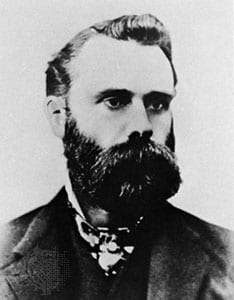
The economic depression of 1893 was already strangling the company. By the fall of 1894 they had run out of money. John C. Beatty, the director from Boston, was eventually accused of fraud. The canal never got built.
The Real Estate Man Who Eloped
Fulton R. Gordon ran his real estate office out of 918 F Street. He shows up later in Columbia Heights building empires, and even later in Chevy Chase doing the same. In 1895 he was 28 and at the start of his career.
He was also kind of married.
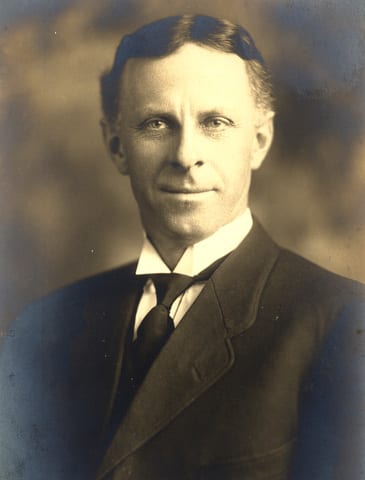
Gordon eloped with Cora A. Hart, age 20, daughter of a War Department clerk. The Washington Post ran the whole soap opera on July 8, 1895.
On Saturday evening she accompanied a married lady, a friend of the family, to the concert at the White House. As she did not return at the usual hour her parents sent to the house of this friend, only to learn that Miss Hart had left there some time before. Both Mr. and Mrs. Hart sat up the greater part of the night hoping that their daughter would come home, and it was only after her absence had extended into the morning that they concluded she had gone away with Gordon.
Miss Hart has been acquainted with Gordon for about two years, her parents say. About that long ago Gordon’s brother-in-law kept a grocery store in the neighborhood and it is presumed that Miss Hart, who was then a school girl, first met the man. Since the Gordon has persistently tried to force his attentions on Miss Hart, even going to the extent of asking her to marry him. He is said to have proposed to her before he had been divorced from his wife.
Mr. Hart stated to a Post reporter last evening that he knew Gordon only through the newspapers. On account of the bad character given him in the courts Mr. Hart had notified him that his visits would not be considered welcome, and Gordon never made any attempt to call. He feels very bitter toward the man who has robbed him of his daughter, and it is probably well for Gordon that miles separate him from the irate parent.
They didn’t get far. Midnight wedding at the Howard House in Ellicott City, then back to Gordon’s country place in Laurel.
The Streetcar Crush of 1912
Two weeks after the Titanic went down, Isadore Slyder of Slyder & Clough, 918 F Street, got himself caught between two streetcars. Streetcar accidents were not rare in Washington in 1912.
Isadore Slyder, of 1915 H Street, senior member of the firm of Slyder & Clough, 918 F street, was caught last night between two street cars at Thirty-sixth and M streets northwest. His collarbone and a rib were broken.
Mr. Slyder alighted from a car and attempted to cross the tracks behind it, when another car backed in on the switch, pinning him between the two ends, the police report. He was taken to Georgetown University Hospital in the Seventh precinct patrol wagon. Physicians at the hospital said last night that he was not dangerously hurt.
A broken collarbone and a rib. He lived.
Fischer’s Diamond Heist
In the 1920s the storefront at 918 F belonged to Fischer’s, jewelers and opticians. Diamonds, gold, high-end watches.
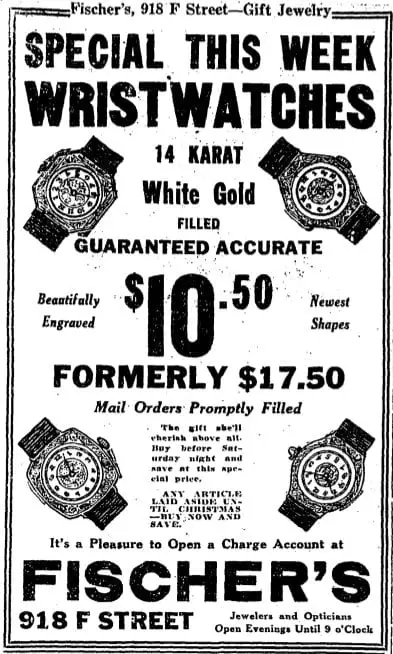
A year later somebody walked off with most of the inventory. The Washington Post ran the story on December 9, 1923.
Diamonds worth between $25,000 and $30,000 have been stolen from his store at 918 F street northwest, Harry Fischer reported yesterday. Jewels worth $150,000 were overlooked by the thief, Fischer told police. Included in the theft were 141 large diamonds, some three karats [sic] in weight, a dozen emeralds and seven packets of the smaller white stones.
Earlier in the day Joseph Fischer, employed by Fischer and his relative, took the jewels from a safe and placed them in a wallet in a steel drawer in the diamond room. Close to the drawers which contained the missing gems is a glass cabinet in which are jewels worth probably $150,000, Headquarters Detectives Kelly and Scrivener said. The jewels were Christmas stock and are covered by insurance, Fischer said. On books at the detective bureau the gems are reported as “lost or mislaid.”
“Lost or mislaid.” 141 diamonds, a dozen emeralds, seven packets of smaller stones, all “lost or mislaid.”
The Sixth-Floor Numbers Operation
Atlantic City wouldn’t legalize gambling until 1976. In 1958 you went to the sixth floor of 918 F Street.
The March 12, 1958 Post wrote it up.
Inspector John B. Layton, head of the Gambling Squad, led a raid yesterday on what he described as “the largest known gambling operation in downtown Washington,” at a sixth-floor suite of the National Union Building, 918 F st. nw.
Layton said a $1500-a-day business was conducted from the suite.
The raiding party waited outside until one of the men arrested opened the door to leave, then walked in, Layton reported. He said police had a search warrant obtained after a month’s observation and telephone calls to the premises. Arrested were:
Salvatore J. Mancuso, 39, listed at Bel Pre rd., Silver Spring; Owen N. Grinder, 55, of 2514 15th st. nw., and Alfred W. Stanley, 51, listed at 1612 18th st. se. They were charged with operating a lottery and released under $1000 bond for appearance before the United States Commissioner today.
A month of surveillance. $1,500 a day. Out the door on $1,000 bond.
The Painter at the Sixth-Floor Window
Eugene Duke, age 28, came to 918 F Street on September 24, 1976 to look at an office he was supposed to paint. He never made it home.
A 28-year-old painter died yesterday after he plunged from a sixth-floor window at 918 F St. NW about 3:15 p.m., D.C. homicide detectives reported.
Police said the man, Eugene Duke, of 4520 Fort Totten Dr. NW, apparently was at the building to examine an office he was to paint. Police said the building’s manager told them the man broke a window with his hand before going upstairs.
Duke landed in an alley beside the building, police said. He was pronounced dead on the scene. An autopsy was scheduled for today although no foul play is suspected, police said.
Music Boxes and a $12 Office
By the 1980s the storefront was the Music Box Center. Snow White figures spinning in glass cases. The vibe of downtown Washington, 1987.
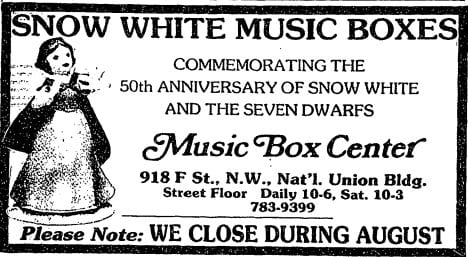
The next year somebody at the building was advertising office space for $12 a square foot in the classifieds. Call Meda. Evenings and weekends.
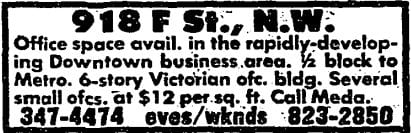
Try renting any office in Penn Quarter for $12 a square foot today.
LivingSocial Buys Itself a Building
This is where the post used to end. In 2011 a daily-deals company called LivingSocial signed a lease on the building, gutted the inside, and reopened it the following February as a “live events center.”
To explain why anyone gutted a 121-year-old Romanesque pile to make space for cooking classes, you have to remember what 2011 felt like.
LivingSocial was founded in 2007 in DC as Hungry Machine by Tim O’Shaughnessy and three Revolution Health colleagues. They built social games for Facebook for a couple of years, then in 2009 they bought a tiny site called BuyYourFriendADrink.com and pivoted into the daily-deals business that Groupon had just invented. They renamed themselves LivingSocial.
By 2011 they had 4,500 employees, a deal with Amazon, and a $176 million Series F led by JP Morgan that valued the company at roughly $6 billion. There was talk of a $10 billion IPO. They were the DC tech story.

918 F Street was the showpiece. The company spent $4 million on the renovation, gutting load-bearing masonry walls and replacing them with a steel grid so the interior could open up for events. They built a test kitchen for three dozen students, an art studio, a commercial kitchen for pop-up restaurants, and rooms that could be reconfigured for whatever the calendar demanded. The pitch was that local merchants would use the space to reach LivingSocial’s millions of subscribers in person. Cooking classes. Wine tastings. Live shows.
It opened in February 2012.
The Bubble Pops
The daily-deals model started cracking almost immediately. Customers redeemed the cheap deals once and didn’t come back. Merchants got squeezed by the discounts and the platform fees. The market saturated. Both LivingSocial and Groupon started bleeding.
In January 2014 LivingSocial reported a $183 million net loss for 2013. The same week, the company announced it was getting out of the live events business and closing 918 F Street that spring. The Washingtonian put it bluntly: “LivingSocial to Close Its DC Storefront After Another Bad Year.”
The 918 F Street venue had been open for just over two years.
By March 2016 LivingSocial had laid off half its remaining employees. By October 2016 it was over. Groupon, the rival the company had spent half a decade trying to dethrone, agreed to buy LivingSocial. Groupon called the price “not material” and didn’t disclose it. Four months later, in February 2017, Groupon admitted in an earnings report that it had paid zero. Nothing. The company once valued at $6 billion sold for no consideration at all.
The Washington Post wrote LivingSocial’s obituary that same month under the headline “RIP LivingSocial: The fast rise and slow demise of a daily deals company.”
Six billion to zero in five years.
What’s There Now
After LivingSocial cleared out in spring 2014 the space sat empty for more than a year. Then a startup called EquityEats took it over for an idea called Prequel, a “pop-up megaplex” where chefs would test concepts before committing to brick-and-mortar restaurants, with diners able to invest through equity crowdfunding.
Prequel opened in fall 2015 across five floors and 18,000 square feet. It launched a few legitimate restaurant careers, including Bluebird Bakery and the eventual Gravitas. It also went out of business.
The building reverted to its actual name. The National Union Building is now an event venue with eleven private spaces across seven floors, run by Douglas Development. Weddings, galas, corporate offsites, the occasional concert. The interior is the same gutted, steel-gridded shell LivingSocial spent $4 million on. The cooking classes are gone. The startup logo on the awning is gone. The building is what it was when Glenn Brown drew it up in 1890. A six-story brownstone next to an alley in Penn Quarter.
Downtown DC has done this trick before. The Willard Hotel sat empty for eighteen years before someone spent $73 million to bring it back. The Walsh-McLean Mansion on Mass Ave outlived the family that built it and still stands. Buildings down here are tougher than the people who pay to use them.
The original tenant sold fire insurance. The latest tenant rents out the floors for weddings and corporate galas. In between were a Civil War general, the Dow Jones founder, an eloping real estate man, a stolen tray of diamonds, a numbers operation, a music box store, and a unicorn.
The building is still there.