
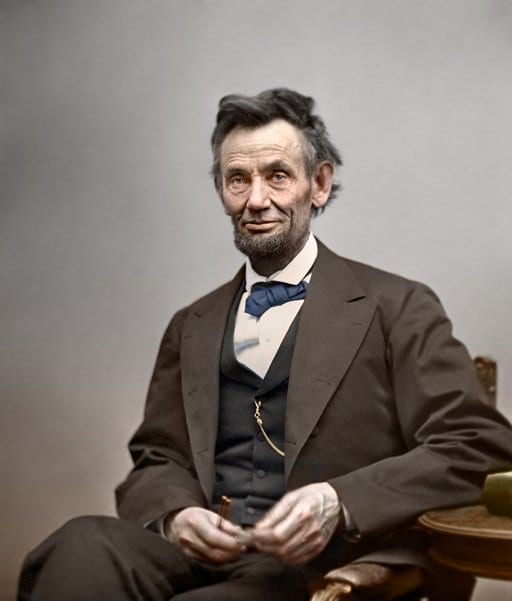
On February 5, 1865, Abraham Lincoln sat for a photographer at Alexander Gardner’s gallery on 7th Street NW in Washington. He was 55 years old. He had 68 days to live.
This is that portrait, colorized.
The Man Behind the Camera
Alexander Gardner was born in Paisley, Scotland, in 1821 and came to the United States in 1856. He found his way to Washington, joined Mathew Brady’s studio, and quickly became one of Brady’s most capable photographers. When Brady refused to give individual credit to his photographers for their work, Gardner left in 1863 to open his own gallery at 511 7th Street NW, a few blocks from the Patent Office and the Post Office building.
The gallery became the preferred studio for Washington’s wartime elite. Gardner photographed Lincoln at least six times over the course of the presidency. He was at the Capitol on March 4, 1865, a month after this sitting, to photograph the second inauguration. And when the assassination came in April, Gardner was there to document everything that followed: the conspirators in custody, the military tribunal, and the execution.
February 1865 in Washington
When Lincoln walked into Gardner’s studio that February, the Civil War was in its final months. Sherman had finished his March to the Sea. Grant had Lee pinned at Petersburg. The end was not yet official but it was visible. Lincoln had already begun drafting what would become one of the most consequential second inaugural addresses in American history, delivered 27 days after this photograph was taken.
Look at his face. He was 55, but the age he carries is not 55. When Lincoln arrived in Washington in February 1861 as president-elect, he was a vigorous if angular man. By 1865, four years of war had done what four years of war do. The lines around his eyes had deepened, his cheeks had hollowed, and the characteristic sadness that friends and colleagues remarked on had settled permanently into his features. His secretary John Hay, who knew him as well as anyone, said Lincoln was “the saddest man I ever knew.”
What Color Changes
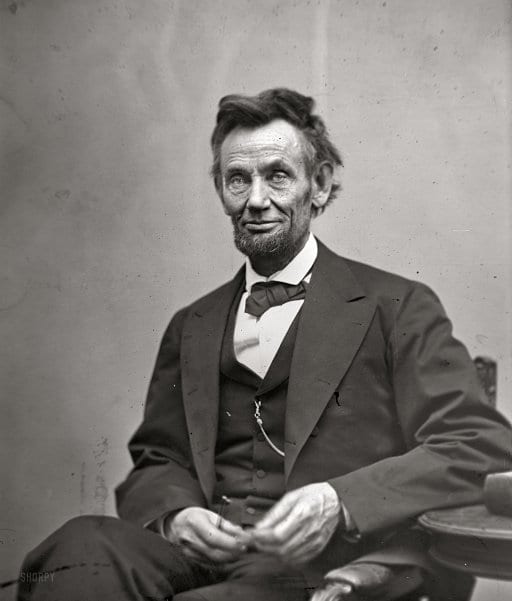
Black and white photography does something to historical figures that color undoes. The monochrome palette turns them into monuments. It creates a kind of protective distance: this was a long time ago, in a different world, among people who were fundamentally unlike us. The gray scale makes them safe to admire.
Color removes that. The specific dark brown-black of Lincoln’s coat, the warmth in his skin, the texture of the studio backdrop: suddenly this is just a person sitting in a photographer’s chair on a cold February morning. He is tired. He has a country to finish saving. He is going to deliver one of the greatest speeches in American history in less than a month, and he is going to be shot in the back of the head six weeks after that.
Color does not add drama to this image. It removes the drama of historical distance and replaces it with something harder to look away from.
What Gardner Captured Next
Gardner was at the Capitol steps on March 4, 1865, when Lincoln delivered the second inaugural. The surviving photographs from that day show the crowd, the unfinished grounds, and the new dome barely completed above them. If you look carefully at the inauguration photograph, Lincoln is visible at the podium. It is one of the most remarkable documentary photographs of the 19th century.
On April 14, Lincoln was shot at Ford’s Theatre. He died the following morning. Gardner photographed the conspirators held at the Washington Navy Yard, including Lewis Powell, the man who had simultaneously attempted to murder Secretary of State William Seward at his home on Lafayette Square. On July 7, Gardner set up his camera at the Old Arsenal, now Fort McNair at Greenleaf Point in Southwest DC, and photographed the hanging of four conspirators: Mary Surratt, Powell, David Herold, and George Atzerodt.
Gardner spent the rest of his career in Washington. He died in 1882 and is buried at Glenwood Cemetery in Northeast DC, a short distance from the studio where he photographed Lincoln for the last time.
The photographs of Lincoln’s funeral procession down Pennsylvania Avenue on April 19, 1865 show what Washington looked like the week after. They are worth a look.
For the building Washington built to honor him, read our pillar: Lincoln Memorial History: Construction, Designs, the Secret Basement, and the Swamp It Was Built On.
For more on Lincoln’s wartime White House, read about Sarah Josepha Hale’s 1863 letter that convinced Lincoln to make Thanksgiving a national holiday.
American Photo Colorizing.com features 100s of realistic, colorized antique and historical photo downloads. There are over 100 of the American Civil War. You can have your mueum or family photos restored and colorized, too.
Wow, totally creepy. I doubt Lincoln could get elected in the era of television. He looks like near death. Which, sadly, I guess he was.
For me, this remarkable color photo has an effect much like that of a fine, black and white, modern portrait of a person I know or have seen only in color photos. Such portraits capture our interest by providing a new and different look at a face we think we know, but have never before seen in this way. So we look more closely than before, for overlooked features or nuances of expression we might have missed. This colorized portrait of Lincoln is powerful in its ability to draw the viewer in to look, yet again and more closely, at a face we know, but, at the same time, have never seen before. It emphasizes Lincoln’s humanity in a startlingly new and arresting way.
this is the funniest comment i’ve ever seen. I literally laughed out loud at work.
It’s not Abe that makes the photo so creepy – but the colorizing. Check out American Photo Colorizing .com to see what colorizing can look like (another shameless plug). We have 100 colorized photos of Abe Lincoln and the Civil War in our Photo Store. I think you’ll find Honest Abe doesn’t look like Creepy Abe, after all.
He had the weight of the Civil War on his face. He made the decision to send troops South and the war took 4 years to resolve. He probably never thought it was take that long, and during thise years he would take personal heart felt responsibility for so many soldier’s deaths.
Nice color pic, but he looks dirty & grungy.. Could have combed his hair & cleaned the dirt & grime off of his face prior to pic
The grunge is an artifact of the colorization. The hair is part of the style. Where do you come off making comments on what is literally of another time and culture?
I tend to agree about the grunge. Colorized Lincoln photos were introduced in 2009 with the book Color of Lincoln and the associated website (http://coloroflincolln.com). The photos from the 1860s can be colorized with a mor natural look and relative brilliance to the photos of today.
There is a whole website with color photos of Abraham Lincoln – http://www.coloroflincoln.com
Was Lincoln knitting?
Ever seen what FDR looked like during his last presidential campaign? A war will take it out of you.
Hey, this is cool, but your facebook like is broken–you need a ., right now it’s facebookcom/whatever
No…he had just finished sharpening a #2 pencil.
This a great Kodak moment shot with Kodak Kodachrome of Abe in 1865!
He chose the war. The war was of his making and he deserved to become a casualty of it. No tears here.
Lincoln was fifty-six years old when he was killed and he looked eighty-nine years old. What a miserable POS to have married a horrible wench and to have killed so many Americans.
FDR is the reason that we have the NSA spying on us. FDR had more problems than being trapped in a wheelchair. He was an evil SOB whose wife may have signed the women’s suffrage bill into law as he lay dying. #gotohell
Get back on your meds please.
I am a free man. I have never taken psychotropics-nor have they been prescribed for me. I am the picture of health. Yessir! You are probably on something. I take in the love, the hatred, the anger and the pain as it comes in life. I feel it all! I also feel that you are a useful idiot who never questions anything. FYI~I have a bust of Lincoln in my study that was given to me by a scholarly friend. I may take it out in the back and place a bullet behind the left ear some day.