
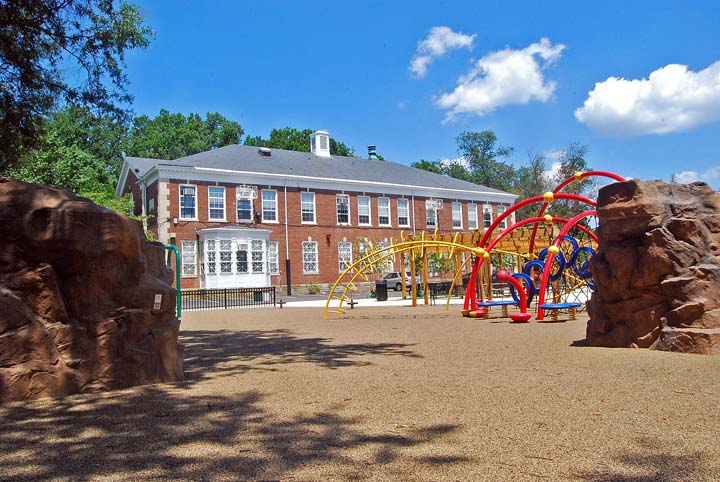
There is a story behind every school name in Washington, DC. Some are generals. Some are commissioners. And then there is Phoebe Apperson Hearst, a woman born into rural poverty in Missouri who became one of the wealthiest people in America and spent the last decades of her life pouring that fortune into public education for children who had nothing.
That is the name on the little school at 37th and Tilden Streets NW in North Cleveland Park. The school is worth knowing. The woman it honors is extraordinary.
A Missouri Childhood
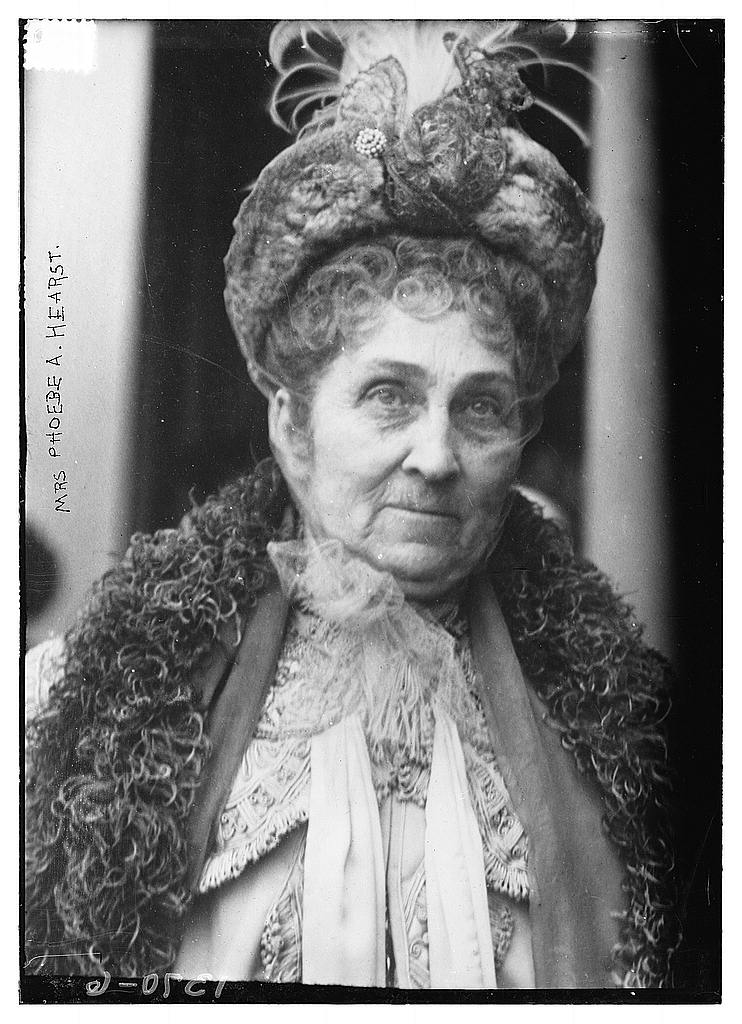
Phoebe Elizabeth Apperson was born on December 3rd, 1842, in Franklin County, Missouri, the eldest of three children. Her father ran a farm and small store. The family was not wealthy. She helped keep her father’s accounts, studied French, and trained as a schoolteacher. By her late teens she was teaching in local schools.
Then George Hearst came back to town.
George was 41 years old, a rough-edged Missouri native who had left for California a decade earlier and struck it rich. Not just rich. He had a talent for reading rock formations that bordered on the supernatural, staking claims in three of the most significant mining discoveries in American history: the Comstock Lode in Nevada, the Homestake gold mine in South Dakota, and the Anaconda copper mine in Montana.
He returned to Franklin County in 1860 to care for his dying mother and met 19-year-old Phoebe Apperson. They married on June 15th, 1862.
She left Missouri and never looked back.
Coming to Washington
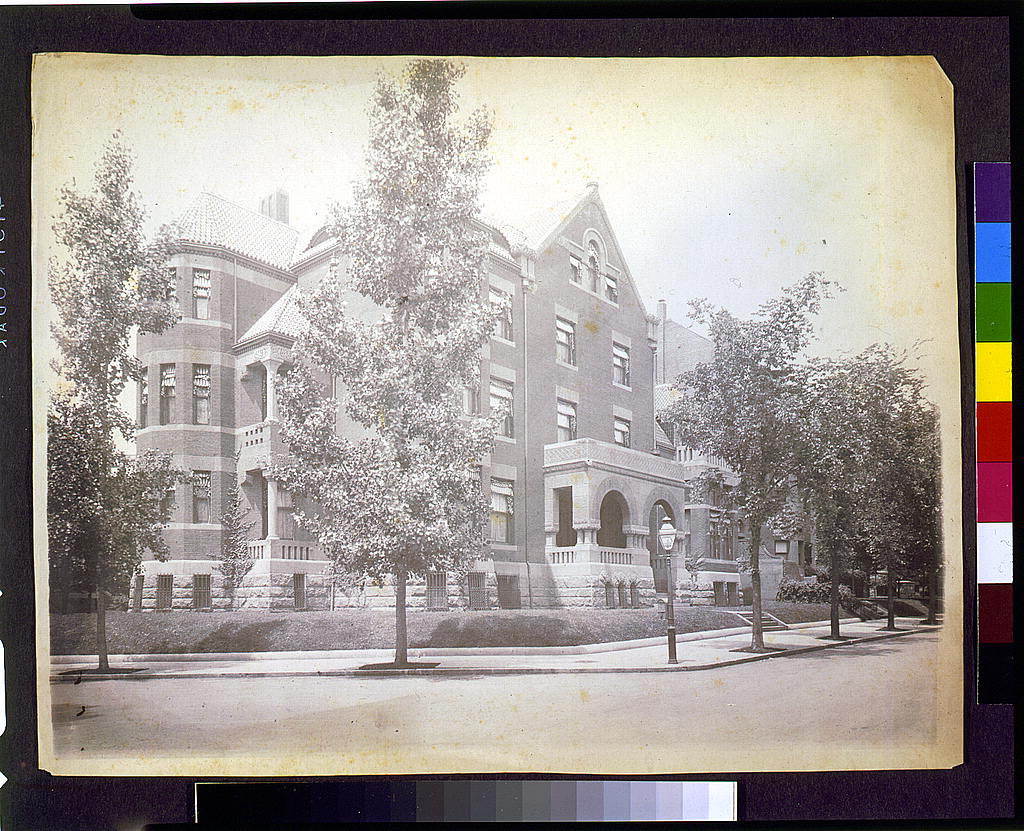
George Hearst was elected to the United States Senate from California in 1886, and the couple moved to Washington. They took a grand home at 1400 New Hampshire Avenue NW, right at Dupont Circle, a Romanesque-style mansion that architect Harvey Page redesigned for them.
Phoebe set up a serious Washington household. She was not content to simply host dinners. She established an afternoon salon culture, sponsoring lectures and talks that were initially considered a peculiar innovation. They caught on. She became one of the most respected figures in capital society.
What mattered most to her was education. Specifically, the education of very young children.
She had seen free kindergartens operating in San Francisco before the move to Washington and wanted to replicate that model here. She funded a school that trained kindergarten teachers for the District, an institution that would go on to produce an astonishing 90 percent of Washington’s kindergarten teachers.
She poured money into the National Cathedral School for Girls, contributing $200,000 to build Hearst Hall, a fireproof building she insisted on for the students’ safety. Her total gift to NCS reached $250,000. She gave money to St. Albans School as well.
And on February 17th, 1897, she and Alice McClellan Birney co-founded the National Congress of Mothers in Washington, DC. That organization became the National Parent-Teacher Association.
The PTA, in other words, is a Washington institution that Phoebe Hearst helped bring into existence.
A Fortune Inherited, a Fortune Given Away
George Hearst died on February 28th, 1891. He left Phoebe his entire estate: $19 million, along with all his property. She was 49 years old and suddenly controlled one of the largest private fortunes in the country.
She moved back to California but never stopped funding Washington. She never stopped funding much of anything.
Between 1891 and her own death in 1919, Phoebe Hearst spent $21 million on philanthropic causes. That is more than she inherited. She became the first woman Regent of the University of California in 1897 and served until her death, funding buildings, expeditions, and the anthropology museum at Berkeley that still bears her name.
She served on the Mount Vernon Ladies’ Association from 1889 to 1918, furnishing the house with objects that had belonged to George Washington and improving the visitor experience at the estate.
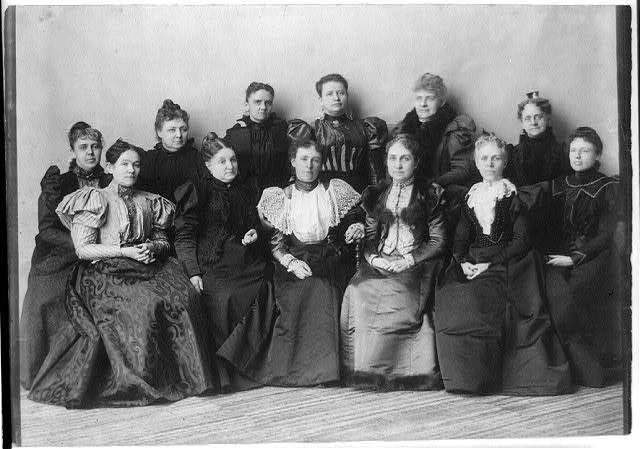
She was also a member of the Congressional Union for Woman Suffrage, photographed at meetings and listed among its national advisory council. The woman who had grown up helping her father balance accounts in a Missouri general store was, by the early twentieth century, one of the most influential philanthropists in the United States.

She died on April 13th, 1919, during the influenza epidemic that swept through California. She was 76.
Washington Remembers
In the fall of 1931, First Lady Lou Hoover attended the cornerstone laying ceremony for a new elementary school going up at 37th and Tilden Streets NW, behind Sidwell Friends in Cleveland Park. The school would be named for Phoebe Apperson Hearst.
A year later, on November 15th, 1932, the school was formally dedicated. Here is what the Washington Post reported that evening:
Described by Senator Royal S. Copeland, of New York, in his dedicatory speech, as “a worthy monument to the most public spirited woman of her period,” the new Phoebe Apperson Hearst Elementary School at Thirty-seventh and Tilden streets northwest was dedicated last night with a program of music and oratory.
Senator Copeland traced the career of Mrs. Hearst, laying stress on the important work she did while in Washington in laying the foundation for the kindergarten system and launching the parent-teacher movement.
Two grandsons of Mrs. Hearst, William Randolph Hearst, jr., and John Hearst, presented an aquarium to the school in behalf of their father, William Randolph Hearst. They took part in the corner stone laying ceremony of the school last year. Miss Catherine Watkins, director of kindergartens in the District, accepted the gift.
…
Dr. Frank W. Ballou, superintendent of District schools, paid a tribute to the memory of Mrs. Hearst, and pointed to the school built in her name as a realization of the type of school she had in mind when she worked for the establishment of ideal school surroundings for young children.
The grandsons at the cornerstone ceremony the year before. The aquarium presented on behalf of their father, William Randolph Hearst, the newspaper publisher. It is a remarkable family to trace back to a small farm in Franklin County, Missouri.
Hearst Elementary School today serves about 200 students. It is a neighborhood public school, exactly the kind of institution Phoebe Hearst spent her life and fortune trying to build. If you have ever been to a PTA meeting, or sent a child to a school with a kindergarten program, some version of that story runs through her.
Want to go deeper on the history of DC public school names? We have a full post on that. And check out our piece on Ross Elementary School in Dupont Circle for another name most people walk past without a second thought.
I grew up in the neighborhood and had friends attend Hearst! I do have a question, not pertaining to the school itself but the surrounding area. Do you know what the story is with that wooded path between the sections of Idaho avenue on the east side of the school? For a long time on some maps it was listed as a road, and then on others it wasn’t, and now I haven’t seen any maps or listings with it as a road in a couple of years. If you find any information on that I would love to know. I’ve been wondering what the deal is with that ever since I was a little kid.
I live in the neighborhood and have a kid at Hearst now. It’s a great school and just getting started on a big building expansion. But the aquarium is still there and in great shape, thanks to Ms. Dawkins, one of the current pre-K teachers. They renovated the existing building already and did a great job really fixing it up and showcasing some of the original building, like the fish tank.
My older brother and I both attended Hearst in the late 70s early 80s. We grew up in Mt. Pleasant and our local school was Bancroft, which was nothing like it is now. Our parents had us take the.H2/H4 busses across the park. It was a good school with a great Principal, Mrs. Greer, who was also the principal at Eaton because of the small sizes at the time.
I played soccer at Hearst for years in elementary school in the 70’s. It was part of the DC rec league at the time. I recall a small clubhouse building with ping pong and pool tables. I should swing by and take a look at the place.
PS – Mrs. Greer was my sister’s principal at John Eaton in the early 80’s. I recall a firm yet warm person.
I went there for 2 years in the early 80’s. I recall a small, very old wooden building in the corner of the playground, and a jungle gym right on the blacktop, neither of which would be allowed today. They used the air raid siren for the fire drills. My 1st grade teacher was Ms. Melvin.
My brother and I attended Hearst in the 50s and early 60s. I attended from Kindergarten through sixth grade. The graduating class had 18 pupils, most of whom had attended the school since Kindergarten. The aquarium was awesome. The school terrific and provided one of the best educational foundations I could have ever received. I used to see the limousine waiting for the Nixon girls every afternoon at Sidwell Friends, which was across the street. The school had 6 Cherry Blossom trees lining both sides of the entry. They were some of the trees that were gifted by the Japanese government which were planted downtown by the Potomac.
The building by the playground was the recreation center for the area. it had been slave quarters before the Civil War. We affectionately called it the “Little House”. In the early 60s the 5th and 6th graders used to turn it into a dance hall and we would dance to rock and roll records after school. The Twist was the new dance. In the summer there were various activities that we could participate in (basket weaving was really taught).
The 4th grade teacher, Mrs. Dunn, started every day checking our nails for cleanliness and to ensure that each had a handkerchief. She read Ecclesiastes verse 3 every morning (years before the Birds recorded Turn, Turn, Turn). She drilled us on our multiplication tables every day until we had them all memorized.
The 5th grade teacher taught us square dancing one afternoon each week.
We played football during every recess in 3rd grade. Boys and girls on the same teams.
We walked or rode our bikes to school each day and every corner had a 5th or 6th grader crossing guard.
Washington was a small town then and a delight to live in. Hearst Elementary was a wonderful experience.
To my great pleasure, I attended Hearst from 1944-1949. I remember those dedicated, warm teachers and my new teachers had a lot to live up to when we moved to Silver Spring! Yes, this LOL (little old lady) has wonderful memories of her first school.