The neighborhood’s name has a direct presidential origin, but the full story is more interesting than that. It involves a Revolutionary War general, a sitting president who secretly purchased a farmhouse to escape official Washington, three competing subdivision names, and a house that stood for decades before being quietly demolished and its stones reused in the building that replaced it.
Pretty Prospects
Long before anyone called it Cleveland Park, the land was known as Pretty Prospects. It was a 998-acre tract west of Rock Creek in what was then Montgomery County, Maryland, first granted to Colonel Ninian Beall in 1720. In 1790, the property was acquired jointly by General Uriah Forrest and Colonel Benjamin Stoddert.
Forrest was a man of some stature. A Revolutionary War veteran, aide-de-camp to George Washington, former Congressman from Maryland, and later mayor of Georgetown, he moved his family from Georgetown out to a small stone cottage at Pretty Prospects in 1793, at his wife Rebecca’s urging. The cottage itself dated to around 1740. In 1794, Forrest bought out Stoddert’s share, built a two-story frame house in front of the existing cottage, and renamed the whole property Rosedale. That farmhouse, now at 3501 Newark Street NW, is one of the oldest surviving houses in Washington and is still standing today.
After Forrest died in 1805, the estate stayed in his family for generations. In 1865, his daughter gave her son George Forrest Green 23 acres carved from the original tract. In 1868, the Greens built a stone dwelling on that land, at 3542 Newark Street NW, and called it Forrest Hill.
The President’s Secret Purchase
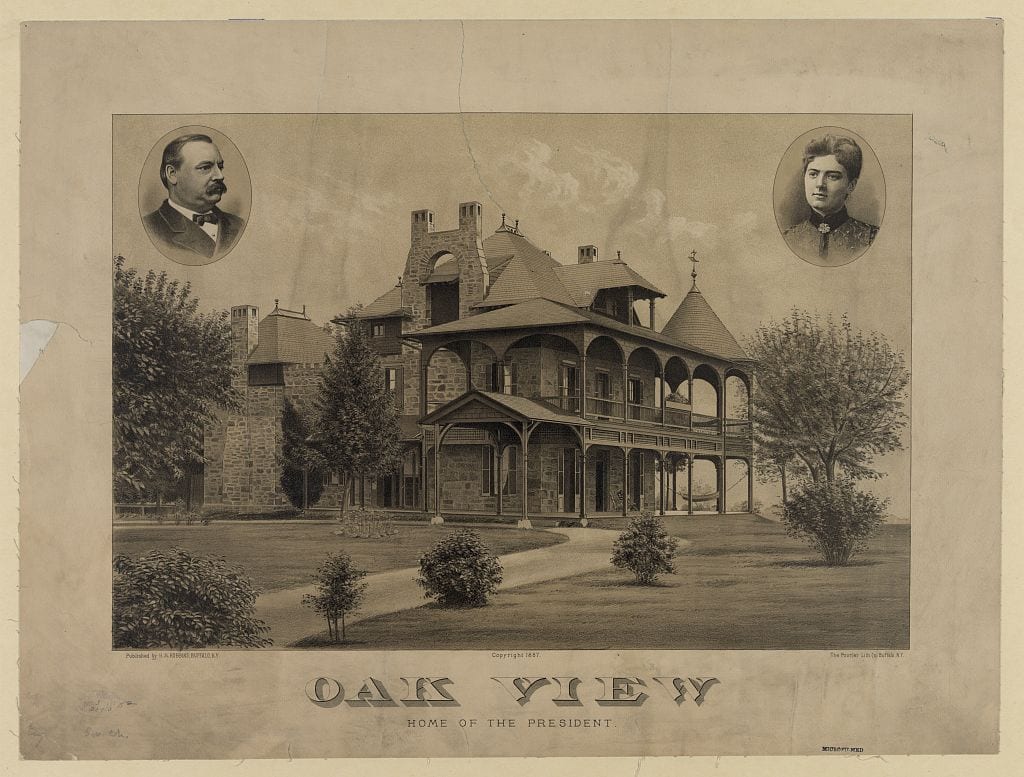
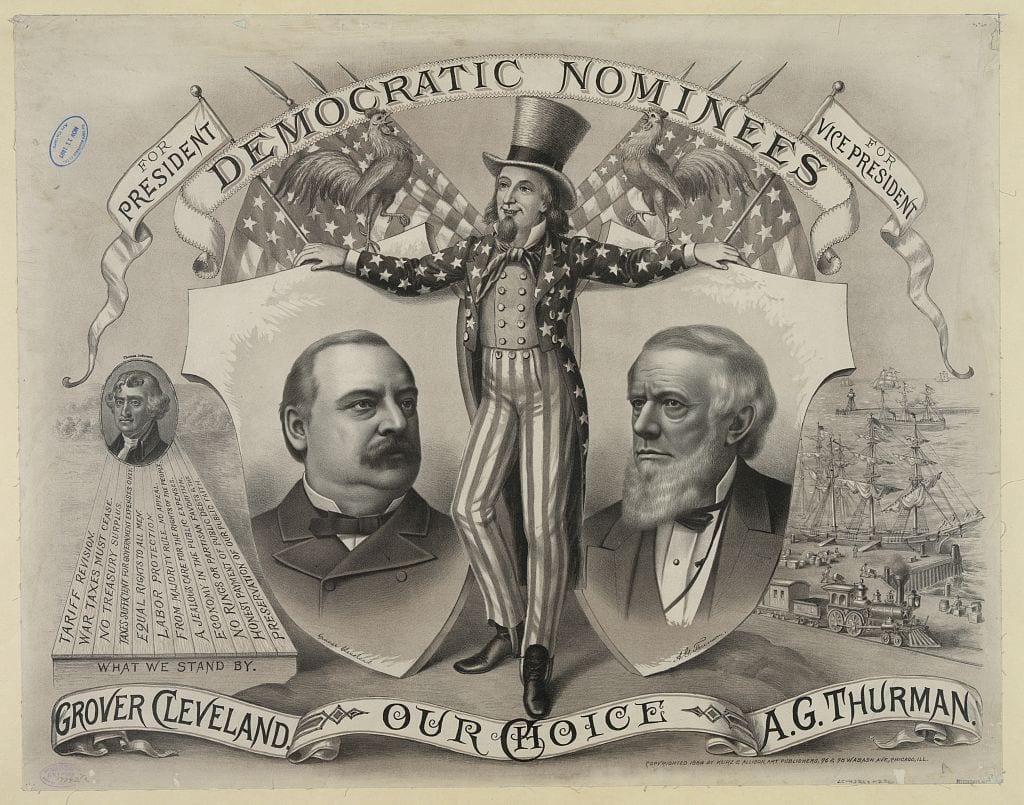
In 1886, during his first term as the 22nd president, Grover Cleveland quietly bought Forrest Hill. The secrecy was deliberate. Cleveland wanted a retreat from the White House and from public scrutiny, and he got one. He immediately set about transforming the stone house into a fanciful Victorian mansion, adding towers, turrets, balconies, and sweeping porches. He renamed it Oak View, for the surrounding oaks. The public took to calling it Red Top, after the steeply pitched hipped roof painted red that crowned the towers and swept over the whole property.
From Oak View, Cleveland commuted each day to the White House. The elevated position above the Rock Creek valley offered relief from Washington’s famously swampy summers, and the 26-acre estate gave him privacy impossible to find anywhere near Pennsylvania Avenue. We’ve also written about the time Grover Cleveland got completely lost in Anacostia during this same period, which gives you a sense of how Washington still felt to him.
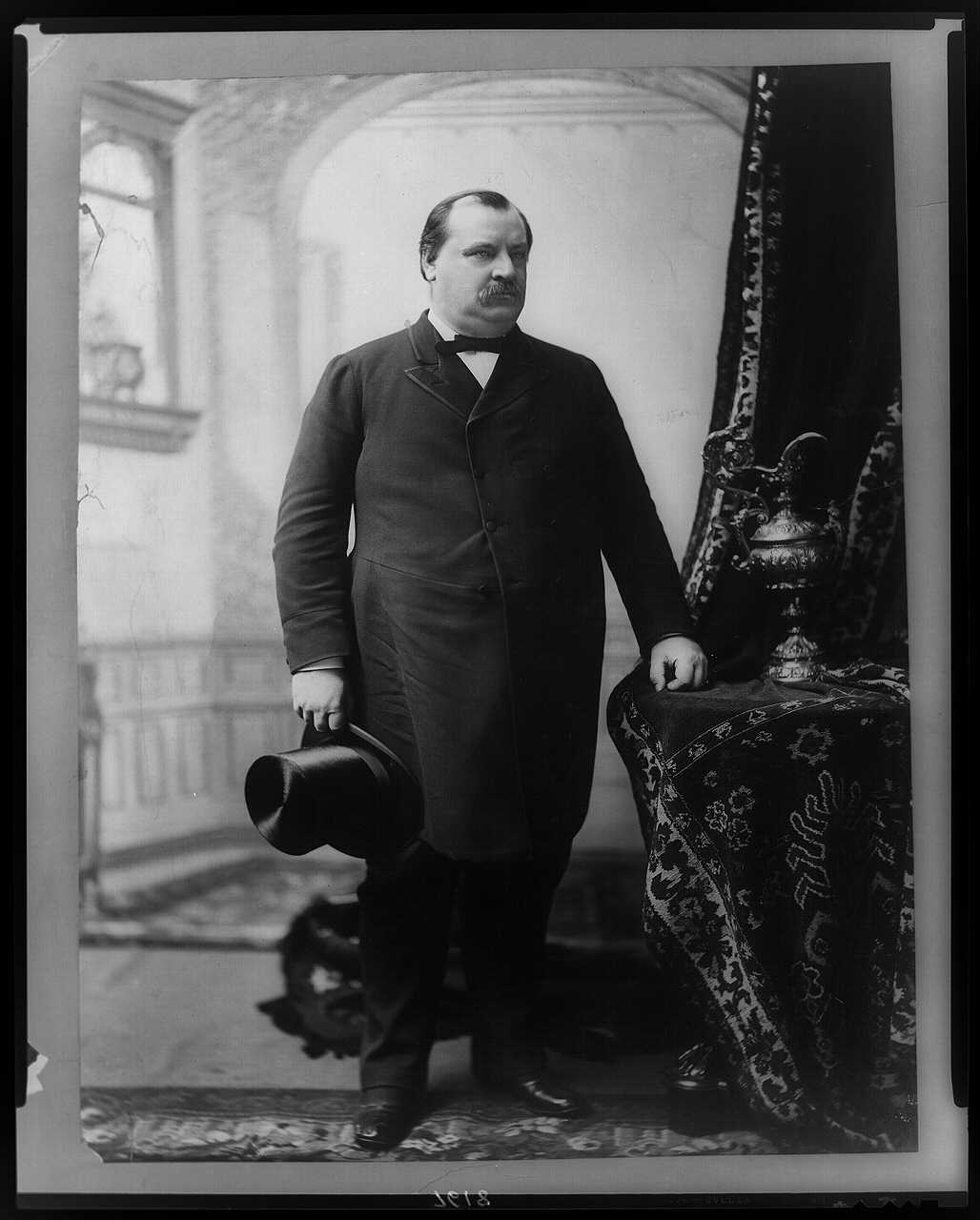
Cleveland did not hold Oak View long. He lost the 1888 election to Benjamin Harrison and in 1889 sold the entire 26-acre estate to Francis Griffith Newlands, a developer who was at that moment building his model suburb of Chevy Chase a few miles up the road. Cleveland moved to New York and joined a law firm. He was not done with Washington, though. He won the three-way election of 1892 and returned to the White House as the 24th president, becoming the only person in American history to serve two non-consecutive terms.
Three Names, One Neighborhood
After Newlands bought Oak View, he subdivided the property. He set aside the house and about two acres as a separate parcel and platted the rest into building lots. The resulting subdivision, formally named Oak View, was recorded in 1890. It was bounded on the south by Woodley Road, on the north by Newark Street, on the west by Wisconsin Avenue, and on the east roughly between 34th and 35th Streets.
Around the same time, a second subdivision west of today’s Reno Road was being laid out and called Cleveland Heights. Both Oak View and Cleveland Heights were responding to the Georgetown-Tenleytown streetcar line along Wisconsin Avenue, chartered in 1888 and extended north to Bethesda in 1890. A third name was also in the air: Connecticut Avenue Highlands. You can see a 1910 real estate ad using Connecticut Avenue Highlands to describe what we now call Cleveland Park, showing how unsettled the naming still was more than a decade into the neighborhood’s development.
None of those three names won. The one that stuck came from a fourth subdivision, and it happened because of a different streetcar line entirely.
In 1892, Newlands’ Chevy Chase Land Company completed the Rock Creek Railway along Connecticut Avenue, cutting five miles of roadbed through the steep ravines of Rock Creek and Klingle Valley. By September 1892, streetcar service ran from Calvert Street to Chevy Chase Lake, with stops at the National Zoo. Within two years, a Cleveland Park stop was added. The Connecticut Avenue streetcar, not the Wisconsin Avenue line, was what finally opened this part of the District to serious development. You can see how the corridor looked on this 1919 map of Connecticut Avenue through Cleveland Park and Chevy Chase.
In May 1894, developer Thomas Waggaman purchased 400 acres between Wisconsin and Connecticut Avenues north of Woodley Road. He partnered with John Sherman and Sherman’s wife Ella to form the Cleveland Park Company, and their first subdivision was formally named Cleveland Park. It covered Newark Street between 33rd Street and Wisconsin Avenue, and Ordway Street from 34th to 36th. The company commissioned noted architects to design individual houses on each lot, establishing quality standards that made the suburb immediately attractive. The first house in what would formally become Cleveland Park was built in 1894 at 3607 Newark Street, by Richard J. Beall, Jr., a descendant of the same Colonel Ninian Beall who had received the original Pretty Prospects land grant 174 years earlier.
What Happened to Oak View
The house at the center of it all had a quiet end. After Newlands subdivided the property, Washington architect Robert I. Fleming purchased Oak View and its remaining two acres. He lived there until his death in 1907. After his wife died, the property was sold and the house was demolished, its stone reportedly incorporated into the retaining walls, entrance gate, and steps of the Georgian mansion built on the site around 1927. That house still stands at 3536 Newark Street NW. There is nothing on its exterior to tell you that Grover Cleveland’s summer retreat once occupied the same ground.
The Cleveland Park Historic District was designated in 1987 and listed on the National Register of Historic Places, with a period of significance running from 1880 to 1941. The neighborhood Grover Cleveland’s name launched has since grown to include one of Washington’s first planned retail centers, a landmark Art Deco movie theater, and one of the city’s most intact collections of individually designed turn-of-the-century houses. For more on Cleveland himself, check out our piece on mapping the second cabinet of Grover Cleveland.