
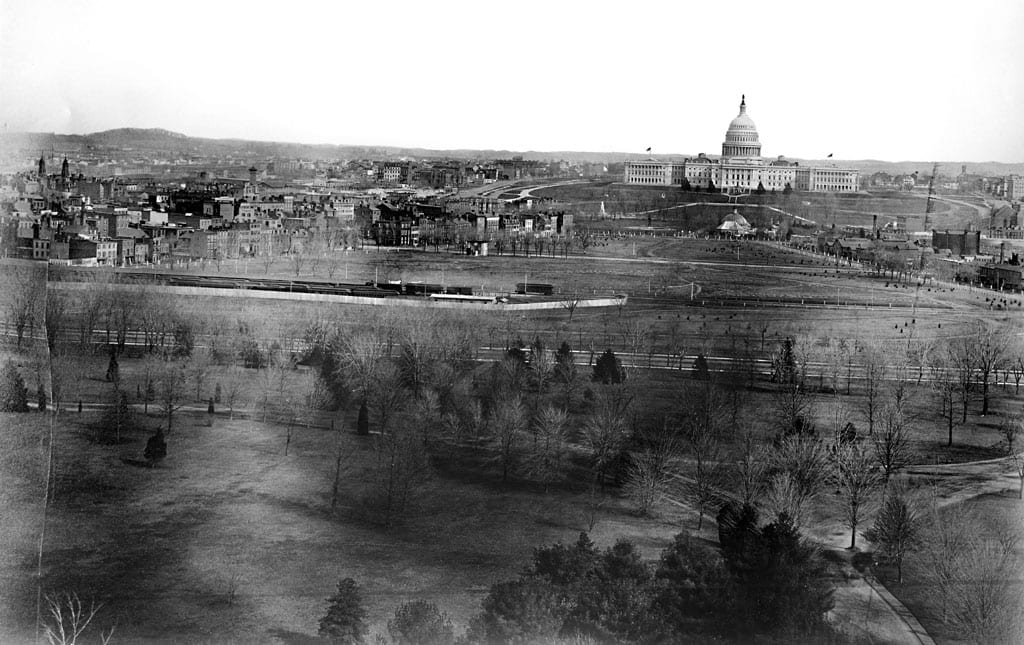
This photograph turned up in the Smithsonian Institution Archives, dated around 1900, and it captures something almost nobody alive today remembers: the National Mall as a working industrial yard, photographed from a high perch on the Smithsonian Castle.
The view looks east toward the west front of the U.S. Capitol. In the foreground sits the United States Botanic Garden, the octagonal glass greenhouse built in 1859, with the central pavilion added after the Civil War rising just behind it. Railroad tracks cut straight across the Mall, and a train sits on the rails. The Capitol dome anchors the horizon.
There is no long lawn, no formal axis, no Lincoln Memorial waiting at the other end. The Mall as we know it has not been invented yet.
The catalog description from the Smithsonian Archives is matter-of-fact about what we are looking at:
Looking toward the west side of the United States Capitol building, a panoramic view of the city of Washington, D.C. shows the Mall area in the foreground before the railroad tracks were removed. A train is visible on the tracks. The domed structure in front of the Capitol is the Botanic Garden original octagonal greenhouse of 1859 and behind it the central pavilion added after the Civil War. The buildings were razed in 1932.
That train on the tracks is no accident of the moment. The Baltimore and Potomac Railroad, a Pennsylvania Railroad subsidiary, ran its main line straight through the Mall along Sixth Street and built a Gothic depot on B Street (now Constitution Avenue) at the foot of Capitol Hill. The depot opened in 1873.
For more than three decades, passengers stepped off trains a few hundred yards from the Capitol and walked past coal piles, smoke, and the rumble of locomotives into the city’s most prominent civic ground.
The B&P station is also where Charles Guiteau shot President James Garfield on July 2, 1881. Garfield lingered through the summer and died in September. The station’s reputation never recovered.

By the time our photograph was made, the Mall in front of the Capitol was a patchwork. The Botanic Garden conservatory had grown into a complex about three hundred feet long. The U.S. Department of Agriculture had its own large building and greenhouses farther west, built in 1867 and razed in 1930. Trees and Victorian carriage paths filled in the gaps. There was no grand lawn, no clear sightline, nothing like the formal east-west axis we now take as the definition of the Mall.
What killed the view
Congress fixed all of that in a hurry. On March 8, 1901, the Senate created what became the Senate Park Commission, chaired by Senator James McMillan of Michigan and stocked with the highest-profile design talent in the country: architect Daniel Burnham, who had just run the 1893 Chicago World’s Fair; architect Charles F. McKim of McKim, Mead and White; landscape architect Frederick Law Olmsted Jr.; and sculptor Augustus Saint-Gaudens.
The commission sailed for Europe on June 13, 1901. For seven weeks Burnham, McKim, Olmsted, and Charles Moore (McMillan’s chief aide and the commission’s secretary) toured the great formal landscapes of England, France, Germany, and Italy. They came home with a report that proposed to scrape the Mall clean.
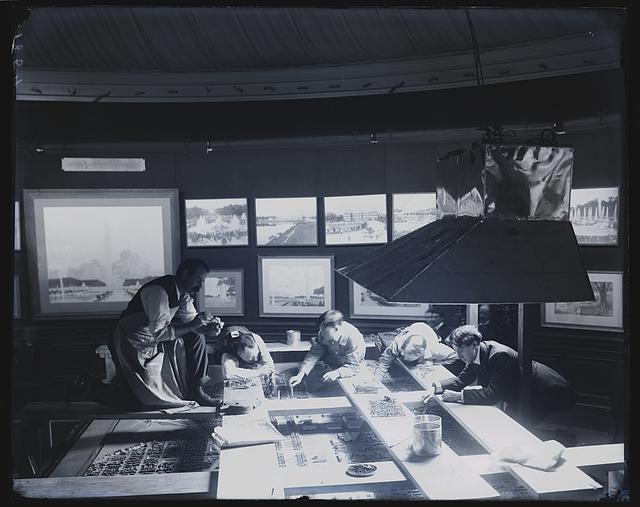
The McMillan Plan was released to the public on January 15, 1902, the same day a massive exhibit of models, drawings, and renderings opened at the Corcoran Gallery of Art. President Theodore Roosevelt was there for the opening. The exhibit was dominated by two enormous scale models of the District, one showing it as it existed and the other showing what the commission proposed: a Mall of unbroken open lawn, exactly three hundred feet wide, running west from the Capitol to the Washington Monument and on to a memorial at the river.
The Victorian gardens were out. The railroad was out. The depot was out. Every building that broke the axis was out.
Congress moved with unusual speed. On May 15, 1902, it authorized a new Union Station north of the Capitol. Legislation reimbursing the Pennsylvania Railroad for moving its tracks off the Mall passed in 1903. The last B&P train pulled out of the Mall depot in 1907. The Gothic station came down in 1908.
The Department of Agriculture Building survived another two decades and was razed in 1930. The Botanic Garden held on the longest. It was shifted a few hundred feet south in 1924, the buildings in our photograph were finally torn down around 1932, and the new conservatory reopened in 1933 at its current location at the foot of Capitol Hill, where it still sits.
What you would see today
The National Gallery of Art’s West Building, opened in 1941, occupies the ground where the B&P depot once stood. The reflecting pool and the long lawn stretch through what used to be tracks, coal piles, and Victorian greenhouses. The Capitol’s west front now looks out across the open expanse the McMillan planners drew on paper in 1901.
The photograph above is one of the last clean records of what was there before.
We dug this one up with help from AI and checked it against the original records below. Here’s how we use AI.