
On the night of April 14, 1865, while John Wilkes Booth was shooting Abraham Lincoln at Ford’s Theatre, a six-foot-tall Confederate veteran named Lewis Powell forced his way into Secretary of State William H. Seward’s house on Lafayette Square and stabbed him in his bed. Powell was twenty years old, captured three nights later at the Surratt boardinghouse on H Street, tried by a military tribunal, and hanged in the prison yard of the Old Arsenal Penitentiary on July 7, 1865.
He was, by every account that survives, the most physically dangerous of Booth’s conspirators. And he is the man in one of the most haunting photographs of the entire Civil War.
Who Was Lewis Powell?
Lewis Thornton Powell was born on April 22, 1844, in Randolph County, Alabama, and raised mostly in Stewart County, Georgia. His father was a Baptist minister. The family moved to Florida in 1859.
When the war came, he enlisted in the 2nd Florida Infantry. He fought through the Peninsula Campaign, Antietam, and Fredericksburg. At Gettysburg on July 2, 1863, he was shot in the right wrist and captured at nineteen.
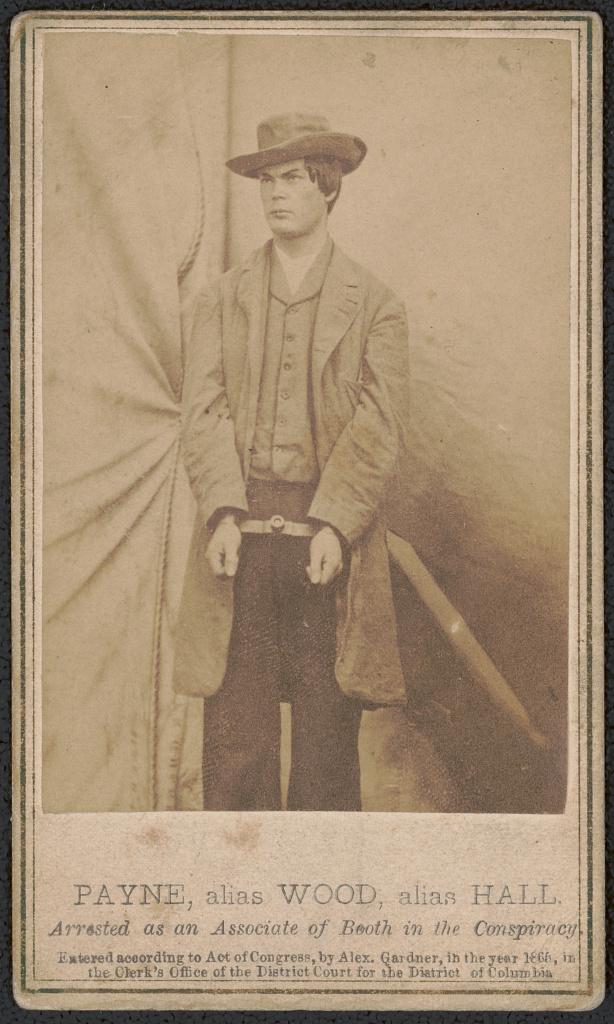
Powell was held at a Union hospital in Baltimore, escaped, and rode south to join John Singleton Mosby’s partisan rangers in Northern Virginia. He fought with the rangers through 1864, then deserted in January 1865 and took an oath of allegiance to the United States in Alexandria, signing his name “Lewis Payne.” The alias would follow him to the gallows.
How he met John Wilkes Booth is murky. By March 1865, Powell was in Washington, lodging at the Herndon House on Ninth Street, waiting for orders.
Booth’s Plan for the Night of April 14
When Lincoln’s victory speech on the White House lawn on April 11 turned Booth from a kidnapper into an assassin, Powell drew the deadliest assignment. He was to kill the Secretary of State.
William H. Seward was bedridden. Nine days earlier his carriage horses had bolted near Vermont Avenue, the Secretary had jumped, and he had landed badly. His jaw was broken, his right arm was broken, and a Washington jeweler had built him a metal jaw splint that he wore strapped around his face and neck.
He was asleep in a second-floor bedroom of his rented house at the corner of Madison Place and Pennsylvania Avenue NW, facing Lafayette Square. Lincoln had named him to the State Department four years earlier (you can see Lincoln’s nomination letter in our earlier post).
Booth shot Lincoln at roughly 10:15 p.m. Powell knocked on Seward’s door at 10:10 p.m. George Atzerodt, given the assignment to kill Vice President Andrew Johnson, drank himself into uselessness at the Kirkwood House bar and never went upstairs.
The Attack on Secretary Seward
A young Black servant named William Bell answered the door. Powell carried a small package and a story. He said he was a messenger from Dr. Tullio Verdi, the Secretary’s physician, with medicine that had to be delivered directly to the patient.
Bell told him to leave the package. Powell pushed past him and started up the stairs. Bell, alarmed, followed.
At the second-floor landing, Powell was intercepted by Frederick Seward, the Assistant Secretary of State, who had heard the commotion. Frederick told the intruder his father was asleep. Powell pulled a Whitney navy revolver and squeezed the trigger.
The pistol misfired. Powell beat Frederick across the skull with the gun barrel until the weapon broke and Frederick collapsed with a fractured skull. He would survive, but only barely.
Powell drew a Bowie knife and pushed into the bedroom. Seward’s daughter Fanny was at her father’s bedside. Powell knocked her aside and climbed onto the bed.
He stabbed at the Secretary’s face and throat. The jaw splint, which had probably saved Seward’s life when his horses ran the week before, saved it again. The blade glanced off the metal frame. Seward rolled himself off the side of the bed and wedged into the gap between the mattress and the wall.
Two more men were in the room by now. Private George F. Robinson, a wounded Union soldier serving as Seward’s nurse, grabbed Powell from behind. Augustus Seward, another of the Secretary’s sons, came in still half asleep. Powell slashed both of them, and a State Department messenger named Emerick Hansell who arrived in the hall as he was leaving.
By the time he hit the street, he had wounded five people. He mounted his horse, dropped his bloody knife in the gutter, and rode east, yelling, by Bell’s later testimony, “I’m mad! I’m mad!”
Seward survived. Lincoln, a mile away across town, did not. For a broader picture of the night, see our piece on contemporary sketches of the Lincoln assassination.
How Was Lewis Powell Caught?
Powell hid in the woods east of the Capitol for nearly three days. He had been told to meet Booth and David Herold at the Navy Yard Bridge. He never found them.
By the night of Monday, April 17, hungry and lost, he made his way back to the one safe house he knew. The boardinghouse Mary Surratt kept at 604 H Street NW had been a meeting point for the conspiracy. Surratt herself had been arrested earlier that same evening by officers from Major Henry W. Smith’s command. The house was full of detectives when Powell knocked.
He had improvised a disguise on the way over. He wore a pant-leg cut from a pair of long drawers, pulled down over his head as a cap, and he carried a pickaxe to look like a day laborer. He told the officers he had been hired by Mrs. Surratt to dig a gutter.
The detectives turned to Mary Surratt. Major Smith asked her if she knew the man. She raised her right hand and answered, by the trial record, “Before God, sir, I do not know this man, and have never seen him, and I did not hire him to dig a gutter for me.” Powell was arrested on the spot.
The Surratt boardinghouse still stands at 604 H Street NW, in the middle of what is now Chinatown. We wrote about its current life as a Chinese restaurant. The famous War Department broadside offering $100,000 in rewards was issued three days after Powell’s capture and listed only Booth, John Surratt, and Herold. See the post on the original Wanted poster.
The Photographs on the USS Saugus
Powell was transferred to the Washington Navy Yard and held in irons on the deck of the USS Saugus, an ironclad monitor anchored in the Anacostia River.
Nine days later, on April 27, 1865, Alexander Gardner came down to the Yard with a camera. The federal government had hired him to document the conspirators. Gardner photographed Powell more than any of the others.
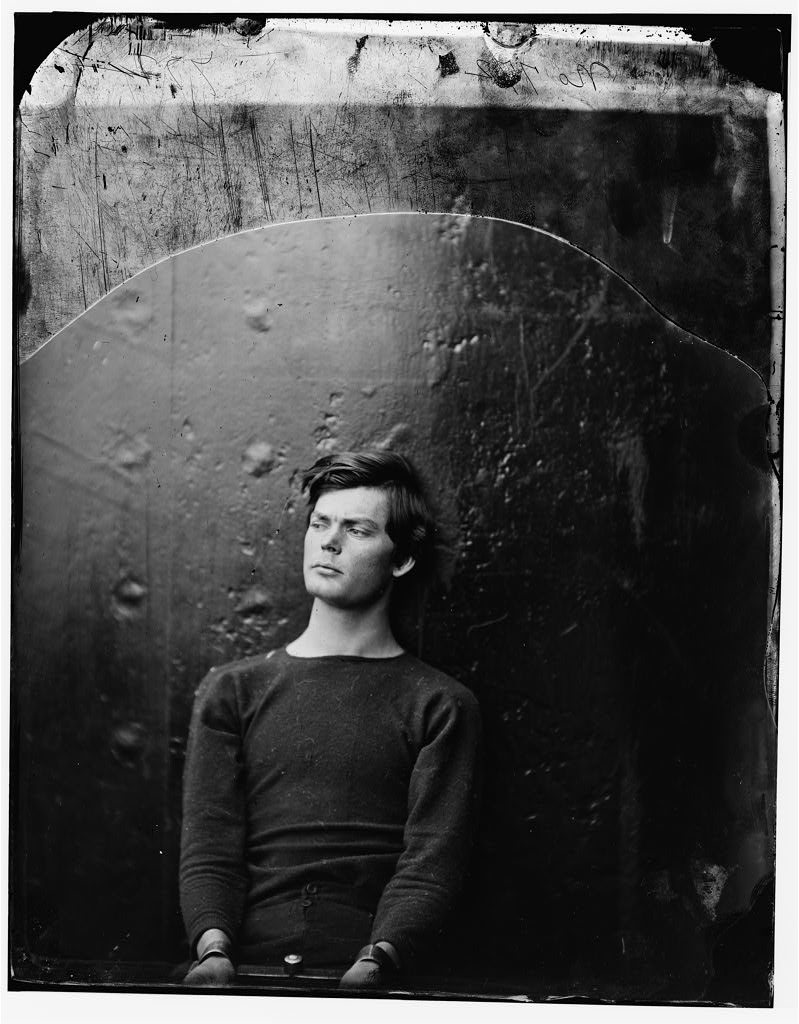
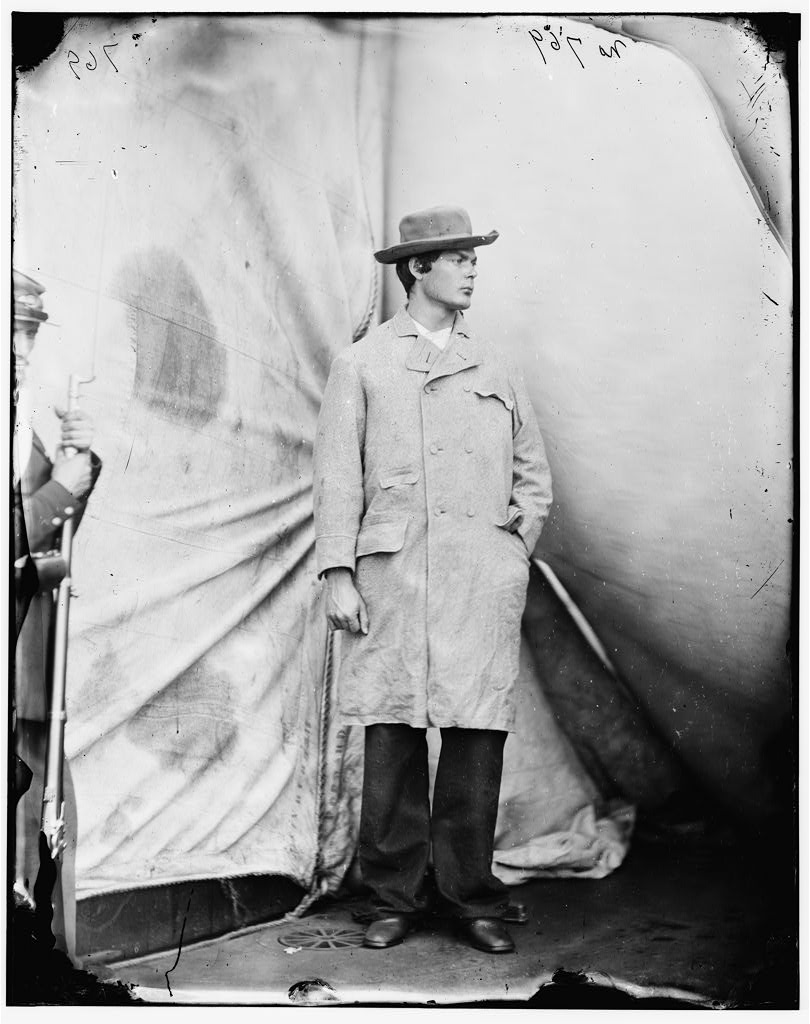
He posed him standing in an overcoat and hat. He posed him seated against the gun turret in a wool sweater, manacled. He shot him with and without “lily irons,” a kind of restraint that locked the wrists together so they could not be moved independently.
The seated portrait is the one history remembers. Powell stares directly into the lens, dark hair pushed back, jaw set.
Roland Barthes used a Gardner print of Powell as the closing image of his 1980 book on photography, Camera Lucida. He titled the entry, simply, “He is dead and he is going to die.”
The Trial and the Execution
The military tribunal convened in a converted room on the third floor of the Old Arsenal Penitentiary on May 9, 1865. Eight defendants were tried at once.
Powell’s court-appointed attorney, William E. Doster, pleaded insanity. He argued that Powell’s brain had been broken by Mosby’s war and that Powell sincerely believed he had been carrying out a soldier’s orders.
The argument was honest, and it was hopeless. Powell himself said almost nothing through the seven-week trial and gave no testimony in his own defense.
The verdict came on June 30, 1865. He, Mary Surratt, David Herold, and George Atzerodt were sentenced to hang.
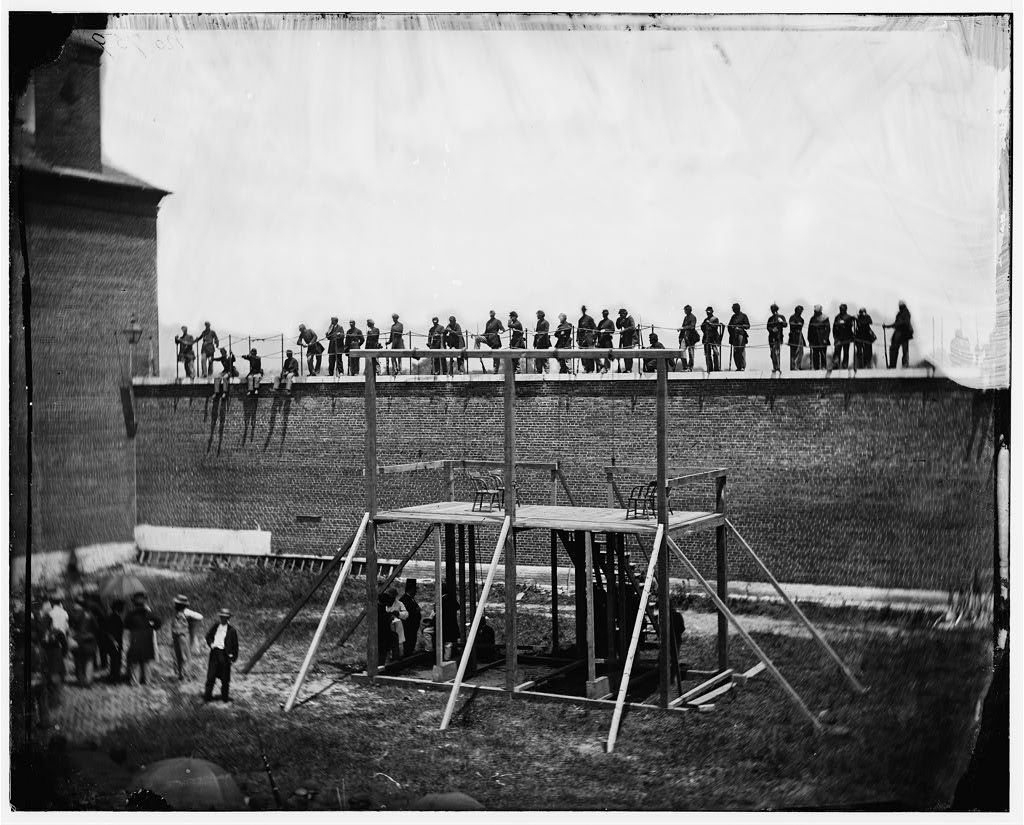
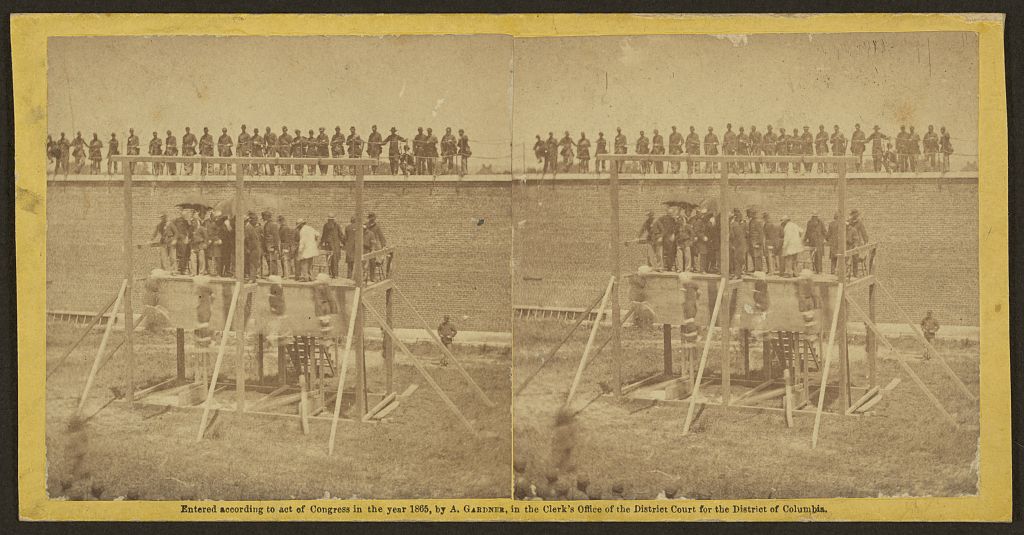
The gallows was built in two days inside the courtyard of the Old Arsenal. It was twelve feet high and wide enough for four people to drop at once.
July 7, 1865, was a hundred-degree day. More than a thousand witnesses pressed into the yard or stood on top of the arsenal walls. Soldiers held umbrellas over the condemned to keep the sun off their heads. The drop fell at 1:26 p.m.
Surratt and Atzerodt died quickly. Herold and Powell did not. Powell, who weighed roughly 175 pounds and dropped less than six feet, struggled at the end of the rope for nearly five minutes before he stopped moving.
Alexander Gardner photographed the execution. His stereographs survive at the Library of Congress and they are exactly what they appear to be. The Old Arsenal site is now part of Fort Lesley J. McNair at the southern tip of Buzzard Point. There is a tennis court roughly where the scaffold stood.
For the broader story of the manhunt and the soldier who actually killed John Wilkes Booth, see our post on Boston Corbett, Lincoln’s avenger.
How Tall Was Lewis Powell? What Color Were His Eyes?
Powell stood six feet two inches, exceptionally tall for a man of his generation. The average Union infantryman was about five feet seven. Witnesses who saw him at Seward’s house called him “athletic” and “powerful.”
His eyes are described in contemporary accounts as gray-blue, set under dark, heavy brows. His hair was dark brown and combed back high off his forehead. His mouth, in the Gardner portraits, sits in something between a sneer and a refusal.
The Long Strange Afterlife of His Skull
Powell, Surratt, Herold, and Atzerodt were buried in the arsenal yard the day they were hanged. In 1869, the families were given permission to take the remains home for reburial. Powell was sent to Florida.
Or so everyone assumed.
In January 1992, an anthropologist named Stuart Speaker was inventorying a Smithsonian collection for possible repatriation to Native American tribes. He came across a skull with the number “2244” written on the forehead in faded ink. The accession card said it had arrived at the U.S. Army Medical Museum on January 13, 1885, from the office of Joseph Gawler, a Washington undertaker. The donor had identified it as Lewis Powell.
How a Washington funeral home had ended up with Lewis Powell’s skull twenty years after his execution is still not fully clear. The most credible theory is that when the conspirators’ remains were released in 1869, someone at the burial site kept the head as a souvenir, and it passed through private hands until Gawler donated it to the Army museum in 1885.
The body had gone home to Florida. The skull had not.
On November 12, 1994, Powell’s skull was buried at Geneva Cemetery in Geneva, Florida, beside the grave of his mother. He had finally been reassembled, in a manner of speaking, 129 years after he was hanged in the Arsenal yard.
He was twenty-one years old when he died, by twelve weeks. He had been a Confederate soldier for nearly four years. He had been part of John Wilkes Booth’s conspiracy for about six weeks. And he is one of the most photographed faces of the entire 1860s.
It’s a great photo. Based on the similar background in the pic on his Wikipedia entry http://en.wikipedia.org/wiki/Lewis_Powell_%28conspirator%29
it seems apparent this photo was taken at the same time aboard the USS Saugus.