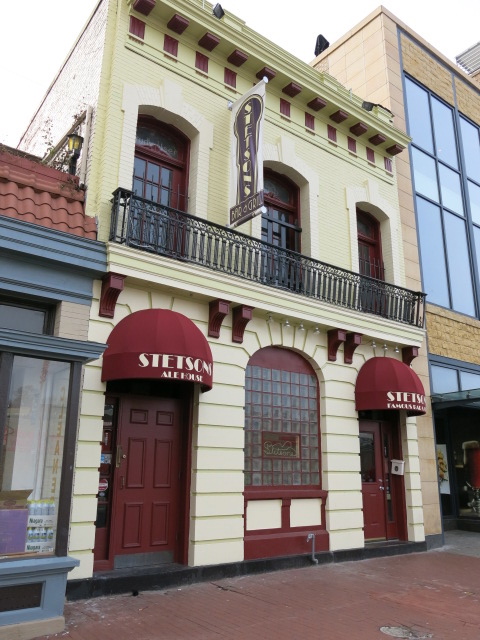
Halloween 2015 was closing night at Stetson’s Famous Bar & Grill, and the storefront it emptied out of had been serving drinks, off and on, since before Prohibition.
Stetson’s ran the place for thirty-five years. The building outran Stetson’s by roughly seventy.
Anna Spiegel broke the closing news in Washingtonian on October 30, 2015. Douglas Development had bought the building and the liquor license, and the divey “Tex-Mex saloon” was pouring its last round the next night. On February 17, 2016, the DC Alcoholic Beverage Control Board formally cancelled ABRA license number 060455, held by 1610 Restaurant, LLC, t/a Stetson’s. The order noted that the licensee had gone dark on December 29, 2015.
Today the same storefront is Exiles Bar, an Irish-leaning sports pub opened by Donagh Gilhooly, Brian Hillery, Karl Keane, and Danny Price. Exiles won Best Bar in DC at the 2023 Rammy Awards. Two floors and a patio. Penn State, Buffalo Bills, UNC, Liverpool FC on the screens. Different flag, same address.
Which is the interesting part. Because 1610 U Street NW has been a place people go to drink for about a hundred years, and the ownership chain has more Prohibition-era mugshots than any bar tour of U Street will tell you.
Federal agents raided the storefront five times between 1921 and 1924, hit it again in 1930, and arrested a proprietor named Thomas McCarthy in the basement, washing bottles.
Stetson’s (1980 to 2015)
Stetson’s opened in 1980. In the Washington Post’s Weekend section on January 14, 1983, Lloyd Grove profiled DC’s most interesting jukeboxes and stopped by 1610 U Street to hear the Rock-Ola Quadphonic at “STETSON’S, a Tex-Mex spot at 1610 U Street NW.” Grove named the three co-owners: Peter Shillinglaw, from Liverpool; Tommy Fitts, from Austin, Texas; and Ralph Le Blanc, from Vidor, Texas. Their jukebox, Shillinglaw said, offered “a selection of everything from Billie Holiday to country & western to Elvis Costello.”
Seven months later, Roger Piantadosi returned for a full Weekend review on August 26, 1983. “Hats Off to Stetson’s” opens with a British guy at the bar in Crimean War navy regalia and moves quickly to what surrounded the place:
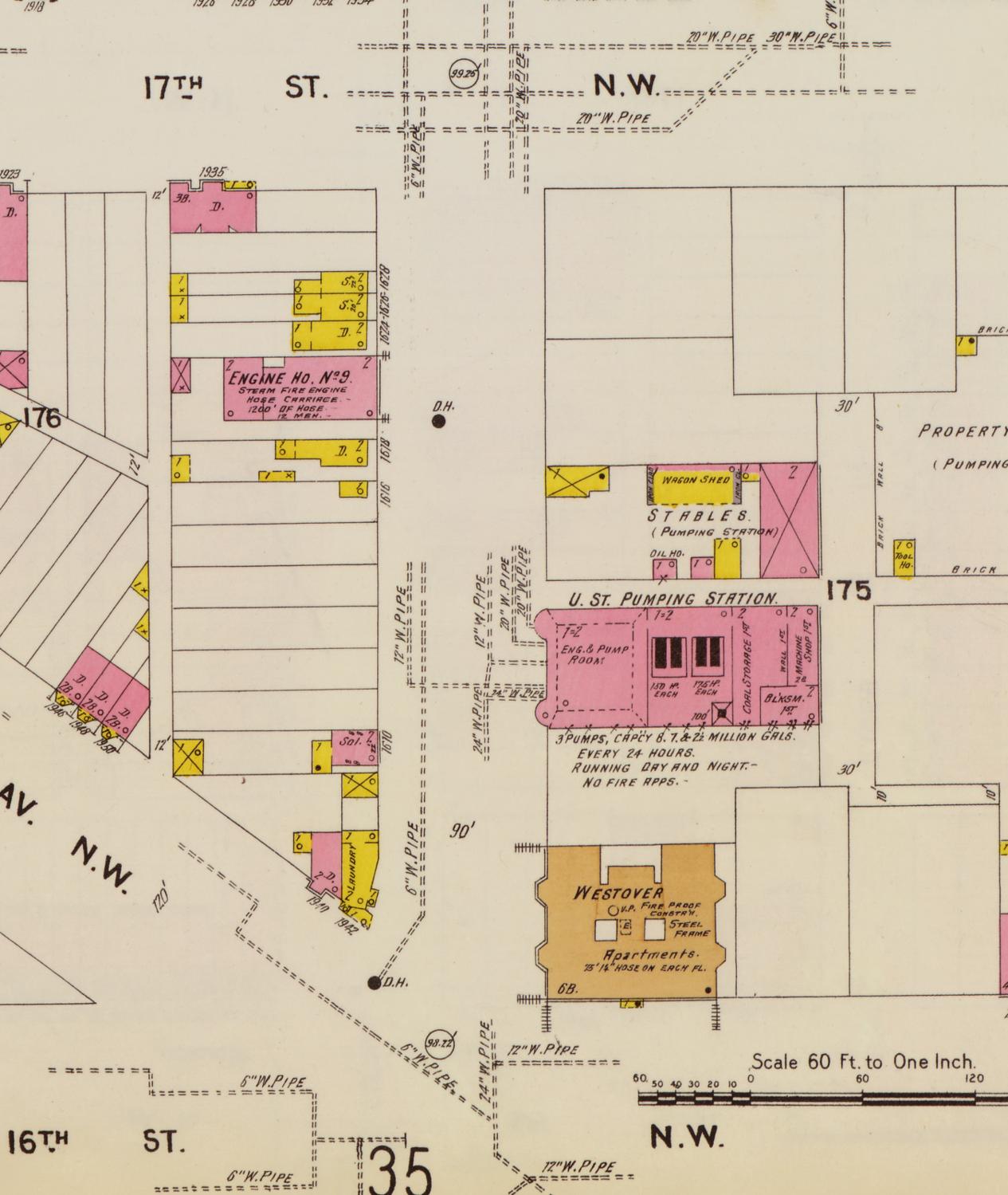
This is also U Street: the block where you’ll find the back door of the Third District police station, plus a huge boarded-up apartment building and one of the city’s most popular firehouses. In other words, Stetson’s jukebox, while it’s both good and loud, yields regularly to the hook and ladder.
He goes on:
And a healthy imagination, which, by the way, is probably the biggest threat to your personal safety in this unjustly avoided neighborhood.
“Unjustly avoided neighborhood.” That is the U Street corridor of 1983, fifteen years after the disturbances that followed the King assassination and fifteen years before the U Street Metro station and the wave of new bars and condos that came with it.
Stetson’s was one of the holdouts on a block that had lost most of its earlier commerce. Its Tex-Mex saloon shtick, boarded-up neighbors, and firehouse-siren jukebox soundtrack lasted straight through the neighborhood’s revival.
Alfred’s Steak House (1940s to 1950s)
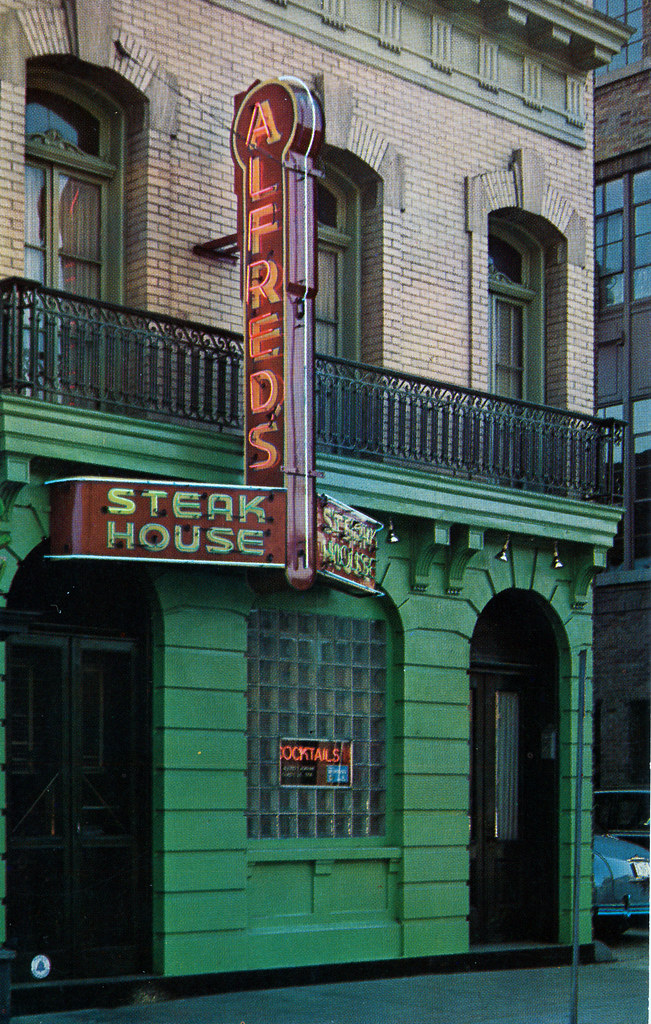
Before Stetson’s, the storefront housed Alfred’s Steak House. The primary evidence is a postcard from Alfred’s own promotional stock, held in the collection of John DeFerrari, author of Historic Restaurants of Washington, D.C.: Capital Eats, and posted to Flickr by his Streets of Washington account. The postcard puts Alfred’s at 1610 U Street NW in the 1950s.
The Washington Post historical archive turns up nothing tying Alfred’s Steak House to 1610 U Street by name and address, which is worth flagging honestly. Everything currently in circulation about Alfred’s, including the famous list of jazz-era patrons, traces back to Stetson’s own website copy. That doesn’t mean the stories are wrong. It does mean the postcard is the anchor, and anything further, including the celebrated names dropped in later retellings, is not something we can source to a dated article or ad.
What we can say is that the building’s second half of the 20th century started as a steakhouse on the western edge of U Street’s Black Broadway commercial run, and finished as a Tex-Mex bar on the same block.
Prohibition: five raids and a basement
Rewind to the driest stretch of U Street’s history.
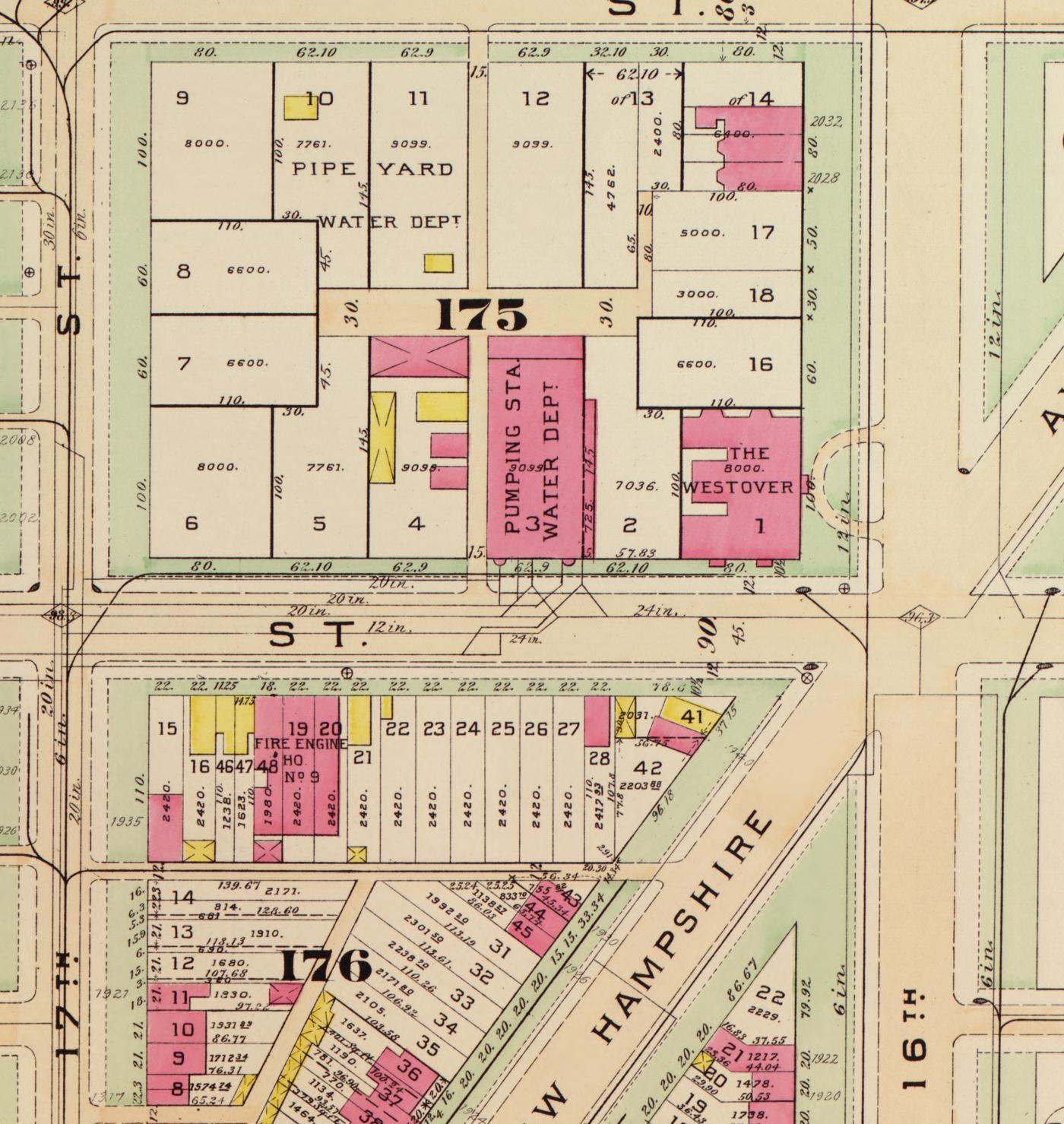
DC went dry on November 1, 1917 under the Sheppard Act, more than two years before national Prohibition. The saloons on U Street either closed, converted to lunch counters, or went to work selling near-beer with a whiskey chaser out the back. The storefront at 1610 U picked door number three.
On November 24, 1921, the Evening Star reported the seizure of 181 quarts of whiskey and 40 quarts of gin at 1610 U Street. The paper named the operator:
Patrick J. Murphy, thirty-two, residing at the U street address, was arrested and charged with selling, illegal possession and use of alleged fraudulent revenue stamps.
Sixteen months later, the Washington Times reported on March 9, 1923, that District Attorney Peyton Gordon was seeking an injunction to padlock the place:
Injunctions are sought in a petition filed today in the District Supreme Court by District Attorney Gordon against Patrick Murphy, at 1610 U street northwest.
That October, they raided him again. From the Evening Star on October 19, 1923:
Lieut. Sullivan and party reached the near-beer place of Patrick J. Murphy, 1610 U street, shortly after 10 o’clock. They arrested Murphy on charges of selling and possession, and reported the seizure of one gallon of corn whisky. Bond of $1,500 was furnished.
Ten months after that, they came back for what the Washington Times front page called the fifth raid. From August 6, 1924, page 1:
Police of the Eighth precinct, led by Lieutenant Sullivan, last night discovered thirteen half pints of alleged whiskey in the near beer saloon at 1610 U street northwest. It was the fifth raid on the establishment, according to police. Patrick J. Murphy, thirty-four, proprietor, was arrested on charges of illegal possession and sale.
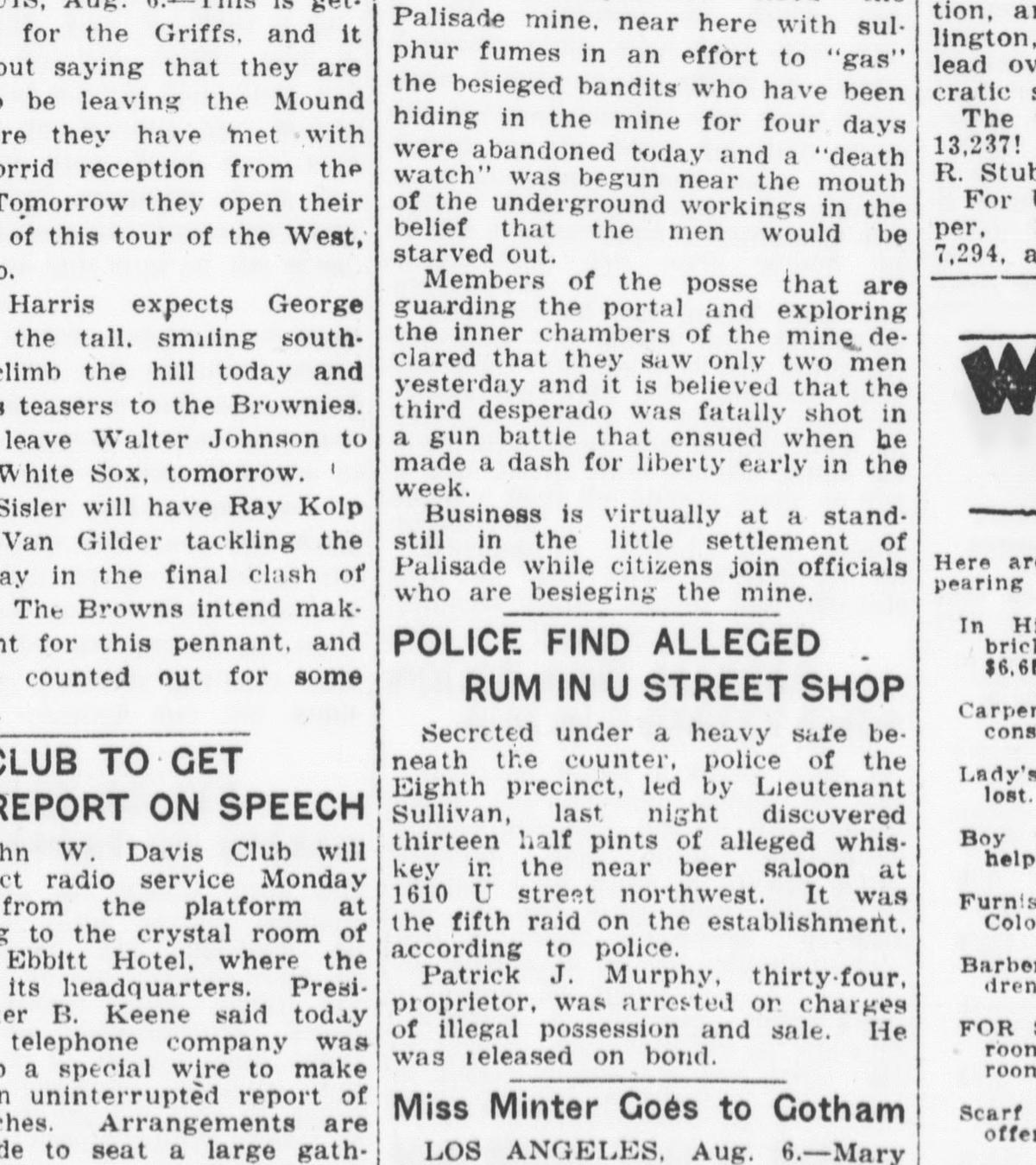
Murphy was in the papers so often that a routine 1920 building permit for a metal garage at the rear of 1610 U Street, cost of $180, listed him by name in the Washington Times real estate column.
By 1930 the operator’s name had changed but the game had not. On May 30, 1930, the Evening Star covered a full day of Prohibition raids in the District and got to 1610 U near the end:
At 1610 U street, where a bar room was operated before prohibition, members of the raiding party found Thomas McCarthy, 58 years old, alleged proprietor, washing bottles. The basement was visited and six glass containers of liquor were found, police reported.
That last sentence is the anchor for one of the durable stories about the site, that renovations decades later turned up bottles in the basement stamped 1610 U Street. The 1930 raid puts an actual basement, actual bottles, and an actual proprietor named McCarthy into the primary record. The rest is folklore built downstream of that.
Pre-Prohibition: John Morris, saloonkeeper
Which leaves the question of what the storefront was before the Sheppard Act shut down every legal bar in the District.
On March 13, 1915, the Washington Times published the Anti-Saloon League’s roster of DC saloons the League claimed were operating in violation of the excise rules, specifically on non-business blocks or in residential sections. The list is a straight roster of names and addresses, in the same layout a phone book uses. One line reads:
John Morris. 1610 U street northwest.
Morris is a pre-Prohibition saloonkeeper the League wanted put out of business. Two and a half years later, the Sheppard Act did the job.
There is a good chance the building was serving liquor even before Morris took the lease. The Washington Times noted a resident of 1610 U Street NW as far back as January 1, 1913, when thirteen-year-old Cora Sheets was knocked down by a horse-drawn cart in the neighborhood. Saloons of the era typically had a proprietor’s family upstairs and the barroom on the street level. That was the arrangement Prohibition never really broke, just drove into the back rooms.
What happened on Halloween
Douglas Development advertised the leasing flyer in September 2015 and sent Stetson’s out the door on Halloween night, October 31, 2015. Anna Spiegel called it “one of U Street’s stalwart bars.” The Alcoholic Beverage Control Board sent the closure notice on December 30, 2015, and cancelled the license the following February.
Eight years later the same room had a Rammy on its shelf.
The block is now what Piantadosi’s 1983 review predicted the neighborhood one day would not have to be. The apartment building he called huge and boarded-up is not boarded up anymore. The firehouse still runs. The Third District police station’s back door still opens onto the same alley. And the storefront at 1610 U Street NW is still a bar.
Different bar. Fifth time it has been.
We dug this one up with help from AI and checked it against the original records below. Here’s how we use AI.