
The guy behind the guy is always in a specific room. In this town the room tells the story. When Sherman Adams ran the Eisenhower White House from 1954 to 1958, his room was the Peirce Still House at 2400 Tilden Street NW in Cleveland Park, a converted 1811 whiskey distillery three miles from Lafayette Square. It was not a random rental. Two of his predecessors as guy behind the president had picked their rooms just as carefully. Their buildings tell the story too.
Harry Hopkins in the Lincoln Bedroom, 1940
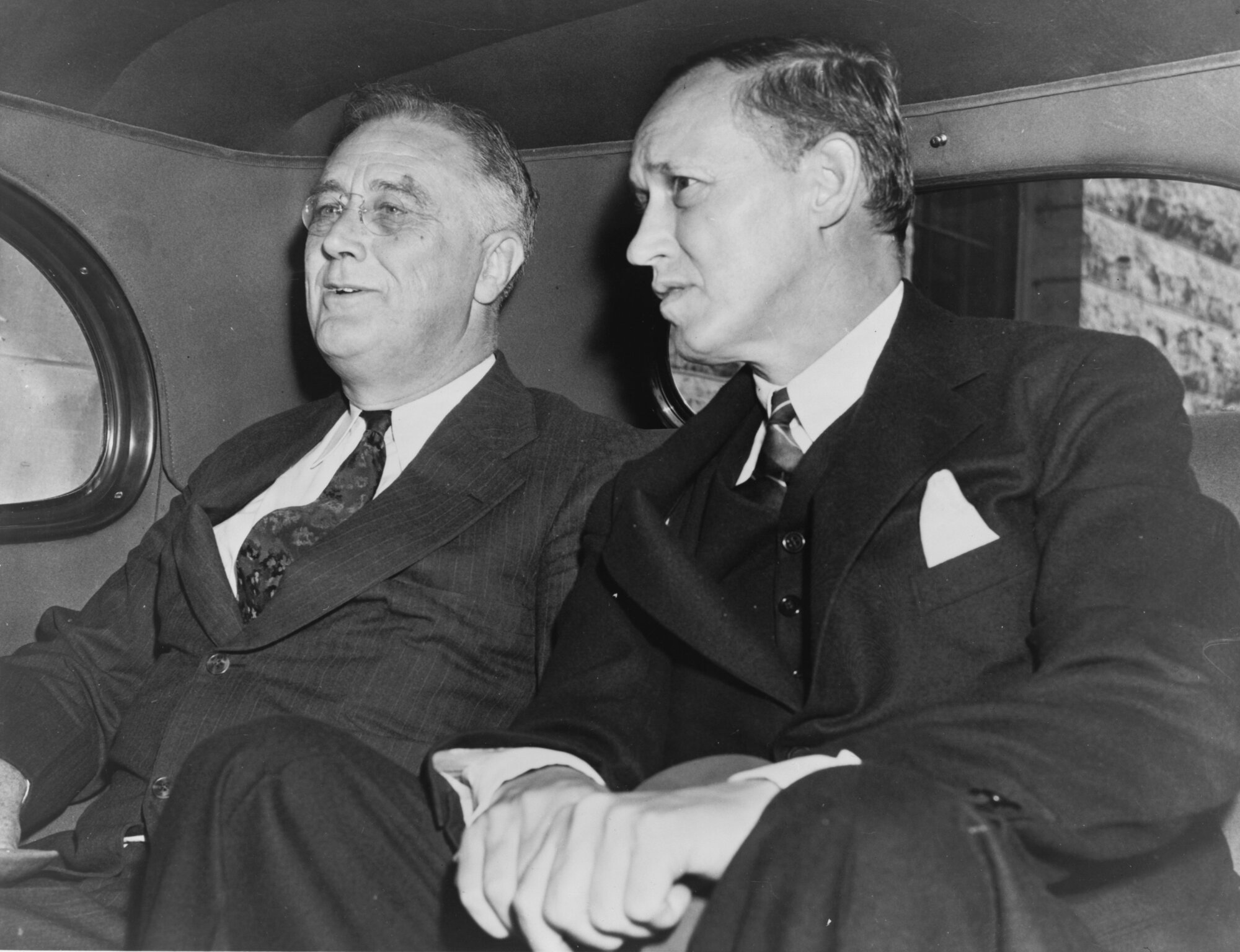
Harry Hopkins’s room was the Lincoln Bedroom of the White House, one door down from Franklin Roosevelt. He walked in for dinner on the night of May 10, 1940, the same day the Wehrmacht rolled into the Low Countries, and never really walked out.
Roosevelt kept Hopkins upstairs for three and a half years. The suite that FDR gave him was the room today called the Lincoln Bedroom, which in the 1860s had been Abraham Lincoln’s Civil War office and Cabinet Room. Hopkins slept there, took meals off a tray there, and worked the transatlantic cables from a small desk his hosts wheeled in.
He carried no formal title matching the influence he wielded. He was, in the phrase Robert Sherwood used in his 1948 memoir, the president’s traveling companion, back channel to Churchill and Stalin, and often the last voice FDR heard before bed.
On December 21, 1943, Hopkins and his wife Louise finally moved out. They took a three-story Federal row house at 3340 N Street NW in Georgetown, built about 1830, half a block off Wisconsin Avenue. A plaque on the front today reads “Harry Hopkins House.” He died at Memorial Hospital in New York on January 29, 1946, less than a year after Roosevelt. What FDR ran on for a decade was a machine of friends inside rooms. When Roosevelt died at Warm Springs in April 1945, Harry Truman inherited a White House with no organization chart.
John Steelman drives in from Chevy Chase, 1946
Truman spent his first year and a half trying to make FDR’s kitchen cabinet work. It did not. On December 12, 1946, he created a new title in the executive branch and gave it to a forty-six-year-old Arkansas labor economist named John Roy Steelman. The title was The Assistant to the President, and Steelman was the first person to hold it.
He did not, however, move into the residence. Steelman lived with his family at 2715 Daniel Rd in Chevy Chase, Maryland, and drove into DC each morning. Even the man who invented the role kept his center of gravity outside downtown.
When Steelman left the White House with Truman in January 1953, he opened an industrial consultancy in the Albee Building at 1426 G Street NW, four blocks east of the residence he had just left. The Albee was a 1912 Beaux Arts pile designed by Jules Henri de Sibour for the Keith-Albee vaudeville circuit, later folded into RKO Pictures.
The theater block was demolished in the late 1970s, though the de Sibour facade survives as the front of the office tower on the site today. Steelman ran his practice out of it into the 1990s and died in 1999 at ninety-nine, buried at Arlington.
Sherman Adams at 2400 Tilden Street NW, 1954
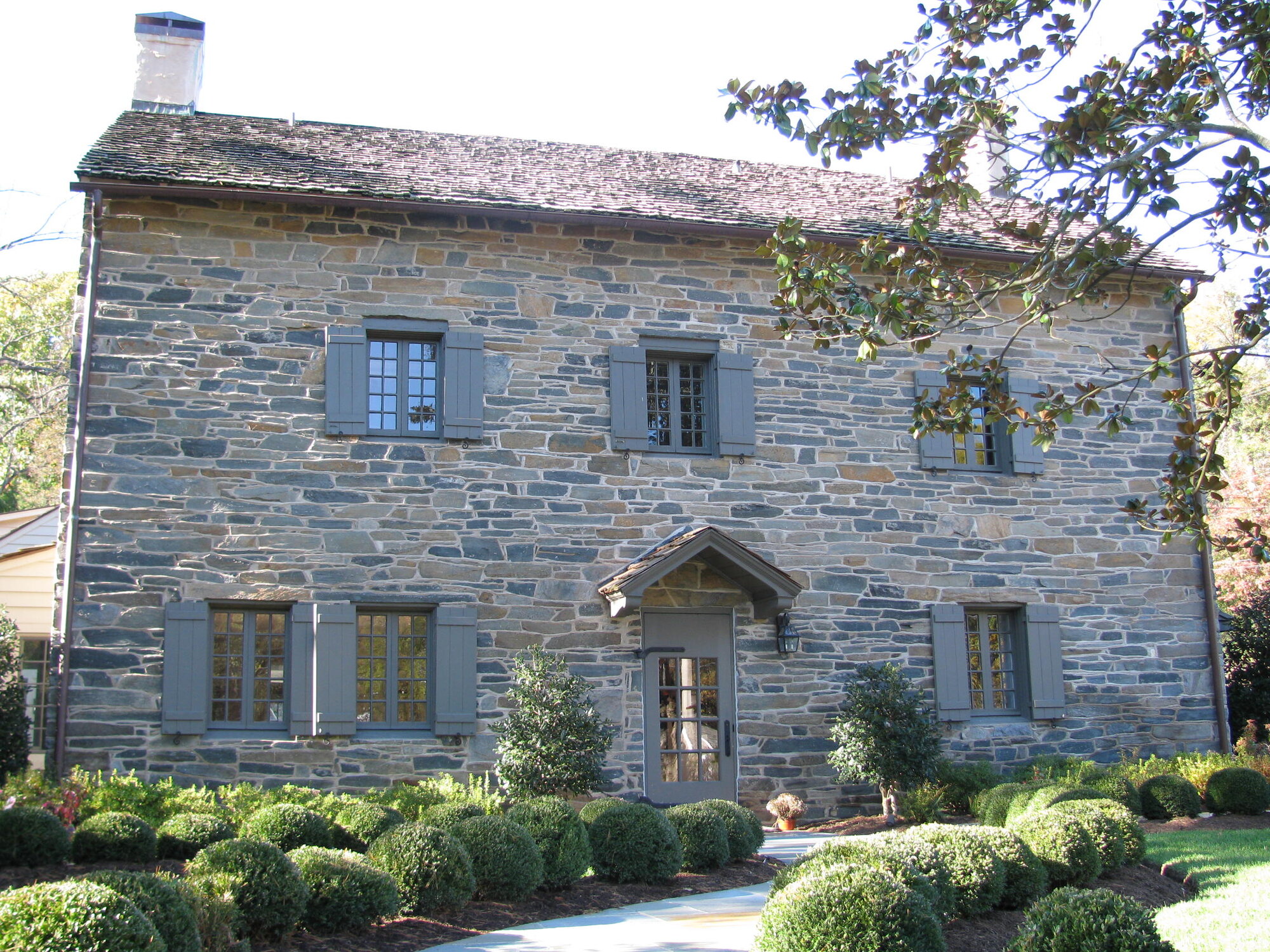
Isaac Peirce bought the land in 1795. He was a Pennsylvania Quaker, a slave owner despite it, and a miller by trade. He built the whiskey still first. The National Register nomination dates the stone building to 1811, and the historical marker on Tilden Street brackets it to 1796 through 1811. A carved stone below the north gable reads “1811 BIP,” the initials probably standing for Betsie and Isaac Peirce.
The walls are two feet of rough blue granite quarried from the upper Potomac. The roof is wooden shingle. The building measures roughly thirty by forty-five feet, rising to three stories at the peak. An interior basement spring drained into the still and produced the water Peirce turned into apple brandy and whiskey. In 1829 he built the current Peirce Mill across the road, ground corn, wheat, and rye for local farmers, and set the still house, the mill, a stone barn, and a springhouse together as a self-contained industrial hamlet on Rock Creek.
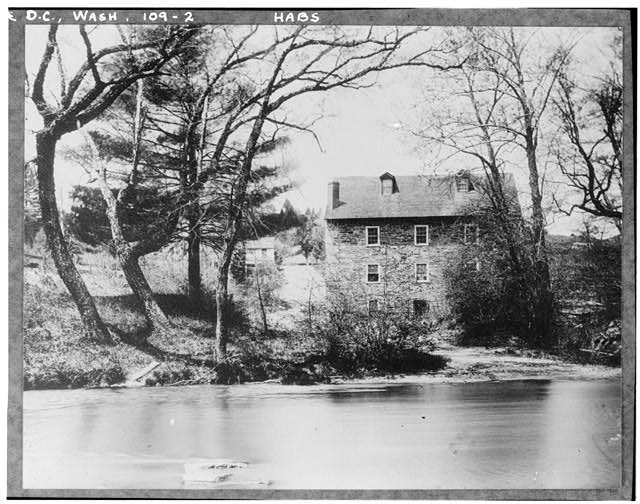
Rock Creek Park was established on September 27, 1890, the third national park in the United States after Yellowstone and Mackinac. In 1892 the federal government bought the section of the Peirce holdings that contained the mill and springhouse and folded them into the new park. The land holding the still house and the adjoining Peirce Shoemaker mansion stayed private. The still had long since gone out of the whiskey business by then. Mid-nineteenth century photographs show it converted into a stone barn, with hay stored where the mash tubs used to be.
In 1924 the Peirce Shoemaker family sold the still-house parcel to Dr. Harry Hyland Kerr and his wife. Kerr was a Canadian-trained surgeon who published in the American medical journals from Washington through the 1920s, 30s, and 50s. Contemporary newspapers sometimes shortened him to Dr. Harry H. Kerr, and the National Register nomination drops the given name entirely and calls him Dr. Hyland Kerr. All three refer to the same man, disambiguated by his 1923 JAMA paper on intestinal surgery.
Dr. Kerr turned the stone barn back into a habitable building. The hand-hewn floor planking of the loft was pulled up and reused as flooring for the new living room. The original beams stayed. Kerr added a one-story Tudor wing to the west, half-timbered with herringbone brick, and a larger dining room addition beyond that.
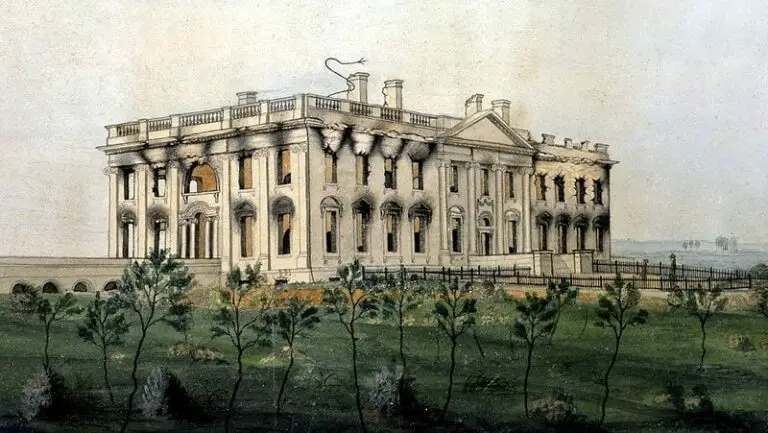
He installed a mantel above the living room fireplace of three wooden planks that the nomination hedges as “said to be” salvaged from the old Capitol Building the British burned in 1814. A later Washington Post profile gave the same planks the burned White House instead. Neither claim carries a documentary source in the record.
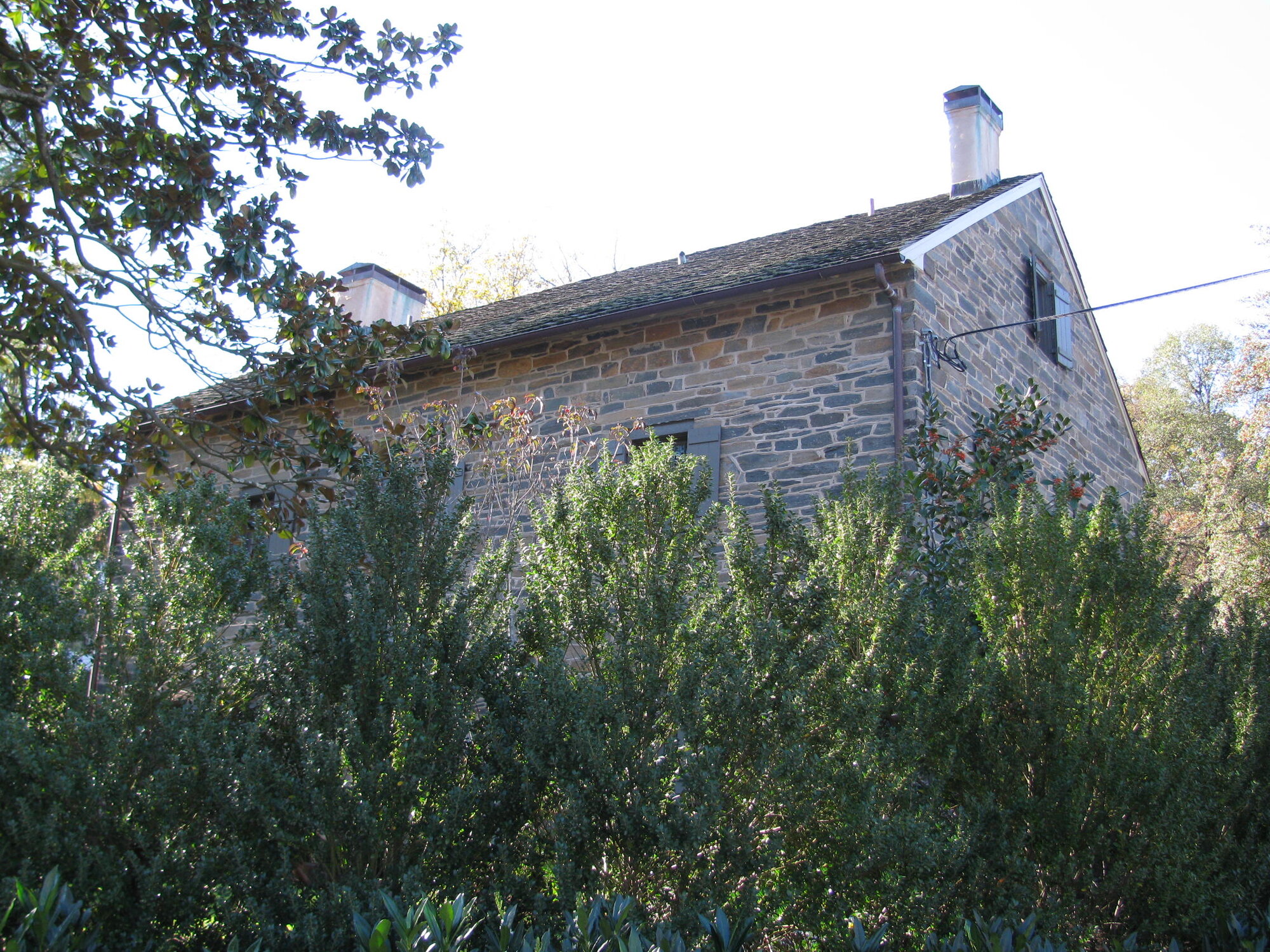
In early 1954, Dr. Kerr leased the house to a new tenant. He and Mrs. Kerr moved themselves to 1929 Q Street NW and kept a summer place in Nantucket. The new tenant was Sherman Adams.
Adams was fifty-five, Vermont-born, Dartmouth Class of 1920, a six-month Marine at the tail of the Great War, a lumberman in Lincoln, New Hampshire for eighteen years, Speaker of the New Hampshire House in 1943, U.S. Representative 1945 to 1947, Governor of New Hampshire 1949 to 1953. Five foot eight, gray-granite face, and since January 1953 The Assistant to the President under Dwight D. Eisenhower.
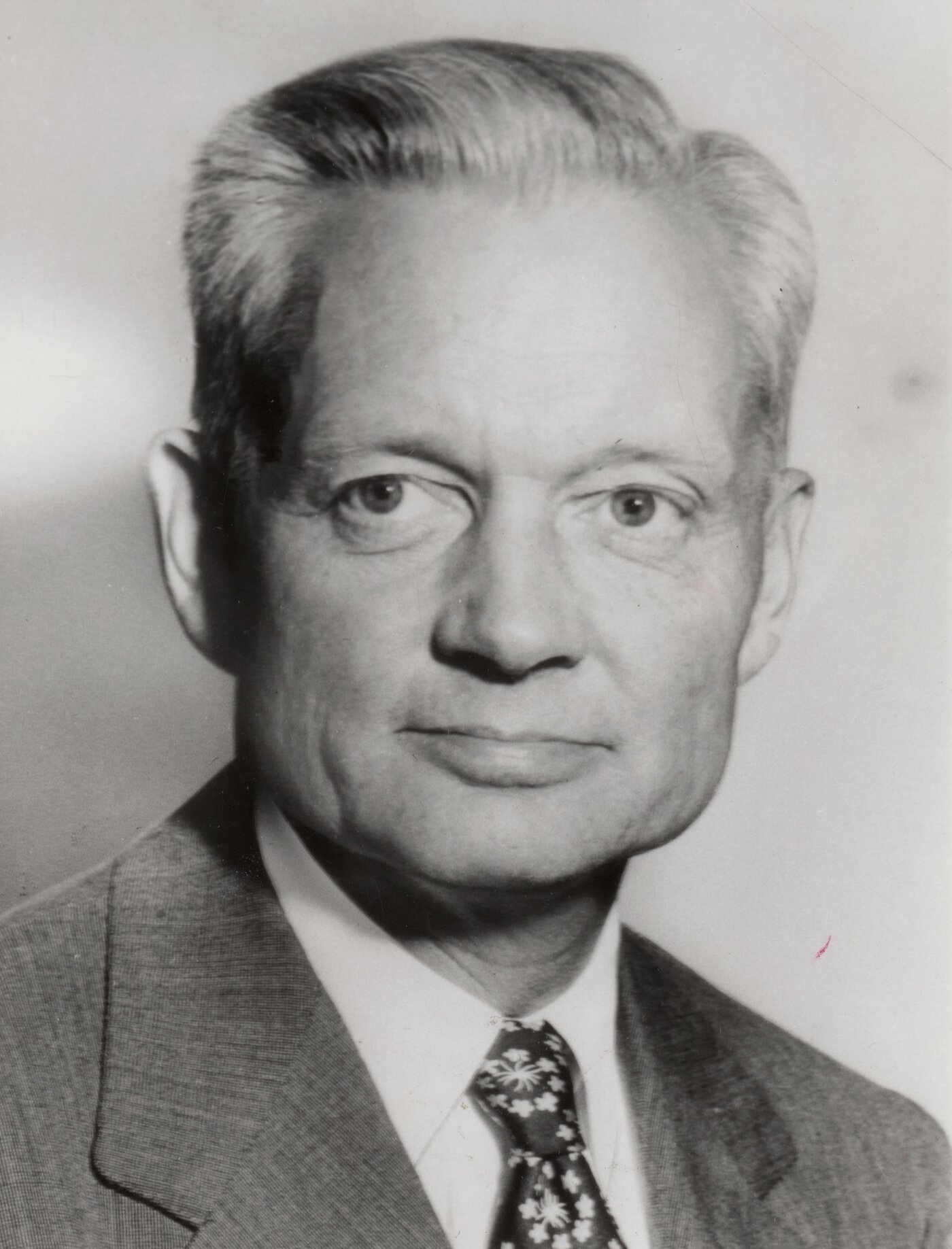
Eisenhower had given Adams the title Steelman invented, and used it to build the proper staff structure Truman never had, modeled on the general staff Ike had run at SHAEF during the war. Adams got a corner office thirty paces from the Oval, first look at every paper the president saw, and the final word on which cabinet secretary got a meeting and which one did not.
Reporters clocked him waking at 5:45 a.m., eating fruit and two eggs, working on Sanka through the day, and answering the phone in a curt New Hampshire clip that made cabinet officers flinch.
Life inside a stone distillery, 1954 to 1958
On January 30, 1955, Mary Van Rensselaer Thayer of the Washington Post was let inside the house for a Sunday feature titled “Life in a Barn, Adams Style.” Her piece is the best surviving portrait of the Adamses at home in Cleveland Park.
She measured the living room at twenty-eight by thirty feet, walls two feet thick, ceilings high enough to swallow whatever noise came in from Tilden Street. The mantel over the fireplace, she wrote, was made of three stout planks, “appropriately once part of the old, British-burnt White House.”
Rachel White Adams, whom Sherman called Plum, cooked his 6:30 breakfast every morning. They kept the social calendar to three nights a week maximum. On weekends they walked out the back door and hiked in Rock Creek Park. Rachel had claimed a converted upstairs maid’s room as a painting studio. The only Adams family member who lived at 2400 Tilden year-round was Sylvia, the family Siamese cat.
Their daughter was teaching kindergarten in Melrose, Massachusetts. Their son was at St. Paul’s School in Concord, New Hampshire. Christmas they went home to Lincoln, where Rachel griddled Vermont maple pancakes and Sherman skied.
Adams drove himself, in a plain sedan, up Rock Creek Parkway and around Washington Circle to Pennsylvania Avenue. Three miles door to door. The paper trail followed him home. He read cables and cabinet memos by the living-room fire until midnight, under the mantel that had come from someone’s burned government building in 1814.
Churchill in the living room
The historical marker on Tilden Street, placed by the National Register, is direct about who came through the door:
In 1955, the House was occupied by Sherman Adams, Chief of Staff to President Dwight D. Eisenhower, who entertained many political figures at the House, including Sir Winston Churchill.
The specific occasion has not surfaced in the published record. Churchill made no documented Washington visit in 1955. He resigned as Prime Minister on April 5 of that year, was recovering from a stroke by June, and did not cross the Atlantic again until May 1959, after Adams was gone.
His last Washington trip as Prime Minister was the June 25 to 29, 1954 stay with Eisenhower, per the Library of Congress Churchill exhibition and the Hillsdale Churchill Project. Adams had already been in the house six months. If Churchill sat in the Peirce Still House living room, it was almost certainly during that late-June week. The marker’s 1955 appears to be a rounding of Adams’s full residency.
The vicuna coat, and the exit
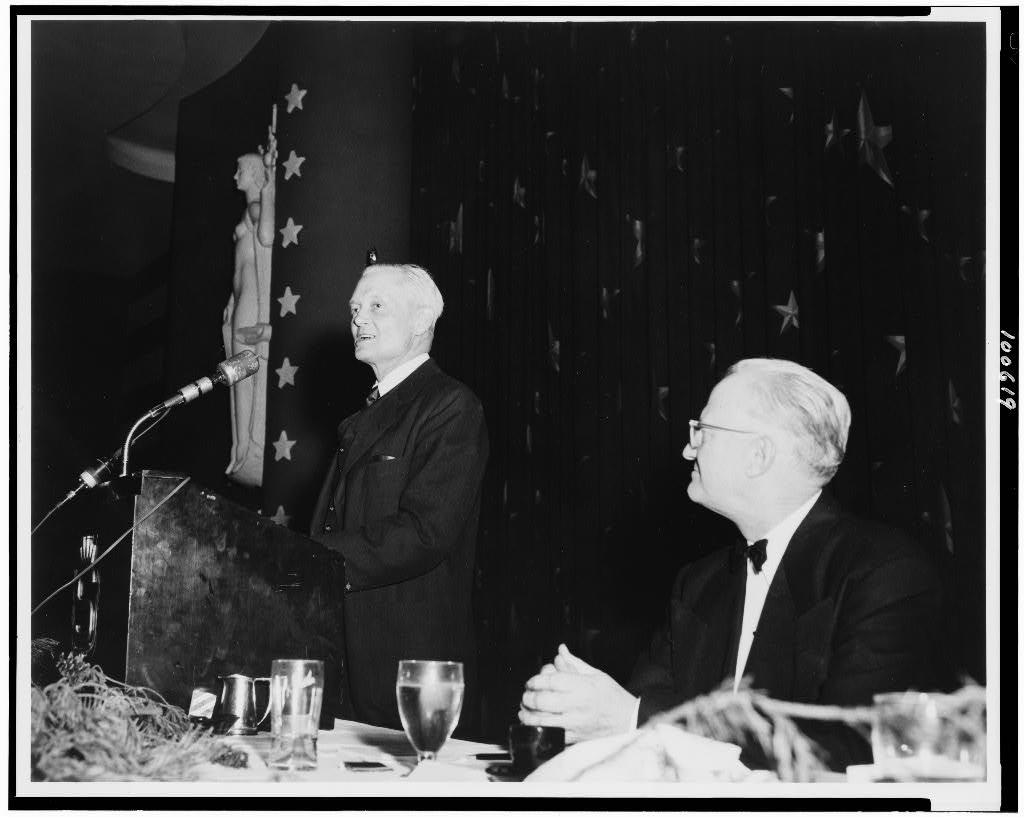
By June 1958 the House Legislative Oversight Subcommittee was investigating a New England industrialist named Bernard Goldfine who had done favors for a range of federal officials. The subcommittee produced a vicuna coat, an oriental rug, and long stretches of Boston hotel bills covering 1955 through 1958, all paid by Goldfine, all having gone directly or indirectly to Sherman Adams.
Eisenhower kept him for three months. On September 22, 1958, Adams resigned. He and Rachel packed the house on Tilden Street, drove north to Lincoln, and never lived in Washington again. Adams died in October 1986. Dr. Kerr’s mantel outlasted him.
What the buildings tell us
Proximity is the through-line. Hopkins lived inside the White House, one door down from the president, for three and a half years. Steelman commuted from Chevy Chase and, when the job was done, moved his office four blocks east. Adams rented a stone whiskey still three miles from Lafayette Square and made it a working extension of the West Wing. Every one of these men chose his ground carefully. Every one of them treated the room as part of the job.
The Peirce Still House is still there. From the Tilden Street sidewalk you can see the two-foot blue granite walls Isaac Peirce quarried out of the Potomac shale in 1811. Across the road, closer to the creek, Peirce Mill still stands, a National Park Service site kept in working order by the same agency that runs the surrounding park.
We dug this one up with help from AI and checked it against the original records below. Here’s how we use AI.