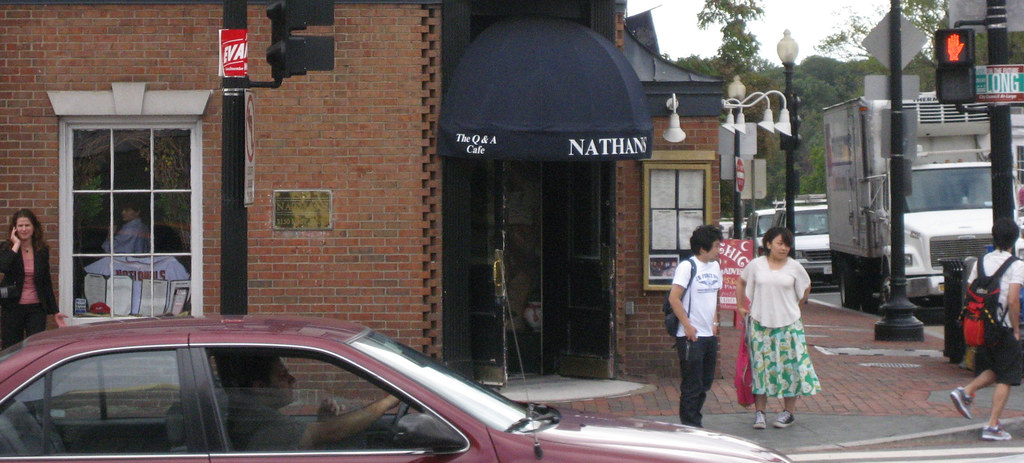
At the southeast corner of Wisconsin and M, in the most photographed intersection in Georgetown, a Capital One Café now sits where Nathans poured drinks for forty years, and the regulars who never quite forgave the closing are still telling stories like the last bell rang yesterday.
Nathans occupied 3150 M Street NW from 1969 to 2009. Greek diner before that. Serendipity 3 briefly after. And then a bank. None of which is meant unkindly. It just happens to be the actual sequence on one of the busiest retail corners in Washington.
How Nathans Started in 1969
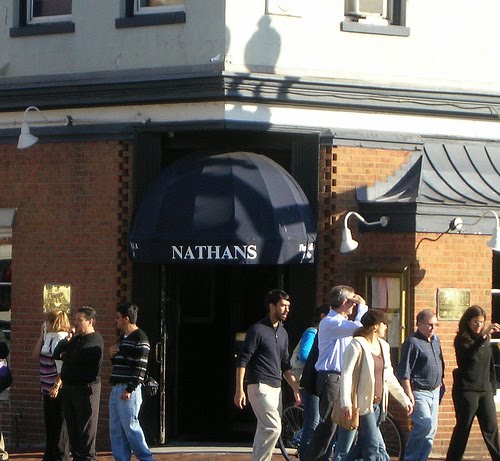
The building belonged to the Heon family, who had owned the corner since around 1916. They ran the storefront as a diner for decades and lived in the upper floors during the middle of the twentieth century. At one point they leased the space to a restaurant called Heritage House, whose matchbook still circulates among Georgetown collectors. The first guy to try Nathans was a bookie who called himself Nathan Detroit.
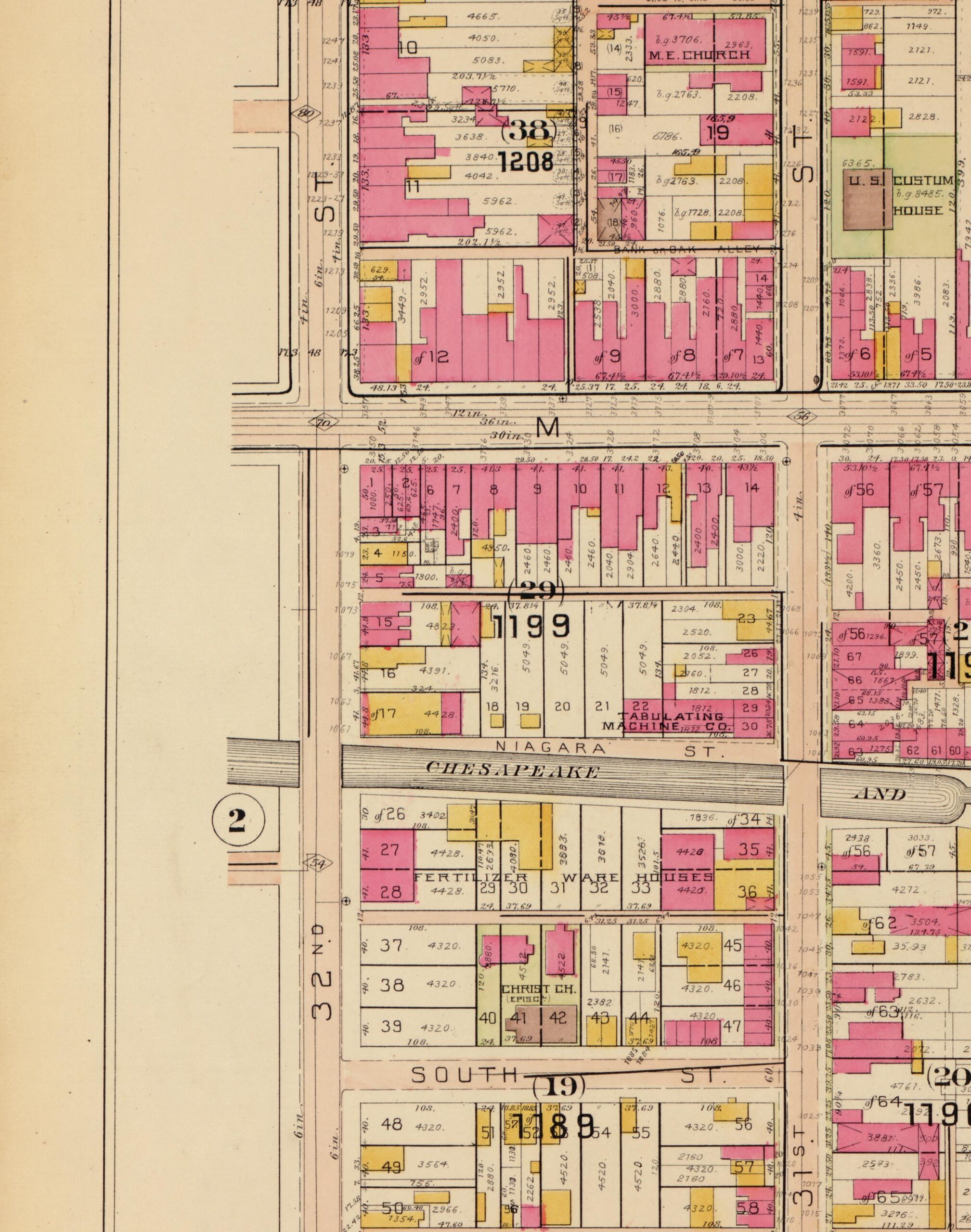
Pull up the 1903 Baist real estate atlas at the Library of Congress and the corner is already developed. A row of small brick storefronts faces M Street on what the atlas calls Square 1199, with the Heons not yet in the picture.
The same block, on the 31st Street side near the C&O Canal, holds Herman Hollerith’s Tabulating Machine Company at 1054 31st Street NW. Hollerith retired in 1921, his successor merged the company a few more times, and by 1924 the name on the door was International Business Machines. The corner that would eventually pour Howard Joynt’s Jim Beam shared a Georgetown block with the direct predecessor of IBM.
That part is not invented. Harry Jaffe at the Washington Examiner laid it out plainly on July 8, 2009, the week the bar closed:
Nathans has occupied the southeast corner of Georgetown’s main crossroads of Wisconsin and M streets since 1969. It had been a Greek diner. A bookie who went by the name “Nathan Detroit” got the lease and hoped to open a restaurant. When gambling debts sunk his eatery, a local kid named Howard Joynt took over and kept the name, thus Nathans.
Nathan roped in two partners to get the place open. One was Charlie Matheson, a member of the Virginia horsey set. The other was a twenty-something Howard Joynt, whose father gave him the money to buy in.
Then Nathan ran up the gambling debts the Examiner article mentions and wanted out. Howard’s father gave him the money to buy Nathan out. Then Charlie’s wife wanted Charlie out of the bar business, and Howard’s father gave him the money to buy Charlie out too. By March 1969, Howard owned the whole thing.
He kept the name. Carol Joynt, his widow, later explained why to The Georgetown Metropolitan: “He didn’t want a drunk walking in the door and saying, ‘Where’s Howard?'”
Howard Joynt’s Saloon
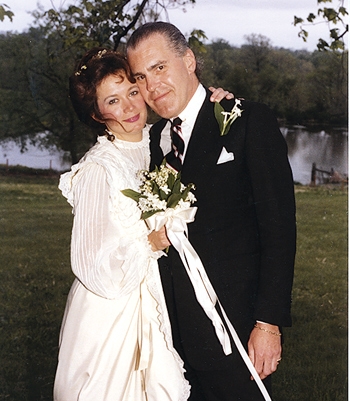
For the next twenty-eight years Howard ran Nathans as the Georgetown saloon Georgetown deserved. Dim. Crowded. Open on holidays. Burgers and Jim Beam on the same check.
Harry Jaffe’s column on the closing painted the bar the way longtime customers remembered it:
Howard ran a well-stocked, man’s bar, though the men brought lovely women. The well-worn oak floor lacked only sawdust to give it a traditional pub feel. Georgetown’s upper crust, and Jim Kimsey, would meet and mix with kids from Virginia and tourists from Kansas.
Janet Donovan, a lifelong Georgetown resident, gave Jaffe the line everybody else who ever drank there gave too. “It was like ‘Cheers.’ Everyone knew your name. On Thanksgiving Day, it was the only place open.”
The economics under all of that affection were never as solid as the regulars assumed. Howard’s father had bankrolled the buy-ins that gave Howard the bar in 1969, and the place leaned on that family money to get on its feet.
None of the customers knew that. The bar felt permanent. That was the whole atmosphere.
The Morning of the Lawyers
Howard Joynt died of pneumonia on February 1, 1997. He was 57. His widow, Carol, had a five-year-old son named Spencer, a job as a producer for Larry King Live on CNN, and no clue what was actually happening at Nathans.
Two weeks after Howard’s funeral, Howard’s accountant told her she needed to come down to the offices of Caplin & Drysdale on Thomas Circle and meet with Howard’s lawyers. She put on a black suit. She thought she was signing some papers.
She wrote about that meeting in her 2011 memoir, Innocent Spouse. Washingtonian magazine ran a long excerpt that June. She called the meeting “the morning of the lawyers.” The lead lawyer, Cono Namorato, a former criminal-tax-enforcement official at the Justice Department, did the talking.
He said that when Howard died, he was under investigation for federal criminal tax fraud and that the case against him covered both our personal taxes and the taxes of the business.
The mechanics, as the IRS had reconstructed them: Howard had been withholding federal taxes from his employees’ paychecks at Nathans and not sending the money to the government. About $200,000 of it. He kept it for himself, for the bar, and for some favored employees. He ran his personal expenses through the business and operated it at a paper loss. The promissory notes and the audit trail looked exactly like what they looked like.
One of Howard’s lawyers slid a sheet of paper across the conference table. The debt to the IRS was almost $2.5 million. With interest and penalties it was, as Carol put it, “a breath shy of $3 million,” and the meter was still running. Maryland and DC numbers had not been calculated yet.
The lawyers floated the only legal door out: an “innocent spouse” filing, the provision in the federal tax code that can relieve a spouse from joint tax liability for debts the other spouse incurred without her knowledge. Carol hired former IRS commissioner Sheldon Cohen and his partner Miriam Fisher to fight it.
In January 1998, almost a year after Howard’s death, the IRS granted her innocent spouse status. The Washington Post‘s Megan Rosenfeld, profiling Carol that summer, put the practical effect plainly: she “was granted ‘innocent spouse’ status, which essentially absolved her of liability for tax debts he had incurred without her knowledge.”
What she did not get out from under was Nathans itself. She had inherited the lease, the staff, the kitchen, the cash flow problem, and the building’s expectations. She told the Examiner: “The employees didn’t know who I was. Every year I tried to get the landlords to take the keys.”
Carol Joynt and the Q&A Café
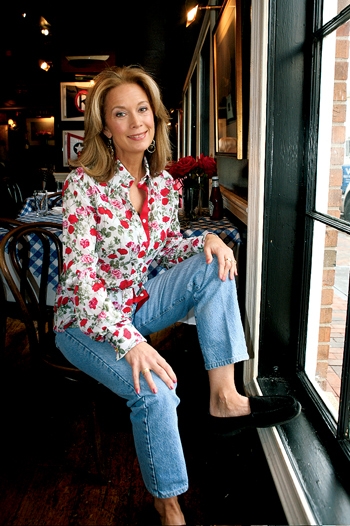
Before any of this, Carol Ross Joynt had a real career. She started at United Press International and Time, became the first female writer for the CBS Evening News with Walter Cronkite, won three Writer’s Guild Awards for “Best News Script” on Watergate and Vietnam coverage, and later, as a CBS Nightwatch producer, shared a national Emmy with Charlie Rose for a 1987 interview with Charles Manson.
When Howard died she was a senior producer at Larry King Live on CNN. After Nathans, she went back to the booking-producer track. She is now a booking producer for Face the Nation at CBS News.
And in October 2001, a month after the September 11 attacks, she started a weekly lunchtime interview show inside her bar. She called it the Q&A Café. It ran in the dining room at Nathans for the next eight years.
The original premise was 9/11 reporting and counterterrorism interviews. It grew quickly into a Washington power lunch with a microphone on the table. Bob Woodward sat for it. Tom Brokaw sat for it. So did Jack Valenti, John Riggins, and, across about 500 episodes, most of the people you would expect to see in a Cabinet hearing room or a network green room.
DC’s Office of Cable Television called it “the first ‘talk show in a bar.'” That undersells it a little. For the better part of a decade it was the only on-the-record, sit-down lunch interview series in town, and it ran weekly from a saloon two blocks from Georgetown University.
The Slow Squeeze and the Last Call
The Q&A Café and Carol’s relentless promotion kept Nathans visible long after the math had stopped working. By 2009 the rent was $15,000 a month, plus a $4,500 monthly escrow payment for the building’s property taxes. The cushion that Howard’s father had poured in for thirty years was gone. No investor wanted in at that rent.
The Georgetown Metropolitan published the cleanest account of how the ending actually unfolded, on July 8, 2009. Carol had signed a short lease extension in June, paid roughly $100,000 in back property taxes to the city and $30,000 in back rent, and put a $168,000 loan on her own house to do it. The extension came with a grace period: if business did not pick up, she could exit before defaulting.
Business did not pick up. She exercised the grace period and gave her staff one week’s notice so they could fish for tips during a wave of nostalgic last drinks. The Georgetown Metropolitan caught the texture of that final week. As Carol put it on her own blog at the time: “We pray the June rent checks clear the bank. We also pray someone buys the building. In other words, miracles.”
The miracles did not come. The last Q&A Café luncheon ran on Thursday, July 9, 2009. The Washington Examiner’s Harry Jaffe was there. Carol, he wrote, looked elegant and calm, and told the crowd: “How do I thank you for coming here all these years? I close.”
Nathans served its last drinks on Sunday, July 12, 2009. The closing announcement, posted to the restaurant’s website that week, framed it the way every closing announcement frames it. “After 40 years of serving millions of happy and loyal customers, and opening its doors 365 days of every year, Nathans will close at last call on Sunday, July 12. This ends an era of delicious, interesting and often outrageous moments at what Zagat called ‘the quintessential Georgetown saloon.'”
By the next morning the bar, owned by the landlord, stayed where it was. The David Hume Kennerly photographs that had hung in the dining room came down and went back to Kennerly. The upstairs subtenants were evicted. The Q&A Café eventually moved to the Ritz-Carlton down the street, then since 2015 to the George Town Club at 1530 Wisconsin Avenue NW, where it still runs.
Two years later, Carol gave the Georgetowner one of the more unsentimental quotes ever filed about a beloved Georgetown bar:
“Happiest day of my life when it finally closed,” said Carol Joynt, the last owner… “Owning Nathans was a nightmare I would not wish on anyone.”
Serendipity 3, Briefly
The space did not stay dark long. On Memorial Day weekend, May 30, 2011, the DC branch of New York’s Serendipity 3 opened at 3150 M Street NW. Frozen Hot Chocolates, foot-long hot dogs, and the famous $1,000 Golden Opulence Sundae moved into the old Nathans dining room.
It lasted three years. Serendipity 3 closed on June 3, 2014, after the building’s LLC, 3150 M Street LLC, sued the restaurant for more than $98,000 in unpaid rent, utilities, and fees. Washingtonian and the Hoya both covered the end. The corner went dark again.
Capital One Café Georgetown
For most of the next five years the storefront sat behind paper. In February 2016, War Horse LLC — the development firm run by Scott Plank, brother of Under Armour founder Kevin Plank — bought the building for $12.25 million, and a flagship Under Armour store was widely expected at the corner. Under Armour never signed a lease.
Capital One bought 3150 M Street NW outright for $50.2 million. The Georgetowner broke the deal terms on August 28, 2019, in the same piece that announced the opening: “The 3150 M St. NW property, renovated by Kevin Plank’s Sagamore Development, was at first thought to become an Under Armour store. However, it was unexpectedly sold two years ago to Capital One Bank for $50.2 million.”
The Capital One Café opened on August 28, 2019, with a grand opening event held about a month later, on September 28. It was the 38th Capital One Café nationally and the second in DC after the Chinatown location. The corner now has three floors of coffee, free Wi-Fi, free co-working desks, free meeting rooms, two ATMs, and an event calendar painted on the brick.
The coffee partner is Peet’s. The pastries come from Baked & Wired, Bullfrog Bagels, and Good Company Donuts, all of which Capital One leaned on in its launch press as evidence of community partnership.
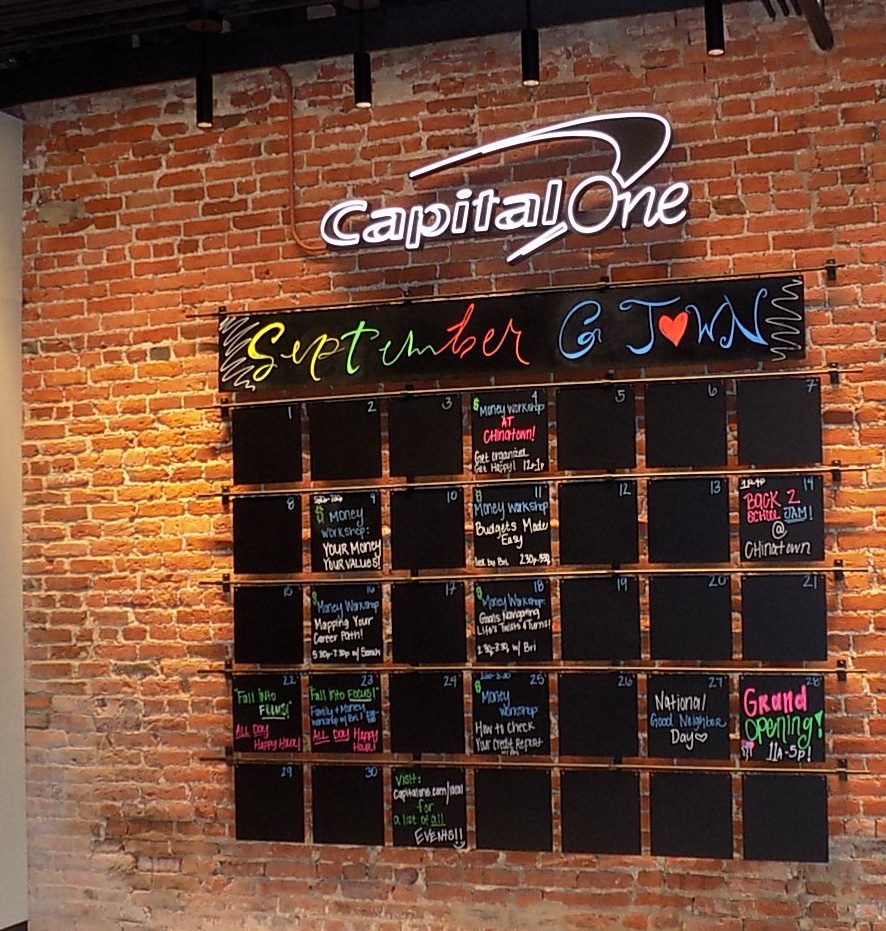
The ATMs sit in a 24-hour vestibule with blue light strips and a floor decal that reads “DIY Banking. Help yourself.” Which, depending on your priors about Georgetown, lands either as a perfect bit of brand voice or a very on-the-nose epitaph for the corner.
Why the Corner Reads Like It Does Now
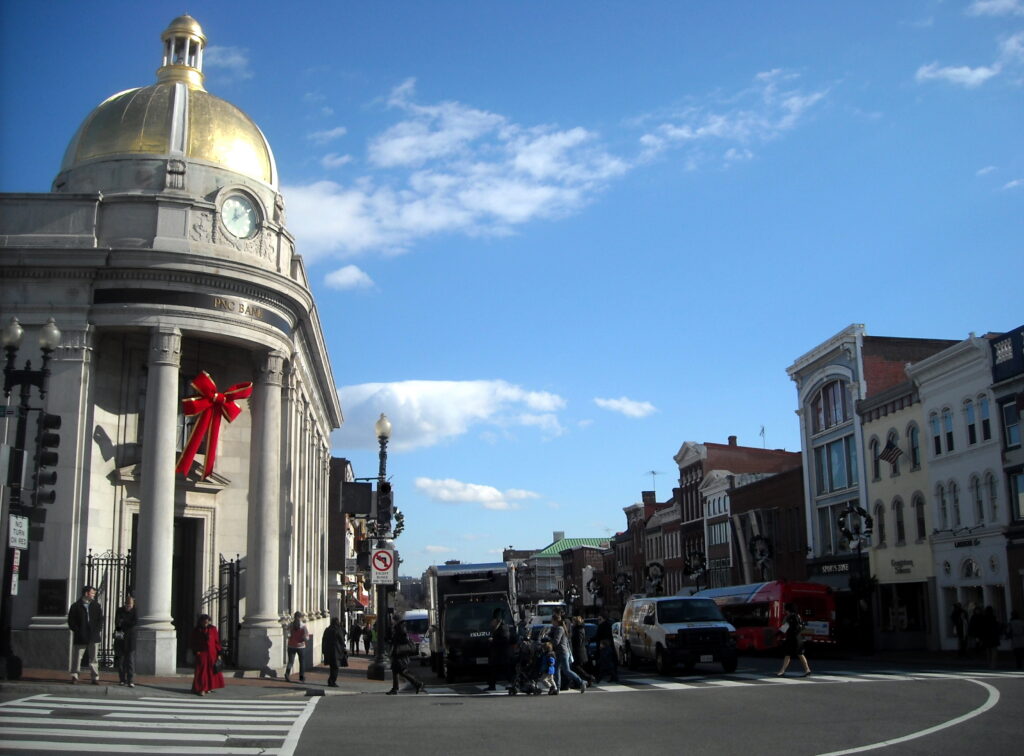
In her 2011 conversation with the Georgetowner, Carol Joynt offered her own theory of why Georgetown could no longer support a bar like Nathans. “It began to end with the building of the mall, The Shops at Georgetown Park, and then all the chain stores. Georgetown unique gave way to brand-name chic. Nathans gave way to perhaps the Apple store as the place to be in Georgetown.”
The Apple store she meant opened a block up Wisconsin, in the 1229 Wisconsin Ave NW building that had cycled through a half dozen retail tenants before Apple landed there. The same logic ran the books on the rest of the corridor. The independents priced out, and the storefront economics tilted toward tenants who could carry $15,000-and-up monthly rents on national balance sheets. Capital One has a national balance sheet.
Two blocks up Wisconsin, 1420 Wisconsin Avenue ran the same arc on a slower clock: a punk-era boutique called Commander Salamander gave way to an M&T Bank in the same building. Up Wisconsin, the all-night French bistro Au Pied de Cochon went the same way at a different speed. The same story, different storefront.
You can still walk the southeast corner of Wisconsin and M. You can still look out the window at the exact same intersection Howard Joynt watched from behind the bar for twenty-eight years. The view is identical. The traffic light cycles haven’t moved.
Other Georgetown bars from that era took different paths. Martin’s Tavern up Wisconsin has been there since 1933, JFK booth and all. Clyde’s of Georgetown opened on M Street in 1963 and is still running. Rhino Bar at 3295 M Street made it 63 years before closing. The Bayou ran 45 years under the Whitehurst Freeway before it was demolished. And the corner that Nathans owned for forty years is a coffee shop and a bank.
Three names on the corner since 1969. A Greek diner nobody remembers. Nathans for forty years. And now a Capital One Café where you can pour your own coffee, schedule a workshop on credit cards, and DIY your way through a deposit. You can sit upstairs and watch the intersection the regulars watched. You just can’t order a Jim Beam and a beer.