
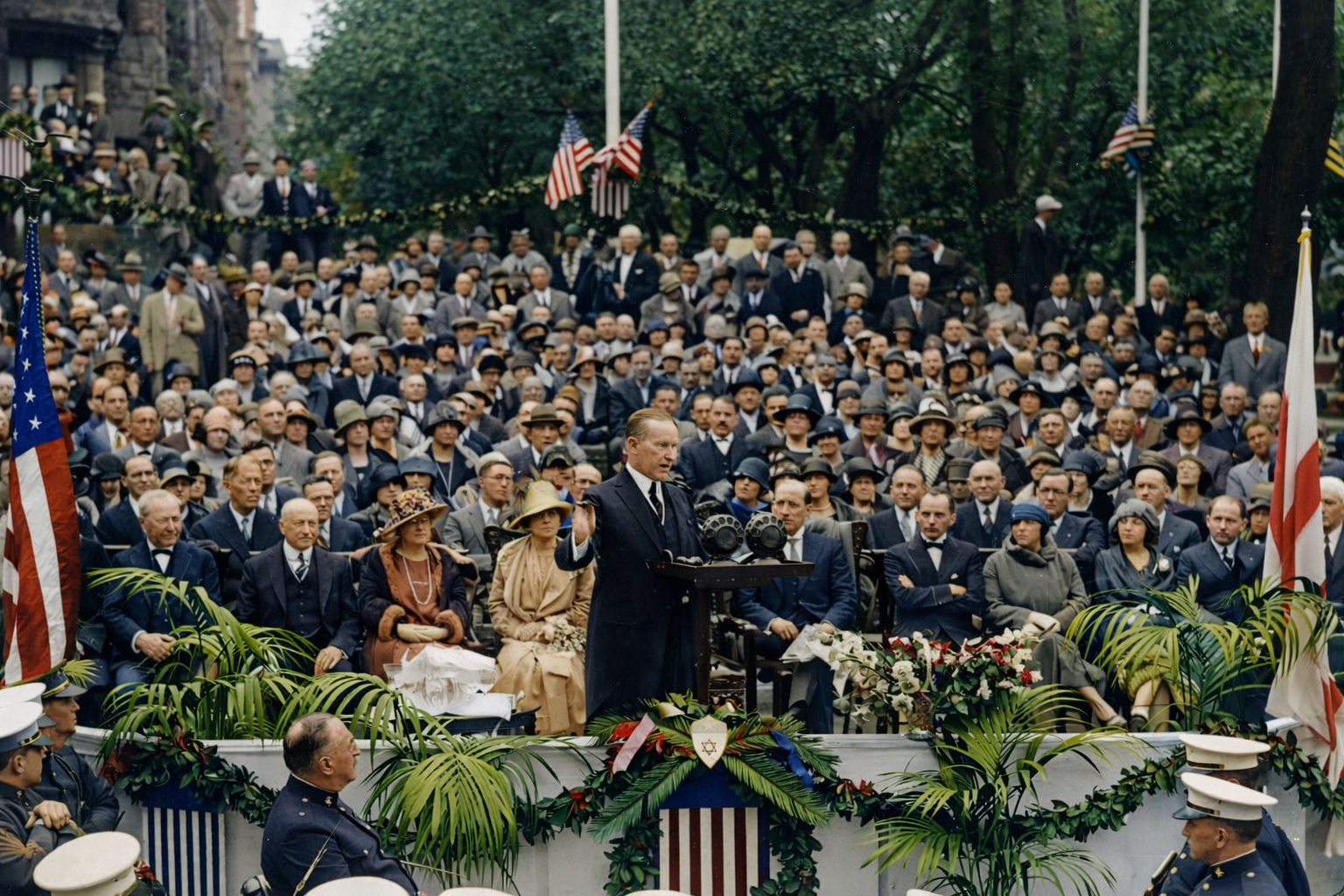
On May 3, 1925, Calvin Coolidge came up 16th Street from the White House, climbed a platform at the corner of Q, and laid the cornerstone of a Jewish community center.
A band played in front of him. A crowd filled the lot. The sitting president of the United States had come to give a speech titled “The Spiritual Unification of America,” and he used it to walk through a century and a half of Jewish contribution to American life, naming names.
He called out Haym Solomon, the Polish-born financier of the Revolution. He named Isaac Moses and Benjamin Levy, signers of the 1765 non-importation resolution. He referenced a Charleston infantry unit “preponderantly of Jews.” Then he borrowed a line from the historian William Lecky:
Hebraic mortar cemented the foundations of American democracy.
And this, on what America had done for its Jewish population:
The greatest thing it has done for them has been to receive them and treat them precisely as it has received and treated all others.
A sitting United States president, speaking at a Jewish community center cornerstone laying in 1925, in the middle of the Klan revival and a year after Congress slammed the door on Jewish immigration. Sit with that for a second.
A Five-Story Home on 16th Street
The building rose at 1529 16th Street NW, between Dupont Circle and Logan Circle, on a lot bought after a five-year fundraising campaign. The architect was B. Stanley Simmons.
Simmons was one of Washington’s most prolific. He designed the Wyoming apartments on Wyoming Avenue, the Fairfax Hotel at 21st and Massachusetts, and the Barr Building on Farragut Square. The DC JCC was his neoclassical turn at 16th and Q, five stories, roughly 60,000 square feet.
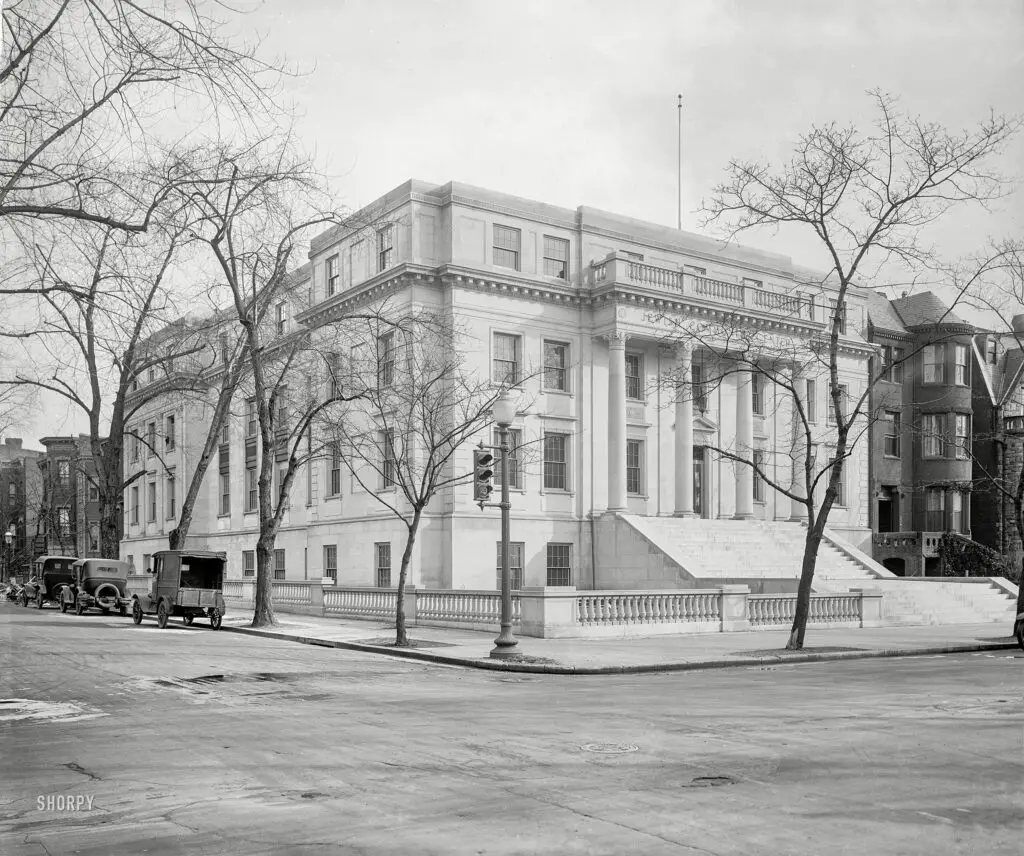
The official opening came on February 22, 1926, Washington’s Birthday.
Inside the DC JCC
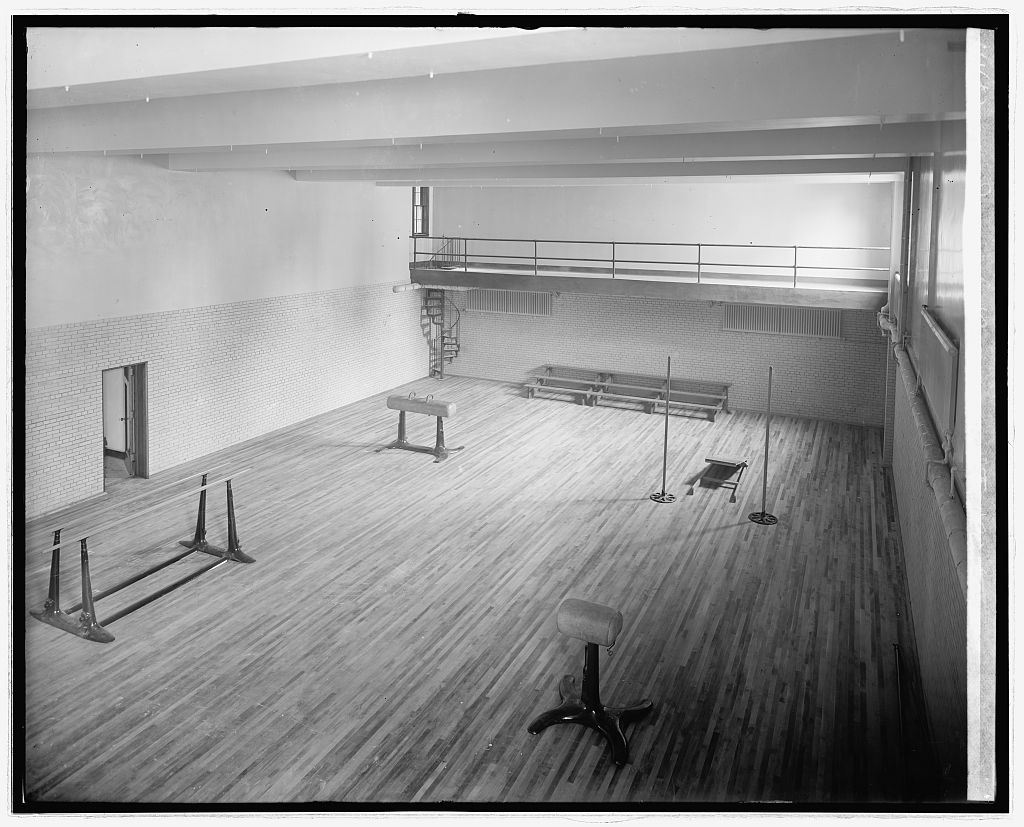
Squash courts. Handball courts. A steam room. A men-only health club, per the standards of the era. A massage room staffed by Seventh-day Adventists.
Roof dances in the summer. The JCC ran an annual Queen Esther Beauty Contest big enough that the Washington Post printed photos of the finalists.
Six Jewish organizations kept offices in the building: B’nai B’rith, Hadassah, the American Jewish Committee, among them. Adas Israel ran its Hebrew school out of the JCC until the congregation decamped to Woodley Park in 1955. Abe Pollin, who later built the downtown arena and owned the Bullets, remembered the JCC as the place “where all the camaraderie took place.”
For a flavor of what a Washington gym looked like in the same era, see our post on Vice President Coolidge breaking a sweat with House Speaker Gillett in the old House gym. The JCC’s health club was the neighborhood version of that world.
The Meyers Help Expand It
In 1939, Eugene and Agnes Meyer, the owners of the Washington Post, funded an expansion of the building. A library wing. More squash and handball courts. Six years earlier, Eugene Meyer had bought the Post out of bankruptcy for $825,000. Now he was putting money into another Washington institution up the street.
The JCC dedicated a USO lounge in 1942 and ran a “Program for Victory” through 1943 and 1944, selling war bonds and stamps.
Building T-5
By the 1960s, Washington’s Jewish population was moving out of the District. Bethesda. Rockville. Silver Spring. The rooftop dances on 16th Street started to feel like a building in the wrong place.
The new suburban JCC opened in Rockville on May 8, 1969. The District facility closed the year before. The city bought the building and handed it to Federal City College, the predecessor of the University of the District of Columbia, which redesignated 1529 16th Street NW as “Building T-5.”
Fifteen years later, UDC didn’t need it anymore. The city floated two possibilities: turn it into a prison, or a homeless shelter.
A prison. On the block where Coolidge had stood.
The Long Way Home
Neither idea took. In 1990, the DC Jewish community bought the building back.
After seven years of restoration, the JCC reopened its doors on January 12, 1997. The opening exhibit, drily titled, was a display of photographs and artifacts documenting “the demise and rebirth of urban Jewish spaces in America.”
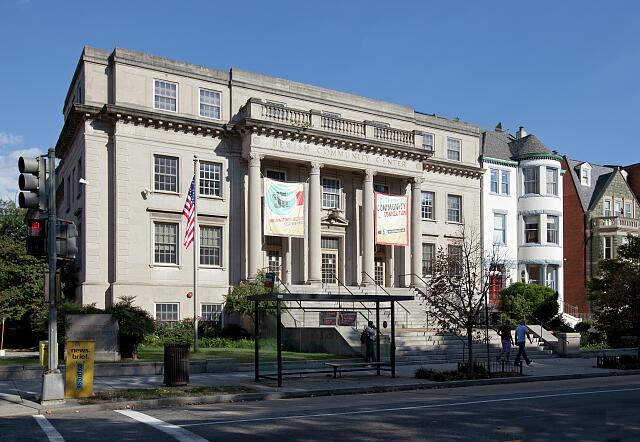
The building is now the Edlavitch DCJCC. Theater J runs out of it. Hebrew school runs out of it. The front door sits roughly where the platform was.
A hundred years on.