
The Washington National Cathedral took 83 years to build. Construction began on September 29, 1907, in front of President Theodore Roosevelt and a crowd of 20,000.
The final stone was set on September 29, 1990, in front of President George H.W. Bush. Same day on the calendar, 83 years apart.
In between: two world wars, the Great Depression, the death of three principal architects, and a funding model that ruled out a single federal dollar. The cathedral was built the medieval way, stone on stone, with no structural steel holding it up.
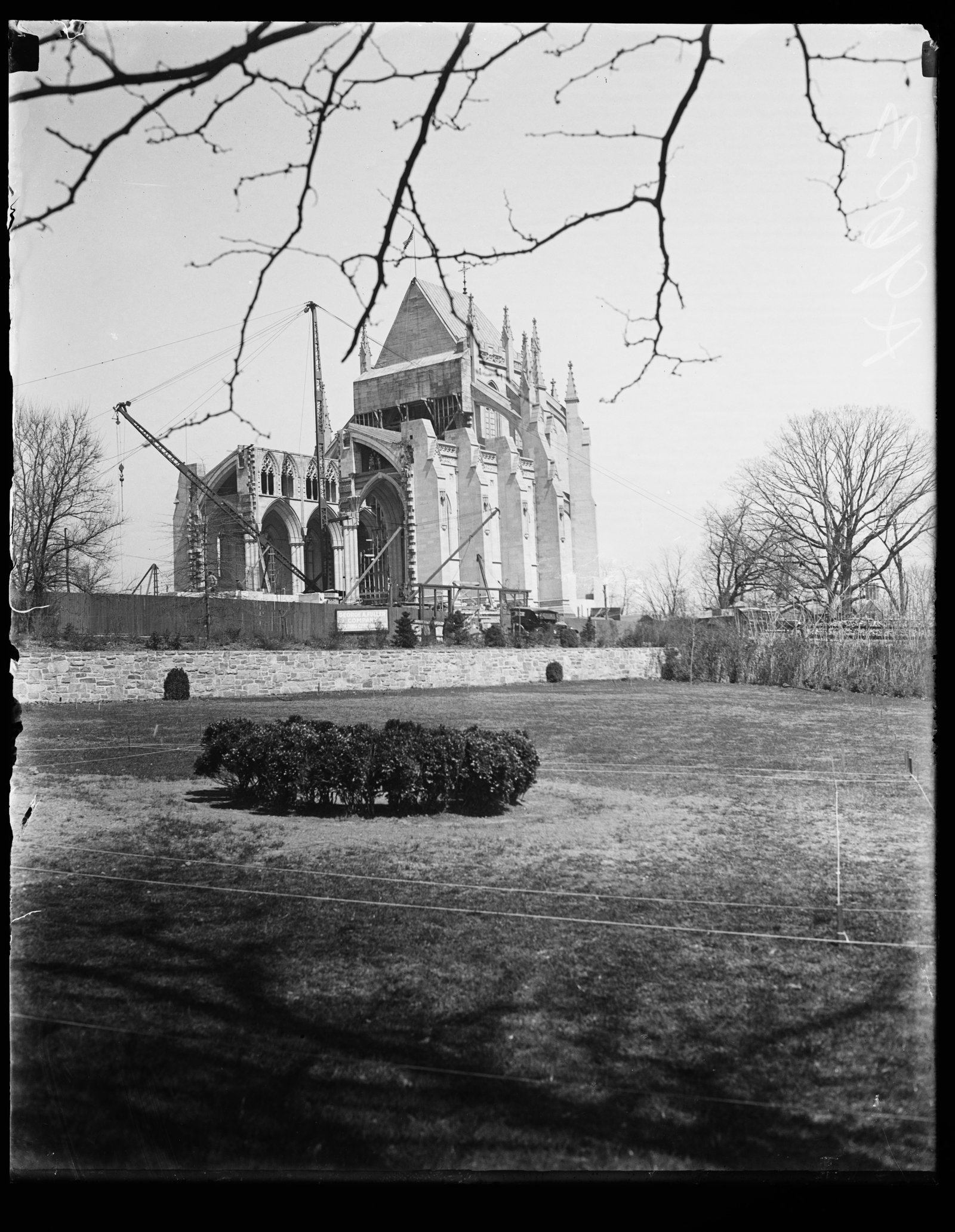
The photo at the top of this post shows the cathedral in 1925, deep in the middle of that long project. It’s a Harris & Ewing photograph from the Library of Congress, and there’s a quieter one of the interior further down. To understand what you’re looking at, you have to back up to 1907.
September 29, 1907: Theodore Roosevelt Lays the Foundation Stone
The foundation stone went into the ground on Mount Saint Alban in Northwest Washington on September 29, 1907. President Theodore Roosevelt was there. So was the Bishop of London. So were roughly 20,000 onlookers spread across the cathedral close.
The stone itself came from a field near Bethlehem and was set inside a larger block of American granite. The Latin inscription read The Word was made flesh, and dwelt among us. Roosevelt’s remark on sending the workmen in: “Godspeed the work begun this noon.”
The master plan had been drawn by George Frederick Bodley, a leading English Gothic Revival architect of the late nineteenth century. Bodley’s American partner on the project was Henry Vaughan, a Boston architect who had once been Bodley’s chief draftsman. Bodley died less than a month after the ceremony. Vaughan carried it forward.
1912: Bethlehem Chapel Opens, and the Cathedral Starts Working
Bethlehem Chapel, tucked underneath the main crypt level, was the first usable space inside the cathedral. It opened for services in 1912, five years after the foundation stone. Daily worship has continued in that chapel ever since.
The point worth holding onto: the cathedral was a working church for 78 years before it was a finished building. Visitors who climbed Mount Saint Alban during construction were walking past scaffolding to get to a chapel that already worked.
1917: Vaughan Dies, the War Pauses Work, and a New Architect Takes Over
Henry Vaughan died in 1917. The United States had entered the First World War. Construction stopped.
When work resumed after the armistice, the cathedral chapter hired the Boston firm Frohman, Robb and Little. Philip Hubert Frohman, the youngest partner, became the principal architect and stayed in that role until his death in 1972. Frohman refined Bodley and Vaughan’s plan and gave the cathedral much of the character you can still see today, especially the west towers.
Funding was a constant constraint. The cathedral was chartered by Congress in 1893, but Congress put up no money. Every block of Indiana limestone was paid for by private donation, sometimes coin by coin. There were stretches where the masons stopped because the next gift hadn’t come in.
1925: What the Cathedral Looked Like in the Middle of Everything
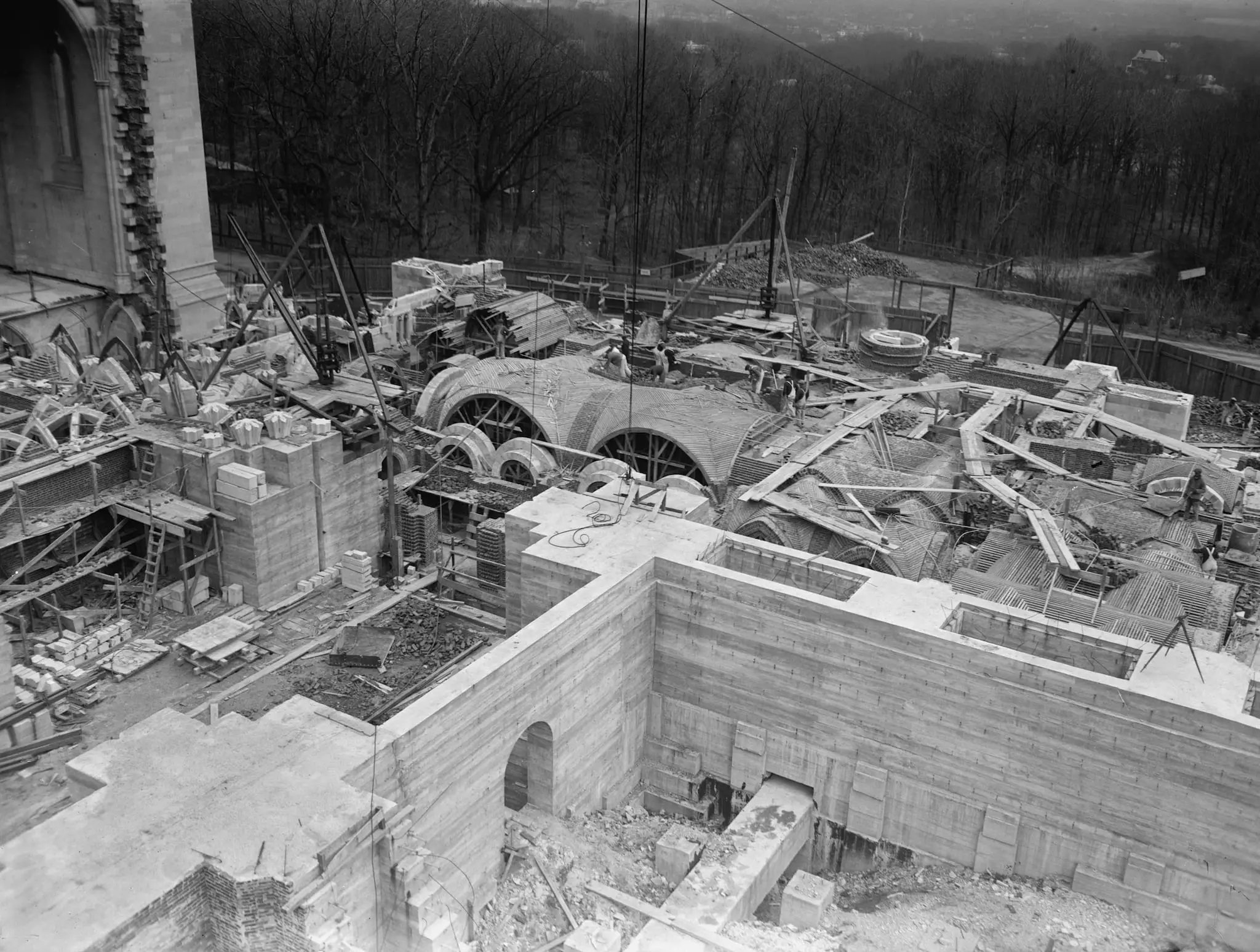
By 1925, eighteen years in, the cathedral’s east end was rising. The apse, the choir, and the bones of the crossing were going up under Frohman. Scaffolding wrapped the building. From a distance it looked less like a cathedral than like a stone quarry slowly assembling itself.
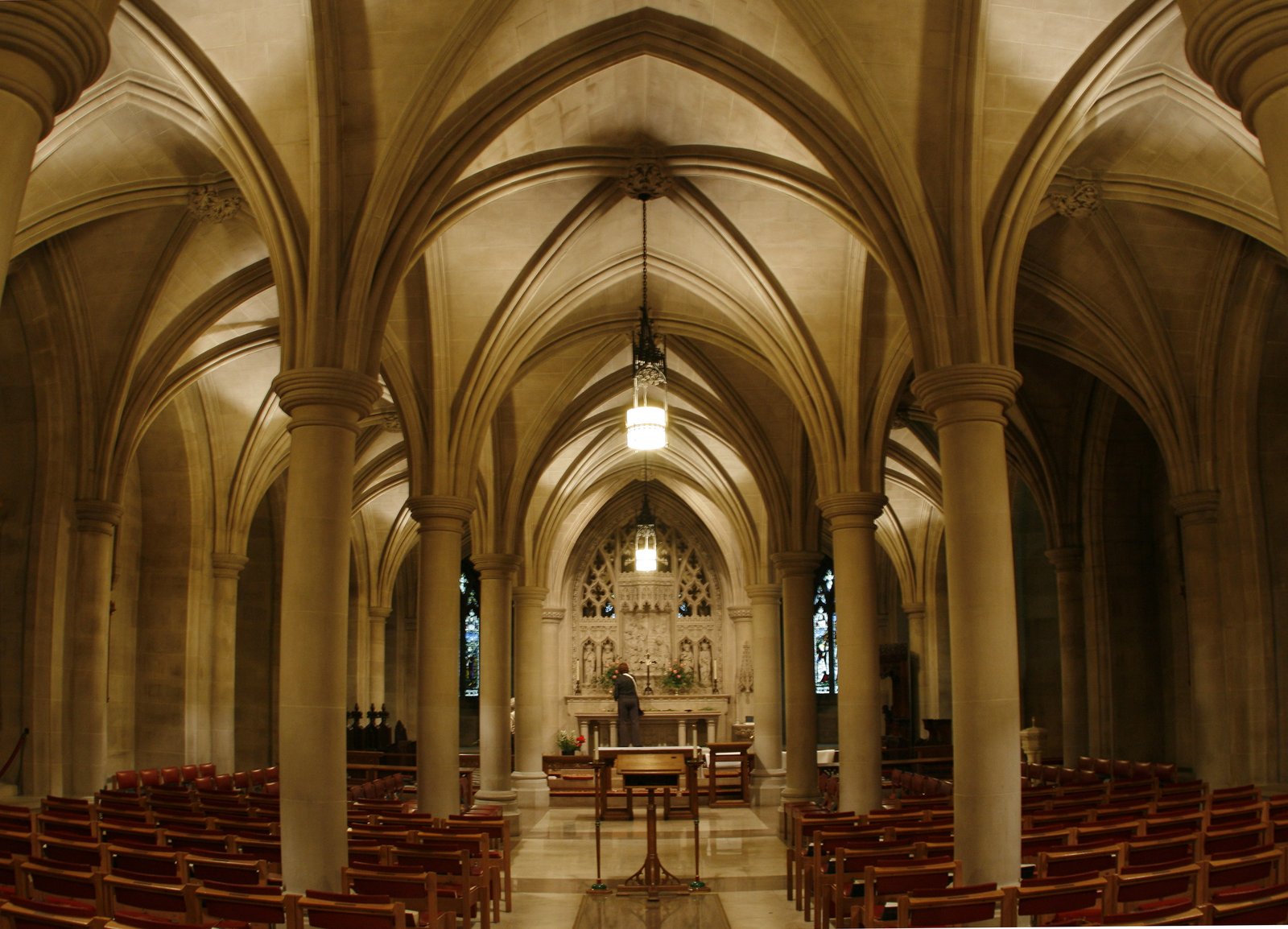
The Harris & Ewing photo at the top of this post catches that moment exactly. The exterior is a half-built skeleton. The interior shot above shows the same thing from inside: stone going up, vaulting taking shape, decades of work still ahead.
For a sense of the land around the construction site at this same moment, see our look at the 1907 map of the area around the cathedral, drawn the same year the foundation stone went down.
1932: Apse, Choir, and North Transept Complete
By 1932, 25 years after the foundation stone, the apse, the choir, and the north transept were done. The east half of the cathedral was usable. The nave and the west towers were still decades away.
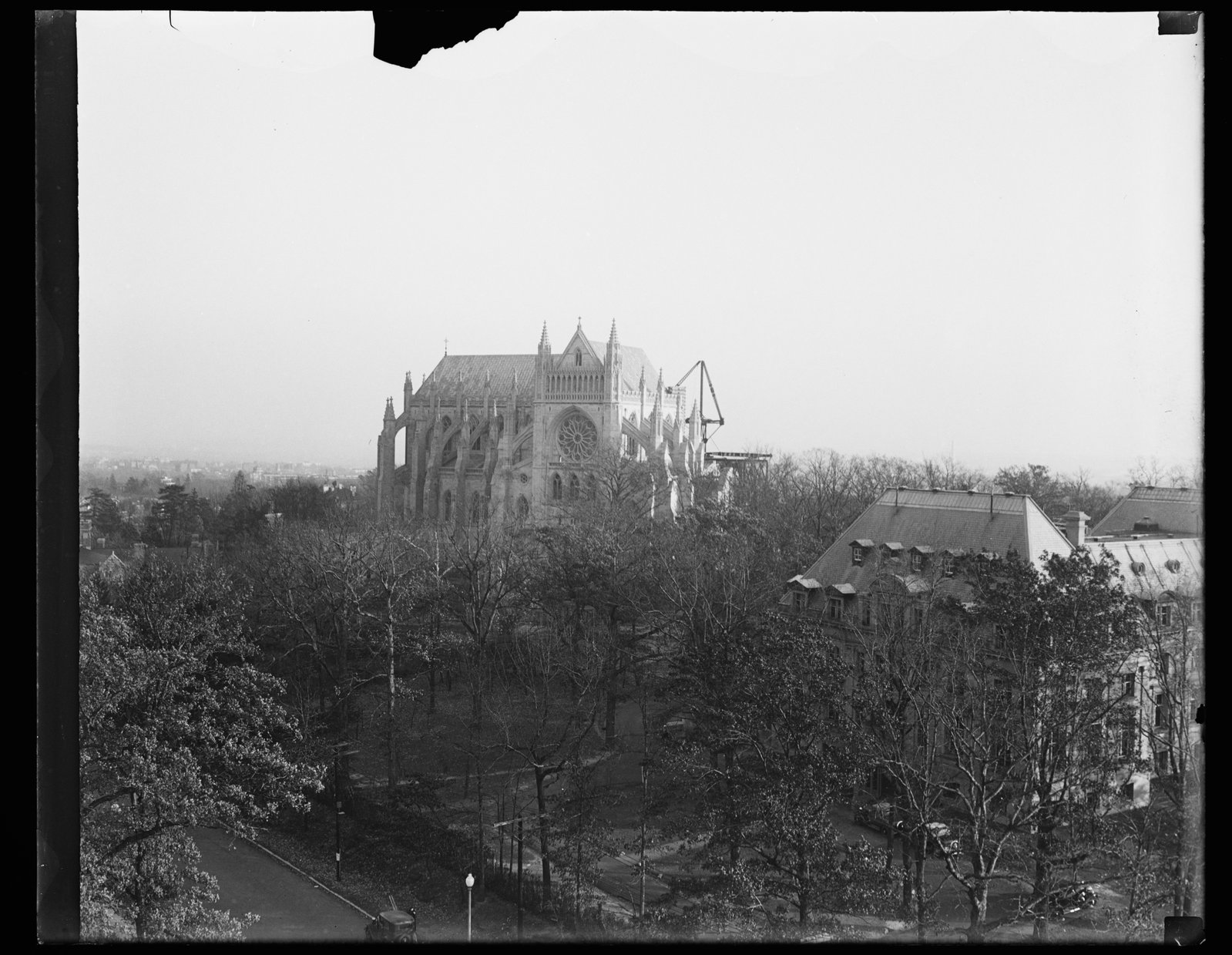
Then the Depression hit. Funding dried up. Work slowed to a crawl, and a second world war stopped it again.
The story of the cathedral’s middle decades is mostly a story of waiting for the next donation.
1964: The Gloria in Excelsis Tower
The Gloria in Excelsis Tower was dedicated on May 7, 1964. It rises 301 feet above the cathedral floor and sits atop the crossing, where the transepts meet the nave. Because Mount Saint Alban is itself one of the highest points in the District, the top of the tower stands 676 feet above sea level. It is the highest point in Washington.
The tower carries the cathedral’s peal of bells and its carillon. Both were installed and dedicated in the years immediately following.
No Steel: Why the Building Is What It Is
Most American “Gothic” buildings from the twentieth century are steel frames wearing a stone costume. The Washington National Cathedral is not. Its walls actually hold up the roof. Its flying buttresses actually do the work the flying buttresses on Chartres do.
Structural steel was used only for roof trusses and, in a few spots, to reinforce the bells in the central tower. The rest is solid masonry, buff-colored Indiana limestone over a brick core, in the same construction tradition used at Salisbury and Wells. That is part of why it took 83 years. Stone-on-stone Gothic moves at stone-on-stone Gothic speed.
It is the sixth-largest cathedral in the world. It is also, by most reckonings, the last major Gothic building ever constructed.
September 29, 1990: George H.W. Bush and the Final Finial
Exactly 83 years after Roosevelt’s ceremony, the final finial was set into place on the south west tower in front of President George H.W. Bush. The date was September 29, 1990. The cathedral was, at last, finished.
The total cost was about $65 million. Every dollar came from private donations. The cathedral had been chartered by Congress almost a century earlier and had never received a federal operating subsidy. It still does not.
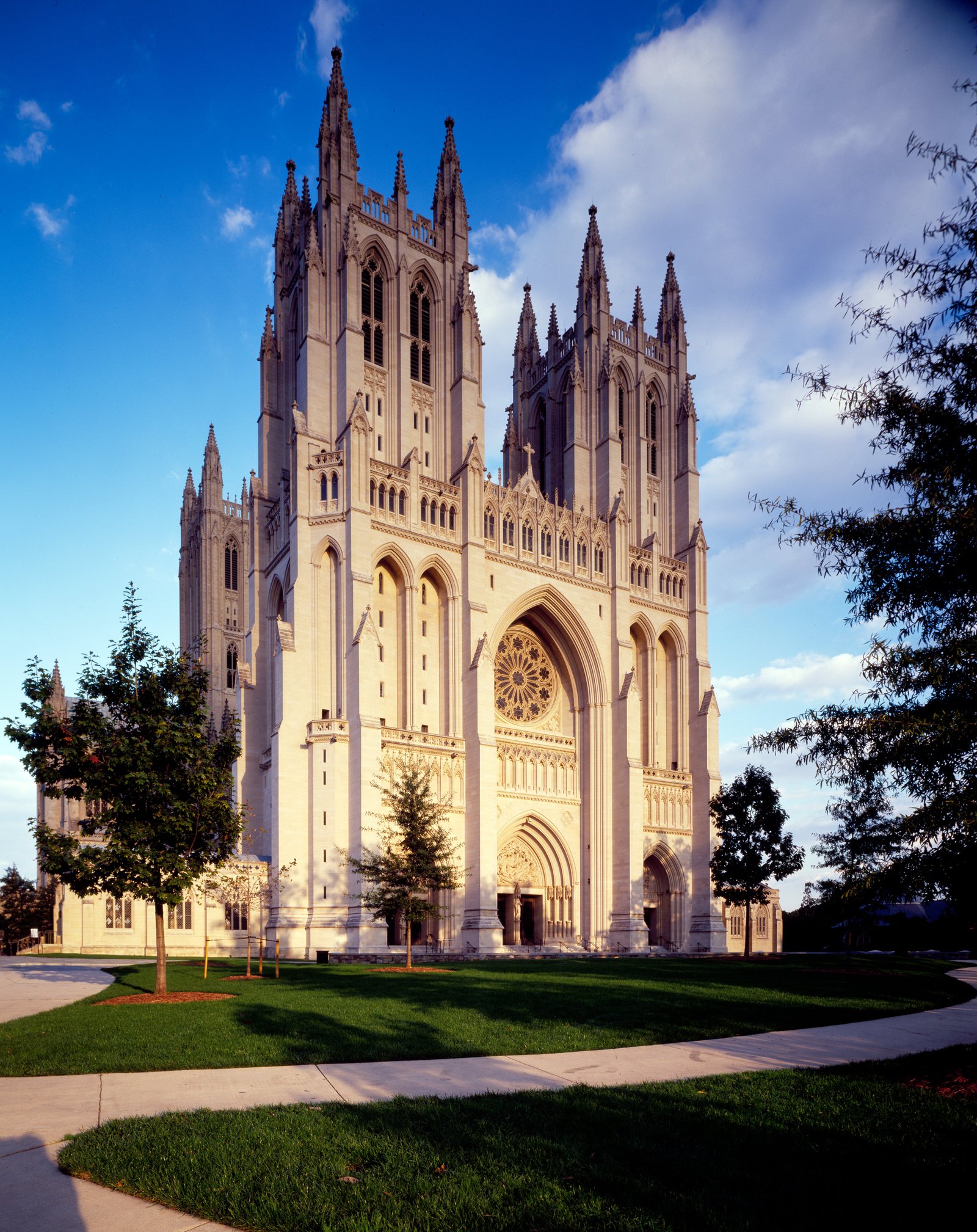
August 23, 2011: The Earthquake
The Mineral, Virginia earthquake on August 23, 2011 was a magnitude 5.8 tremor centered about 80 miles southwest of the District. It shook the cathedral hard.
Three of the four pinnacles on the central tower were cracked or knocked off. More than 75 percent of the pinnacles around the building sustained damage. A 350-pound piece of carved stone fell off the northwest tower and landed near the main entrance.
Nobody was hurt. The damage estimate ran to about $38 million. Repairs are still ongoing, more than a decade later, paid for by the same private donation model that built the building in the first place.
Now
The cathedral is open. Daily services continue in Bethlehem Chapel and in the nave. State funerals, presidential prayer services, and major national observances are still held there, the way Pierre L’Enfant once imagined a great church for national purposes near the heart of his city plan.
The numbers, kept together: 83 years from groundbreaking to completion. Three principal architects. Two world wars and one depression.
Sixth-largest cathedral in the world. Zero structural steel. Zero federal dollars. Roughly $65 million in private gifts, plus what has been raised since for the earthquake.
Looking for related Northwest DC history? See our piece on the Hamilton “Ghost” Circle and Fairview Heights near the cathedral, or the story behind the new Cathedral Commons development on Wisconsin Avenue. For a broader Mount Saint Alban view, the 1909 National Cathedral School ad is a nice side door into the cathedral close in the early construction years.