Drive out Wisconsin Avenue today past the District line, cross Bradley Lane, and you’re in the Town of Somerset. The houses on Hunt Avenue, Langdrum Lane, and Offutt Road look like they’ve been there forever. Most of them have. They went up between 1928 and 1931 on the farm of a developer named Richard C. D. Hunt, in a subdivision he called Chevy Chase Gardens.
Here’s the ad he ran in the Washington Post on August 25th, 1929.
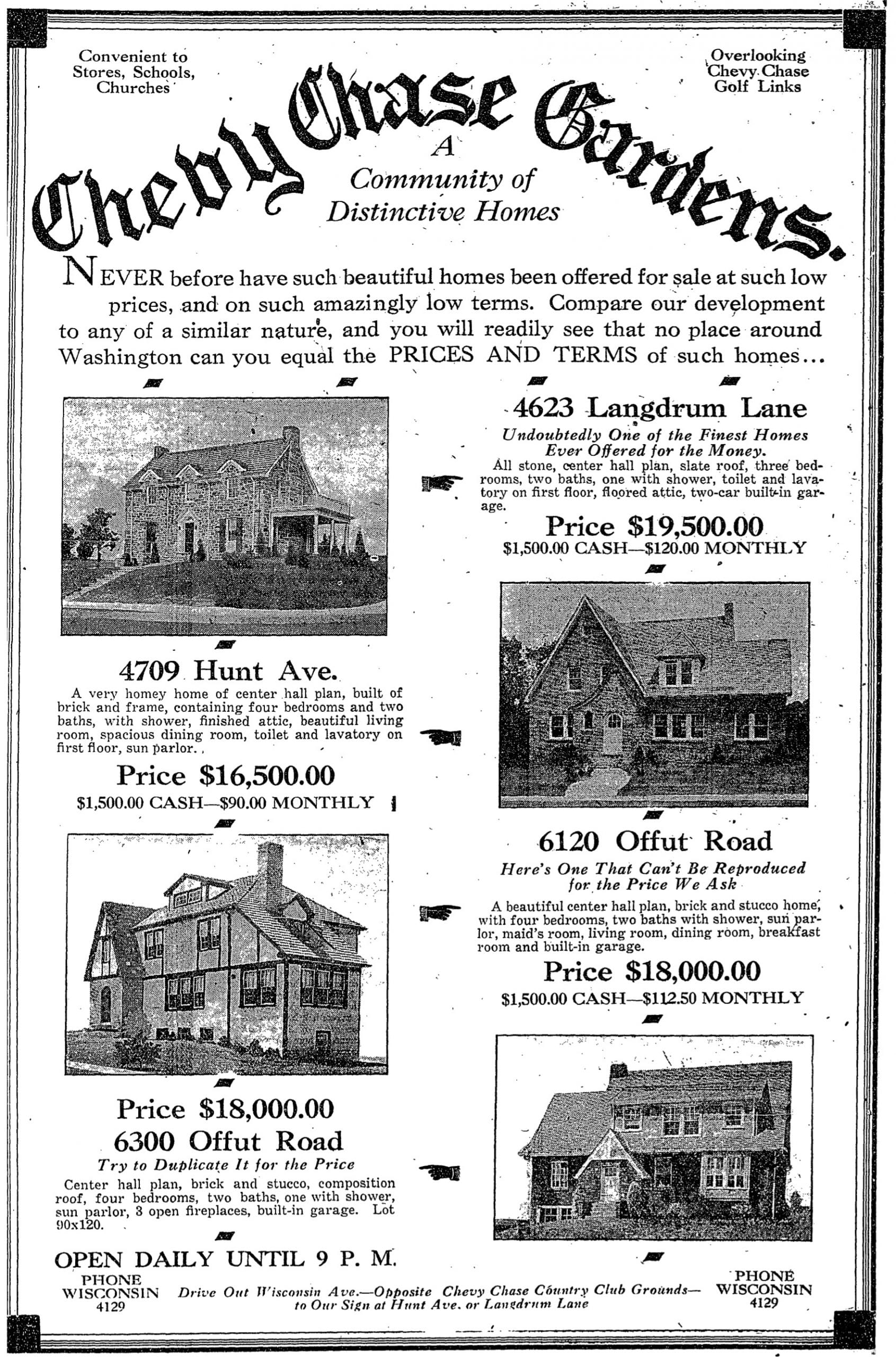
Four houses, four addresses, four prices. “NEVER before have such beautiful homes been offered for sale at such low prices, and on such amazingly low terms.”
The ad ran nine weeks before Black Tuesday.
We’ve shared another 1903 Washington Times ad promoting Chevy Chase as the premier suburb of the capital, and maps from 1907, 1909, and 1918 that show the neighborhood taking shape. Chevy Chase Gardens is a later beat in that story, the overbuilt last gasp of the 1920s suburban boom.
A Community of Distinctive Homes
The pitch is pure 1929. Convenient to stores, schools, churches. Overlooking Chevy Chase Golf Links. The word “distinctive” doing a lot of work.
The four houses on offer:
4623 Langdrum Lane. All stone, center hall plan, slate roof, three bedrooms, two baths, one with shower, toilet and lavatory on first floor, floored attic, two-car built-in garage. Price $19,500.00. $1,500.00 CASH, $120.00 MONTHLY.
4709 Hunt Ave. A very homey home of center hall plan, built of brick and frame, containing four bedrooms and two baths, with shower, finished attic, beautiful living room, spacious dining room, toilet and lavatory on first floor, sun parlor. Price $16,500.00. $1,500.00 CASH, $90.00 MONTHLY.
6120 Offut Road. A beautiful center hall plan, brick and stucco home, with four bedrooms, two baths with shower, sun parlor, maid’s room, living room, dining room, breakfast room and built-in garage. Price $18,000.00. $1,500.00 CASH, $112.50 MONTHLY.
6300 Offut Road. Center hall plan, brick and stucco, composition roof, four bedrooms, two baths, one with shower, sun parlor, 3 open fireplaces, built-in garage. Lot 90×120. Price $18,000.00.
$16,500 in August 1929 was about the price of a nice Washington house. Nothing in this ad was on the Kennedy-Chamberlin level up in Kenwood, where the country club set was paying more. These were solid upper-middle-class brick and stucco boxes with a maid’s room, aimed at federal workers and Wisconsin Avenue commuters.
The terms are the tell. $1,500 down and $90 to $120 a month, for houses that Montgomery County now values at close to a million dollars apiece.
Who Was Richard C. D. Hunt?
Hunt Avenue is named for the man who platted the subdivision.
Richard C. D. Hunt and his wife Helen Hammond Hunt held the land and ran the development. The record of their Chevy Chase Gardens lots is scattered through Montgomery County land books from 1927 through the early 1930s. Sections 1 and 2. Lots conveyed in liber 464 folio 144, liber 488 folio 262, liber 492 folio 336, liber 494 folio 7, liber 494 folio 13. Deed by deed, the Hunts sold pieces of their farm into what the Montgomery Suburban Garden Club would shortly recognize as a distinct community, listed in its 1929 meeting minutes alongside Friendship Heights, Somerset, Drummond, Chevy Chase Terrace, and Kenwood.
Somewhere in the middle of that work, they took out a big mortgage.
In January 1928, Richard and Helen borrowed against a separate 203-acre tract they owned in the Potomac District of Montgomery County. The lender was the Federal Land Bank of Baltimore. The mortgage was recorded in Liber P.B.R. No. 477, page 337.
That date matters. January 1928 was the apex of American land optimism. Herbert Hoover would win the presidency that November on a platform that the Republican National Committee summarized in ads as “a chicken in every pot and a car in every garage.” Ten months after the Hunts signed their mortgage, Hunt was running full-page ads in the Washington Post asking $19,500 for a house with a slate roof.
The Ad Rides the Crest
The Post ad of August 25, 1929 wasn’t Hunt’s only pitch that summer. On August 17th, the Washington Times ran a Saturday real estate roundup that included a new detached brick home at 4613 Hunt Avenue, sold to Mrs. G. W. Henderson for R. C. D. Hunt. Individual type, brick, in Chevy Chase Gardens. One deal in a column of deals.
That’s the rhythm of it. Houses closing in batches. A sign planted at the corner of Hunt Avenue. A phone number printed on every ad: Wisconsin 4129. A pitchman to walk you through whichever house had the shower arrangement you wanted.
The Chevy Chase Country Club grounds sat across Wisconsin Avenue. The Somerset School was a few blocks off. The ad copy was honest about what the place was: a commuter subdivision next door to a golf course, with the added bonus that residents could join the Montgomery Suburban Garden Club, which by September 1929 had members from Friendship Heights, Somerset, Drummond, Chevy Chase Gardens, Chevy Chase Terrace, and Kenwood. They had already started lobbying Senators Tydings and Goldsborough to move the USDA Animal Experimental Laboratory at Wisconsin and Bradley Lane somewhere more rural. You know, away from the homes.
Then October Happens
Black Tuesday fell on October 29, 1929. By Christmas, the bottom of the real estate market had dropped out of Washington’s new suburbs.
You can read the defeat in the Montgomery County Sentinel. Starting in February 1930, weeks of tax sale notices ran in the paper. Lot 5, Section 2. Lot 7, Section 2. Lots 1, 10, and 34, Section 2. The east 5 feet of Lot 35 and all of Lot 36, Section 1. Again and again, the listing reads the same way:
Hunt, Richard C. D. Present owners Harold H. and Anna L. Clark. Lot 5, Section 2 and improvements, Chevy Chase Gardens, as described in a deed recorded in liber 488 folio 262. Taxes, interest, and costs: $130.92.
Dozens of lots. The Clarks. The Bixbys. Ava Maria Rogers. Maurice and Pauline Harmon. Ordinary families who had bought their Chevy Chase Gardens house from Hunt in 1928 or 1929 on $1,500 down. All now delinquent on county taxes.
Helen Hammond Hunt herself shows up in the same notices as present owner of the east 5 feet of Lot 35 and all of Lot 36, Section 1. The developer’s wife was running behind on her own tax bill.
The Farm Goes Under
The Federal Land Bank had priority on the Potomac farm.
On September 23, 1932, the Montgomery County Sentinel published a foreclosure notice from Assignees Charles W. Held and C. R. Rowdybush.
Under and by virtue of a power of sale contained in a mortgage from Richard C. D. Hunt and Helen H. Hunt, his wife, to The Federal Land Bank of Baltimore, dated January 1928 and recorded among the Mortgage Records of Montgomery County… default having occurred, the said undersigned Assignee will offer at public sale on the premises on Wednesday, October 26, 1932, at 11 A. M., all that farm consisting of several tracts of land containing in the aggregate Two Hundred Three (203) acres, more or less, situate in Potomac District, Montgomery County, State of Maryland, and being the same land that was conveyed to said Richard C. D. Hunt by deed dated December 27, 1927, from Clifford H. Robertson, Assignee.
Four years and ten months after Hunt had signed the mortgage, the bank took the farm.
The Chevy Chase Gardens lots were a separate matter. Most of the finished houses had already been sold to the Clarks and Bixbys and Harmons of the world, who would hold on through the Depression with varying success, paying back taxes and keeping their slate roofs intact.
What’s Still There
Three of the four houses in the ad are still there.
6120 Offutt Road. Built 1929. Brick and stucco, four bedrooms. Montgomery County’s tax roll values it close to a million dollars.
6300 Offutt Road. Also 1929. Same vintage, similar plan. The assessment runs just under a million.
4709 Hunt Avenue. The county lists it as 1931, not 1929, which probably reflects a finish date or a later reassessment rather than the ad’s claim. Either way, it’s the brick-and-frame house with the sun parlor, and it’s on the block where the Hunts planted their sign.
4623 Langdrum Lane, the $19,500 stone house, is the one that’s hard to find in current records. The street exists. 4618 Langdrum is a 1929 stone house with a much higher improvement value than its neighbors, which makes it a candidate for the same building. 4619, 4621, 4622 are all 1929 or 1931 stucco or brick. The numbering drifted a little as lots closed and combined, the way subdivision addresses often did before the county cleaned things up. If there’s a ghost address in the ad, it’s this one.
The Neighborhood Wins
The Chevy Chase Gardens Citizens Association held together through the worst of the Depression.
By March of 1932, under chairman R. A. Littleton, it was meeting at the Somerset School and fighting a rezoning proposal that would have changed the character of the properties along Wisconsin Avenue between the D.C. line and Bradley Lane. As the Evening Star reported on March 22nd, 1932:
A resolution opposing the rezoning of property along Wisconsin avenue from the District line to Bradley lane was passed by the Chevy Chase Gardens Citizens Association at a meeting last night in Somerset School… the Park and Planning Commission is requested to take no action in the rezoning of this property until the applicants for such rezoning can present to the commission evidence that at least a majority of the residents and property owners of Chevy Chase Gardens acquiesce in such rezoning.
The subdivision was barely four years old. Its developer was in foreclosure. And its residents were already organized, writing resolutions, and forcing county planners to come consult them before anything changed on the avenue they depended on.
By 1937, Charles E. Jackson, Deputy Commissioner of Fisheries, was heading home to Chevy Chase Gardens from another summer cruising the Alaskan coast. A totem pole sat in his garden from a prior trip, “to the delight of all the children in the neighborhood,” according to the Evening Star. The Depression had ended the Hunts’ ownership. It had not ended the neighborhood.
The houses are still there. The totem pole, probably not.
If you’ve ever driven Wisconsin Avenue out past the District line and wondered why the blocks west of the road feel older than Bethesda proper, now you know. Richard C. D. Hunt built them in a hurry, at the very top of the market, with $1,500-down terms that felt reasonable in August and ruinous by November. A half-century later the same avenue would be torn up again for Metro construction, and the same houses would still be standing.
And one of Hunt’s ads is still in the archive.
I grew up at 4702 Hunt Avenue – the house is now listed for over $1 million