
In the summer of 1948, by the account the White House Historical Association tells, a leg of Margaret Truman’s piano sank through the floor of her second-floor sitting room and brought plaster down on the Family Dining Room below.
Investigators pulled up the floorboards and found the joists eaten through. The phrase that stuck, repeated in many later tellings of the renovation, was that the place was “standing only from force of habit.” That was the diagnosis. The official residence of the President of the United States was about to come down on top of its own family.
Between November 1948 and March 1952, the Trumans were evicted to Blair House across the street. The interior of the White House was stripped down to its sandstone exterior walls and rebuilt from the inside with a new steel frame and two new sub-basement levels.
The Abbie Rowe photographs below, taken for the National Park Service and held by the Harry S. Truman Library, are the official visual record of what happened inside the shell.
How a house built in 1792 got to this point
The trouble started decades before Truman ever moved in. After a 1927 engineering survey flagged weakened roof trusses, Coolidge-era architect William Adams Delano rebuilt the third floor and the roof.
The redesign was sound on paper. What it actually did was shift the weight of a much heavier attic and roof onto interior brick walls that had no real foundations. Those walls sat on clay and rubble fill. They began to settle.
By the mid-1940s the East Room ceiling was visibly sagging. Chandeliers swayed in still rooms. The Trumans, in their own later recollections, described seeing the Blue Room chandelier move during gatherings.
Harry Truman liked to take his bath directly above the Blue Room. In a 1948 letter to his daughter Margaret, he joked about the floor giving way and dropping him through onto one of Bess’s tea receptions for the Daughters of the American Revolution.
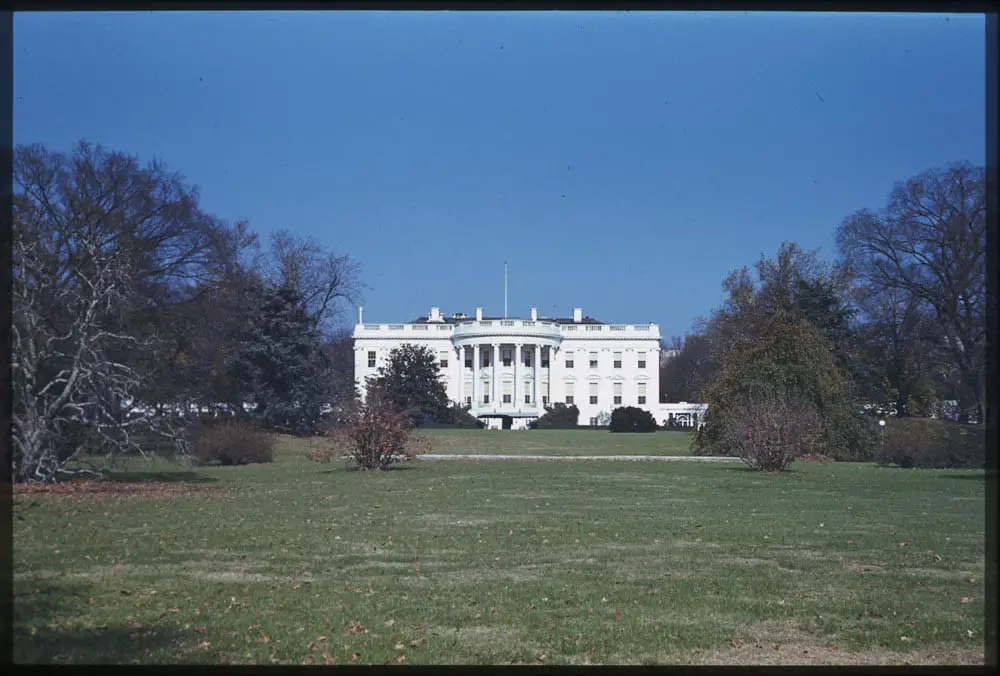
Source: Charles W. Cushman Photograph Collection, Indiana University
On October 26, 1948, plaster came down from the East Room ceiling. Investigators found a crack twelve feet long and a section of plaster sagging eighteen inches in one corner.
By then Margaret’s piano had already gone through the floor upstairs. Bess and Margaret had moved out. Truman was sleeping at Blair House. He wrote in his diary that the second floor of the White House was “about to fall down.”
The survey, the commission, and the decision to gut
In February 1948 Truman had invited Douglas W. Orr, president of the American Institute of Architects, and Richard E. Dougherty, president of the American Society of Civil Engineers, to do a structural survey. Their findings were worse than anyone wanted. The second floor was a fire hazard. The interior walls had cracked from settlement. The State Floor was held up in places by improvised wooden shoring.
Congress responded with the Commission on the Renovation of the Executive Mansion, chaired by Sen. Kenneth D. McKellar of Tennessee. The Commission’s executive director was Maj. Gen. Glen E. Edgerton. They had three options. Tear the building down entirely and build a new one. Tear down the interior but preserve the exterior sandstone walls. Or do a piecemeal repair and hope.
Truman wanted to save the exterior. So did the public. The Commission settled on Option Two, which by any honest accounting was the most expensive of the three. The exterior walls were braced from the outside.
The architect Lorenzo S. Winslow, who had been the White House architect since FDR, became supervising architect for the project. The general contract went to John McShain of Philadelphia, the same contractor who had built the Pentagon.
On site construction began December 13, 1949. The Trumans, already out for over a year, would not return for another three.
Inside the empty shell
The first phase was demolition. Crews stripped wallpaper, pulled out fixtures, broke down plaster, and salvaged what could be saved. Abbie Rowe of the National Park Service was there the whole time as official photographer.
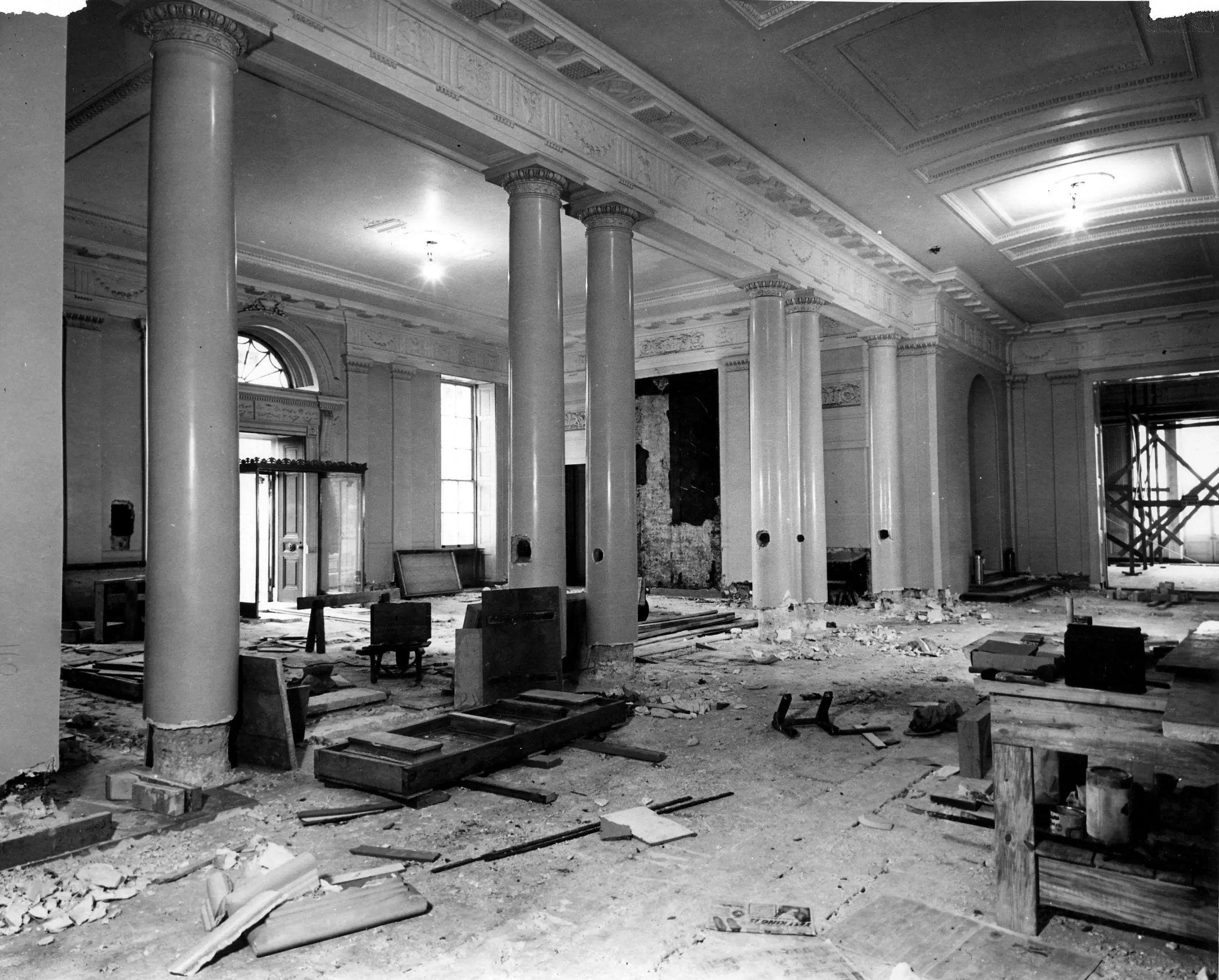
Source: Truman Library, photograph 58-531-029
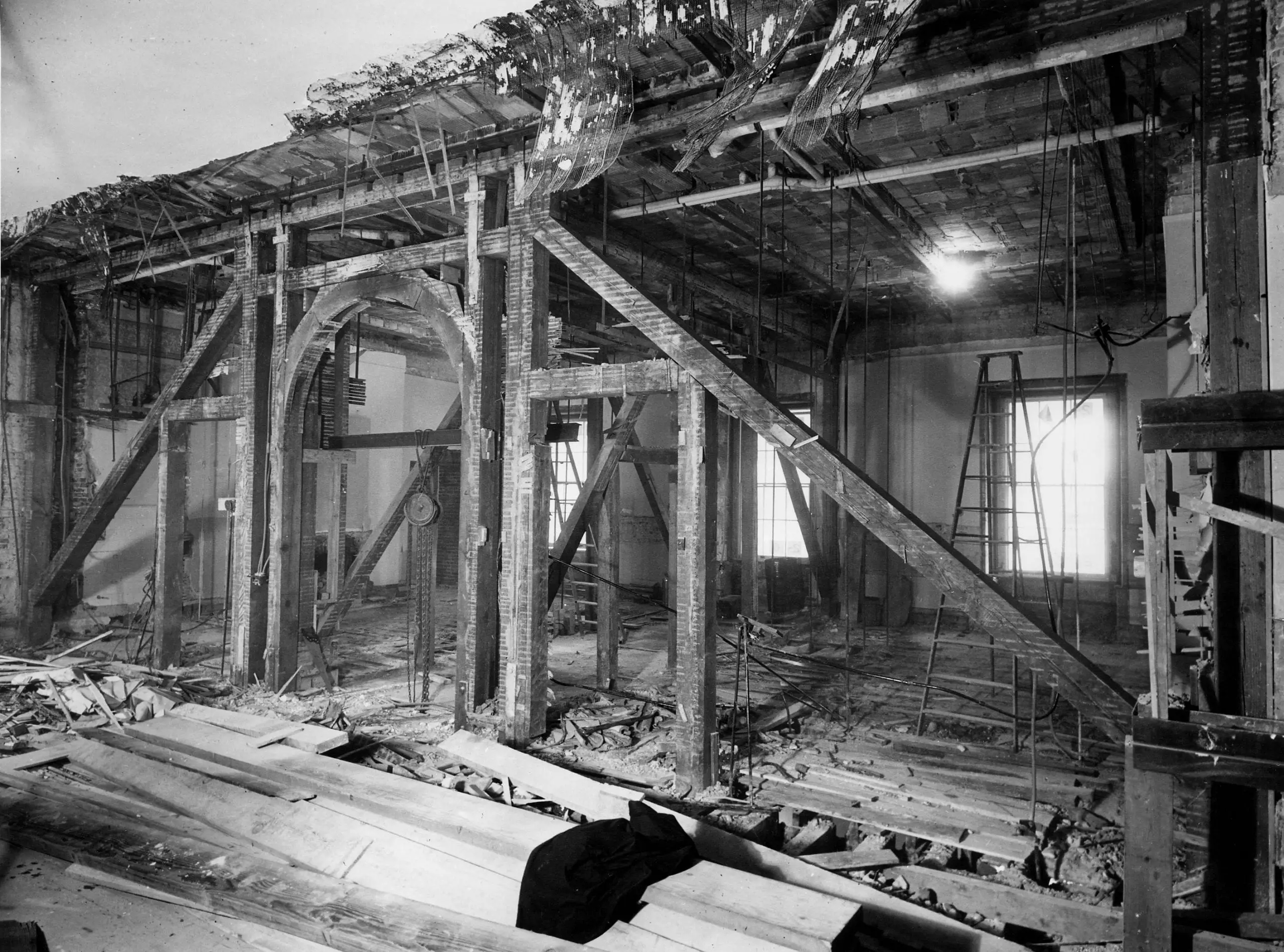
Source: Truman Library, photograph 58-531-035
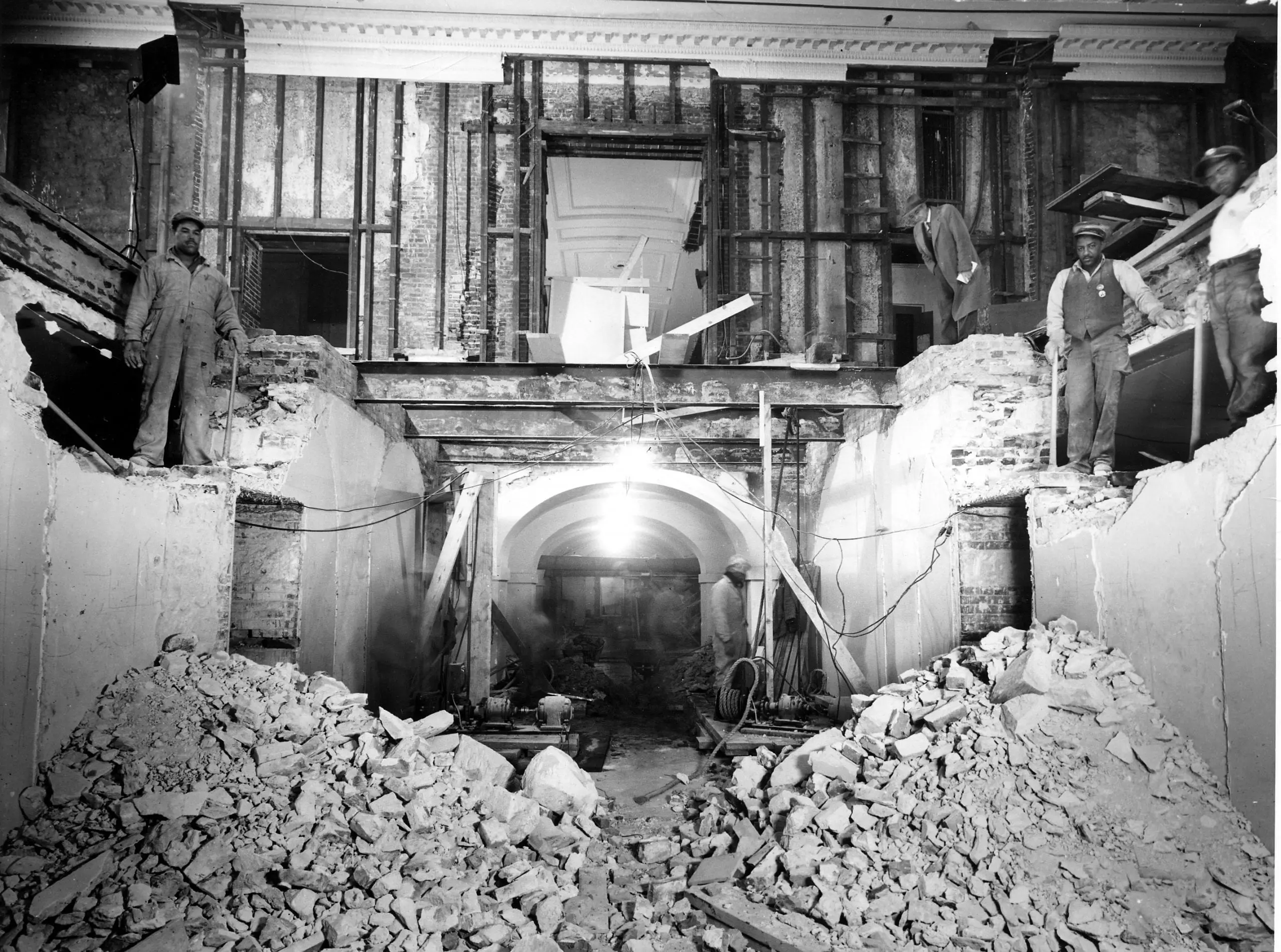
Source: Truman Library, photograph 58-531-050
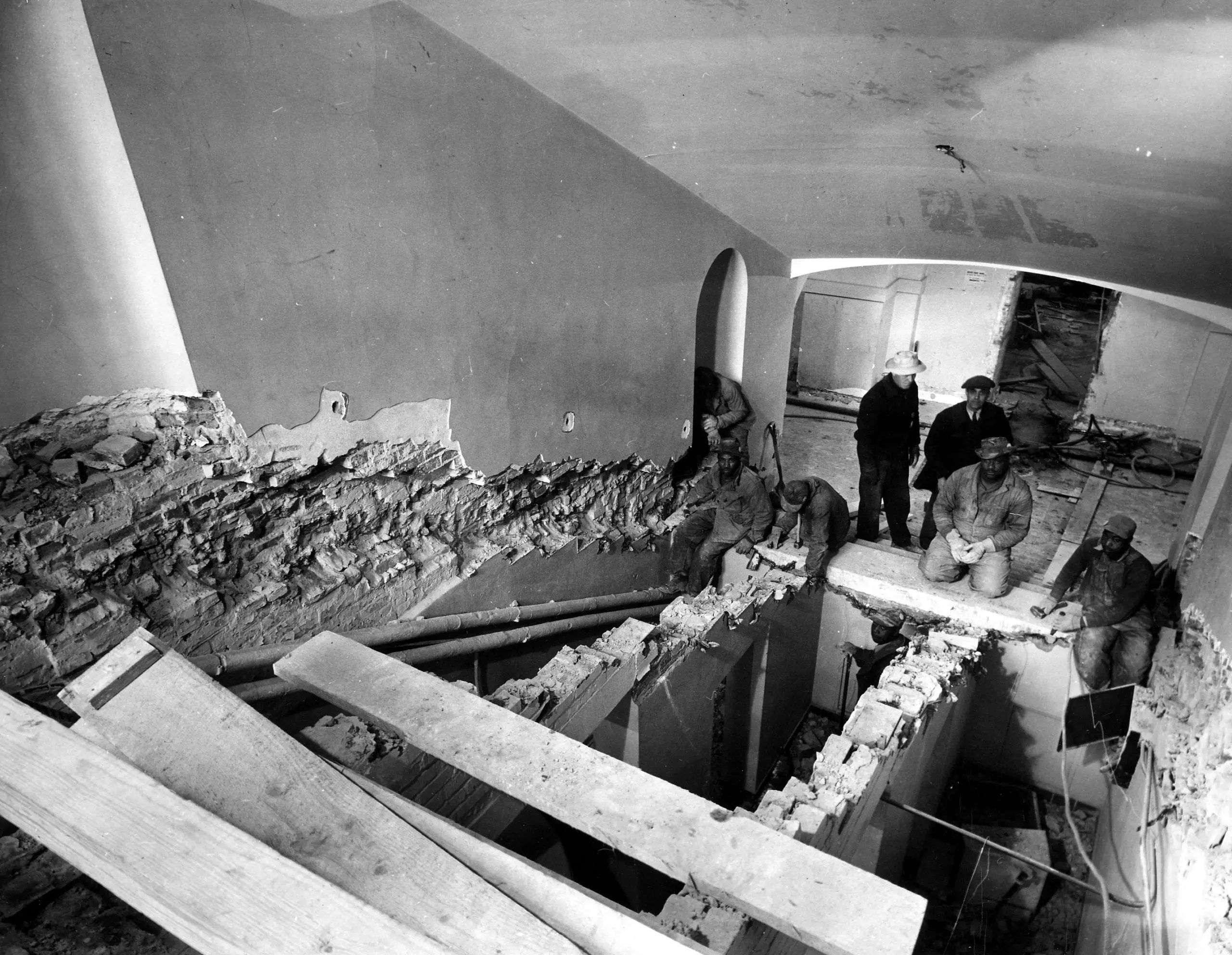
Source: Truman Library, photograph 58-531-017
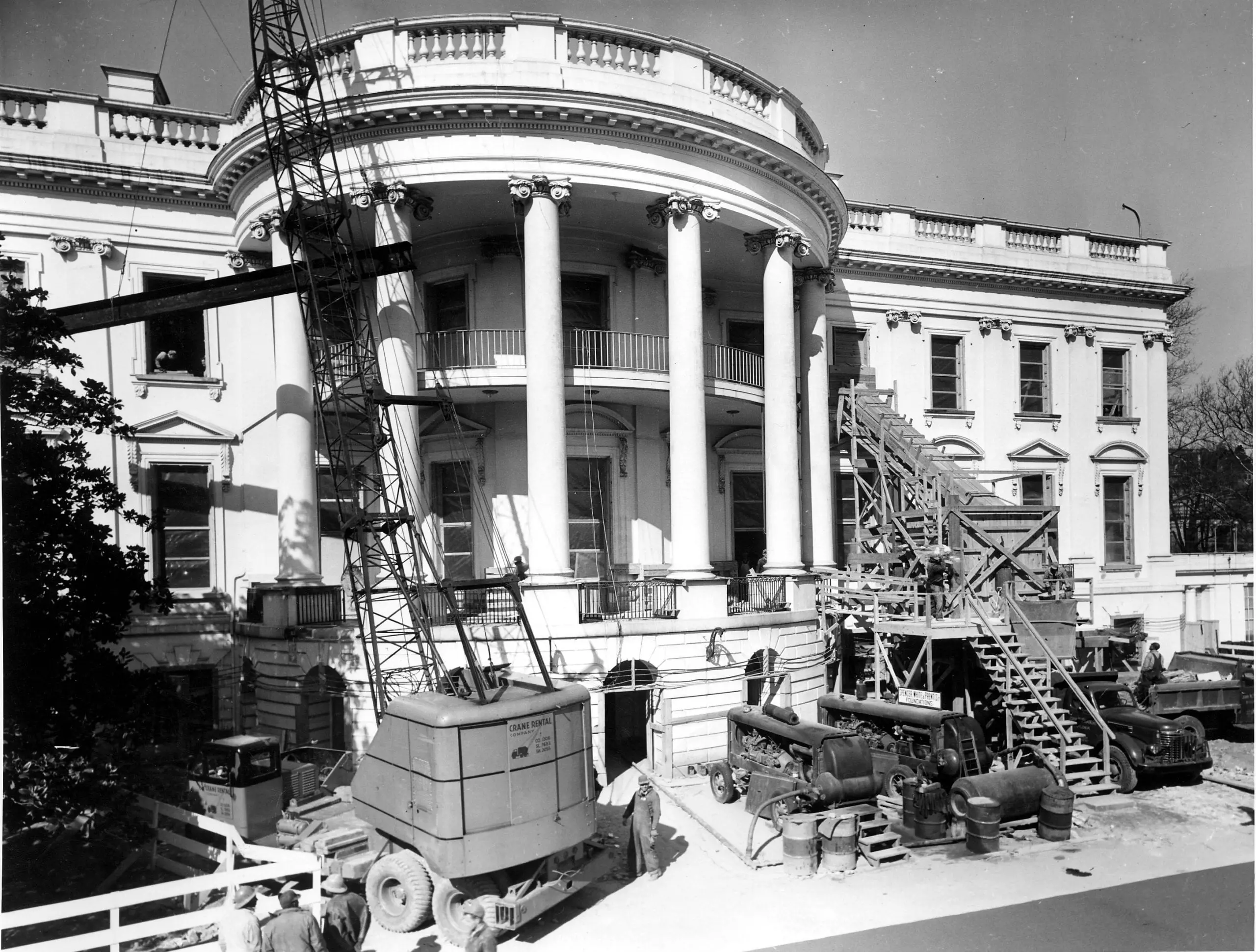
Source: Truman Library, photograph 58-531-011
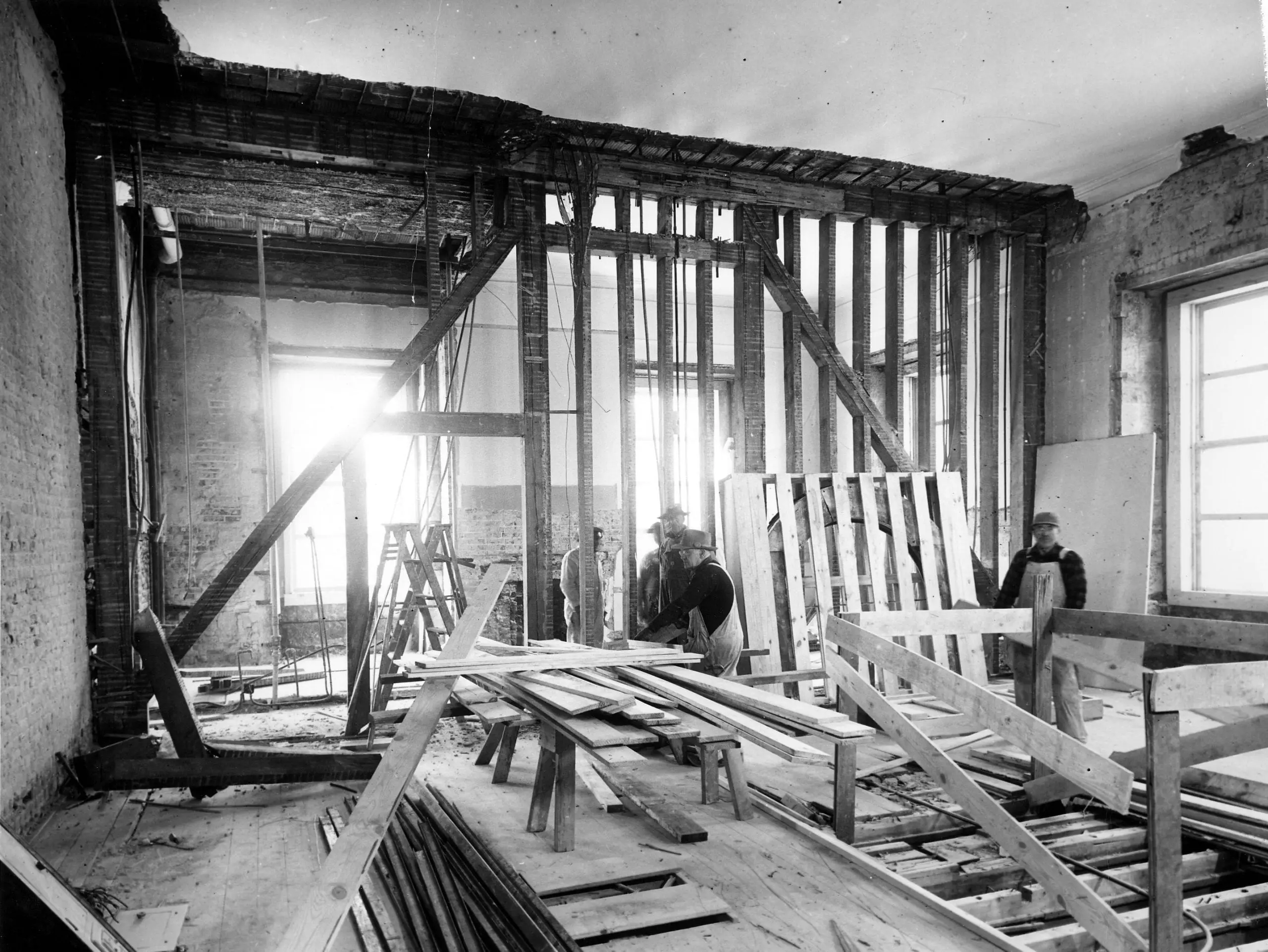
Source: Truman Library, photograph 58-531-03
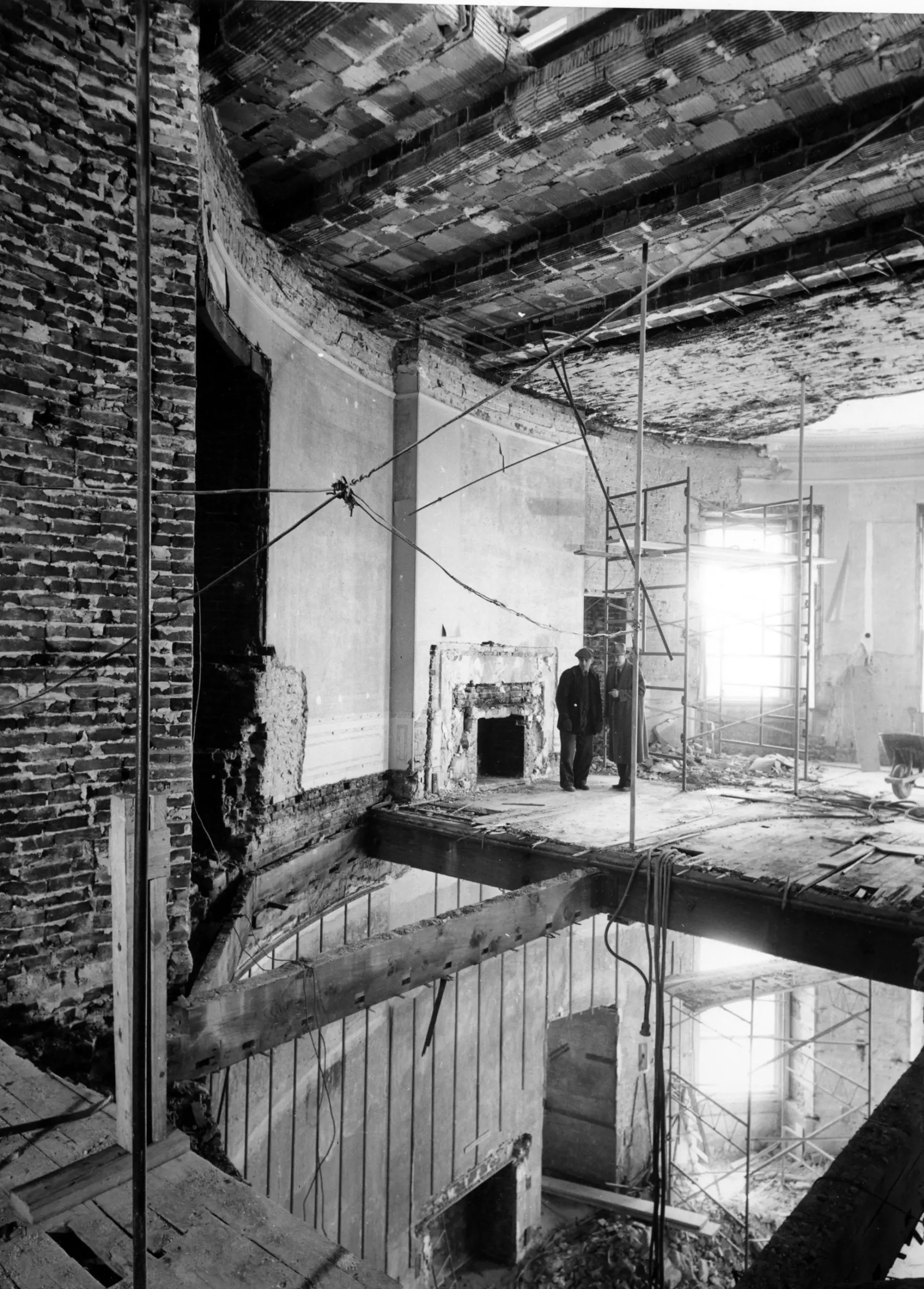
Source: Truman Library, photograph 71-223
By the official Commission timeline, salvage of historic material was complete on March 20, 1950, and excavation of the new basement footings was finished August 16, 1950. The shell at that point was empty.
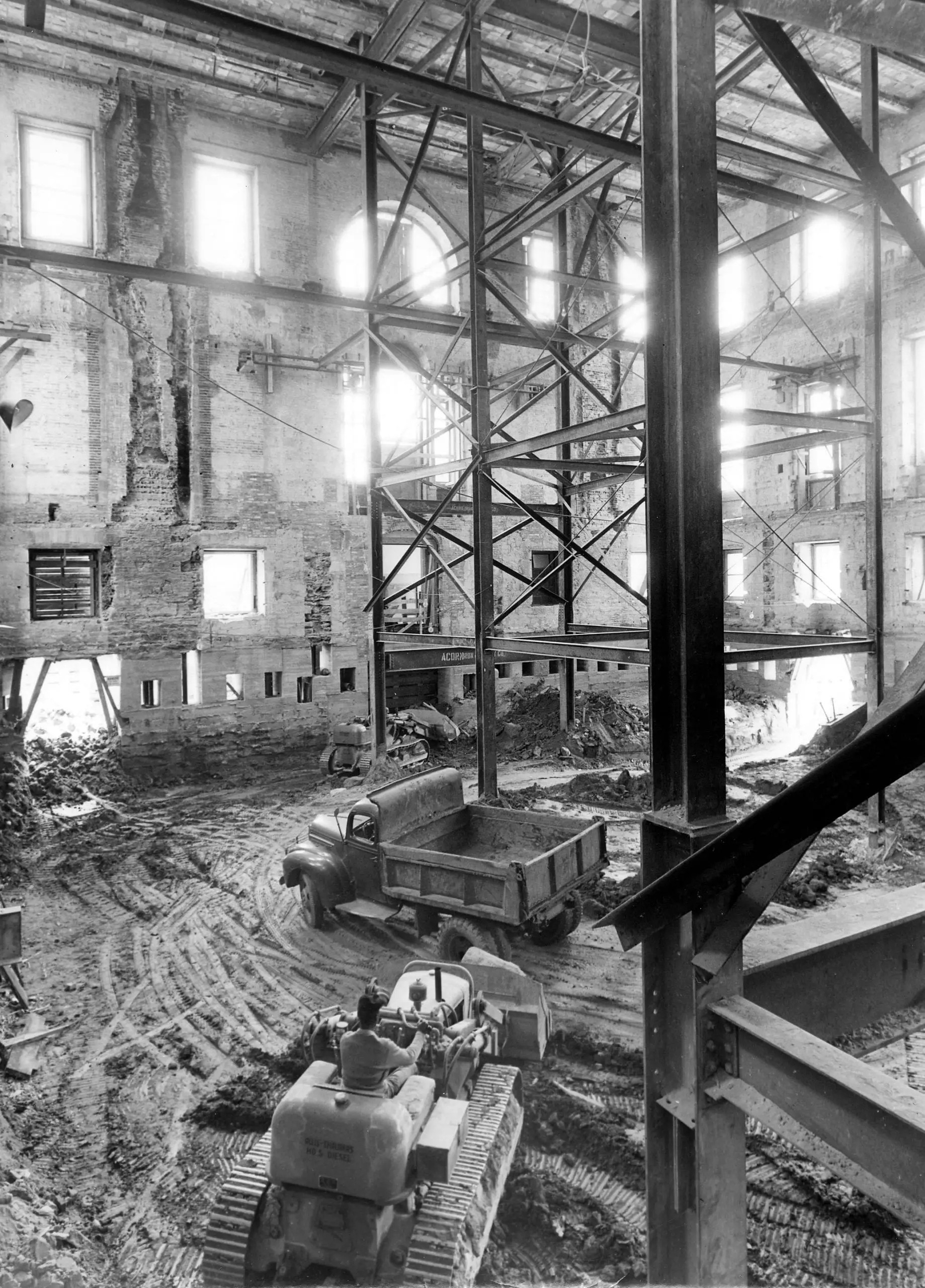
Source: Truman Library, photograph 71-305
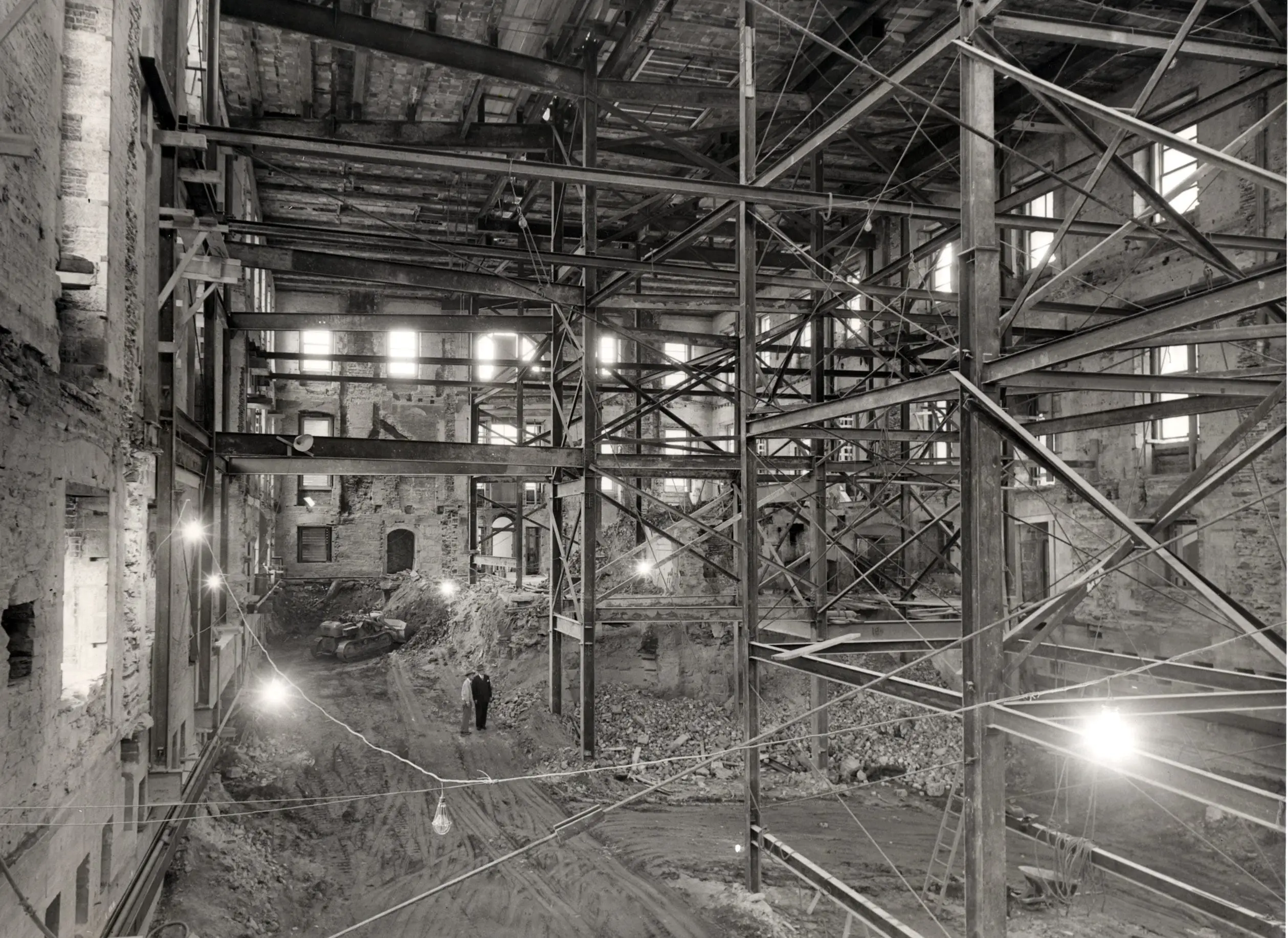
Source: Truman Library, photograph 71-312
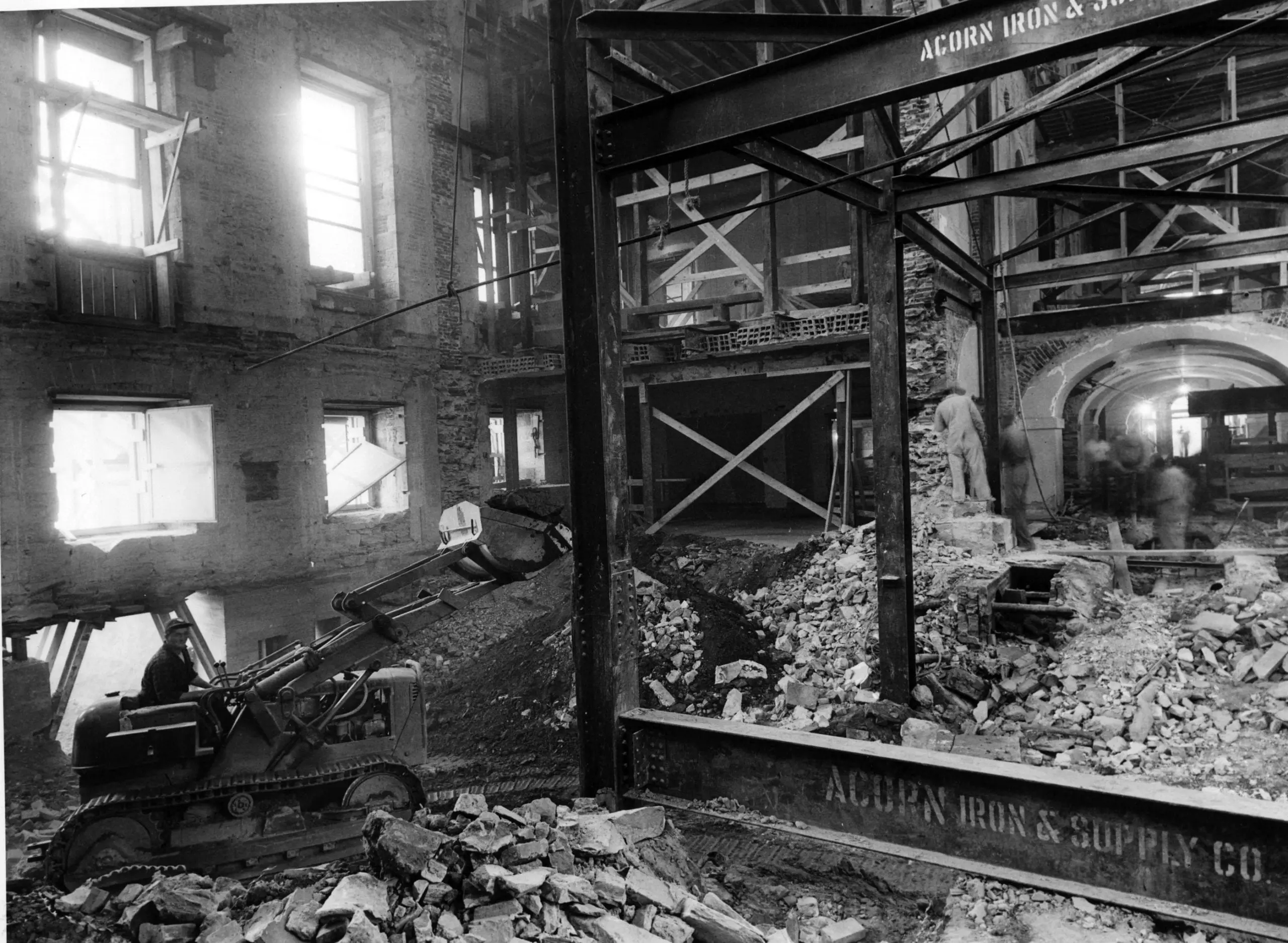
Source: Truman Library, photograph 71-286
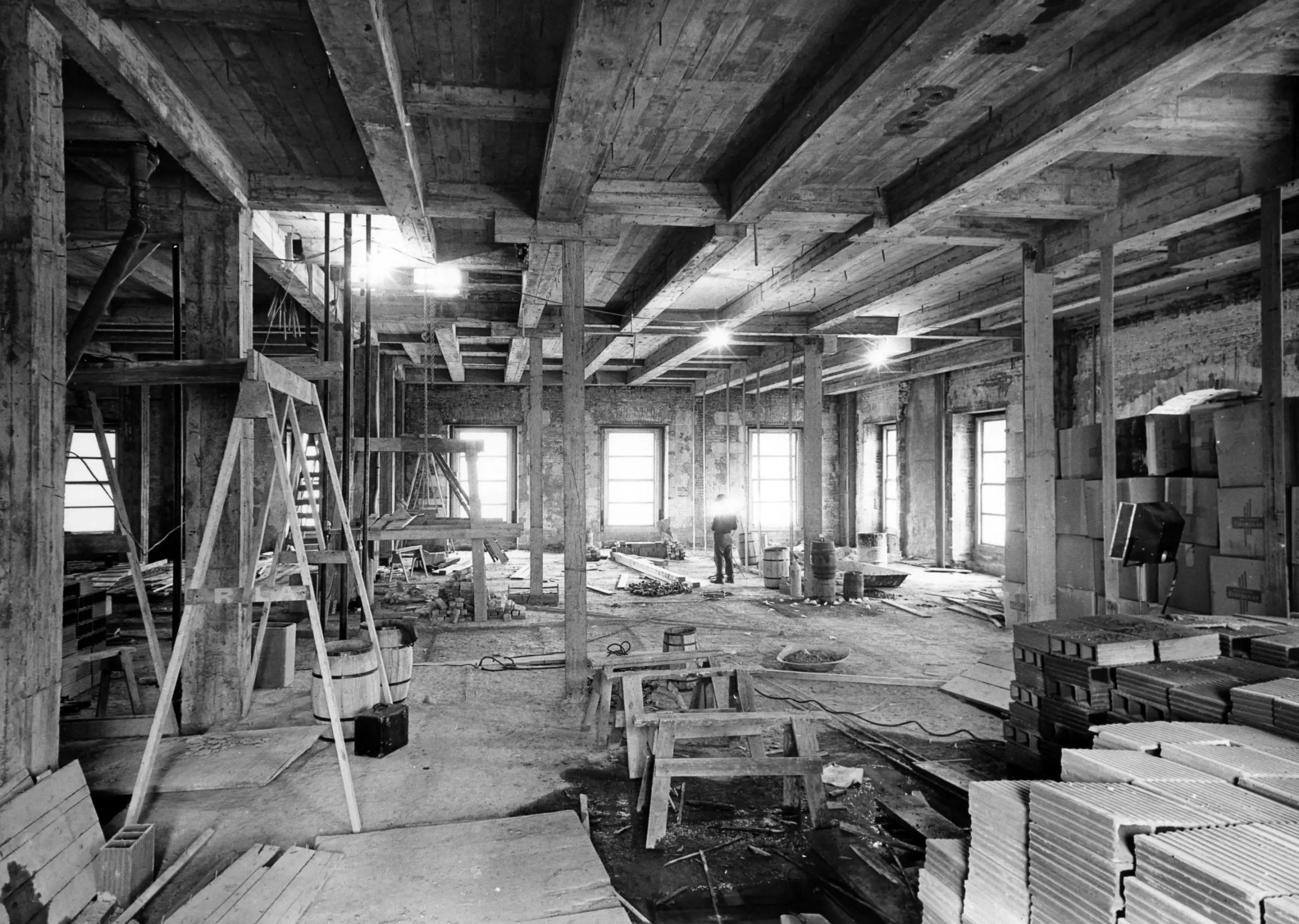
Source: Truman Library, photograph 71-410
The new frame, the new rooms
What replaced the rubble was a modern steel skeleton tied to new poured concrete foundations. The structure carried the weight that the old brick interior walls had failed to carry. With the load now on steel, the architects could redraw the floor plan. The renovation that started with 48 rooms ended with 54.
The two new sub-basement levels added under the original ground floor would, in the decades that followed, hold mechanical systems, a bowling alley, a swimming pool changing area, and what one declassified Cold War study calls a “complex labyrinth deep below ground,” including a top-secret fallout shelter.
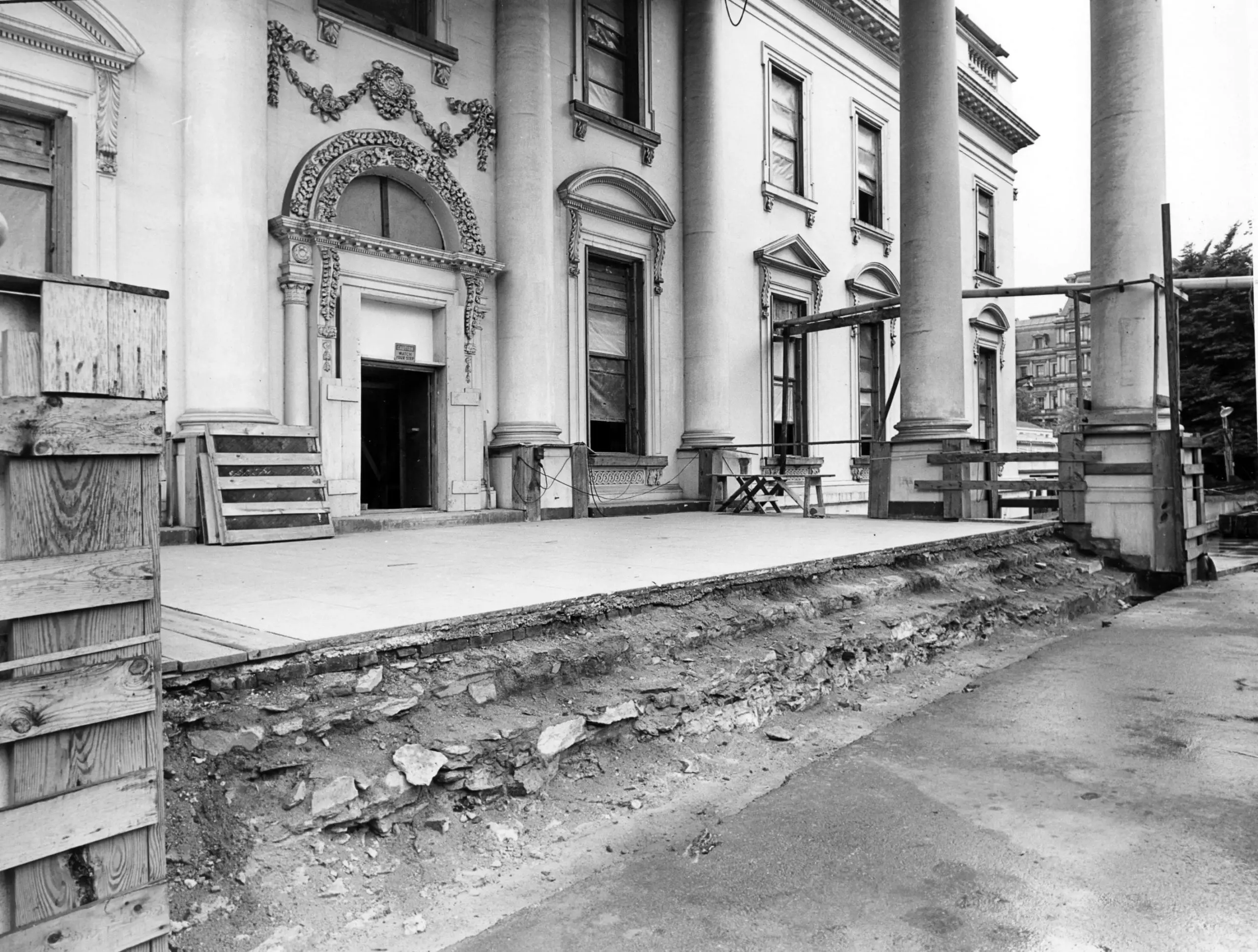
Source: Truman Library, photograph 71-475
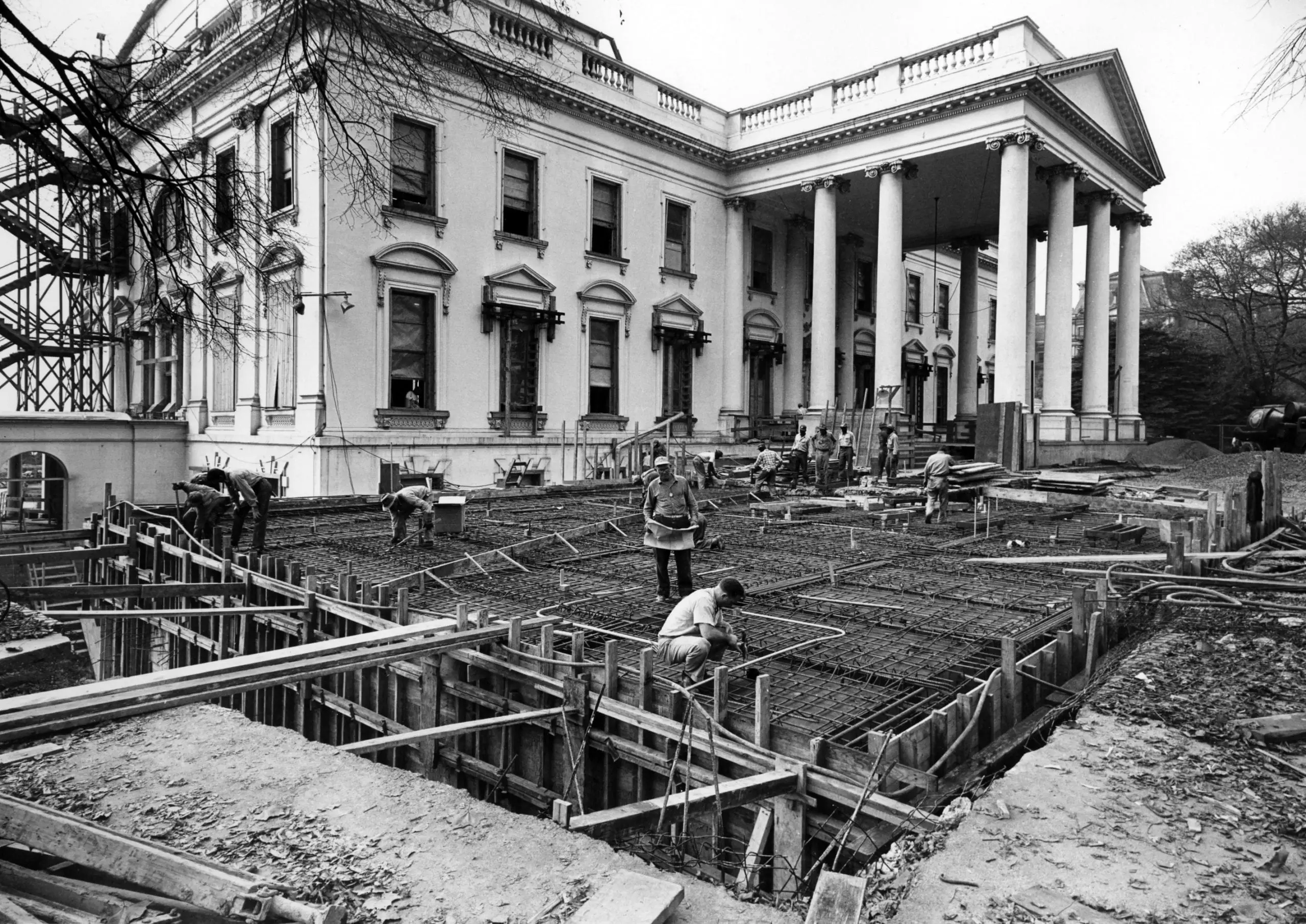
Source: Truman Library, photograph 71-390
The South Portico, which the family used as a private entrance, was treated separately. Its steps were dismantled and rebuilt to accommodate the new ground levels created by the basement excavation.
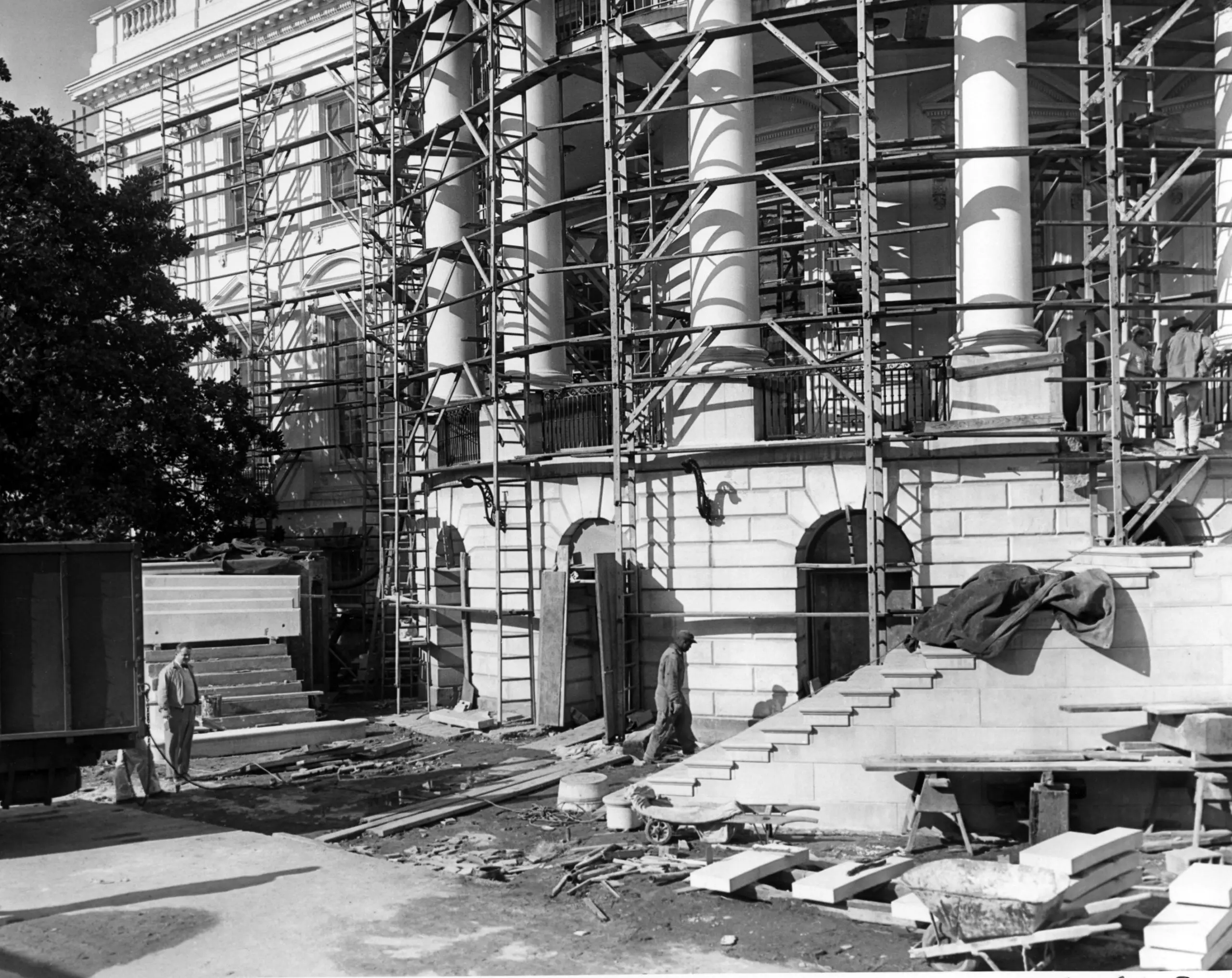
Source: Truman Library, photograph 71-605
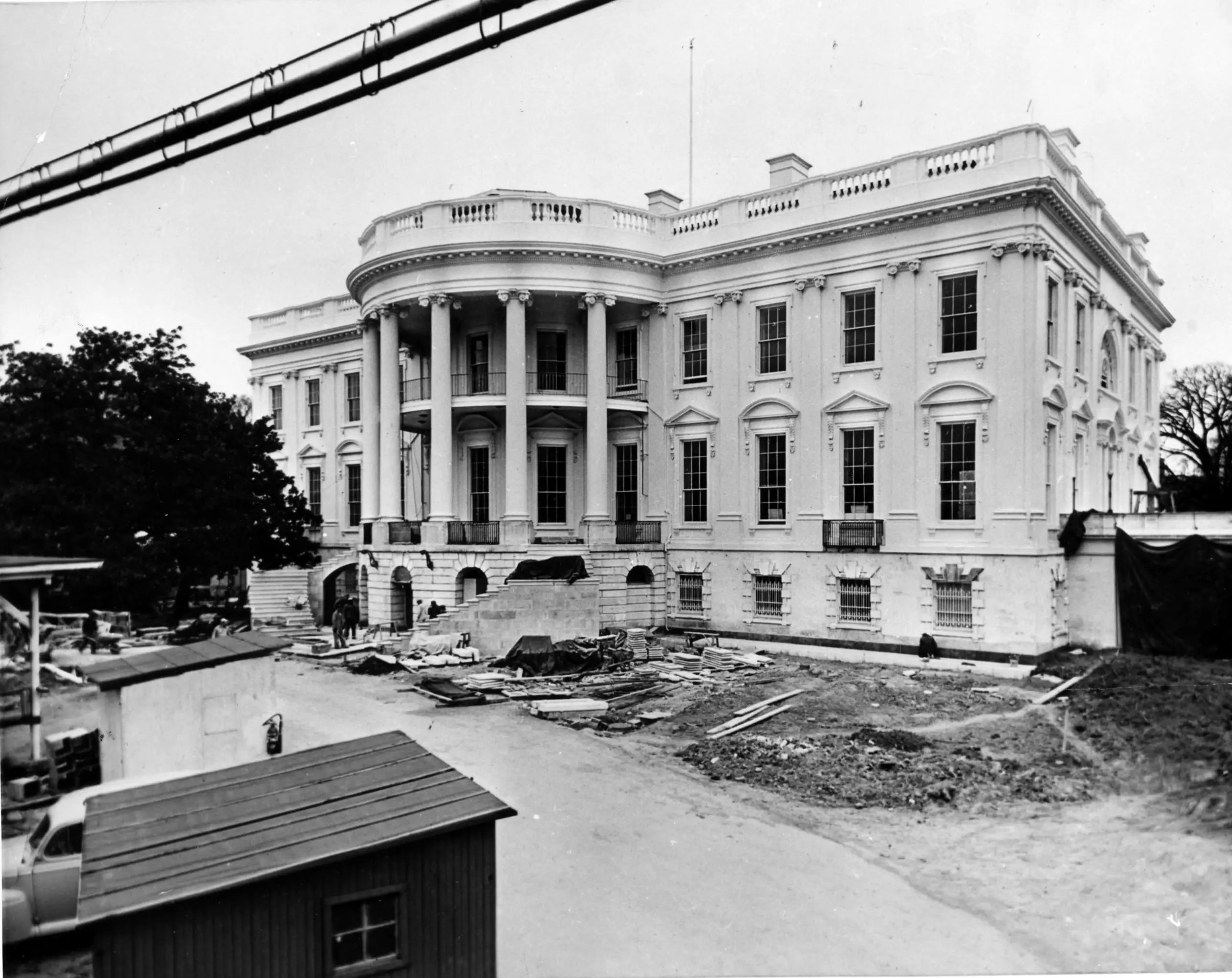
Source: Truman Library, photograph 71-723
The Historic American Buildings Survey at the Library of Congress holds 599 photographs and 41 measured drawings of the White House documenting both the pre-renovation building and Winslow’s rebuilt one. Forty-four of the final measured drawings were withheld from the public collection for national security reasons. The rest are online.
What was lost, what was saved
When the demolition contractors started ripping out the interior, the Commission faced a question that nobody had really thought through. What do you do with two centuries of timbers, doors, mantels, plaster ornaments, and bricks coming out of the most famous house in the country?
Their answer was to sell most of it to the public. Sets of bricks, blocks of stone, and lengths of timber were boxed and offered through mail-order kits. Larger pieces went to a Baltimore woodwork firm, Knipp & Co., which was the millwork subcontractor under McShain. Earvin Ruddick, a young carpenter at Knipp’s, was on the crew.
“There were about 12 to 14 of us working on the White House,” Ruddick told the White House Historical Association decades later. The wood was Georgia longleaf pine, installed during James Hoban’s post-burning reconstruction of the building in 1817. “Very hard, but through age, it had gotten very brittle.” Knipp’s crew pulled the nails, cut out rot, ran the boards through a straight-line saw, and milled them into molding.
Some of that milled-down 1817 pine went back into the building as paneling in what is now called the Vermeil Room. On Ruddick’s ninetieth birthday, the White House Historical Association brought him back for a tour. He recognized his own work on the walls. “Oh, I’m very proud of it now.”
Going home
Truman walked back into the White House on March 27, 1952. There was a gold-key ceremony at the North Portico for the press. A live television broadcast went out from the State Floor. On April 22 he led the country through the rebuilt interior on a longer televised tour, the first of its kind.
The Commission’s Final Report ran to several hundred pages and a stack of appendices. Truman, in his diary, was less measured. The line he kept coming back to was the price tag.
“With all the trouble and worry it is worth it, but not 5½ million dollars! If I could have had charge of the construction it would have been done for half the money and in half the time!”
The Commission was officially terminated on October 30, 1952. Five days later, Dwight Eisenhower defeated Adlai Stevenson at the polls. Truman, who had announced in March 1952 that he would not seek another term, handed over a building he had spent four years and most of his second term saving.
The sandstone walls you see when you stand outside the South Portico fence today are the walls James Hoban put up between 1792 and 1800 and the walls Charles McKim and the Roosevelts restored in 1902, after Caroline Harrison’s unbuilt 1891 expansion plan and Theodore Bingham’s 1900 revival had been scaled down to the modest West Wing. Almost everything behind them is from 1952.
The State Floor where presidents host visiting heads of state, the family quarters where they sleep, the Grand Staircase, the Lincoln Bedroom, the basement that hides the bowling alley: all of it was built between December 1949 and March 1952, inside an empty stone shell, by John McShain’s crews under Lorenzo Winslow’s drawings, while Harry and Bess Truman lived across the street and waited.
A passing tourist with a 35mm Leica caught the same building from Pennsylvania Avenue in 1950, the renovation in progress behind the fence.
Renovation? Total gut rehabilitation!
this is what someone would do to flip the house 😉