
The drawing is inscribed in Fred D. Owen’s hand across the top: “An adaptation. The suggestions of Mrs. Harrison. The extension of the Executive Mansion. 1492 1792 1892 … to be completed by Oct. 13, 1892, the centennial of the laying of the corner-stone of the original structure, 1792.”
That is the dateline a First Lady set herself in 1890. October 13, 1892. The hundredth anniversary of the day George Washington’s commissioners laid the cornerstone of the building Caroline Harrison was now trying to triple in size.
She missed it by twelve days. Not the building. Her own life.
A first lady with plans on the table
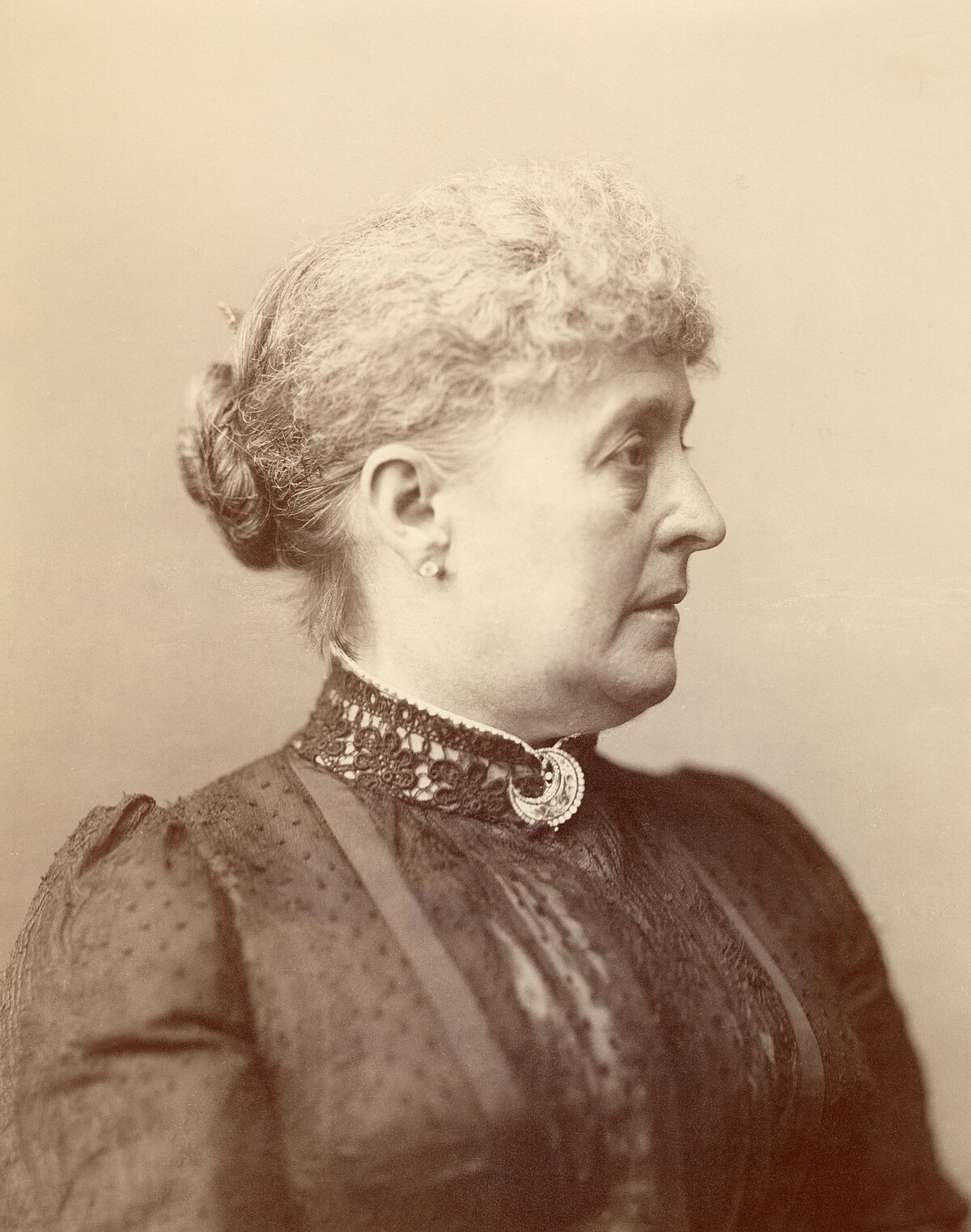
Caroline Lavinia Scott Harrison moved into the Executive Mansion on March 4, 1889. She was 56, a music teacher from Oxford, Ohio, the wife of the new president, and the mother of two grown children.
She also brought everyone else with her.
Four generations of Harrisons squeezed into the residential floor. Daughter Mary Harrison McKee, her husband J. Robert McKee, and three grandchildren. Daughter-in-law May, married to son Russell. Caroline’s aging father, John Witherspoon Scott. Her widowed niece Mary Lord Dimmick. The household total ran to roughly a dozen, sharing what was at the time a single bathroom.
The same floor held the president’s working offices.
Caroline took inventory of the place that first spring and found rot, termites, rats, fraying carpets, and electrical wiring Thomas Edison himself told her could not be safely installed in the building’s current state. The roof leaked. The kitchens had not been touched in forty years.
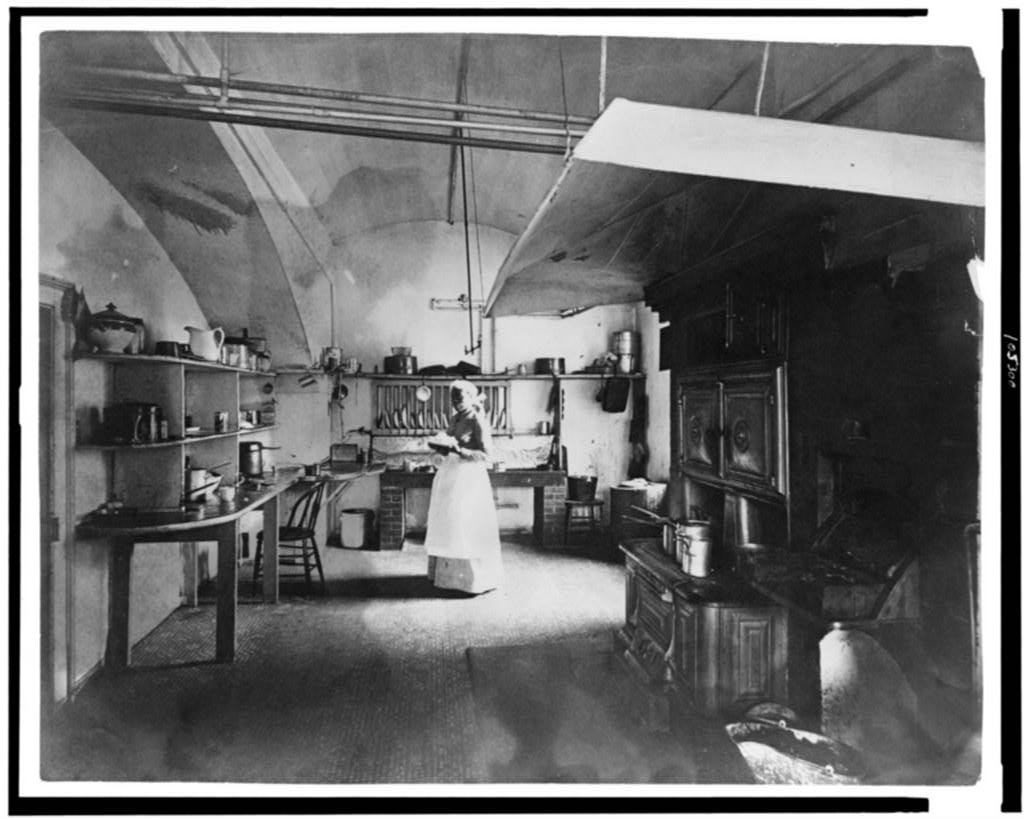
Visitors wandered into the family quarters because there was no architectural division between the residence and the offices. Cabinet members came up the same staircase the grandchildren came down.
She wanted to rebuild it. Not refurbish, not patch. Rebuild.
The Owen plan
By 1890 she had a collaborator. Frederick D. Owen was a Washington architect and a civilian draftsman attached to the U.S. Army Corps of Engineers. He had drawn proposals for a Grant memorial bridge across the Potomac and held a respectable practice.
He was also a friend of the First Lady. She brought him her ideas. He drew them.
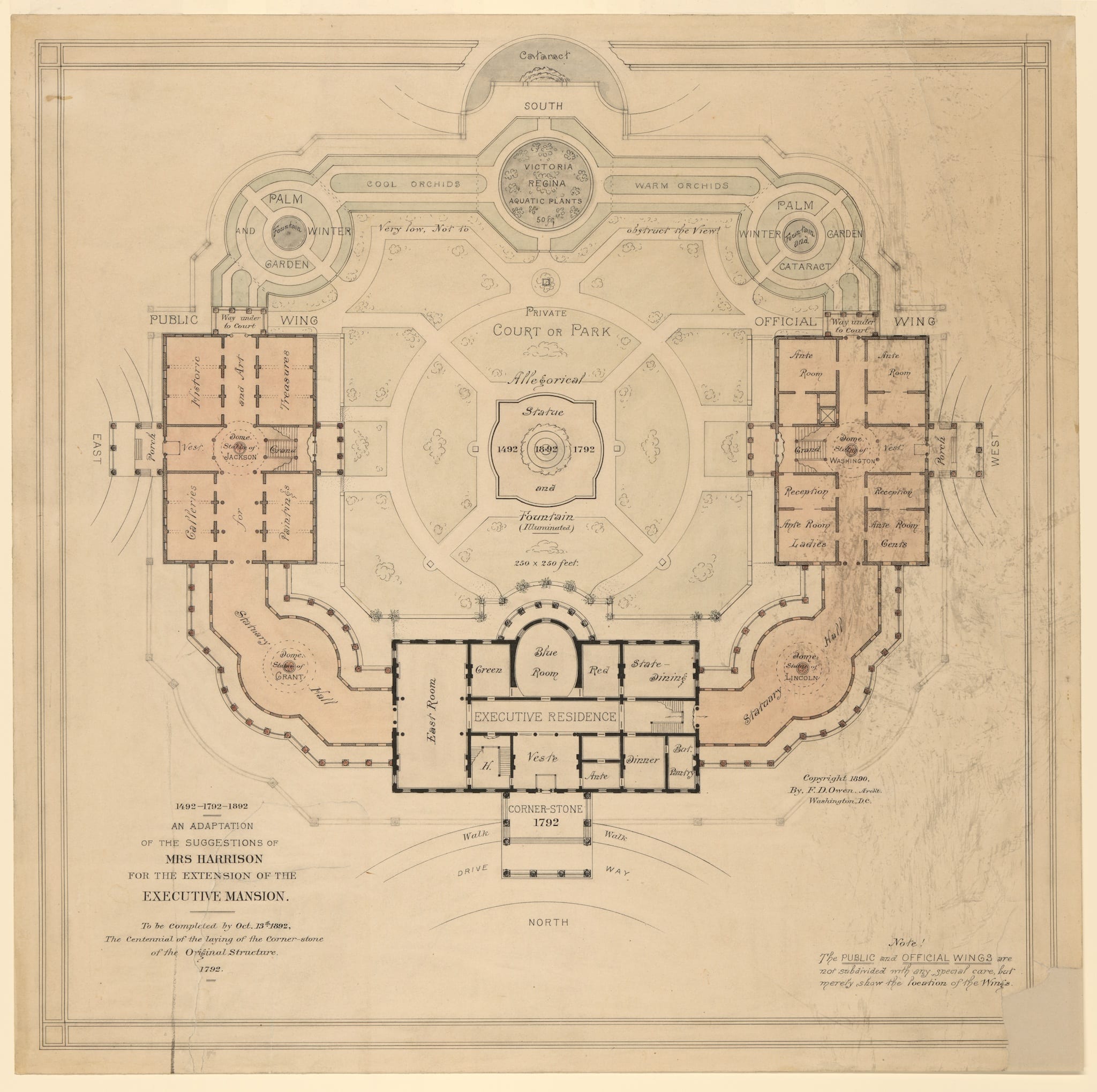
The result was a U-shaped complex that would have made the existing White House one piece of a much larger ceremonial seat of government. The central building stayed where it stood.
To the east, Owen drew a wing labeled “Public Art Wing” or “Historical Art Wing” facing the Treasury Department, intended to house a gallery of American art open to the public. To the west, a matching wing for the president’s official business and formal occasions, facing the State, War, and Navy Building.
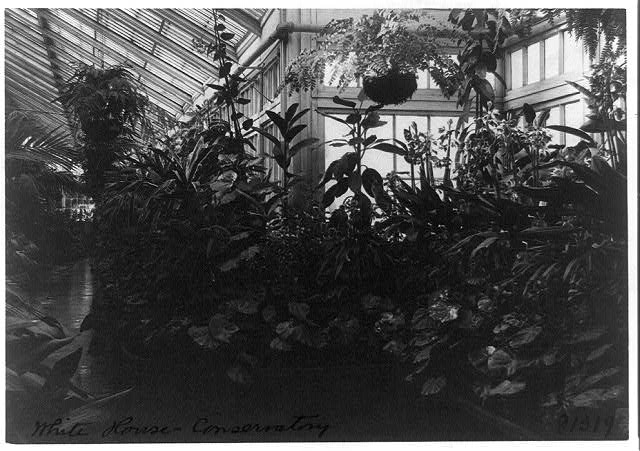
Between them and the original house ran a pair of semicircular colonnades. A long, low conservatory closed off the south end of the quadrangle, glassed in like a botanical hall.
In elevation, the plan pushed the President’s House toward something closer to a national palace. The wings echoed the proportions of the central block. The colonnades borrowed from Hoban’s original visual vocabulary. The conservatory anchored the new south facade in glass.

Owen punched up the silhouette with a quartet of bronze tribute statues, one on each corner dome of the new complex. George Washington. Andrew Jackson. Abraham Lincoln. Ulysses S. Grant.
The four presidents who had presided over the country’s great founding and great salvation moments, looking out over the quadrangle from on top of the very building that housed their successors. It was a centennial argument made in stone, and it would have shown up on the skyline.
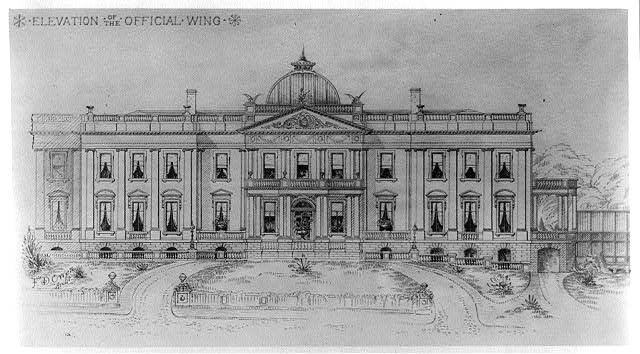
The Library of Congress holds the surviving drawings as the Mrs. H.S. Owen Collection, thirteen items in ink, watercolor, graphite, and photomechanical print, transferred from the Manuscript Division.
They are cataloged not under Benjamin Harrison’s name but under “for Mrs. Benjamin Harrison.” The site plan in the collection bears Owen’s own handwritten inscription, “The suggestions of Mrs. Harrison.” It is the closest thing the record has to a primary attribution. The First Lady’s name is on the drawings because the project was hers.
The centennial deadline
Caroline wanted the new Executive Mansion dedicated on October 13, 1892. That was the hundredth anniversary of the cornerstone laying in 1792, when George Washington’s appointed commissioners and a delegation of Maryland Freemasons set the building’s first stone in the corner of a half-built capital.
Washington himself was likely in Philadelphia that day. The cornerstone went down anyway.
The centennial framing did double duty. It gave the project a political deadline, which always helps a congressional appropriation. It also reflected what Caroline was already doing elsewhere in the building.
She had inventoried the White House’s accumulated furnishings and china and started what is now the White House China Collection, the standing curatorial collection of presidential china. She had taken historical preservation seriously enough to lead the new Daughters of the American Revolution as its first president general in 1890.
Her speech at the DAR’s founding session was the first public address ever written and delivered by a sitting First Lady. She was actively rebuilding the relationship between the Executive Mansion and the country’s hundred-year past.
The expansion was the architectural form of that same project. The Owen drawings used the centennial date not as decoration but as a deadline. “To be completed by Oct. 13, 1892,” in Owen’s own hand on the site plan.
The building was supposed to dedicate itself.
The appropriation fights
Owen’s plans went to Congress with a price tag. The exact appropriation figure varied across iterations, but the Harrison administration backed a bill authorizing the construction with public funds, on the theory that the centennial was the country’s centennial, not the family’s.
It did not move.
The story White House historians tell is that Speaker Thomas B. Reed of Maine personally blocked the bill from reaching the House floor. Reed, the bull-headed parliamentary tactician Washington had nicknamed Czar Reed for his procedural muscle, was said to have been offended that Harrison passed over Reed’s preferred candidate for the post of customs collector at Portland.
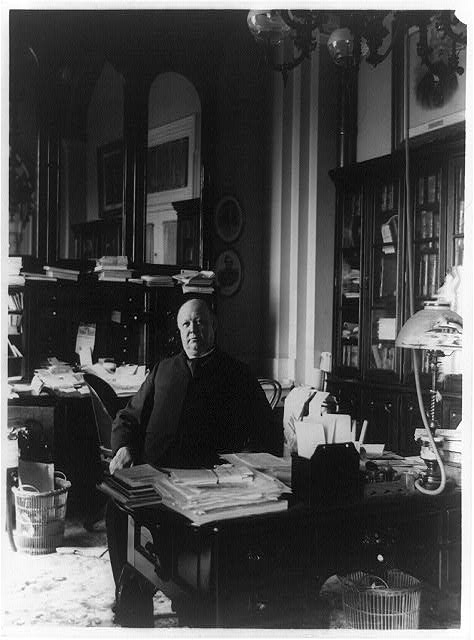
The retaliation, in this telling, was to use the Speaker’s calendar control to make the White House expansion vanish from view. The bill never reached a vote.
The version repeats across White House Historical Association material and popular histories of the Harrison years. It has the shape of a Reed story, and it sits comfortably with what we know about how Reed actually wielded the chair.
What is certain is that Congress did not fund the expansion. What it did fund, instead, was $35,000 for renovations, decoration, and modernization of the existing house.
That allocation paid for new wiring, new plumbing, new bathrooms, modern kitchens, ivory paint on the state rooms’ woodwork, five fresh layers of floorboards over the rotten ones, and ferrets in the basement to take care of the rats. The electrical work alone took four months.
When it was done, most of the family was still afraid to touch the light switches. Caroline kept a servant on call to flip them after dinner.
It was a fraction of what she had wanted. It is also more interior work than any First Lady before her had managed to get done.
October 1892
Caroline got sick in the spring of 1891. By the time her doctors diagnosed tuberculosis, the disease had a foothold.
She spent the summer of 1892 in the Adirondacks at a cottage near Loon Lake, on her physicians’ instruction, breathing the mountain air that consumptive patients of the day were told would help. The expansion fight kept moving without her.
She delegated the East Room duties to her daughter Mary, which set off a small war with the Second Lady and the wife of the Secretary of State, both of whom felt the role of acting hostess should have come to them.
She was brought home to the White House in late September. The bill was still bottled up. October 13 came and went with no centennial dedication and no new Executive Mansion. The Owen drawings stayed in a flat file in Owen’s office.
She died in an upstairs bedroom on October 25, 1892. Twelve days after the date she had picked for the cornerstone of her new building.
Funeral services were held in the East Room. Her body was taken by train to Indianapolis for the final service and burial at Crown Hill Cemetery. Two weeks after that, Benjamin Harrison lost the election to Grover Cleveland and the Harrisons left the White House permanently.
It is believed Caroline died of a combination of tuberculosis and a secondary illness, possibly typhoid fever or influenza. She was the second sitting First Lady to die in the role.
The Bingham revival and the McKim reduction
The plan came back in 1900 in a different form. By then Colonel Theodore A. Bingham was running Public Buildings and Grounds for the Army Corps of Engineers. He took up the expansion question again, scaled it, and built a plaster model of his own version.
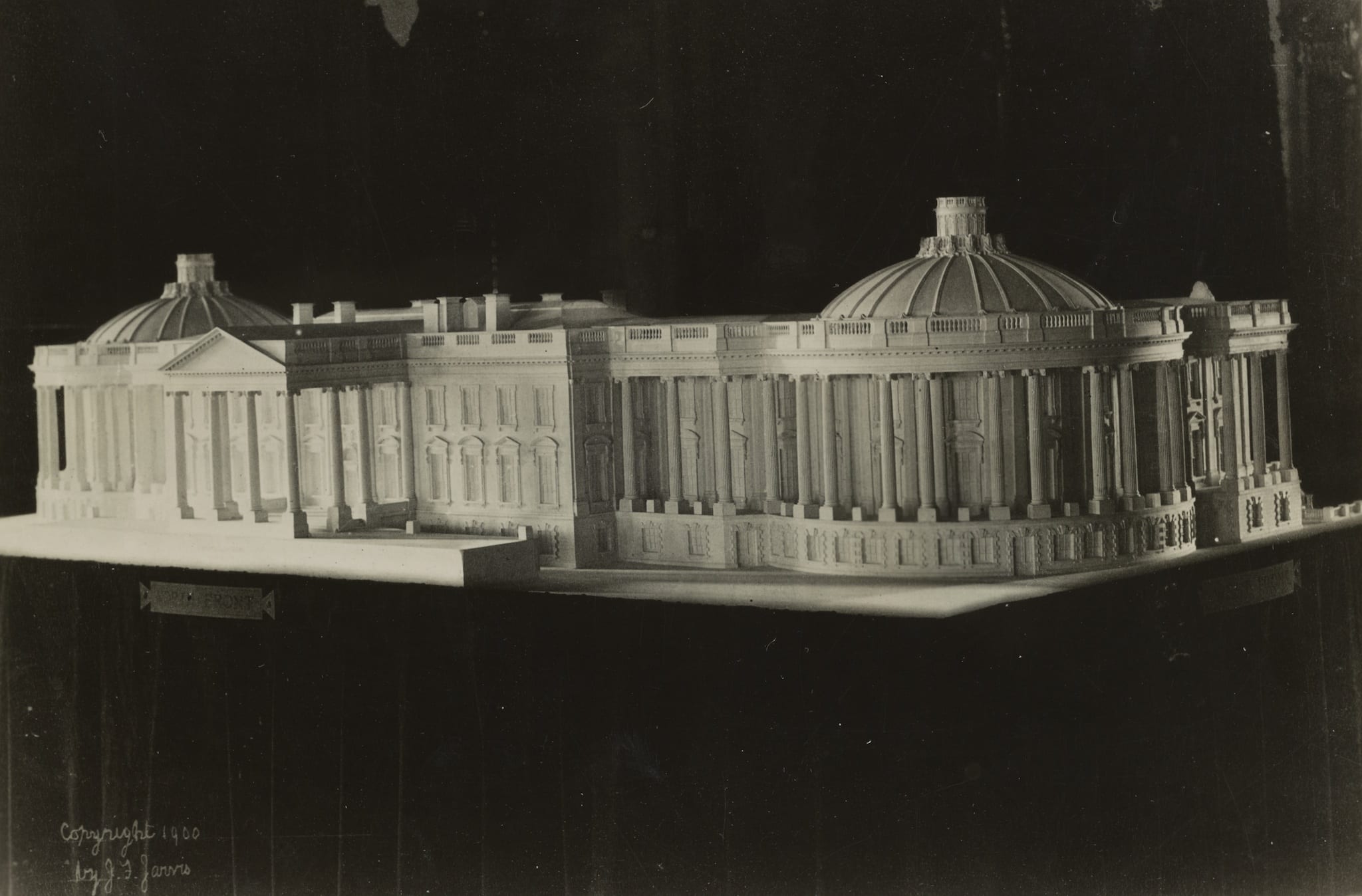
The Bingham scheme kept the U-shape but replaced Owen’s classical wings with two-story cylindrical pavilions topped by domes and lanterns, patterned on the new Library of Congress reading room that had opened in 1897. It was a more confident, more imperial design than Owen’s, and it carried the Beaux-Arts vocabulary of the moment.
The 1900 plaster model is what the photograph above shows. It is sometimes misidentified online as the Owen model from 1891.
The Library of Congress catalog dates the photograph to 1900, with copyright held by the Washington photographer J. F. Jarvis, and the model itself to the Bingham revival, not to Caroline’s original collaboration. The cylindrical domes are the giveaway. Owen never drew them. They are Bingham’s.
Theodore Roosevelt looked at the domes and lanterns and said no. He turned instead to the New York firm of McKim, Mead and White, who produced what is now called the 1902 Roosevelt Renovation.
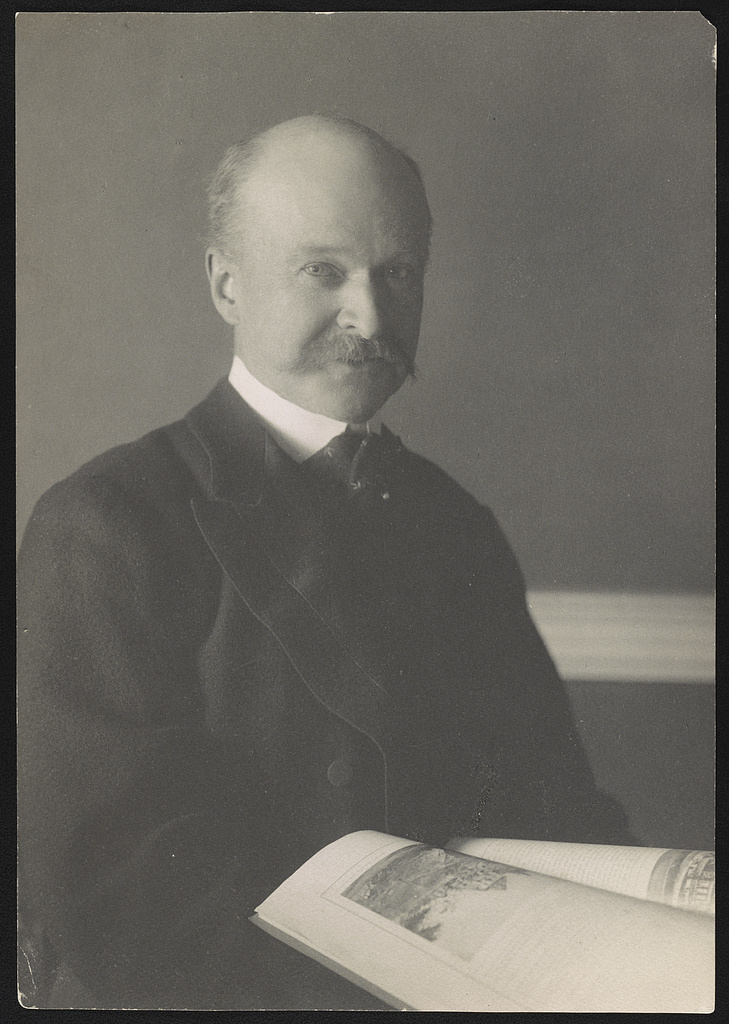
Charles McKim kept the Executive Mansion’s exterior intact, gutted the interior, separated the residence from the offices by building a small detached office building to the west, and gave the country what is now called the West Wing.
The McKim scheme borrowed the U-shape logic Caroline and Owen had pushed for and reduced it to two slender, low-profile connectors and a single working wing. The colonnaded ranges shrank to the modest pergola that today links the residence to the West Wing. The art gallery wing never got built. The conservatory was demolished outright to make room for the new office structure.
What McKim delivered was a fraction of Owen’s plan. It was also the only version that ever got past Congress.
What survives
The Owen plan never made it off the drafting table. The Bingham revival died with Theodore Roosevelt’s veto.
The grand U-shaped Executive Mansion Caroline Harrison wanted to dedicate on October 13, 1892 exists as a stack of drawings, a single plaster model photographed by Jarvis, and a footnote in the architectural history of the building.
What does survive is everything Caroline got done while she was waiting for Congress. The kitchens. The plumbing. The wiring. The Green Room redone in rococo.
The basement floors, finally concrete, finally tiled, finally too smooth for rats to nest in. The Music Room she furnished for her piano teaching, which Frances Benjamin Johnston photographed in 1893 and is still recognizable in the published views.
The china collection that is now the standing curatorial collection of the White House. The first White House Christmas tree, which she ordered set up for her grandchildren in 1889. Orchids as the standing flower at state receptions, an institution she invented.
The architectural conversation she started ran past her death by another six decades. Bingham picked it up. McKim cut it down. Calvin Coolidge added a full third floor in 1927.
The East Wing came later still, built out under Franklin Roosevelt during the Second World War as office space, a cloakroom for state visitors, and an air raid shelter beneath.
And finally Harry Truman’s 1949 to 1952 gut renovation rebuilt the interior to the structural standards Caroline had been pushing for in 1890, when the floors were rotten and the wiring would not take and the family kept tripping over the offices on its way to dinner.
By the time Truman’s crews were done, the only original material left inside the walls was the exterior shell. Everything Caroline had complained about was rebuilt from the studs.
Stand on the South Lawn today, look at the residence with the West Wing on one side and the East Wing on the other, and what you are looking at is the same U-shape Caroline Harrison and Fred D. Owen drew in 1890.
Smaller. Reduced. Quieter. Stripped of the tribute statues and the art gallery and the glassed-in conservatory. But the same idea, in the same place, opened toward the same lawn.
She did not get her centennial dedication. The building got most of her plan anyway, sixty years late.
Yikes!