
There actually was a spring, and it was silver, sort of. In 1840, Francis Preston Blair stumbled on a mica-flecked spring near what is today Georgia Avenue, just over the District line. The flakes of mica caught the sun and made the pool look like it was sparkling with silver.
The spot is now Acorn Park, a small triangle of green where Blair Mill Road, Newell Street, and East-West Highway meet. The spring still runs inside a stone grotto under an acorn-shaped pavilion. The town grew around it.
Who was Francis Preston Blair?
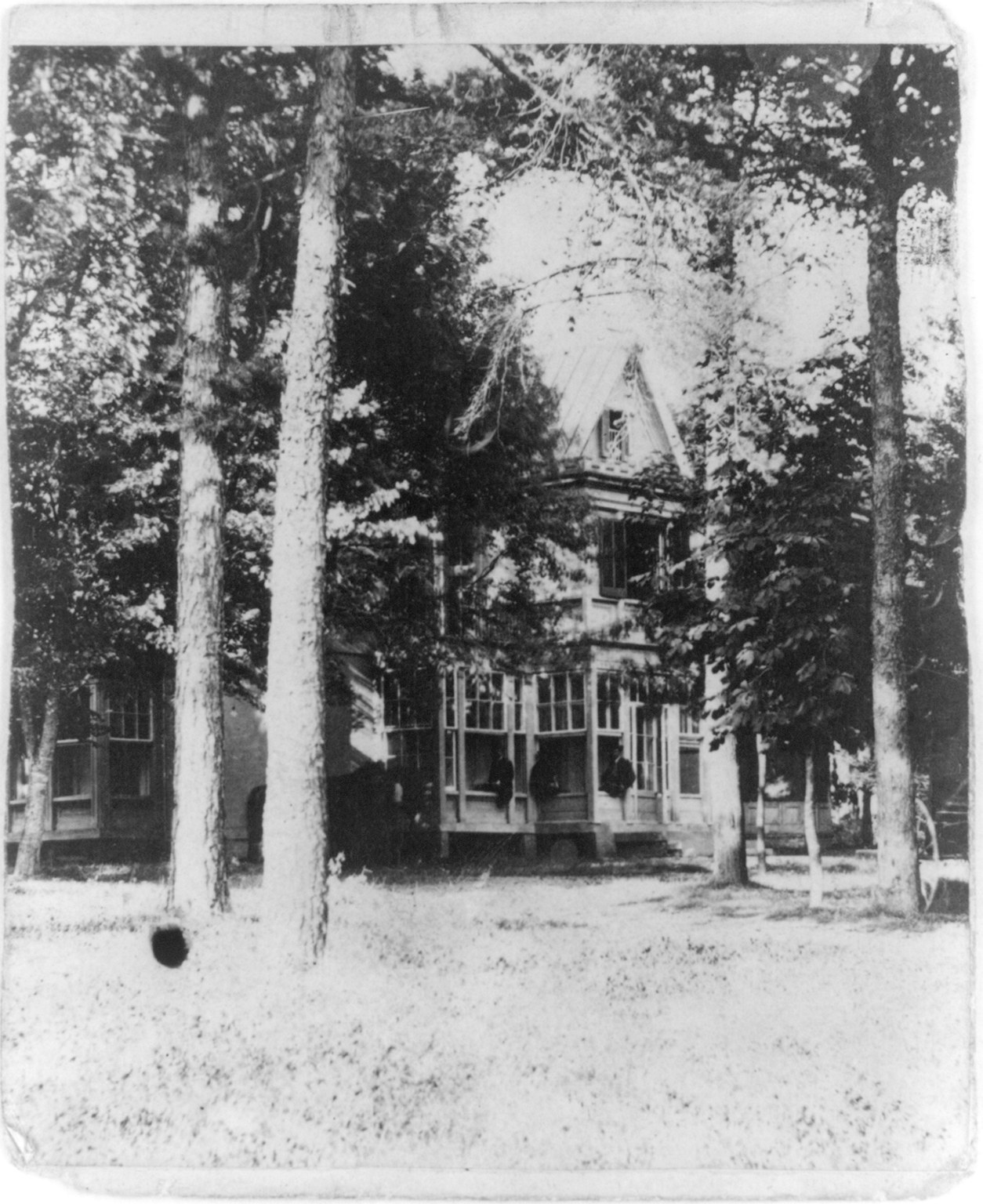
Blair liked the spot enough to buy the land around the spring and put up a 20-room country house on a 250-acre estate. He called it Silver Spring. It gave the family a malaria-free escape from the swampy Washington summer, and the name eventually stuck to the whole area.
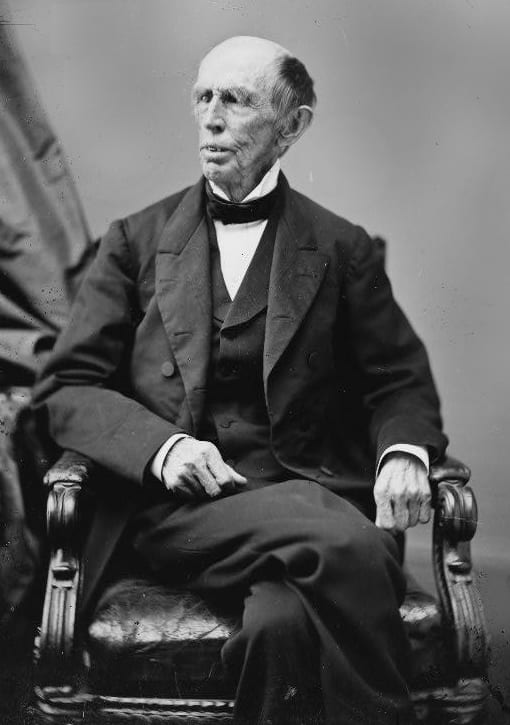
Blair was born in Abingdon, Virginia in 1791 and trained as a lawyer in Kentucky. He came to Washington in 1830 at Andrew Jackson’s invitation to run the Washington Globe, the official mouthpiece of the Jacksonian Democrats. He stayed on as editor through 1845 and sat at the center of Jackson’s “Kitchen Cabinet” of unofficial advisors.
His son Montgomery Blair would later serve as Abraham Lincoln‘s Postmaster General. Another son, Francis P. Blair Jr., became a U.S. Senator from Missouri and the 1868 Democratic nominee for Vice President. The Blairs had a habit of standing close to power.
There is one more famous Blair scene. In April 1861, with Fort Sumter just fallen, Lincoln sent him to Robert E. Lee with an offer of command of the Union armies. Lee turned him down. As Blair recalled the conversation a decade later, Lee told him:
Mr. Blair, I look upon secession as anarchy. If I owned the four millions of slaves at the South, I would sacrifice them all to the Union; but how can I draw my sword upon Virginia, my native State?
Two days later Lee resigned his commission. He took command of Virginia’s forces within the week.
The Blairs in the 1850 census
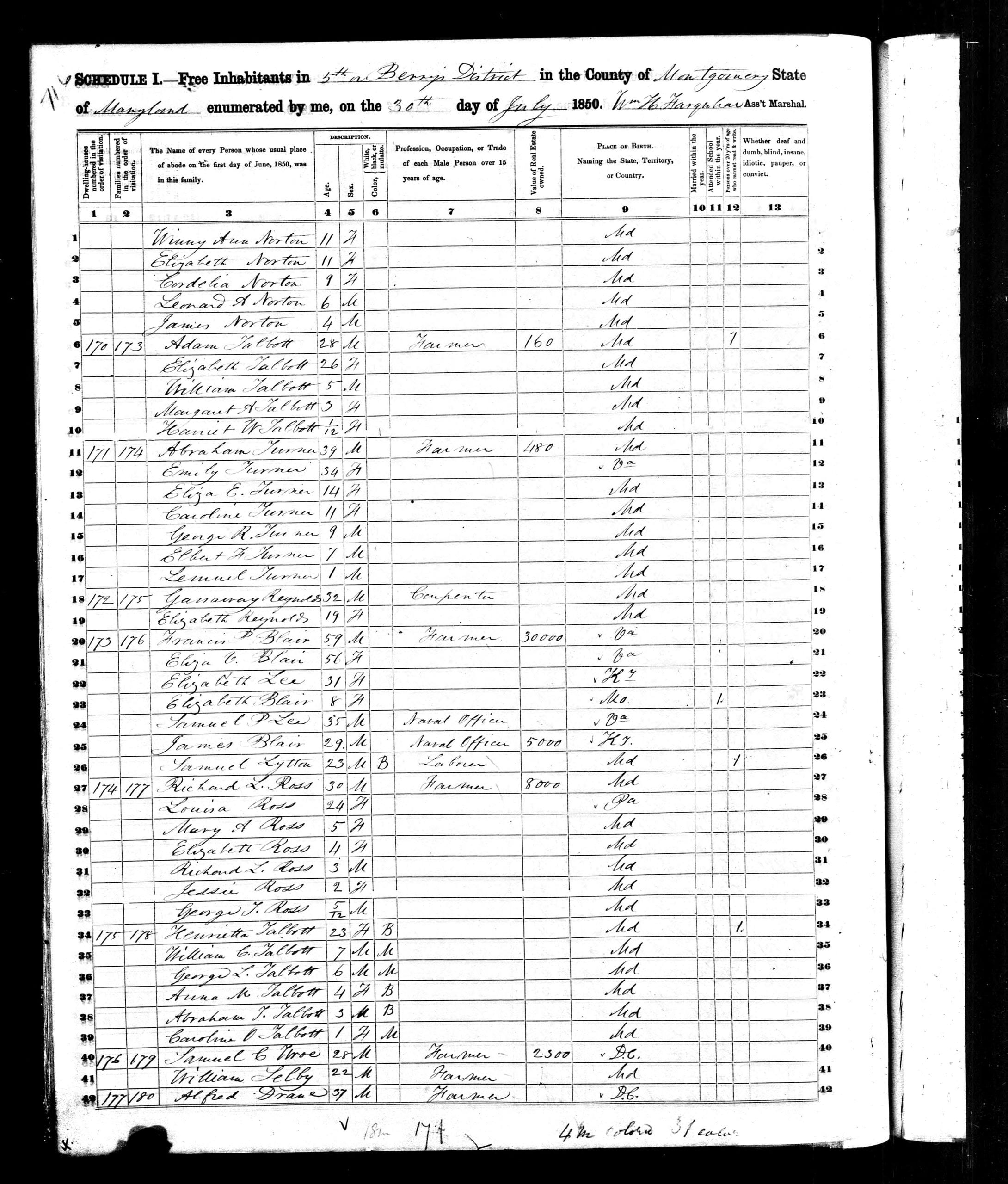
The 1850 U.S. Census catches the Blair household at the Silver Spring estate. Seven members, dwelling number 173, family number 176, in the 5th District of Montgomery County.
Francis P. Blair’s real estate is valued at $30,000. The enumerator wrote it all down on July 30th, 1850, three weeks after President Zachary Taylor dropped dead in office.
The other Blair House
The Silver Spring estate wasn’t Blair’s only famous address. In 1837 he bought the brick house at 1651 Pennsylvania Avenue, across from the White House, for $6,500 from the estate of Dr. Joseph Lovell. The Blairs held onto it for over a century before selling it to the U.S. government in 1942.
It now serves as the President’s Guest House, where visiting heads of state stay. It’s also the building where Puerto Rican nationalists tried to shoot their way in to assassinate President Truman in 1950, while he was living there during the Truman renovation of the White House.
What’s left of the Silver Spring estate
The mansion itself is gone. Confederate troops under Jubal Early swept through the area during the 1864 raid on Washington and burned Montgomery Blair’s neighboring house, Falkland, to the ground. The main Silver Spring house was spared in 1864 only because Confederate general John C. Breckinridge, a Blair cousin, used it as his field headquarters and posted guards against looting.
The mansion lasted another ninety years. Developers tore it down in 1954.
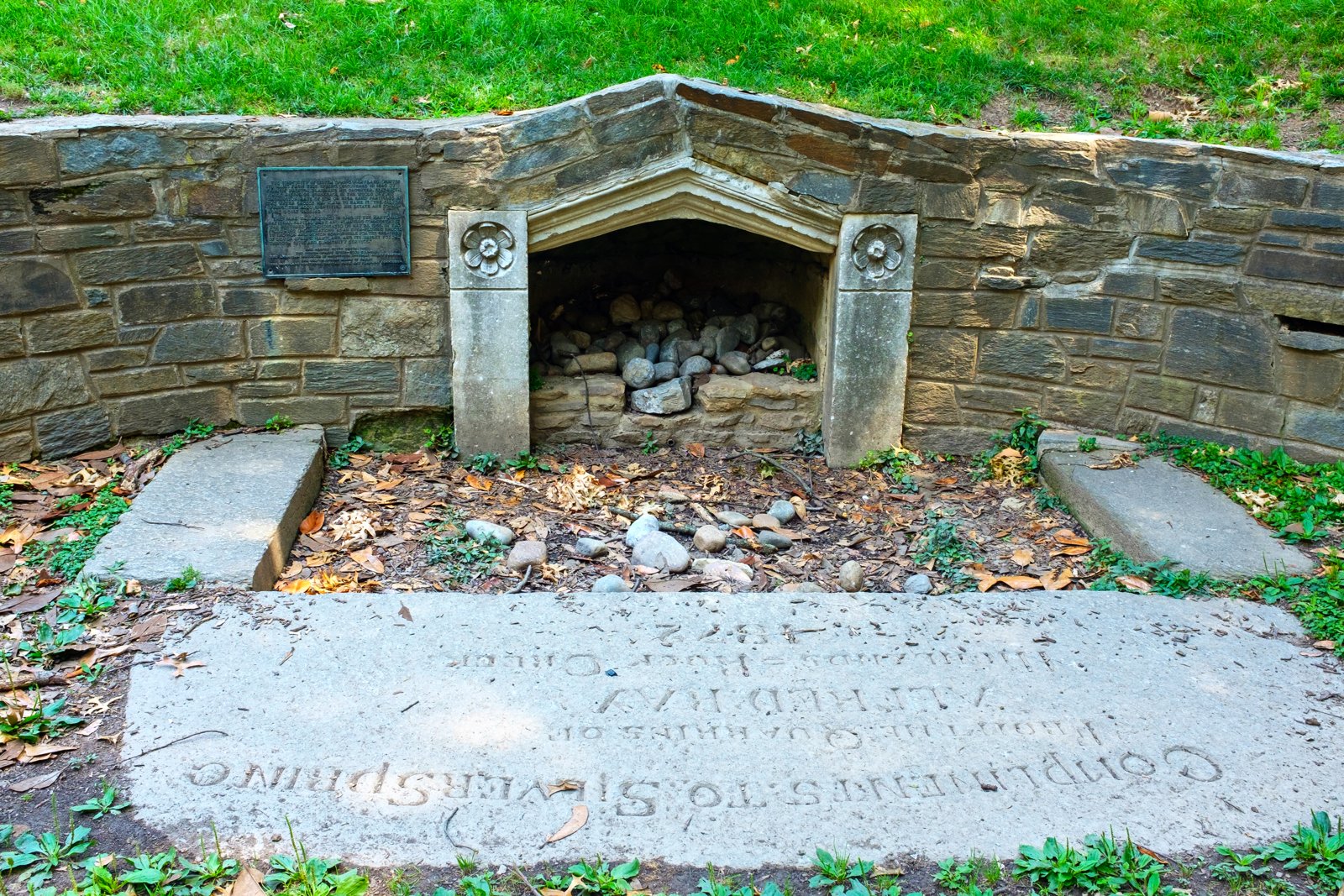
What survives is the spring. It still runs.
But what happened to the actual spring?
Thanks for the Silver Spring post! The ‘burbs are happy to be remembered on GoDC. Did you know the Blair family is still making news around DC? Here’s the latest from Montgomery Blair Sibley, the now-disbarred DC lawyer that represented the DC Madam who is apparently running a write-in campaign for president: http://www.huffingtonpost.com/2012/06/12/montgomery-blair-sibley-birther-lawsuit-presidential-candidate_n_1590582.html
It eventually dried up. But you can actually go to Acorn Park and see it. The remnants of the spring, that is. The park itself is a tiny triangle sliver of a park off of East-West Hwy near the intersection with Georgia Ave.
I live in downtown Silver Spring. Anytime there is construction (arguably, that’s all the time) and some rain, you can see the flecks of mica in the exposed soil glittering.
Thank you! I street-viewed the park too looking for a mention of the spring or the estate via a sign or something, seems like a nice little spot.
Nice post! Glad you could visit us this week. Next time you’re in Silver Spring…. a post about another local landmark, the Quarry House!
They used to have (tap) water trickling in the “spring.” Do they still?
gracias for the #silverspring post. GREAT area to live, play & work! more at http://M.SilverSpringDowntown.com
The water in the Acorn Park is WSSC Potomac water. I was once told by an old surveyor whom I worked for one summer that the “real” Silver Spring had been paved over by Blai Mill Towers construction. I guess you could classify that as “urban legend” . The Acorn Park is reputed to be the “actual” site, dried up tho it be.
Then , too, one is moved to remark that you can still visit the actual “Sandy Spring” up north. It still has some water in it, altho I would not trust it to drink.
Good idea! I heard it was once a prohibition-era speakeasy. True!?
I lived on Blair Mill Road/Drive in the late 60’s thru the 70’s and used to go to Acorn Park with a cup to drink from the spring of Silver Spring. Always cold, clear and delicious!