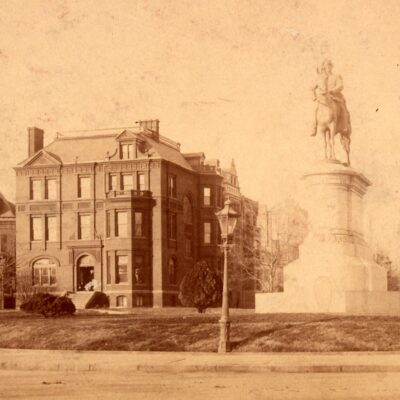


The house at 2249 R Street has been asked to do quite a lot. In 1915, the Washington Post described a senator’s new home with thirty rooms and seven bathrooms. By the time Sweden left the building in 1971, bathrooms were being converted into offices to squeeze in its diplomatic staff.
That is quite a change in expectations for a house near Sheridan Circle. Today it is the Embassy of Kenya, but its earlier occupants left a trail through the newspapers: an ambitious home purchase, a royal visit, and even a brick that police thought had gone through the wrong embassy’s window.
A house built for entertaining
The story starts before the senator. In 1908, C. Peyton Russell and his wife, Mary, commissioned architect Nathan C. Wyeth to design their house at 2249 R Street. Wyeth had also worked on the neighboring house at 2251 with his former partner, Cresson.
The two houses make a convincing pair from the sidewalk. Their matching rooflines and the arches between them help explain why a passerby might read them as one building. The Russell house was the larger and more elaborate of the two, according to the architectural history in the House of Mercy National Register nomination.
On December 2, 1915, the Post reported that California Senator James D. Phelan had bought the Russell property. The price was said to exceed $125,000, and the paper described four stories, thirty rooms, seven bathrooms, hardwood floors, and stained-glass windows.
The paper expected the house to become a center of entertaining, and it was clearly interested in what the purchase would mean for Washington society. Phelan was staying at the Shoreham while the house was being furnished, with a move anticipated around the beginning of the new year.
There is a small trap in that old clipping: it calls him “Senator John Phelan.” His name was James. The address, however, is plainly 2249 R Street, the same one listed for him in the 1918 Congressional Directory.
Swedish royalty comes to R Street
By the early 1920s, the house had become the Swedish legation, Sweden’s diplomatic mission in Washington. A newspaper illustration preserved with this post shows the building alongside portraits of Sweden’s diplomatic representative, Axel Wallenberg, and his wife.

In May 1926, Crown Prince Gustavus Adolphus and Crown Princess Louise came to Washington. After their arrival at Union Station, their route brought them to the legation at 2249 R Street, where reporters met them in the drawing room.
The Post’s May 28 account gives us a lovely little street scene. Near the legation, a child shouted a greeting to the royal couple as their limousine passed. Inside, the crown prince admired Washington’s trees and open spaces, telling reporters, “I have never seen a town quite so beautiful.”
The visit also included a call on President and Mrs. Coolidge, and the royal couple had come for the unveiling of a memorial to John Ericsson, the Swedish-born engineer. For a few days, this house just off Sheridan Circle was part of a much bigger diplomatic occasion.
A brick through the wrong window?
The resemblance between 2249 and 2251 R Street mattered again in November 1969. By then, Sweden’s chancery, the offices of its diplomatic mission, was next door to the South Vietnamese Embassy.
On the evening of November 17, bricks went through windows in both buildings. The Post reported the next day that one landed in a Swedish restroom and another in the South Vietnamese reception area. Police reported no injuries.
Police speculated that both bricks had been intended for the South Vietnamese Embassy at 2251. The newspaper noted that the Swedish building next door appeared to be part of the same structure. That was a theory about the attackers’ intentions, not an established account of what they meant to hit.
Sweden moves out, Kenya buys in
By 1971, the Swedish mission had outgrown its R Street offices. An October 31, 1971, Post story by Michael Kernan looked back at Sweden’s efforts to find more space: an annex, another purchased building, and rented rooms elsewhere. Even bathrooms were being remodeled into offices.
Sweden moved its chancery to the Watergate complex, leaving behind the house that had once looked so spacious in the real estate pages.
Kenya’s own property records give a precise date for the next chapter. Its 2025 foreign policy paper records the Washington chancery’s acquisition date as October 4, 1971, using the address “2247/2249 R Street NW.” That documents the purchase, rather than the day staff moved into the building.
The house has continued to need attention. In September 2020, the Kenyan embassy announced a temporary move to P Street while its R Street chancery underwent renovations. As of October 2026, its official contact page again lists 2249 R Street NW.
The next time you pass those arches, look at the neighboring façades as two houses. They look like a single grand composition, but 2249 has a history all its own.
Liked this one? Get more tomorrow.
Lost Washington stories in your inbox most mornings: the newest, plus a few from the archive.
 The Smithsonian’s Flying Machine That Plunged Into the Potomac Off the Arsenal in 1903
 Who Was the Tyson in Tysons Corner, and Where Did the “Corner” Go?
 Griffith Stadium: The History and Demolition of Washington’s Lost Ballpark
Free. Unsubscribe anytime.
We use AI to help research, write and edit stories across our sites. Here’s how we use AI.Suggest a correction