

Here is one of the strangest and saddest deaths in the modern history of Washington, DC. This one is from March 1995, when a 36-year-old Arkansas woman named Margaret Davis King climbed into the outdoor lions’ den at the National Zoo and was killed by two African lions named Tana and Asha.
This was not an accident. The District’s chief medical examiner, Joye M. Carter, eventually ruled it a suicide. To get to the lions, King had to clear barriers that the zoo’s own spokesman called nearly impossible to cross by accident.
The barriers she crossed
According to the Washington Post and the officials who spoke at the zoo’s March 7 news conference, King climbed a 3 1/2-foot rail and ledge, crossed a four-foot-wide dirt buffer, dropped down a nine-foot wall into a water-filled moat, swam 26 feet across that moat, and emerged on the lions’ landscaped, terraced habitat. Three warning signs and an electrified wire stood between the public sidewalk and the lions.
“It’s almost impossible to accidentally fall into one of these exhibits,” zoo spokesman Robert J. Hoage told reporters.
When the body was discovered, King’s clothes were wet, which gave the keepers their first hint that she had crossed the moat. She was found about 40 feet from the public viewing area, sprawled on the second level of the four-step terrace, in front of the opening to the den where the lions go for feeding.
Who Margaret Davis King was
King was a homeless mother of at least two children from Little Rock with a long, well-documented history of mental illness. Court records in Pulaski County, Arkansas, showed repeated diagnoses of paranoid schizophrenia. She had been treated at mental hospitals in Arkansas, California, and Georgia over the previous decade.
She also had a religious fixation. In 1987 her mother, asking a Little Rock judge to commit her, wrote in a court petition that King “believes she herself is Jesus Christ and has nail holes from the Crucifixion in her hands.” A later psychiatric evaluation cited her belief “that she is Jesus Christ or the sister of Jesus Christ, and that she receives direct messages from God.”
King had served four months in the Navy before receiving an honorable medical discharge in 1979 for reasons related to a pregnancy. By late 1994 she was enrolled in a job-skills program at the John L. McClellan Memorial Veterans Hospital in Little Rock and living at St. Francis House, an Episcopal Church shelter for homeless veterans. She quit the program on February 15, 1995, and left the shelter shortly after.
The day before
King arrived in Washington a few days later. At 3 a.m. on March 1, 1995, she checked into the Allen Lee Hotel at 2200 F Street NW for $41 a night, carrying one suitcase. The hotel manager, Dennis Hollier, later told the Washington Post that no one really saw her after that. Religious writings in longhand were later found in her room.
What we know about King’s final afternoon comes from a federal court clerk named Maureen Feinroth. King arrived at the U.S. District Court around 3:30 p.m. on Friday, March 3, asking how to file a lawsuit. Feinroth spent nearly two hours with her.
She was clean, attractive and well-spoken. She said she was here to get the president’s intervention in what was apparently a child custody problem.
Maureen Feinroth, U.S. District Court clerk, quoted in the Washington Post, March 10, 1995
King told the clerk she was the sister of Jesus Christ and that she and Jesus had grown up with President Clinton. Feinroth handed her a legal pad to write everything down and said King left calmly, promising to return. About fourteen hours later, an animal keeper found her body inside the outdoor lion exhibit.
Tana and Asha
The two lions on the habitat that morning were a 450-pound male named Tana and a female named Asha who weighed about 300 pounds. Both were healthy, well-fed African lions, born in captivity, and part of a group of four lions who rotated through the outdoor enclosure in shifts.
The animal keeper who discovered King’s body, looking through a window, coaxed Tana and Asha into a closed area behind the exhibit before calling police. Zoo spokesman Marc Bretzfelder said both lions had been behaving strangely and initially would not go inside.
After the death, the lions were kept indoors for two days while keepers gave them, in Hoage’s words, “a chance to calm down and return to their normal routine.” The Smithsonian had no plans to euthanize them or reassign zoo staff, and there were no plans to change the lion exhibit. The barriers, in the zoo’s view, had performed exactly as designed.
Earlier zoo tragedies
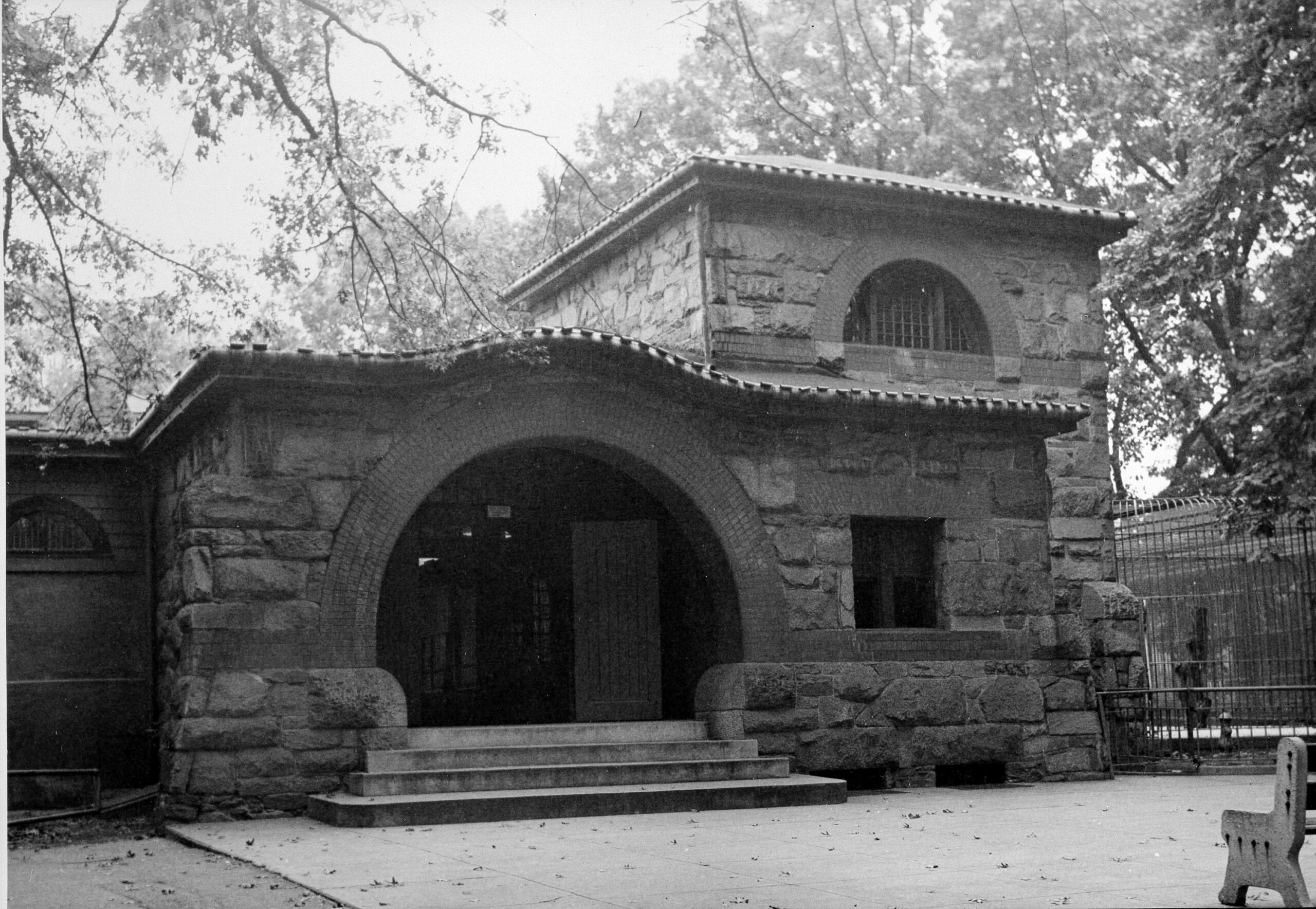
This was not the first time someone had been killed by a lion at the National Zoo. In 1958, a 2 1/2-year-old Canadian girl named Julie Ann Vogt was decapitated when she wandered away from her grandfather and approached two lions in a cage to feed them. The 67-year-old grandfather suffered a heart attack as he tried to beat the animals off with a cane. A second lion mauled the girl’s body afterward.
That 1958 death drove the redesign of the lion exhibit. At the time, only a guardrail and about six feet separated the cages from the public viewing area. By 1995, the viewing area had been moved roughly 40 feet back, and patrons were separated from the lions by the ledge, the dirt buffer, the wall, and the moat. The very barriers King had to cross on purpose existed because of what had happened to that Canadian toddler thirty-seven years earlier.
The zoo has had other strange close calls over the years. There is a separate post on the wolf that escaped and terrorized Cleveland Park, and a piece on the Lion House and the 1943 zoo sign. For background on how the zoo ended up in Rock Creek Valley in the first place, see the pieces on the bison on the Mall that led to the founding of the zoo and the proposed zoological park along Rock Creek.
What we still do not know
Carter, the medical examiner, was careful at her March 7 news conference. She said the death was a suicidal act but stopped short of saying for certain that King had intended to die when she entered the enclosure. D.C. police spokesman Sgt. Joe Gentile put it more plainly when he said “there are some questions that may never be answered as to why the lady took that action that she took.”
Police found no suicide note. They did find a Sony Walkman near King’s body, still containing a cassette of Amy Grant’s album “House of Love.”
When did the National Zoo lion attack happen?
Margaret Davis King’s body was discovered at about 7 a.m. on Saturday, March 4, 1995, in the outdoor lion exhibit at the Smithsonian’s National Zoo in northwest Washington.
What were the lions’ names?
The two lions on the habitat that morning were Tana, a 450-pound male, and Asha, a female of about 300 pounds. Both were African lions born in captivity. Two other lions in the group were not on display that morning.
Was it suicide or an accident?
D.C. Medical Examiner Joye M. Carter ruled the death a suicide on March 7, 1995. Police investigators said the route King took, scaling a 3 1/2-foot rail and swimming a 26-foot moat past three warning signs, ruled out an accident.
Were the lions euthanized?
No. Tana and Asha were held indoors for two days to settle down and were then returned to the exhibit rotation. The Smithsonian’s view was that the lions had behaved as territorial carnivores and that the barriers had worked.
Why didn’t the Smithsonian change the lion enclosure?
The 1995 incident did not change the design of the lion habitat. Spokesman Bob Hoage told reporters there were no plans to alter the exhibit. The redesign that mattered had already happened in 1958, after the death of Julie Ann Vogt, when the viewing area was pushed back roughly 40 feet and the moat-and-wall system was added.
I do remember this! I’m rying to remember when the gates were put at the Zoo, I think they’re (relatively) recent additions and I’m wondering if it is related to this incident.
Yep…I think before the gates all the animals were free roaming and you entered the zoo at your own risk.
I remember her.We called her Mary. She and I were residents at the same halfway house in Little Rock, I was a federal bootcamp graduate and she was a homeless mental patient. She use to talk to me about how she was Jesus sister and how Pres. Bill Clinton was going to help her get her kids back. Her kids came and visited her once while she was there.I was very hurt tie hear this after she left there. Came in from work and everyone was sad and the mood was depressing. We cried and prayed for her. We missed her.
I remember when this happened. It would not be the way I would want to go.
Very sad.
While her passing may have been a merciless way to go, I’m sure her God bestowed mercy in her after-life!