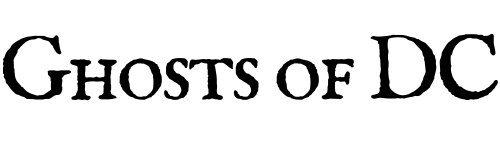
On the afternoon of May 17, 1865, a thin, dark-bearded sergeant in a New York cavalry uniform climbed three flights of stairs inside the Washington Arsenal, was sworn in by a military court, and explained how he had shot John Wilkes Booth.
His name was Boston Corbett. Three weeks earlier, in the predawn dark outside a tobacco barn on the Garrett farm in Caroline County, Virginia, he had fired a single revolver round through a crack in the boards and hit Booth in the neck. Now he was the most famous sergeant in the United States, and he was the government’s witness.
Corbett spent most of the spring of 1865 in or near Washington, and the surviving record of those weeks is the spine of his story. The DC chapter of Boston Corbett is small, but it is the part of his life we can actually see.
The 16th New York rides into Washington
The detachment that ran Booth to ground left Washington on April 24, 1865, under Lieutenant Edward P. Doherty of the 16th New York Cavalry, with two civilian detectives, Everton Conger and Luther Baker, riding along. About twenty-five enlisted men went with them. Boston Corbett was the senior sergeant in the party.
They steamed down the Potomac to Belle Plain, picked up the trail across the Rappahannock, and on the night of April 25 surrounded the Garretts’ tobacco barn near Port Royal. Booth was inside with David Herold. Herold surrendered. Booth refused. Conger set the barn on fire to drive him out. Corbett, watching through a gap in the slats, saw Booth swing his carbine toward the door and fired.
Booth lived for about two more hours on the Garretts’ porch. He died at dawn on April 26.

The detachment got Booth’s body onto a wagon, then onto a small steamer, and rode back into the capital on April 27. The body was carried to the navy yard and laid on the deck of the ironclad Montauk for an autopsy. The cavalrymen were directed to the Old Capitol Prison, then sent to their quarters. Within hours every newspaper in the city had Boston Corbett’s name.
If you want to walk the rest of the geography, the War Department reward poster for Booth, Surratt, and Herold is from this same April. The Surratt boardinghouse on H Street, where the conspirators had met, is now a Chinese restaurant. And the Ford’s Theatre playbill for the night of April 14 still names the play Booth interrupted.
Corbett at the Arsenal
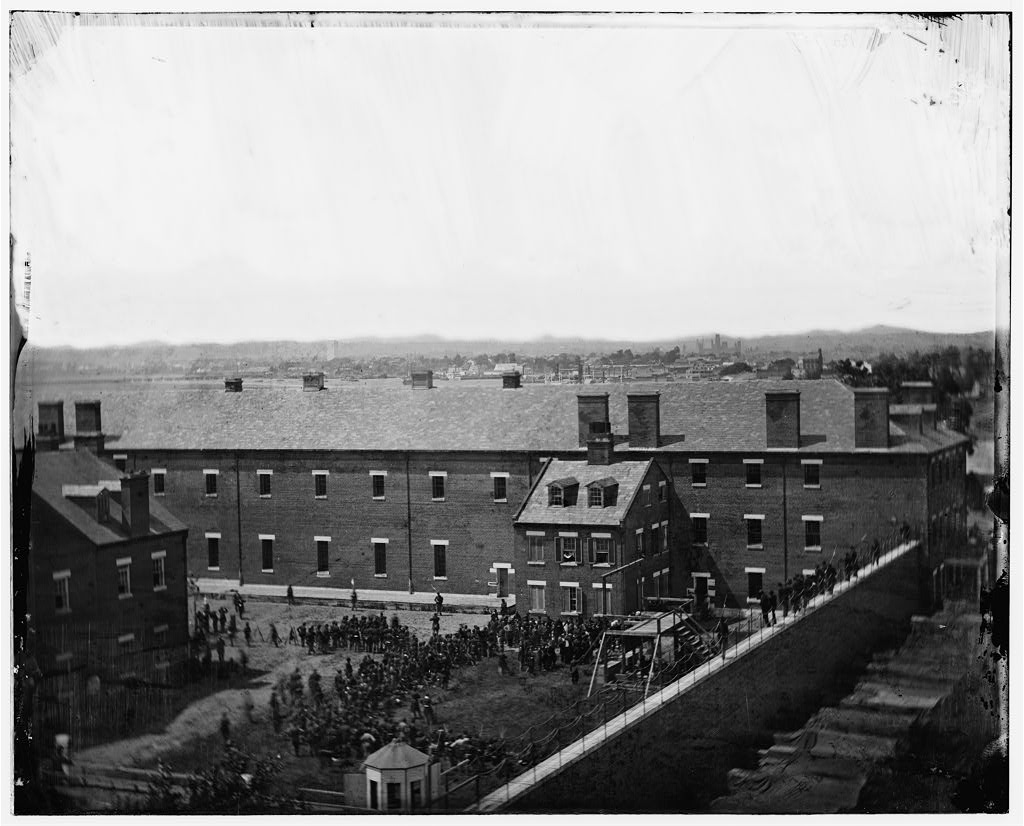
The eight surviving conspirators were tried by a nine-officer military commission in a remodeled third-floor room of the Old Penitentiary inside the Washington Arsenal grounds, at the southern tip of what is now Fort Lesley J. McNair. The room had been outfitted with a long table for the court, a railed prisoners’ dock, a witness chair, and a pool of reporters along the wall. Court convened on May 9, 1865.
Corbett’s name appears on the witness list for May 17. The court called Lieutenant Doherty and the detective Luther Baker that morning to establish how Booth had been tracked. Corbett followed in the afternoon. The recorder noted his rank, his regiment, his place of residence on the day of testimony (Washington, D.C.), and put him under oath.
The testimony itself is brief. Corbett walked the court through the arrival at the Garretts’, the standoff at the barn, the decision to fire the barn, and the shot. Asked the simple question that everyone outside the courtroom had been asking, he said it plainly:
Finding the fire gaining upon him, he turned toward the door, with a carbine in his hand, as if to push his way out. I took steady aim on him with my revolver, and fired.
The recorder then asked whether Booth had aimed at him first. Corbett answered no. Booth had been moving toward the door, not toward him. He was excused from the stand and the court moved on to the next witness.
That third-floor courtroom is the only one where Corbett’s voice survives on the record. Seven weeks later, on July 7, 1865, four of the conspirators were hanged in the yard below. Alexander Gardner climbed onto the Arsenal roof and made the photograph.
The reward money question
The federal government had posted $100,000 for the capture of Booth, John Surratt, and David Herold combined. After Booth was killed and Herold surrendered, the War Department had to decide who got paid.
The answer took more than a year of wrangling in the House of Representatives. Congressman Giles W. Hotchkiss of New York shepherded the bill that divided the reward among the soldiers and detectives. When it cleared in 1866, Corbett’s share came out to $1,653.84. The largest pieces went to the senior officers and the civilian detectives. The enlisted men of the 16th New York each drew the same sergeant’s portion Corbett received.
Corbett himself wrote to the War Department about the money in December 1866. The letter, recovered from a private collection and published in 2017 by the Surratt House Museum’s blog, was sent from the Intelligencer Building at 7th and D streets NW, where Corbett was lodging while he transacted his business in Washington.
In it he asked that his share be drawn and assigned to the firm of Johnson, Brown & Co., his agents. The letter is short and businesslike. He signs it “Boston Corbett, late Sergt. Co. L, 16th N.Y. Cav.”
That little 1866 document is the cleanest piece of paper we have in Corbett’s own hand on the question of the reward. It puts him in Washington in late 1866, dealing with civilian agents at a city address, working through the official channel. There is no swagger in it.
The hat-maker who shot the assassin
Thomas P. Corbett was born in London in 1832 and brought to America as a small child. By his early twenties he was working as a hatter, first in Troy, New York, then in Boston. After his young wife and infant child died in childbirth, he wandered, drank, and eventually walked into a Methodist street meeting in Boston, was converted on the spot, and took the name “Boston” after the city of his rebirth.
The hat trade was, in this period, a chemical hazard. Hatters worked with mercury nitrate to felt rabbit and beaver fur, and chronic exposure produced tremors, hallucinations, and paranoia. Historians, including Scott Martelle in The Madman and the Assassin (2015), have suggested that mercury poisoning helped explain Corbett’s later disintegration.
It’s an attractive theory. It is also unprovable from the surviving record. Corbett’s behavior after the war was strange in many ways that had nothing to do with mercury, and the diagnosis is retrospective.
What is documented: in 1858, in a fit of religious zeal after being propositioned by two women on a Boston street, Corbett went home and castrated himself with a pair of scissors, then went to a prayer meeting and then to dinner before checking himself into Massachusetts General Hospital. The story is sourced to the hospital’s admission records and was picked up by the Boston papers at the time.
By the time he enlisted in the New York militia in 1861, Corbett was an unusually intense Methodist street preacher with a known history of self-mutilation. He spent most of the war in the ranks, was captured in Virginia in 1864, survived five months in Andersonville, and came out emaciated but alive.
That is the man who climbed the witness stand at the Arsenal eight months later.
Should Corbett have been court-martialed?
This is the part of the story that gets retold the most and verified the least. The popular telling has it that Secretary of War Edwin M. Stanton wanted Booth taken alive; that when he learned a sergeant had shot the most wanted man in the country dead, he ordered Corbett arrested for disobeying orders; and that he later said something to the effect of “the rebel is dead. The patriot lives,” and let the matter drop.
The “rebel is dead” line is folklore. It does not appear in Stanton’s papers, in the official Booth-pursuit reports, or in the contemporary newspaper coverage. It was first attached to Corbett in later 19th-century reminiscences and has been repeated as if it were primary ever since. It probably should not be.
The orders question is murkier. The detachment had been told to bring Booth back. Lieutenant Doherty and the detective Conger both understood the mission that way.
Whether anyone had said the words “alive” out loud, in those specific terms, before the men reached the Garretts’ farm is contested. Edward Steers Jr., the most exhaustive modern historian of the assassination, argues that no clear “take him alive” order was issued. Hotchkiss, working the reward bill on the House floor in 1866, said the opposite. Both men had reasons of their own.
What is clear is the official outcome. Corbett was brought back to Washington, interviewed by the War Department, allowed to testify at the conspirators’ trial as a government witness, and released. No charges were ever filed. He was honorably discharged with the rest of his regiment at the end of his enlistment and went home with the reward share and his rank intact.
There is also a separate counter-narrative from the Garretts themselves. In testimony given decades later, members of the Garrett family insisted that the man killed in their barn was not Booth at all, that the federal party had killed the wrong man, and that Booth had escaped. The claim has been repeated in a small library of conspiracy literature.
Steers and most professional historians find it implausible: too many people who knew Booth identified the body, the autopsy on the Montauk matched his known scars and dental work, and the Garretts’ postwar bitterness toward the federal raid is a sufficient explanation for the story without any escape. It is worth knowing the counter-claim exists. It is not worth treating as settled.
What happened after Washington
Corbett did a brief lecture circuit, returned to hat-making, drifted, and in the late 1870s landed in Concordia, Kansas, where he lived in a dugout on a small homestead and preached on Sundays. In 1887 the Kansas legislature hired him as assistant doorkeeper of the state House of Representatives.
On February 15, 1887, after weeks of mounting paranoia, he drew his revolver in the statehouse, was wrestled to the ground, and was committed to the Topeka Asylum for the Insane.
On May 26, 1888, he climbed a horse tied to a hitching rail outside the asylum gate and rode away. He was never seen again with certainty. A man calling himself Thomas Corbett died in the Great Hinckley Fire in Minnesota in 1894, and most modern accounts treat that as the likely end. Some don’t. The man who shot Lincoln’s killer slipped out of the historical record the way most Civil War sergeants did, only later.