
Check out this great find. It’s a rendering of a proposed design for the Kennedy Center, then called the National Cultural Center. It’s actually not terribly different, just with far more curved lines than the boxy shape it takes today.
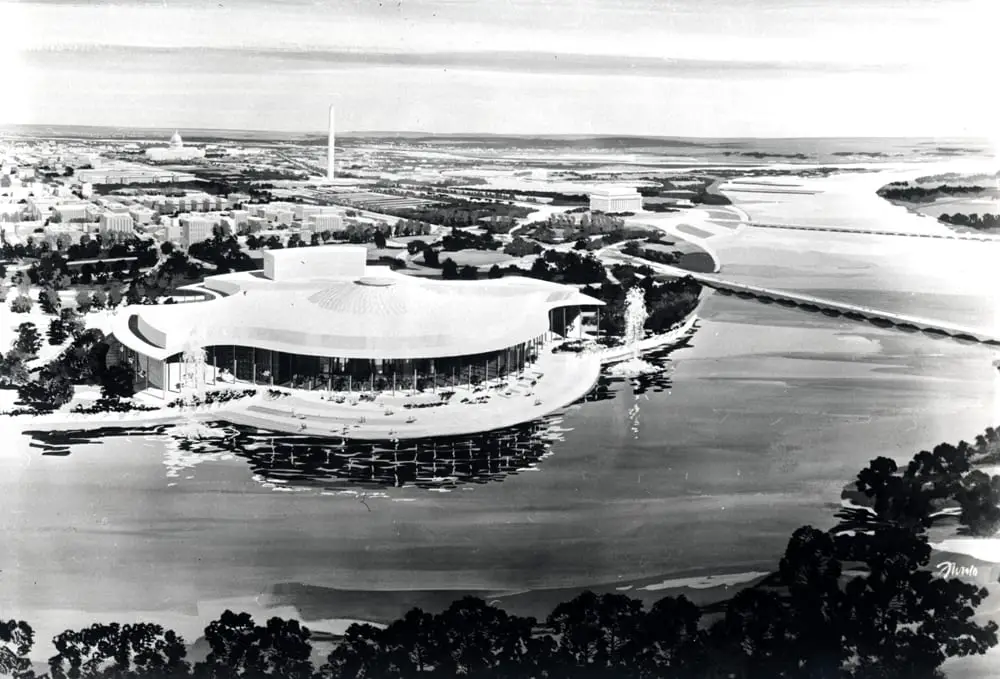
Not long after it was built, a very curvy Watergate would take up position right next to it.
This drawing was done by Edward Durell Stone, the architect who would design the final building as well as a contemporary of Frank Lloyd Wright.
The idea for a national cultural center dates to 1933 when Eleanor Roosevelt discussed ideas for the Emergency Relief and Civil Works Administration to create employment for unemployed actors during the Great Depression.
Congress held hearings in 1935 on plans to establish a Cabinet level Department of Science, Art and Literature, and to build a monumental theater and arts building on Capitol Hill near the Supreme Court building. A congressional resolution called for building a national cultural center near Judiciary Square, but it never happened.
In 1950, Congressman Arthur George Klein of New York introduced a bill to authorize funds to plan and build a cultural center. It included provisions that the center would prohibit any discrimination of cast or audience.
In 1955, the Stanford Research Institute was commissioned to select a site and provide design suggestions for the center. Until 1958, Congress debated the idea until it was finally passed that summer.
On September 4th, President Eisenhower signed into law the National Cultural Center Act which kicked off the process to eventually build what would become The Kennedy Center.
Nice design, but where would Rock Creek Parkway have gone? Today it’s flanked by the Kennedy Center and the river. The drawing doesn’t seem to show it at all there.
A few years back I was interviewing The great Arkansas architect, Mr. Fay Jones for an article in PEOPLE Magazine. He told me a charming story about Edward Stone, a verrrrry formal gentleman.
A group of fellow architects had been invited for dinner in New Orleans by Stone. Mrs Jones (who went by the name of ‘Gus’!) was seated at Stone’s right. A waiter came and whispered Mr. Stone he was “wanted on the telephone.” He responded, the waiter “should get the telephone number.” Stone believed it extremely rude to leave his guests.
The waiter left; then, he returned. He said: “This is an important call.” Stone replied, “As the evening’s host – leaving to answer the telephone is impossible!”
The waiter came back a third time. He loudly announced: “Mr Stone, The White House is calling. Go to the phone!” Stone turned to Gus smiled, then murmured: “Please excuse me. I have a phone call.”
Upon his return his return, Stone picked up his fork and resumed eating. Everyone at the table was about to burst with curiosity. No one moved or spoke – they just stared at the man. Finally Stone looked up, said; (with a sort of off hand delivery) “Oh did you all want to know about the call?” That was President Eisenhower. I’ve been invited to design the National Center for Performing Arts!”
Fantastic, Thank you!
I like this one MUCH better. The Kennedy Center looks too stark to me. I like the curve.
No no no… the Watergate did not get built after the Kennedy Center as this article incorrectly states but before: “Not long after it was built, a very curvy Watergate would take up position right next to it”. Construction on the Watergate began in 1963 and was completed one building at a time – 1965, 1967, 1968, 1969 completions for the apartment buildings and hotel, with the 5th building (mixed office and residential) in late 1970. The Kennedy Center on the other hand did not open til September 1971