
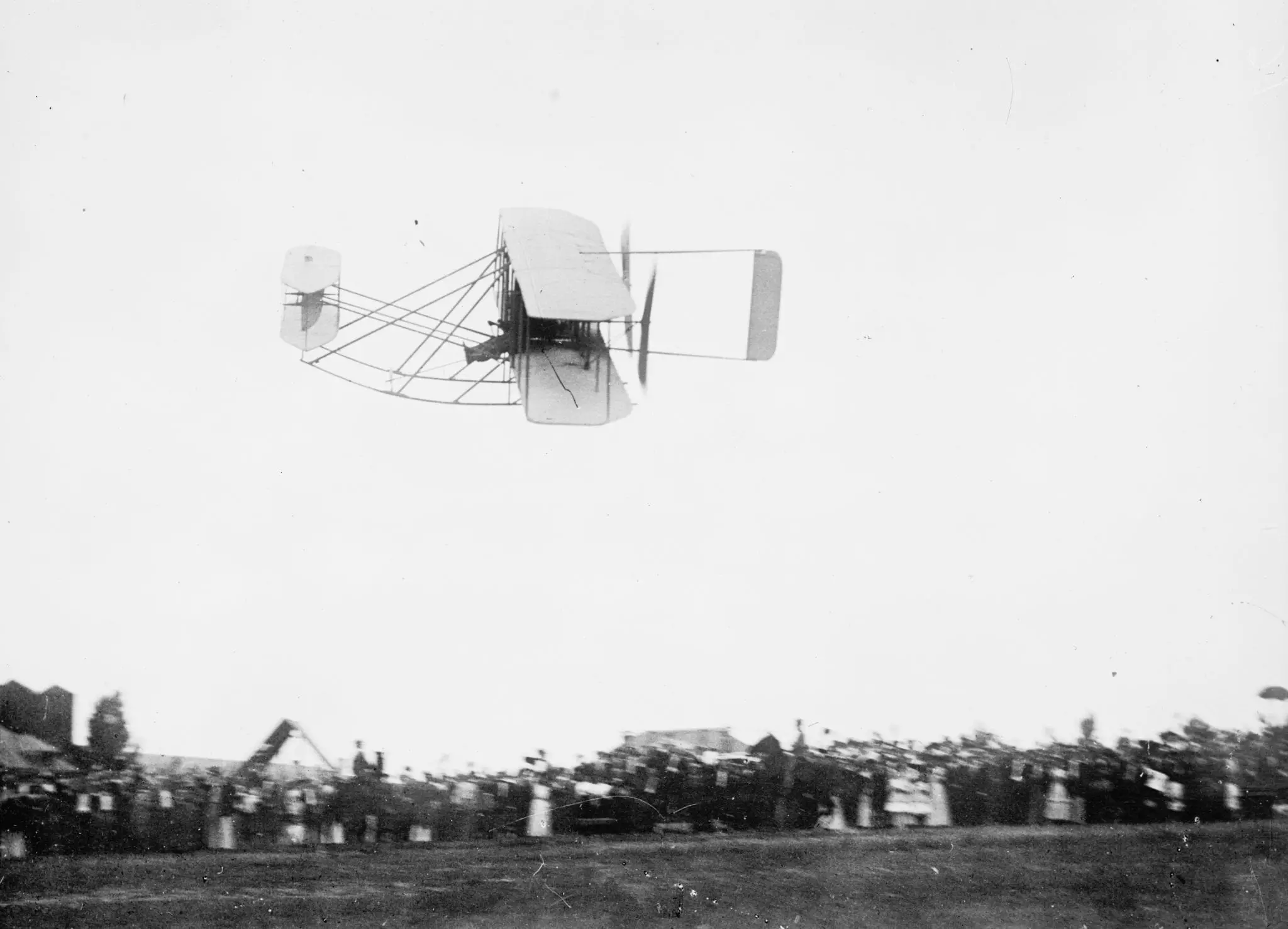
Just after 5 o’clock on the afternoon of September 17, 1908, the Wright Flyer fell out of the sky and onto the parade ground at Fort Myer. Orville Wright walked away with a broken thigh and four broken ribs. His passenger, 26-year-old Lieutenant Thomas Selfridge of the Signal Corps, did not walk away at all. Selfridge died at the post hospital that night, the first person ever killed in the crash of a powered aircraft.
Ten months later, Orville came back. On July 27, 1909, with President Taft and roughly 10,000 spectators watching, he set a world duration record carrying a passenger. Three days after that, on July 30, he made a 10-mile cross-country run to Alexandria and back at 42.5 miles per hour, satisfying the final term of the Army’s contract. On August 2, 1909, the U.S. Army formally accepted Signal Corps Airplane No. 1, the first military aircraft anywhere in the world, for $30,000.
This is the story of how it all happened at a small Virginia post above Arlington National Cemetery.
Why Fort Myer
In February 1908, the U.S. Army Signal Corps awarded the Wright brothers a $25,000 contract for a heavier-than-air flying machine. The terms were specific. The plane had to carry two men, stay aloft for at least an hour, average at least 40 miles per hour over a 5-mile course, and be portable enough to pack onto a wagon. If it beat 40 mph the price went up by $2,500 per mile per hour. If it fell short of 36 mph, the contract was void.
The Signal Corps chose Fort Myer because the parade ground at the foot of the cemetery was large, flat, and already fenced. It also sat just across the Potomac from War Department brass.
Orville arrived in late August 1908 with mechanic Charles Taylor. The Flyer went up for the first time on September 3. By mid-September he was carrying passengers and setting records. On September 9 he flew for 57 minutes, breaking his own world endurance mark, and later that same day took Lieutenant Frank Lahm up for the first passenger flight to last more than six minutes. Reporters had begun calling the Fort Myer trials a foregone conclusion.
September 17, 1908
The afternoon of the 17th was clear. Orville had spent the previous day installing a new set of propellers, six inches longer than the originals, hoping to claw back a few revolutions he had lost the week before. About 2,000 people were on the grounds by 4:30. The Flyer rolled out a little later. Orville turned to Selfridge and said, “You might as well get in. We’ll start in a couple of minutes.”
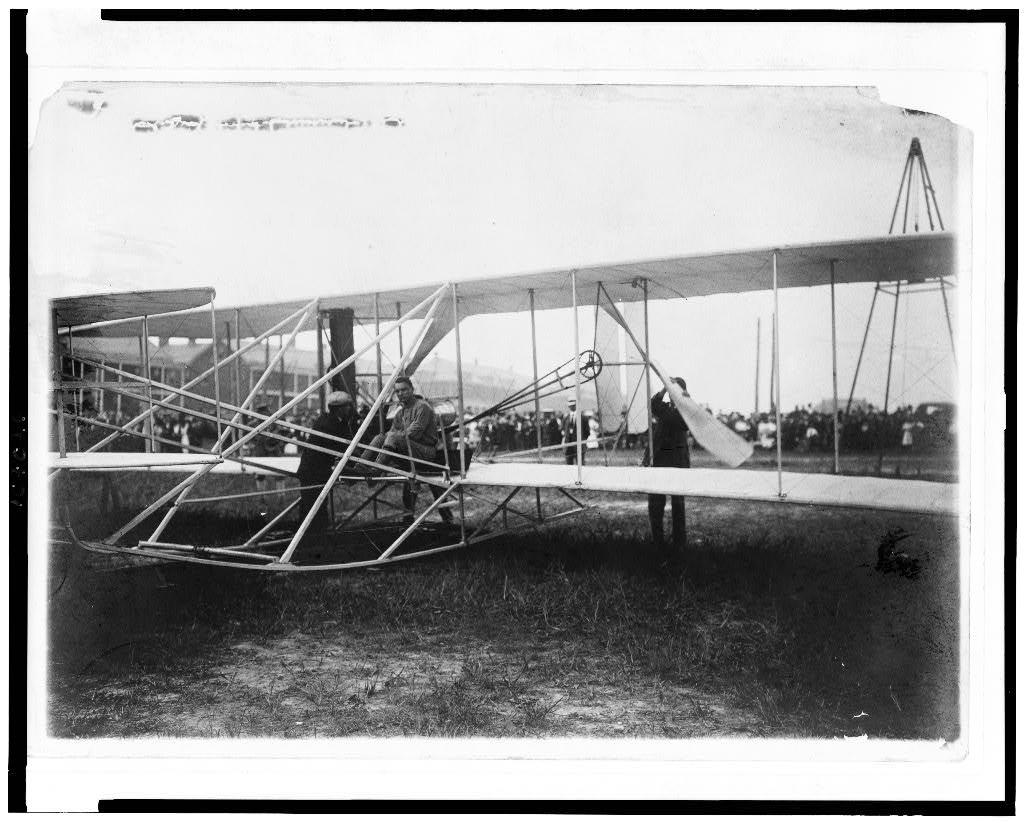
At 5:14 the Flyer left the launching rail. The takeoff was sluggish. Selfridge weighed about 175 pounds and was the heaviest passenger the plane had ever carried. The aircraft completed three circuits of the parade ground at roughly 150 feet, with Orville and the young officer chatting visibly above the propeller wash.
Halfway through the fourth circuit, one of the new propeller blades cracked, snapped clean off, and went tumbling sixty feet through the air. The Flyer wobbled, climbed a few feet, then dove nose-first into the field at about forty miles an hour.
A New York Times correspondent on the scene filed his story that night. Of the crowd’s reaction:
From the largest crowd that has yet witnessed a flight there arose a cry that was neither a scream nor a groan. For a moment there was not a movement, and then the people surged across the field. Col. Hatfield, in command at the army post, issued some quick, sharp orders and the cavalry guard dashed forward. The crowd was frenzied and the cavalrymen were compelled to use actual force in many instances in controlling it.
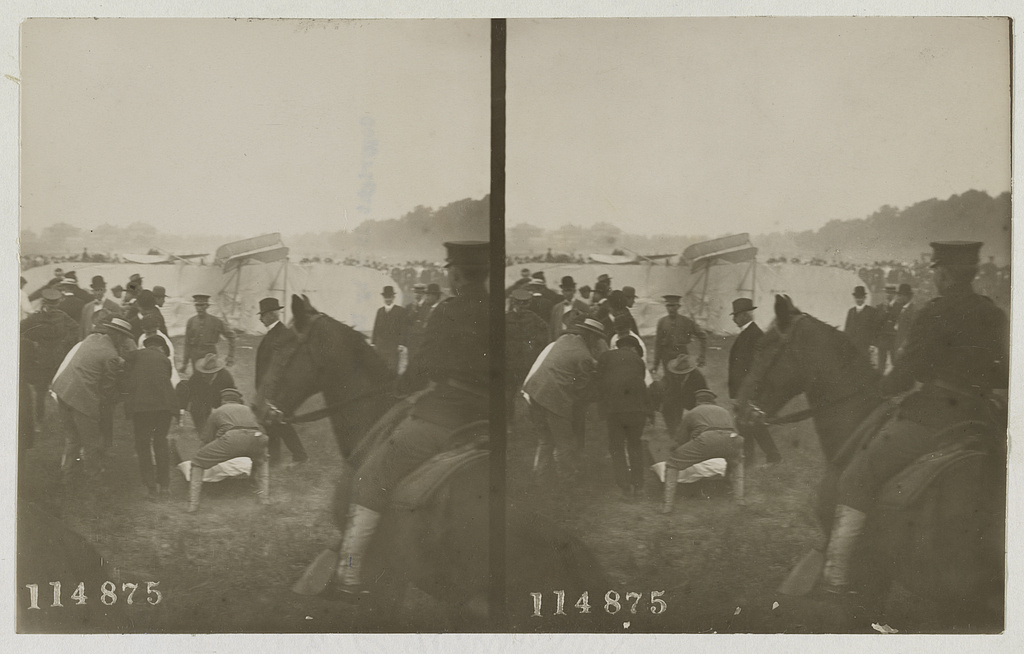
Both men were pinned in the wreckage by the bracing wires. Soldiers from the Signal Corps pulled Orville out first. He was conscious and badly cut, his coat torn from his body. Selfridge was lying partly under the engine and the fuel tank. It took several men to lift the wreckage off him. He never regained consciousness. The post hospital announced his death at 8:10 p.m.
Orville had a broken left thigh, four broken ribs, scalp lacerations, and a back injury that would bother him for the rest of his life. He spent seven weeks at the post hospital. His sister Katharine came from Dayton to nurse him.
The accident report blamed the propeller change. The longer blade, set at a less aggressive pitch and turned at higher revolutions, had developed a hairline crack that opened in flight. When the broken half came loose it sliced a guy wire bracing the rear rudder. The rudder swung horizontal and pushed the nose down.
Who was Thomas Selfridge
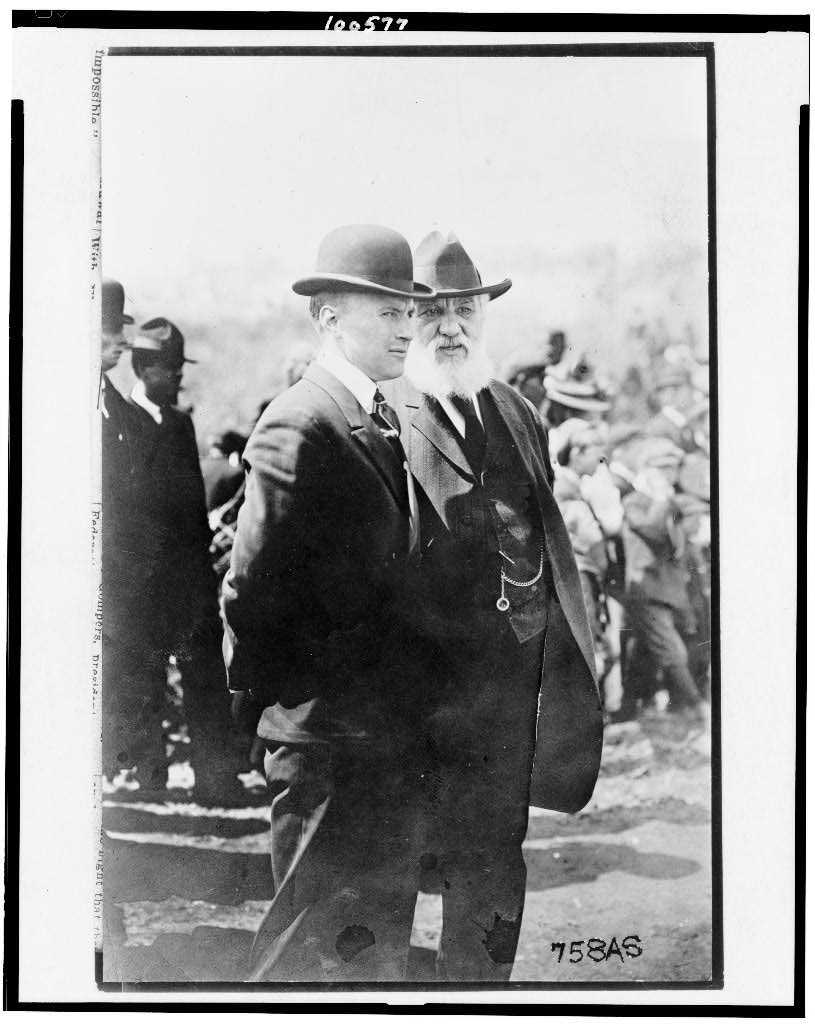
Thomas Etholen Selfridge was 26. West Point class of 1903, Signal Corps, and one of the very small number of Army officers in 1908 who had any real understanding of aircraft. He was the Army’s official observer to Alexander Graham Bell’s Aerial Experiment Association in Nova Scotia, where he had designed a working biplane of his own called the Red Wing earlier that year. He had flown as a passenger in dirigibles. He was scheduled to leave the very next day to assist Lt. Benjamin Foulois at army maneuvers in St. Joseph, Missouri.
The Times obituary noted a strange detail. Selfridge had designed the propeller for the Baldwin dirigible, which was considered a marvel of efficiency. He died because of a propeller.
The Army buried him at Arlington National Cemetery, a short walk from where the Flyer had fallen. The cemetery gate nearest the crash site was later renamed Selfridge Gate. A Michigan Air National Guard base, Selfridge Field, carries his name today.
Orville comes back
Charles Flint, the Wrights’ New York agent, told reporters the night of the crash that the trials would resume “as soon as Mr. Wright has recovered and the machine is repaired.” Secretary of War Luke Wright said much the same thing. The Army was committed. They had the money in the budget and they wanted the plane.
The Wrights spent the winter of 1908-09 in Le Mans, France, where Wilbur was flying demonstrations for European buyers. Orville recovered in Dayton through the spring. By late June 1909 he was at Fort Myer again with a new Flyer built to the same contract specifications.
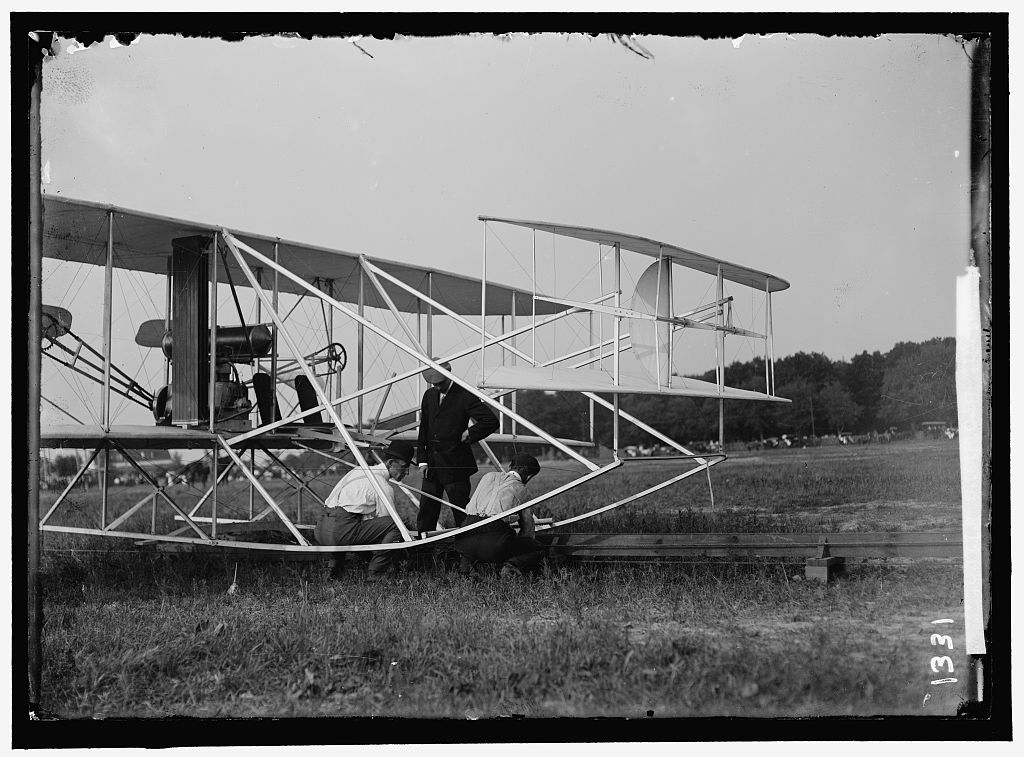
Practice flights began June 29, 1909. The crowd that turned out was very different from the one in 1908. The earlier trials had been a curiosity. The 1909 trials were a national event. President Taft came. Cabinet secretaries came. Diplomats came. The Signal Corps had to bring in extra cavalry to manage spectators.
July 27, 1909: the duration record
On the afternoon of July 27, 1909, with Taft and an estimated 10,000 people on the grounds, Orville took Lieutenant Frank Lahm up for the duration trial. The contract called for an hour in the air with a passenger. Orville stayed up for 1 hour, 12 minutes, and 40 seconds, setting a new world record for two-man flight.


July 30, 1909: the cross-country to Alexandria
The speed trial was all that remained. The contract required a 10-mile course averaging at least 40 mph, with a $2,500 bonus for every mile per hour above 40 and a $2,500 penalty for every mile per hour below it.
Taft came back. So did Foulois, Selfridge’s friend, who climbed into the passenger seat. The course ran from Fort Myer out to a captive balloon tethered above Shuter’s Hill in Alexandria, ten miles round trip, over the trees. The outbound leg, into the wind, averaged 37.7 mph. The return leg, with the wind, averaged 47.4 mph. The official average was 42.583 mph.
The bonus came to $5,000. The Wrights’ total payment was $30,000.
August 2, 1909
The Army formally accepted Signal Corps Airplane No. 1 on August 2, 1909. It was the first military aircraft in the world. The plane is still in existence. It sits today in the National Air and Space Museum on the National Mall, a few miles from where it flew.
Orville and Wilbur trained the Army’s first three aviators, including Foulois, at College Park, Maryland, that fall. None of those three died in an aircraft. Selfridge remained the only American military aviation fatality for almost three years.
Is this the flight on which Lt. Selfridges was killed?