
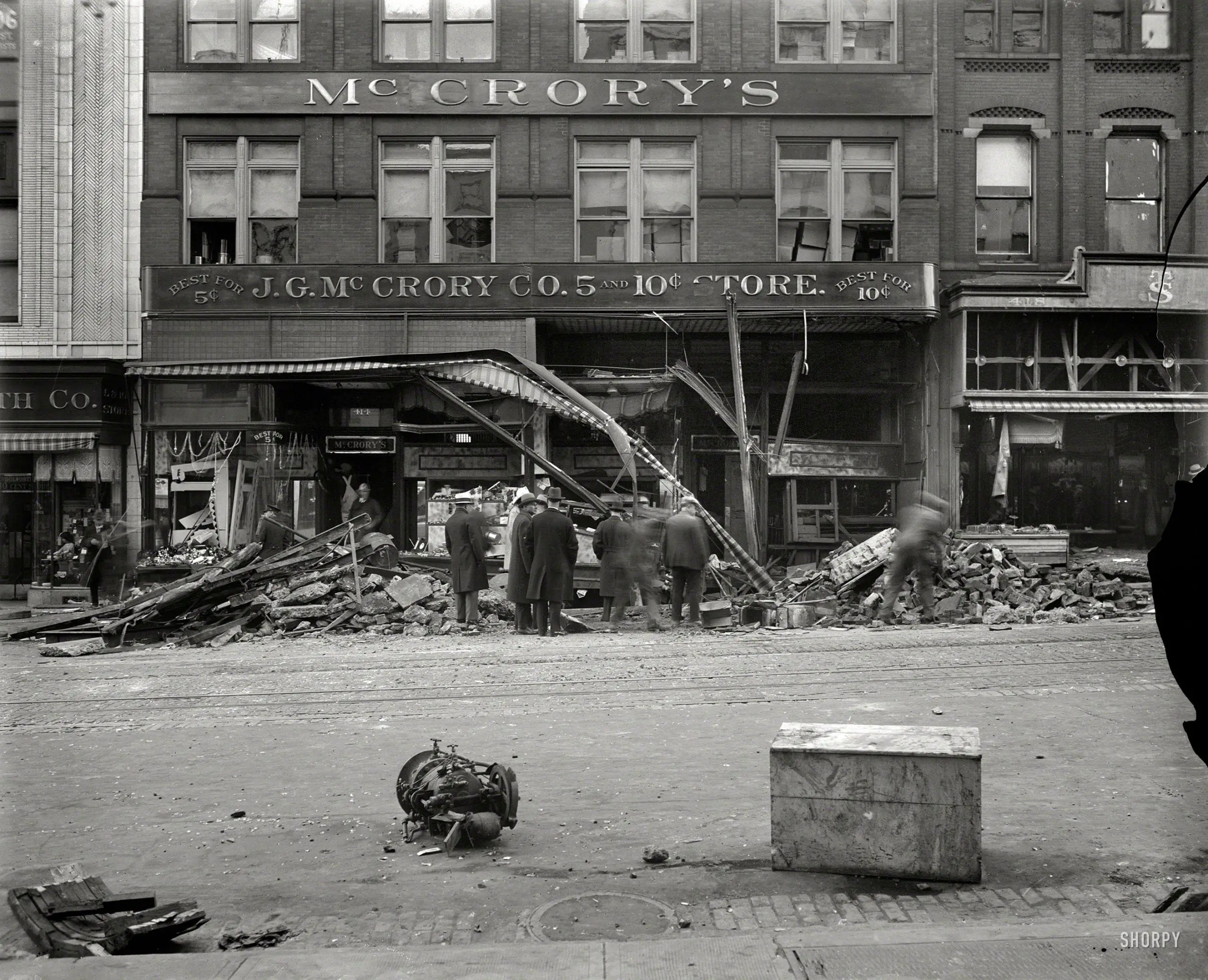
It was 1:32 in the afternoon on November 21, 1929, and the lunchtime crowd was thick on the sidewalk in front of the McCrory five-and-dime at 416 Seventh Street NW. Then a 500-gallon hot-water tank in the basement let go.
The blast lifted a forty-foot square of concrete sidewalk into the air, blew out the storefront, and sent debris across the street. Six people died. Roughly fifty more were hurt. None of the dead worked at the store. Almost all of them were strangers walking past on a fall afternoon, headed to lunch or to a bargain shelf somewhere down the block.
This is the story most Washingtonians have never heard.
A 500-gallon tank in the basement
The McCrory’s at 416 Seventh Street was part of the J.G. McCrory five-and-ten chain, founded in Scottdale, Pennsylvania in 1882 by John Graham McCrorey, who later trimmed the “e” off his last name to save money on the gilt letters of his store signs. By the late 1920s the chain had nearly 200 stores. The Washington branch sat in the heart of Seventh Street’s old retail corridor, the lower-end shopping spine that ran north from Pennsylvania Avenue past furniture rows and small department stores like Goldenberg’s and King’s Palace.
The tank that exploded sat in a boiler room below the store, tucked under the public sidewalk. It was where the building’s hot water came from. According to news accounts that began appearing the next morning, the tank had been installed in 1920 and had not been inspected in the nine years since. There was no requirement that anyone inspect it. The District of Columbia would not have a boiler-inspection law for another six and a half years.
A janitor named Frank Brown was supposed to be in that basement at the moment the tank let go. He was not, by pure luck.
The afternoon of November 21
The early casualty list, posted by 5 p.m. that day, read: 2 dead, 3 dying, 30 injured. By the time the Washington Post went to press for its November 22, 1929 edition, the toll had climbed to five dead, five more expected to die, and “nearly two-score” hurt. The final figure settled at six killed and roughly fifty injured.
The Post led its front-page story this way:
Caught helpless and unwarned in a veritable maelstrom of flying debris, hurled into the street by an explosion of undetermined origin in the basement of the J.G. McCrory Five and Ten Cent Store, 416 Seventh street northwest, at 1:32 o’clock yesterday afternoon, five persons are dead, five more so seriously injured it is believed they will die, while nearly two-score others are less seriously hurt. Fifteen of these received treatment at hospitals.
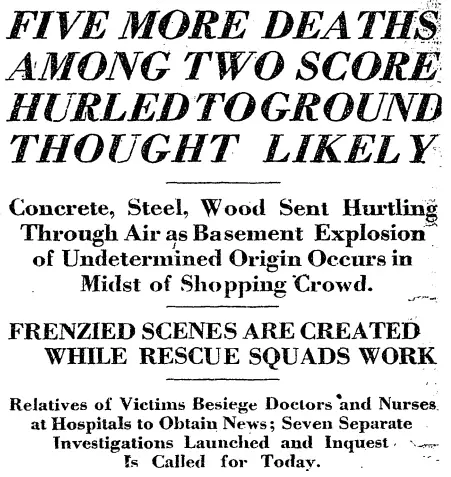
The Post continued:
Three fire alarms and calls for first aid equipment brought all the downtown fire apparatus, the Fire Rescue Squad, ambulances from all hospitals, the Red Cross and public utility emergency cars to the scene, with police reserves arriving in squads.
And on what had failed:
While the exact cause of the explosion had not been determined last night, it was learned that the welded end of a 500-gallon tank in the boiler room of the store, located under the sidewalk, had been blown out. Just what caused the tank to explode is what the investigators are endeavoring to learn.
The bottom of the tank failed first. With the seal blown, the tank rocketed straight up, slammed into a steel beam that supported the sidewalk, and disintegrated into shrapnel. The boiling water inside flashed instantly into steam and pushed outward, cracking concrete, throwing slabs and steel into the street, ripping the storefront apart from inside.
“I saw a man hurled 30 feet”
A police detective named Benjamin Keuhling happened to be in the neighborhood when the tank let go. He told the United Press what he saw:
I saw a man hurled 30 feet, and a woman shoot straight up in the air. It was a miracle that at least 20 persons were not killed.
The Associated Press dispatch, carried as far as Washington state’s Ellensburg Daily Record, offered another image of the immediate aftermath. “Firemen arriving immediately began digging beneath the ruins for bodies,” the AP reported. “Steam poured upon the cavity upon a score of firemen as they worked feverishly to lift the huge blocks of concrete which had fallen.”
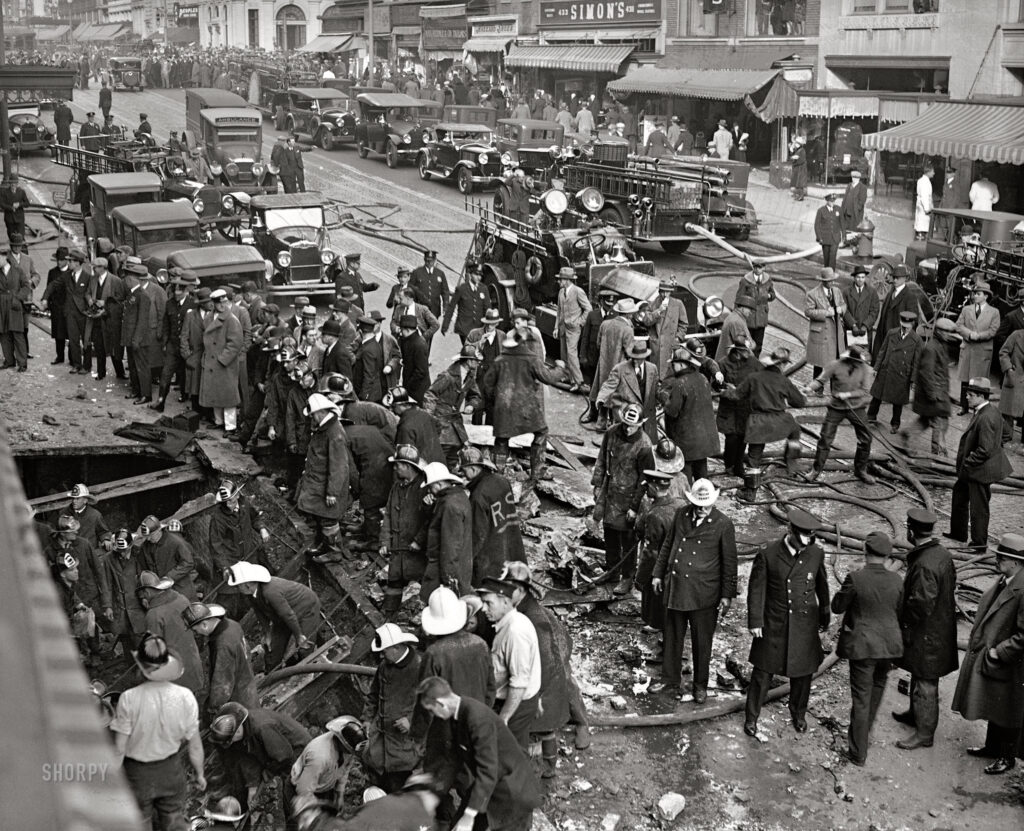
A man standing across Seventh Street named Wilbur Smith was thrown by the blast against an automobile and fractured his skull on impact. Another man was found an hour after the explosion at the bottom of the McCrory’s elevator shaft. He remembered being struck by a car and waking up in the shaft. He could not remember his own name. He was sent to the hospital for shock.
The Washington Post would describe the rescue scene this way:
Struck down as they walked along the street in front of the store, the victims of the explosion never had a chance. It was as though an earthquake had suddenly seized the entire block. Pieces of concrete, steel and wood shot from the store front with terrific force, sweeping all obstacles before them and the sidewalk in front of the place collapsed with a loud roar.
As the dust slowly settled into the yawning cavity in front of the McCrory store, a scene of indescribable horror was presented to the first rescuers who rushed into action.
Men, women and children lay in the street, where they had been thrown by the force of the explosion. Blood-covered, the most seriously injured lay inert while others, still conscious, groaned and shrieked. Hats, shoes, clothing and personal effects of the victims were strewn for many feet in all directions as huge pieces of debris from the store front covered other articles torn from the grasp of the stricken.
The man who survived two of D.C.’s worst disasters
One of the most remarkable witnesses was a man named L.E. Donaldson, who happened to be a few doors down from the McCrory’s when the boiler blew. According to his testimony, this was not the first time he had walked into a Washington disaster.
On the morning of January 28, 1922, Donaldson had just bought his ticket and was stepping into the Knickerbocker Theater on 18th and Columbia Road when the roof collapsed under two days’ worth of accumulated snow. The collapse killed 98 people and remains the deadliest single accident in D.C. history.
Donaldson made it out of that building. Seven years later he was on Seventh Street when the McCrory boiler let go. He made it out of that one too.
The dead
No store employees were killed in the blast. Only three were even injured, and none seriously. They were all young women: Olga Shipley, 18, of 3560 Alton Place NW; Florence Davis, 18, of 701 South Lee Street, Alexandria; and Mary Virginia O’Neil, 21, of 61 East Maple Street, Alexandria. The lunchtime configuration of the building seems to have spared the McCrory staff almost entirely. The dead were the people on the sidewalk above them.
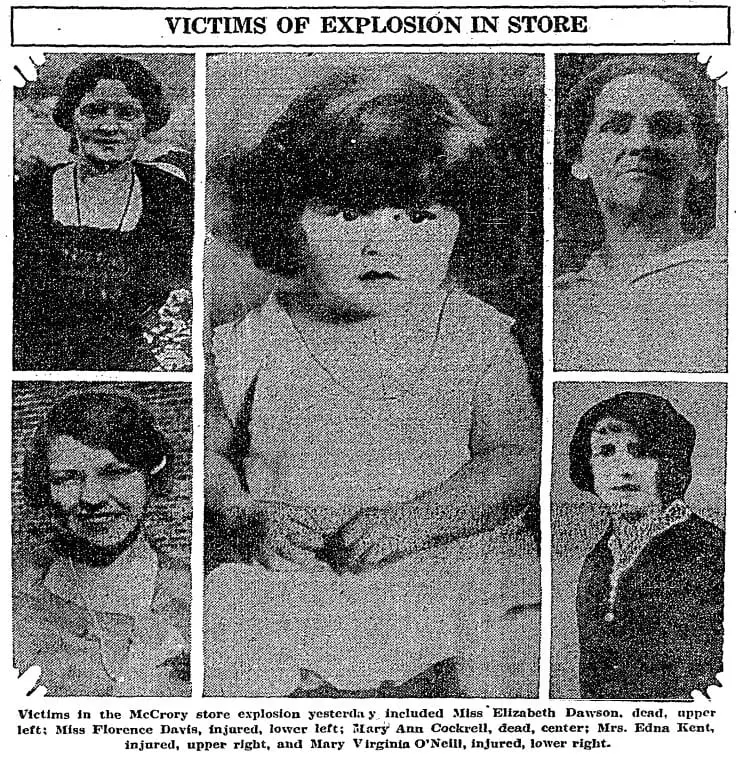
Among the names that came out of the morgue and hospital lists in the days after: Elizabeth Dawson. Charles Jacobson. Anna Mae Cockerell. Cockerell’s two-year-old daughter, Mary Ann. And Cockerell’s aunt, Catherine Cullinaine. Three generations of one family lost in a single instant on a Thursday afternoon, on a block they had no reason to fear.
The janitor who almost died
The Washington Post’s coverage included this passage about the man who was supposed to be in the boiler room when it blew:
Frank Brown, colored janitor in charge of the furnace narrowly escaped being in the furnace room at the time of the explosion, employees of the store said. He had been mopping floors in the store and was just preparing to go to the furnace room when it occurred. He is understood to have told Acting Fire Marshal Achstetter that he had coaled the fire at 7:30 o’clock yesterday morning, and, as is customary, had not looked at it since.
That last detail, about coaling the fire at 7:30 a.m. and not checking on it, was not negligence in 1929. It was the standard practice. Hot-water tanks of that size were left to themselves all day. There was no inspection regime in the District of Columbia that required otherwise. There was no city inspector who came around and checked safety valves. There was no licensing of boiler operators. The tank under the sidewalk on Seventh Street had been doing its job for nine years, and on the tenth year it lifted the sidewalk into the air.
(The period racial label that appears in the Post’s wording reflects 1929 newsroom convention and is preserved here as it ran. We are not endorsing the descriptor, just leaving the source intact.)
The law that came too late
The District of Columbia did not regulate boiler safety in any systematic way before the McCrory blast. The federal statute that finally created an inspection regime, the Boiler Inspection Act of the District of Columbia, was approved by Congress on June 25, 1936, six and a half years after the disaster on Seventh Street. The Act, codified at 49 Stat. 1917, set up a Boiler Inspection Service inside the Engineer Department of the District, required every steam boiler and unfired pressure vessel in the city to be examined and certified safe at a stated maximum pressure, and required that certificate to be posted in plain view next to the equipment.
That is the law that should have caught the tank in McCrory’s basement. By the time it existed, the people on the sidewalk were already gone.
What’s there now
The block of 414-416 Seventh Street NW that opens onto Penn Quarter today is a continuous commercial facade with a stuccoed upper level and an aluminum storefront at street. The Library of Congress’s Historic American Buildings Survey documented the building under file number HABS DC-650 (414-416 Seventh Street, Northwest, Commercial Building). The McCrory’s name is gone. The five-and-dime as a category is gone. The chain itself filed for bankruptcy in 1933, just under four years after the Washington blast, then re-formed and limped along for another seventy years before shutting down for good in 2002.
The 7th Street commercial corridor has changed in ways its 1929 shoppers would not recognize. The furniture rows are gone, the cheap department stores are gone, People’s Drug is gone. The block is now restaurants, galleries, and the District Architecture Center a few doors up at 421. A Shorpy reader has noted that the corner where the fire chiefs and hose lines once stood is now outdoor seating for a Peruvian restaurant. The same brick cornices on the buildings to the north show up in both the 1929 glass negative and the modern street view.
You walk past it without knowing.
A footnote on the founder
There is one more odd coincidence worth noting. John Graham McCrory, who built the chain that ran the Washington store, died on November 20, 1943, at his home in Brush Valley, Pennsylvania. That date is the day before the fourteenth anniversary of the Seventh Street disaster. Whether McCrory ever spoke publicly about the explosion that killed six of his customers is not something the obituaries record. By 1943 he was 83 and many years removed from the day-to-day of the company. His son and named successor, Van Clair McCrory, had himself died in a 1929 hunting accident in Florida, ten months before the Washington tank let go.
It was a hard year for the family.
Six dead in seconds
The McCrory disaster never made it into D.C. fire department mythology the way the Knickerbocker collapse did, or the way the 1968 riots or the Air Florida crash later would. There is no plaque on the Seventh Street facade. There is no marker on the sidewalk where the tank lifted the concrete forty feet into the air. The clearest record of the day is the Harris and Ewing glass negative that survives in the Library of Congress, a single black-and-white frame of the cratered storefront and the firemen working in the steam.
Six people who were just walking down a busy retail block at lunchtime never made it home. The sidewalk that opened up under them got patched. The store reopened. The city eventually wrote the inspection law. The people on the corner today are eating lunch where the bodies fell.
That is the story.
All of these stories of D.C. are so unreal. My maternal grandfather was born in DC in 1875/his oldest brother was born there in 1859. There were 11 kids, mostly born in Washington & my great grandfather operated a liquor store on 9th St. I need to check the addresses on all the businesses that family operated. Odenwalds Shoe Store; a Millinery store on 7th . I believe; A relative via marriage operated a hotel/bar in DC and in fact shot the son of the former chief of police (in self-defense). I am learning so many stories. The pictures and additional posted here just add to the discoveries. I wish my dad were alive as he would love all of this. He too grew up in the District , moving to VA as an adult but still working at the US Capitol for 30 plus years. Memories for me……….cannot imagine how many there would be for him. Not sure if my mom would follow any of it anymore. She won’t get on a computer …….sigh.