
If you want the most-told ghost story in Washington, you want the Octagon. The house at 1799 New York Avenue NW has been called the most haunted building in the city for well over a century, and the legends have a confidence to them that most DC ghost stories don’t. Phantom servant bells ringing at the dinner hour. Two Tayloe daughters who fell to their deaths down the spiral staircase. The smell of lilacs in the front hall whenever Dolley Madison is in the room. A gambler shot at a card game on the third floor whose body refuses to leave.
It’s a great catalog. The complication, which we’ll get to, is that the most famous part of it isn’t actually true.
But the house itself is the real anchor here, and the real history is wilder than the haunting. The Octagon was the executive mansion for six months after the British burned the White House in 1814. James Madison signed the document ending the War of 1812 in the circular room upstairs. And the oldest of the ghost legends, the bell ringing, was already in print in 1874, written down by people who had heard it from the Tayloes themselves.
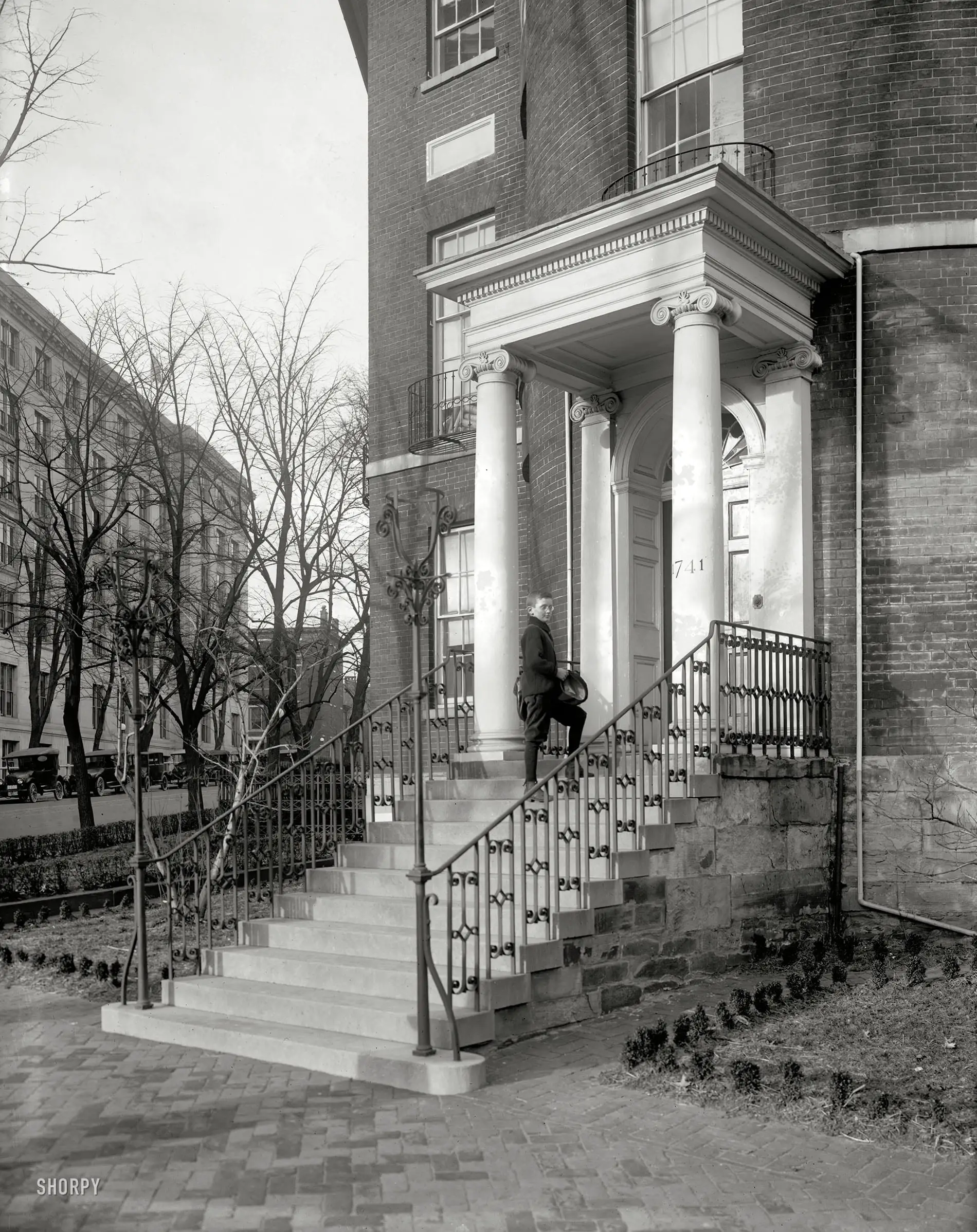
A six-sided house called the Octagon
Colonel John Tayloe III was the richest planter in Virginia, the master of Mount Airy on the Rappahannock, and a personal friend of George Washington. He was going to build his winter townhouse in Philadelphia. Washington talked him out of it. The new federal city needed a marker of permanence, and a Tayloe mansion near the President’s House would be exactly that.
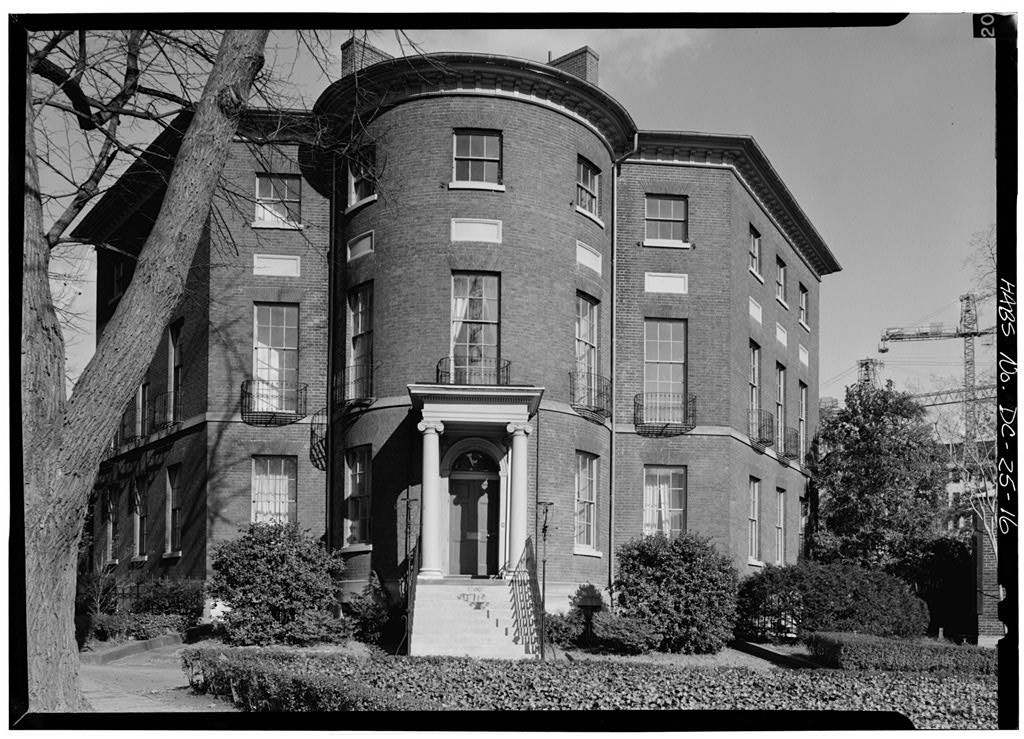
Tayloe bought lot 8 in Square 170, at the corner of New York Avenue and 18th Street NW, for $1,000 in April 1797. The triangular lot is what created the famous floor plan. Tayloe hired Dr. William Thornton, the self-taught architect who had just won the design competition for the U.S. Capitol, and Thornton solved the awkward corner by rotating the house to face both streets at once. The two long walls meet at 70 degrees. A round vestibule and a stack of circular rooms fill the front. Closets on every floor, which was unusual in 1799. Mahogany doors on the first story. Secret doors in the back hall with the chair rail run cleanly across them, hinges hidden.
On April 19, 1799, Thornton wrote to George Washington that “Mr. J. Tayloe, of Virginia, has contracted to build a house in the City near the President’s Square of $13,000 value.” Construction finished in 1801. The Tayloes called it the Octagon despite the fact that the building has six sides, not eight. Why is genuinely unclear. Period English usage sometimes called any room with eight angles an “octagon salon,” and the house does have eight interior angles. Whatever the reason, the name stuck.
The temporary White House, 1814
Tayloe was a Federalist and not enthusiastic about James Madison’s war. But when British troops marched on Washington in August 1814, Ann Ogle Tayloe made one of the more strategic decisions in DC real estate history: she offered the house to the French minister, Louis Sérurier, who promptly moved in and flew the French tricolor over the door.
When the British arrived on August 24 and torched the White House, the Capitol, and the Treasury, the Octagon was untouched. The French flag may have helped, although the British were technically under orders to spare private property. Either way, while the White House smoldered, Dolley Madison sent her pet parrot to the Octagon for safekeeping. We covered the chaos of those days in our look at contemporary news reports of the burning and the engravings made afterward of the gutted President’s House.
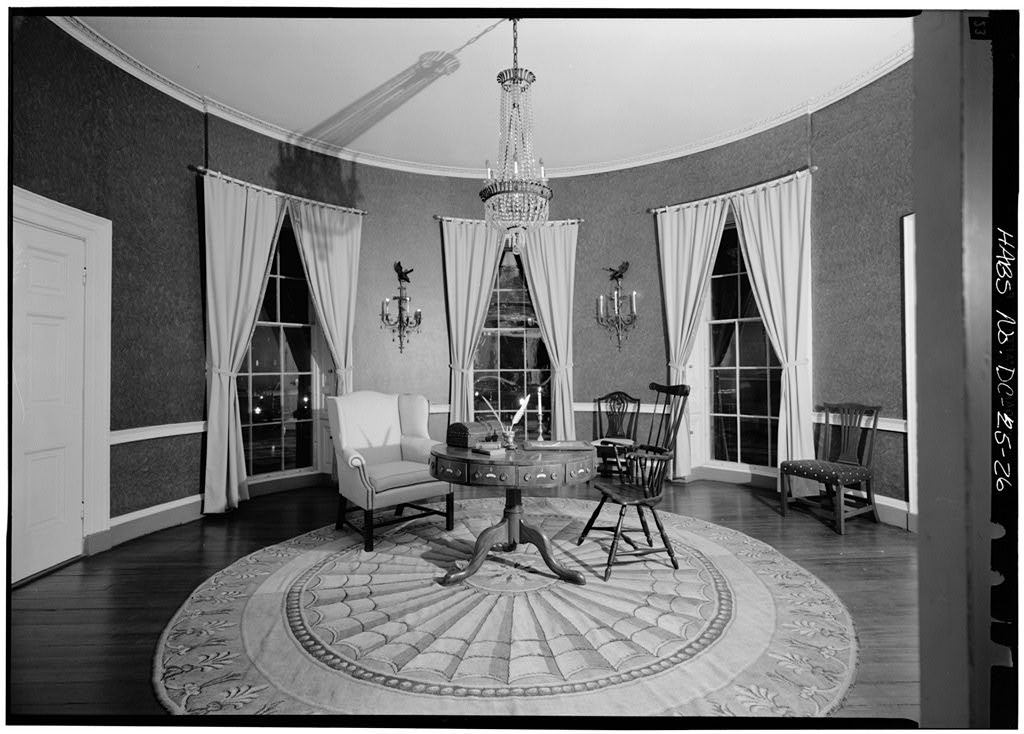
The Madisons moved into the Octagon on September 8, 1814. Tayloe charged them $500 in rent for the six-month stay. James Madison ran the executive branch out of the second-floor circular study, the round room directly above the entrance. Dolley held her Wednesday-night “squeezes” in the drawing room downstairs and got back to the business of being the most consequential hostess in early American politics.
Signing the Treaty of Ghent
The peace treaty ending the War of 1812 had been signed in Belgium on December 24, 1814, by American and British negotiators. It then had to physically travel back across the Atlantic before the war could actually end. A copy reached Washington in mid-February. The Senate ratified it on February 16, 1815. Madison signed and ratified it the next day, February 17, 1815, in the upstairs circular study at the Octagon. That signature, on that piece of paper, in that small round room, is what officially ended the war.
A few weeks later, the Madisons moved back to a rebuilt residence on Pennsylvania Avenue and the Tayloes returned to their house. If you want a sense of just how close Washington came to being abandoned during all of this, we wrote about the congressional vote to move the capital out of the city after the burning, which failed by nine votes.
The bells
The oldest Octagon ghost story is the one that has the strongest pedigree. The Tayloes owned hundreds of enslaved people across their plantations. Twelve to eighteen of them worked at the Octagon, summoned through the rooms by an elaborate system of pull-rope bells. After Colonel Tayloe’s death in 1828, the bells started ringing on their own.
Virginia Tayloe Lewis, the Colonel’s granddaughter, grew up in the house and recorded the family’s own version in an unpublished manuscript:
The bells rang for a long time after my Grandfather Tayloe’s death, and every one said that the house was haunted; the wires were cut and still they rang… Our dining room servant would come upstairs to ask if anyone rang the bell, and no one had.
By 1874 the bell legend was already in print. Mary Clemmer Ames, in her book Ten Years in Washington: Life and Scenes in the National Capital as a Woman Sees Them, gave the most quoted version:
It is an authenticated fact, that every night at the same hour, all the bells would ring at once. One gentleman, dining with Colonel Tayloe, when this mysterious ringing began, being an unbeliever in mysteries, and a very powerful man, jumped up and caught the bell wires in his hand, but only to be lifted bodily from the floor, while he was unsuccessful in stopping the ringing.
A second, very specific account came from Marian Gouverneur, who wrote in her 1911 memoir As I Remember that General George D. Ramsay, chief of ordnance for the U.S. Army and commander of the Washington Arsenal, had stayed at the Octagon overnight as protection for the Tayloe daughters while Colonel Tayloe was away. The bells, she wrote, “began to ring violently.” Ramsay grabbed the bell rope to silence them. They kept ringing.
The bells are gone now. They were taken down at some point in the 19th century, after several priestly exorcisms reportedly failed.
The daughters on the staircase
This is the most famous Octagon story and it is the one that doesn’t survive contact with the historical record. The version that has circulated for over a century goes like this. Two of Colonel Tayloe’s daughters fell to their deaths from the elegant spiral staircase. The first quarreled with her father on the second-floor landing over her relationship with a British officer stationed in Washington, turned to storm down the stairs, and fell. The second eloped, returned to reconcile, argued with her father on the third-floor landing, and fell. One is sometimes seen as a candle ascending the stairs. The other haunts the foot of the staircase, where a turned-up edge of carpet is said to right itself overnight.
The story made its first known print appearance in the Minneapolis Tribune in 1908 and has been repeated in ghost books, newspaper features, and television specials ever since. The trouble is that none of the Tayloe daughters died at the Octagon. The Tayloes had seven daughters. Of the three who died young, one was an infant in 1800 who never lived there. Rebecca Plater Tayloe did die at age 18 in 1815, but she died at Mount Airy in Virginia while the Madisons were renting the Octagon. The four remaining daughters all lived past 38. There is no plausible candidate for either falling daughter in the family record.
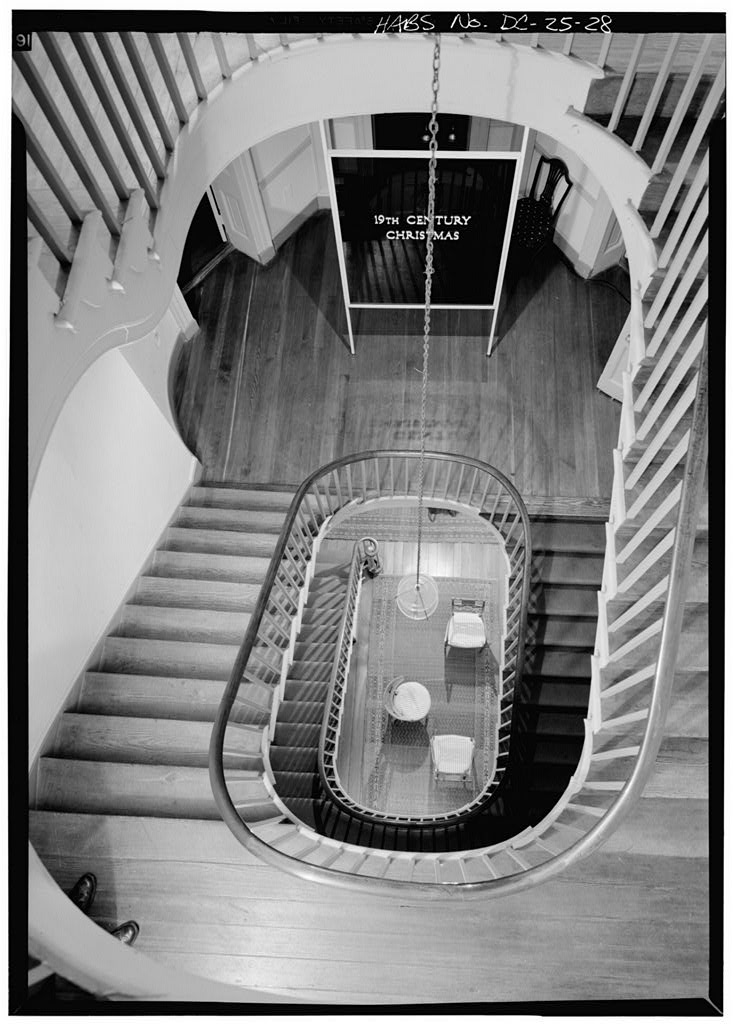
The bells are documented in 1874. The falling daughters appear in 1908, a generation after the last Tayloe heir left the house. That’s a 34-year gap, and it shows. Somebody added the staircase tragedy after the fact because the bells alone didn’t quite carry the building’s atmosphere.
Dolley Madison’s lilacs and the gambler on the third floor
After the Tayloes left, the house had a rough seventy years. Boarding house. Girls’ school in the 1860s. Office space for the U.S. Navy’s Hydrographic Office in the 1870s. By the 1880s the Octagon had been carved into ten apartments, one family per room, mostly Foggy Bottom factory workers. It was during this tenement period that two more ghosts joined the cast.
Dolley Madison started appearing in the front hall and drawing room. Witnesses identified her by the smell of lilacs, supposedly her favorite scent. She is the busiest ghost in Washington with appearances credited to her at the White House, the original Madison residence on F Street, and now back at the Octagon. We pulled together her other documented haunts in our piece on the ghosts of the executive mansion.
The gambler is later and more lurid. A man who kept rooms on the third floor was supposedly killed in a card game in the late 19th century, shot as he reached for the bell rope to call for help. His story turns up in the Philadelphia Evening Telegram on October 5, 1912, in a feature called “Washington Mystery House” by Mary Kouncelor Brooks, who interviewed a man claiming to have been visited every night for a month by the gambler’s ghost.
By 1888 the Octagon was famous enough as a haunted house that twelve men spent a night inside it to prove the legends wrong. The account that ran in a local newspaper afterward made the opposite case:
The hours wore quietly on. The party were dispersed from garret to cellar. At the hour of midnight, as I and two others were crossing the threshold of a room on the second floor, three feminine shrieks rose from the center of the room. Aghast we stood. From all quarters the party rushed… Too brave to desert, yet cowards at heart, we watched the gray light of morning dawn, and each man of us thanked God his night among ghosts was past.
The American Institute of Architects rented the Octagon as their headquarters in 1898 and bought it outright in 1902, which saved the house from demolition during the Foggy Bottom industrial decades. AIA staff in the 1960s reported lights flicking on and doors opening on the upper floors after closing. A doctor making a house call in the late 1940s asked the caretaker about the costume party, having just passed a man on the stairs in an early-1800s military uniform. There was no party.
The most haunted house in DC, more or less
The Octagon Museum is still there, open to the public, run by the Architects Foundation. The bells are down. The Tayloe daughters never fell. Dolley Madison’s lilacs and the gambler’s blood are stories that grew up around a real house that genuinely was the executive mansion in 1814, where the Treaty of Ghent was genuinely signed, where Colonel Tayloe genuinely died in 1828.
If you want a haunted DC story with named, currently-employed witnesses, the Omni Shoreham’s Suite 870 is still the one to read. If you want a story where the ghost story is real but the house behind it is also tragic and well-documented, the Walter family house at 1815 Adams Mill Road is the one. The Octagon is somewhere in between, which is probably why it has lasted longer than the rest.
For two 1970s legends from the suburbs, read about the Maryland Goatman and Virginia’s Bunny Man.
We dug this one up with help from AI and checked it against the original records below. Here’s how we use AI.