Just after 8 o’clock on the evening of Thursday, July 29, 1937, a capacity crowd stood in the aisles of a brand-new movie house at 12th and Newton streets NE. Doors had opened at 7, and every seat in the 1,007-seat auditorium was taken.
Commissioner Melvin C. Hazen was supposed to welcome the theater on behalf of the District, but he could not make it, so corporation counsel Elwood Seal spoke in his place. Leon Brusiloff’s string ensemble played. The owner, Louis J. Bernheimer, ran a trailer on the screen pledging himself and his fourth theater to the comfort and entertainment of Brookland.
Then the lights went down for the opening feature, “I Met Him in Paris,” starring Claudette Colbert, Robert Young, and Melvyn Douglas.
The Washington Daily News called it “one of the swellest comedies of the season.” The Washington Post’s Nelson Bell, filing the next day, wrote the Newton up under the headline “The Newton is Picture House of First Rank.” The Evening Star’s own review the morning after described “a mighty attractive cinema house,” ultra modern inside and out, walls in a warm brown tone, seats “comfortable and well spaced,” an auditorium rounded off so it had no acoustic corners.
The corner it sits on
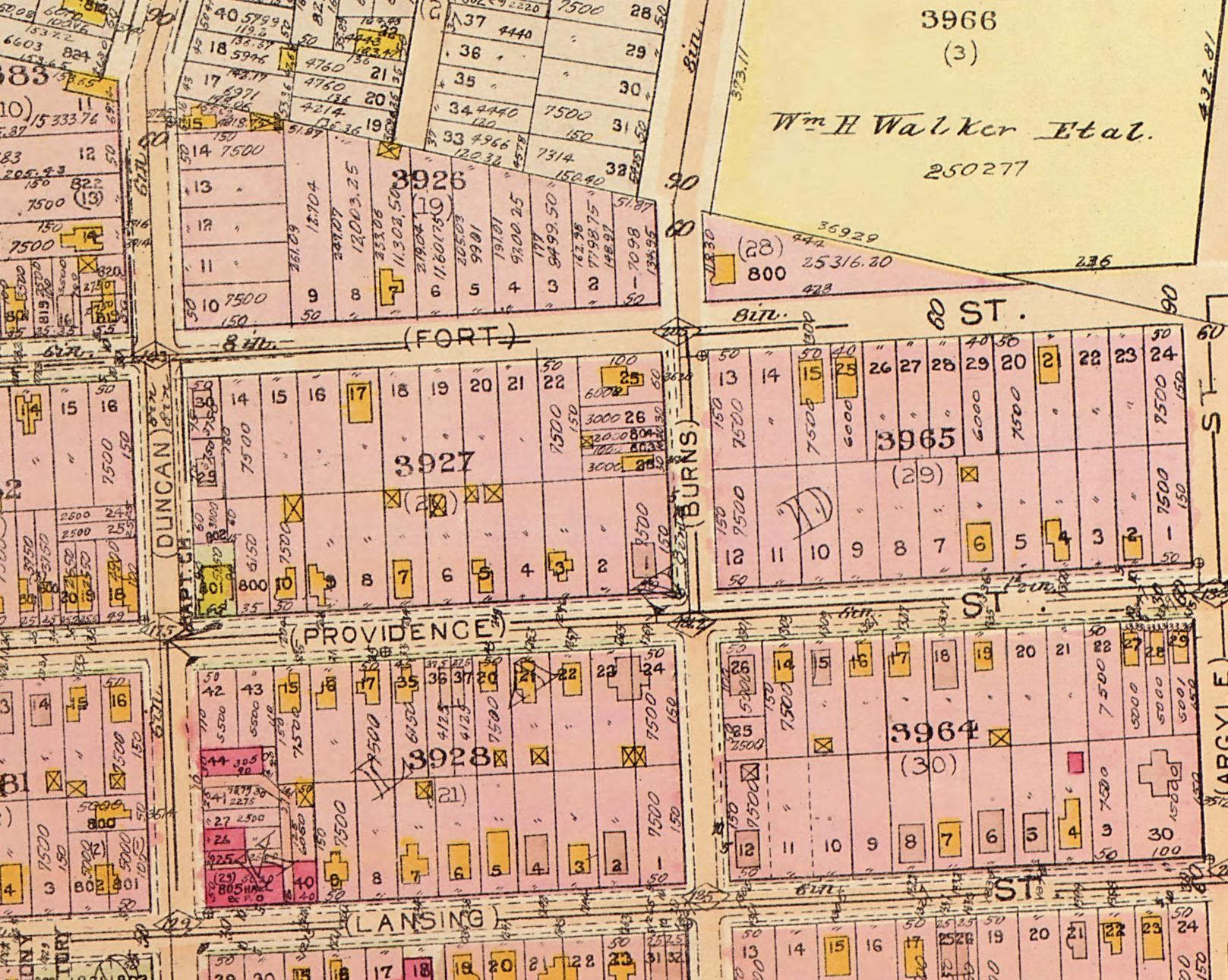
The Newton went up on a corner with its own recent history. Brookland Baptist Church had stood at 12th and Newton until it burned down in 1926. The lot sat empty for eleven years.
Then, in 1937, John J. Zink, Louis Bernheimer, and the Washington contractor Davis, Wick and Rosegarten put a 1,007-seat Art Deco movie palace on top of it for an estimated $40,000.
Bernheimer’s fourth theater took an anchor slot on the 12th Street NE commercial strip, the streetcar spine of Brookland. Before the Newton opened, Brookland residents who wanted to see a movie in the neighborhood watched silent films at Saint Anthony’s Church.
Zink, and what a Zink theater looked like
John Jacob Zink was 51 years old and running a Baltimore practice when the Newton opened. Before he went out on his own in the early 1920s, he had interned in New York with Thomas W. Lamb, one of the great movie-palace architects of the era.
His DC-area work already ran deep. The Rialto downtown (1918), the Takoma at 6833 4th Street NW (1922), the Uptown in Cleveland Park, the Reed in Alexandria, the Milo in Rockville. Also the Metropolitan. The National Register nomination for the Newton credits Zink with more than 200 movie theater projects across the region across his career.
The Evening Star caught the design a month before opening. On June 22, 1937, its movie columnist walked past the not-quite-finished building and reported it “nearing completion,” “completely modern in every detail,” air conditioned year-round, seats spaced for legroom. The Washington Daily News that same day noted that steel and equipment had been ordered months in advance, so the summer’s steel strikes would not delay the opening.
What Zink actually built at the corner is still there. The main entry sits on the corner itself, angled to face the intersection, so a streetcar rider looking up 12th Street saw the box office first.
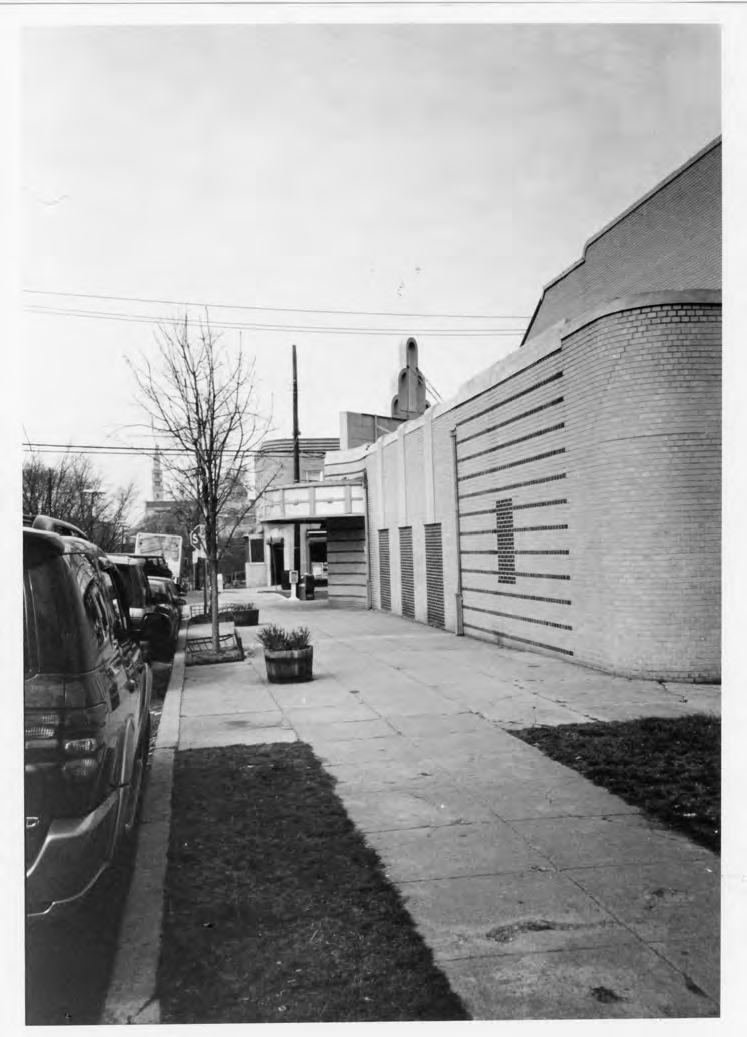
Two curved brick pylons, faced in glazed yellow brick with intersecting bands of dark brown running every fifth course, support the kidney-shaped canopy. Above the canopy, a vertical ziggurat sign in Art Deco stepped tiers stands up above the lobby roofline. The auditorium runs 150 feet deep along the length of the lot, with a stepped parapet along 12th Street hiding the pitched auditorium roof behind it.
Inside, per the Washington Post’s Nelson Bell writing the day after the opening, the lobby was “richly furnished,” “of modified modernistic design,” “softly illuminated with indirect lighting and made inviting by deep cushioned divans and potted palms.” The auditorium itself was “elliptical in shape, the side walls curving gracefully to the proscenium.” Every seat, Bell wrote, had “perfect sight lines to the screen.”
Zink was known as a technician. The National Register nomination notes his focus on sightlines, lighting, and acoustics, and his habit of tucking nurseries, lounges, and smoking rooms into the plan. He was not a Beaux-Arts atmospheric-palace designer trying to force himself into Art Deco. He was already in his 50s when the style caught up with him, and he made a virtue of tight budgets by using simple masonry gestures, streamlining bands of contrasting brick, ziggurat signs, curved piers, that read as modern without being expensive.
The Newton was a second-run house, meant to serve Brookland, Woodridge, and Michigan Park after downtown had already had first crack at the picture. That was the tier Bernheimer built for.
Dedication night: who spoke, who played, what showed
The Star’s preview on July 29, 1937 laid out the ceremony. The box office would open at 3 that afternoon. Doors at 7 to let patrons walk through the new house. Formal dedication at 8. Speakers: Commissioner Hazen for the District, John J. Hurley for the Michigan Park Citizens’ Association, John Fowler for the Brookland-Woodridge Business Men’s Association. John McLean, president of the Brookland Citizens’ Association, as master of ceremonies. Music by Leon Brusiloff’s string ensemble.
When the Star reported out the next morning, the crowd had been standing room only, Hazen had not made it, and Elwood Seal had welcomed the theater on the commissioner’s behalf. Everything else went as printed.
The neighborhood theater years
For the better part of a decade, the Newton was the anchor of Brookland’s 12th Street. It ran ads in the movie pages next to the Uptown and the Carolina and the Circle.
It also hosted an annual spring benefit for St. Gertrude’s School of Arts and Crafts, an event the Evening Star’s society pages picked up every year from at least 1941 through 1961. In May 1941 the benefit was a screening of “Queen of Destiny,” the technicolor Anna Neagle biography of Queen Victoria. By 1961 it was still running under the Ladies of St. Gertrude’s Guild, still in Brookland, still at the Newton.
The Newton also collected small period detail. In August 1960, an “Evening Star” lost-and-found line: “PARAKEET, light green, gray wings, banded: vic. Newton Theater: says ‘Puggy.’ Reward. LA. 6-1065.”
The slow closing
The National Register nomination puts the Newton’s “period of significance” at 1937 to 1945. That is the specific way the Historic Preservation Office says it: popular for a decade, then a slow decline. Neighborhood movie houses across the country were being squeezed at the same time. Television took audience share. Downtown venues came under their own pressures. The 12th Street Business Men’s Association would eventually lose Brookland’s supermarket too.
The National Register nomination attributes part of the decline framing to desegregation making “redundant” neighborhood theaters unsustainable. That framing is the Historic Preservation Office’s, and it is worth flagging that it sits inside the nomination’s own interpretive voice rather than being demonstrated with a specific closing document.
What the nomination does say, in plain terms, is that the Newton closed “in the mid-1960s.” The exact date has not surfaced in the archive material available to us. If a Washington Post closing notice exists in ProQuest, it is the next thing to pin down.
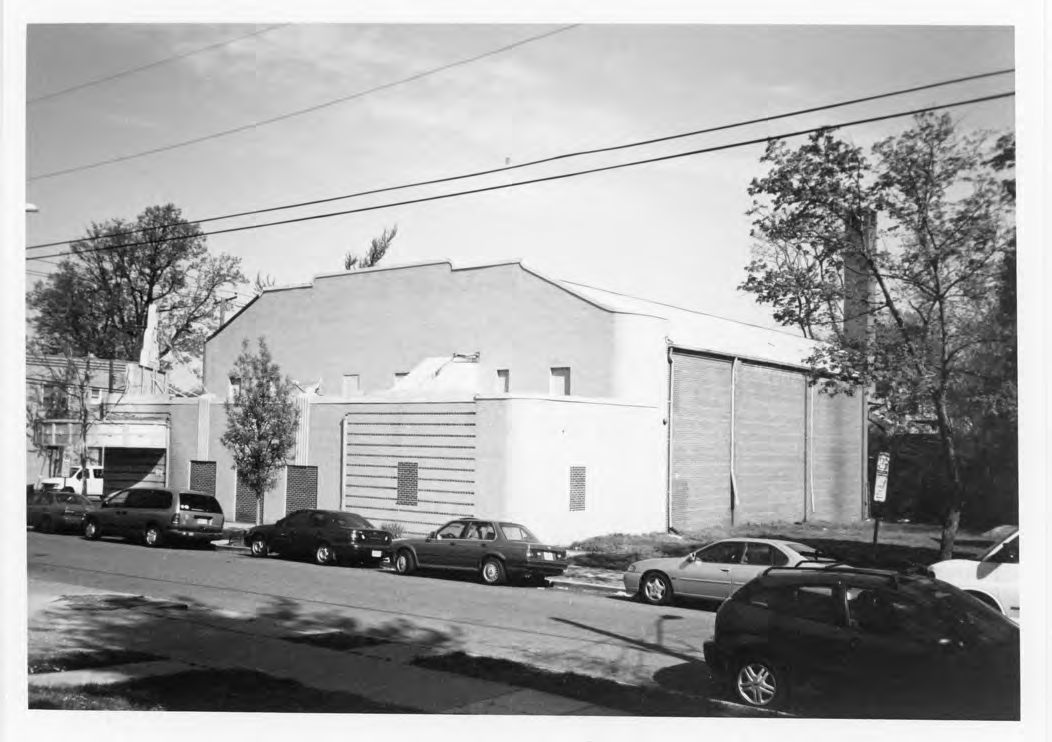
CUA, a nursery school, and a bookstore
After it closed, Catholic University bought the building. CUA’s music department used the space through 1971. The nomination cites Washington Post coverage of the property’s ownership arc but does not quote a purchase price or exact acquisition date.
In the summer of 1977 a neighborhood community group leased the theater and started showing movies again. Joann Stevens covered the moment for the Washington Post in a July 28, 1977 piece titled “Planning a Brookland Business Renaissance.” The revival lasted less than two years. By the beginning of 1979 the group had given up on the theater as a theater. The lobby was leased to a bookstore. The auditorium space became a nursery school and a warehouse.
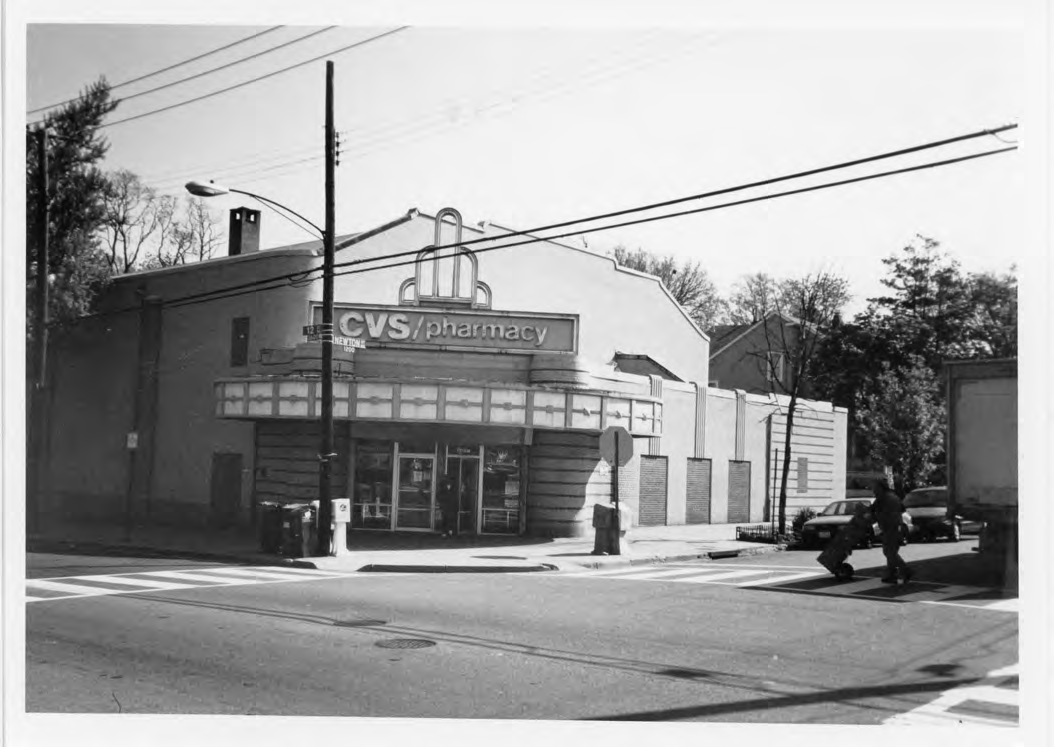
A People’s Drugstore moved in eventually, and then CVS. The Newton sign was swapped for a similar drugstore-chain sign in the 1980s, and the ziggurat crown stayed. The 1990s CVS renovation then gutted the interior. The exterior was left largely alone. Some openings got bricked up.
What’s there now
You can stand on the corner of 12th and Newton NE today and read the whole building as a CVS Pharmacy, if you want to. The signage says CVS. The interior sells shampoo and cough medicine. But look up. The kidney-shaped canopy is 1937. The curved yellow-brick piers are 1937. The ziggurat crown is 1937. Even the streamlining bands on the Newton Street elevation are what Zink drew in Baltimore, on paper, in the same year his firm was also finishing the Reed Theater in Alexandria.
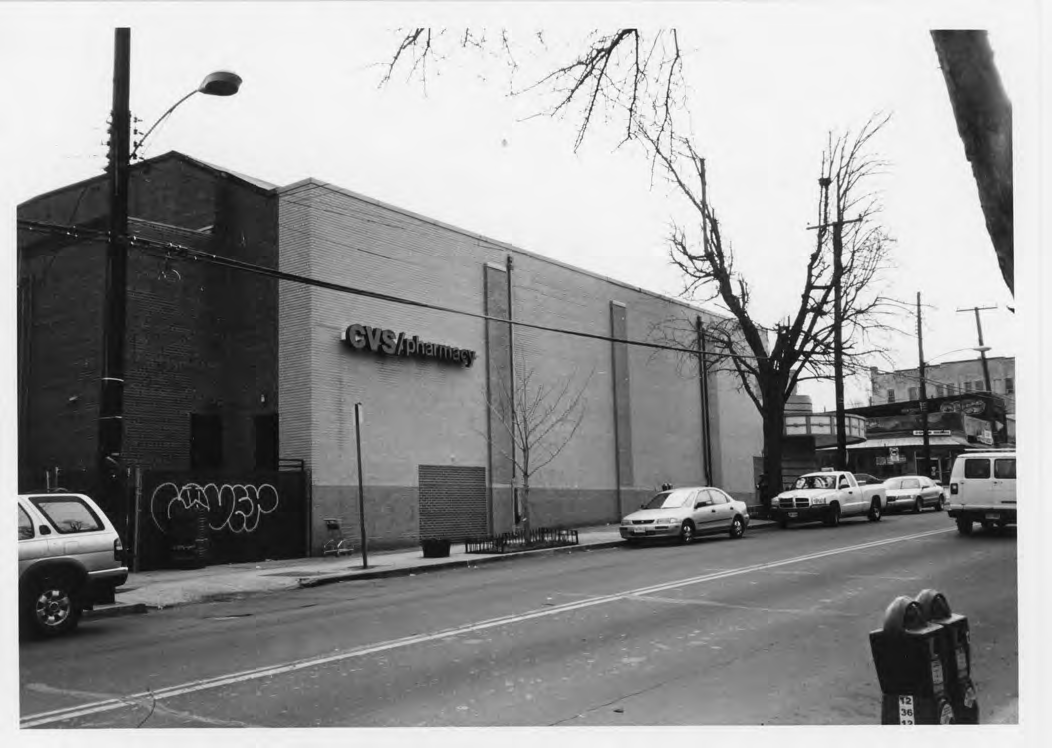
The building went on the National Register in 2007. The nomination was drafted by Rebecca Toepfer and Tim Dennee for the DC Historic Preservation Office. That is the reason the corner is still recognizable as a Zink theater and not a stucco box.
Brookland has other GoDC stories too. The Brookland Bowling Alley shared the same 12th Street commercial strip a generation earlier, and the neighborhood only got its Metro stop in 1977, the same summer the shuttered Newton was briefly a movie theater again.