
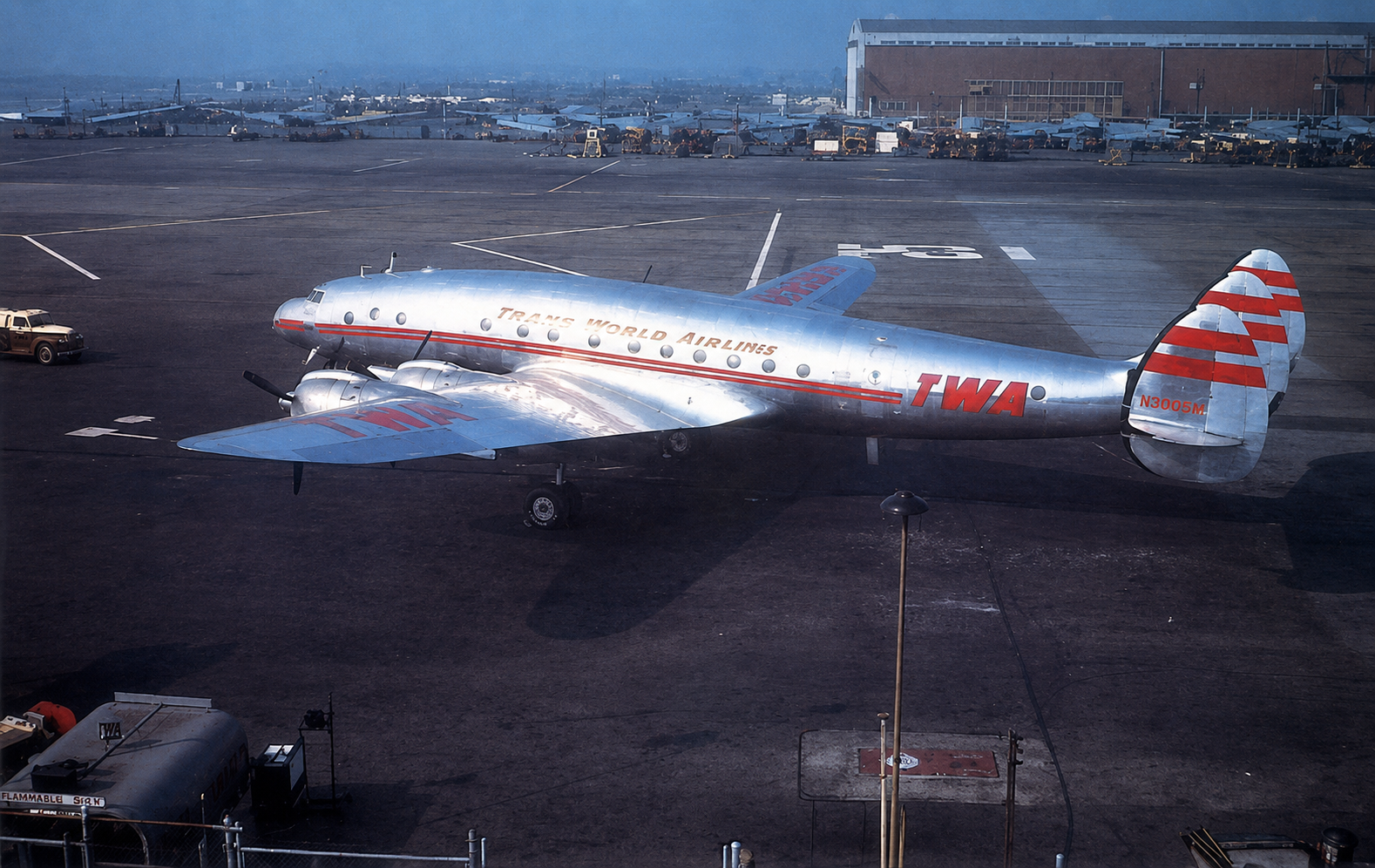
Picture the scene at Washington National Airport on December 3, 1945. A military band strikes up “The Last Time I Saw Paris.” A brand-new, four-engined Lockheed Constellation, gleaming and enormous, waits on the apron with its three tails catching the winter light.
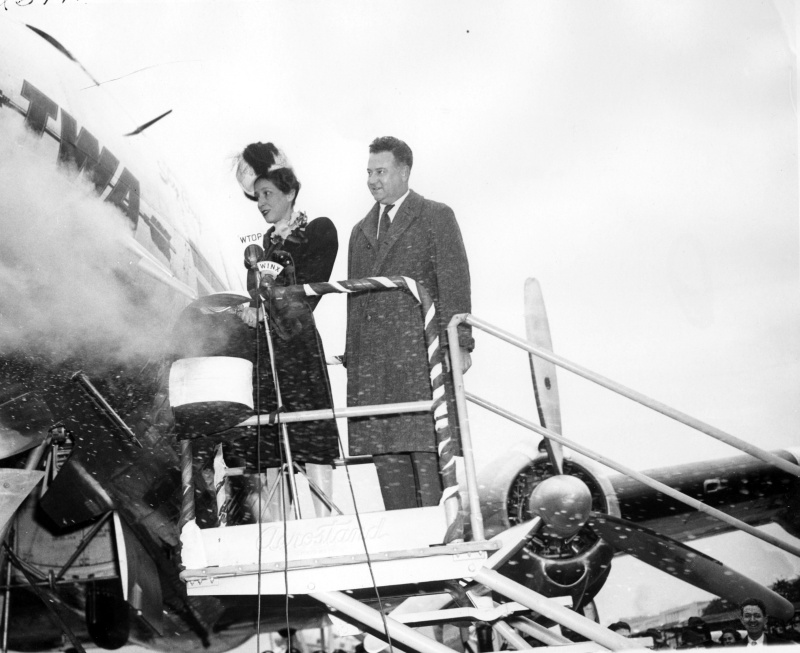
Mme. Henri Bonnet, wife of the French Ambassador, steps up to christen it. There is no champagne. Wartime habits die hard, and nobody wants to dent the polished aluminum. Instead, a specially built fire extinguisher sprays the nose with a white, cloud-like vapor, and the airliner is named the “Paris Sky Chief.”
Then it takes off for Paris.
This is an awesome find. We dug it out of the Washington Post and the Evening Star, and it is a piece of DC history that has been mislabeled for years in aviation write-ups. The flight is real, the send-off happened right here at National, and the date is December 3, 1945.
Washington to Paris in a single day
For Washingtonians in 1945, this was close to science fiction. The Constellation was the new wonder of the skies, a pressurized, air-conditioned airliner that cruised above the weather at better than 300 miles an hour.
The day before the flight, TWA president Jack Frye laid out the pitch to the Associated Press.
This flight will show for the first time what can be expected in high speed, over weather flying across the Atlantic. Passengers will ride at 5 miles a minute in the smooth air of high altitudes. A pressurized, air-conditioned cabin will insure ground level comfort.
The takeoff was set for 2:30 p.m. from National Airport. TWA billed the trip as the first use of the giant transport for commercial passenger travel, the opening of its service to Europe and the Middle East.
Peace was only months old
It is worth stopping on the date. December 3, 1945 was barely seven months after V-E Day, and only three months after Japan’s surrender. The war was not yet history. It was the air everyone was still breathing.
Look closely and the whole flight is the war turned to peacetime use. The Constellation was no civilian invention. It had been built for the Army Air Forces as the C-69 military transport, and TWA’s new airliners were converted from those cancelled wartime orders.
The route was a wartime inheritance too. Gander, in Newfoundland, was one of the great north Atlantic ferry stops that crews had used to move warplanes toward Europe. Now it was a refueling halt for a planeload of congressmen, who carried on to Shannon, in Ireland, then just opening up as the new gateway for transatlantic airliners.
Even Orly was a recent battlefield prize. Paris had been liberated in August 1944, and the airport had served as a U.S. Army Air Forces base. The “Paris Sky Chief” was landing on ground the Allies had taken back barely a year and a half earlier.
A blast of vapor instead of champagne
The christening detail is too good to paraphrase, so here is the Washington Post from December 4, 1945, under the headline “‘Paris Sky Chief’ Opens Air Service To French Capital.”
While a military band played “The Last Time I Saw Paris” a giant four-motored Constellation plane, “Paris Sky Chief” took off for the French capital yesterday. The flight inaugurates Transcontinental Western Airlines regular service to France. Before leaving, the plane was christened by Mme. Bonnet, wife of the French Ambassador, Henri Bonnet. A specially-constructed carbon monoxide fire extinguisher was used for the christening instead of the traditional champagne.
The vapor did the ceremonial job without risking a dent in the fuselage, which is exactly the kind of practical, slightly absurd 1945 detail we love.
Who was on board
This was no quiet test hop. The passenger list read like a guest book for a state dinner.
According to the Evening Star, aboard the “Paris Sky Chief” were Postmaster General Robert Hannegan, Senator Robertson, Republican of Wyoming, Representatives Lea, Democrat of California, and Cannon, Democrat of Missouri, Francis Lacoste, the French Minister plenipotentiary, Sean Nunan, Counselor of the Irish Legation, and W. A. M. Burden, Assistant Secretary of Commerce.
The press came too. The Star’s advance story listed correspondents from the Associated Press, the United Press, International News Service, CBS, and NBC, so the takeoff went out to radio audiences across the country.
And the airplane carried more than dignitaries. In the hold were 4,000,000 units of penicillin, the wonder drug the war had pushed into mass production. Half was donated by Mayors Edward J. Kelly of Chicago and Johnny Kerrigan of Boston, to be handed to the mayors of Dublin and Paris for the needy sick. The rest came from American Relief for France, sent for an ailing Paris dress designer.
Europe was still hungry and short of medicine. So the dawn of luxury air travel doubled as a mercy mission, the new airliner carrying healing to cities it had recently helped to bomb free.
The crossing
The “Paris Sky Chief” flew the great northern route, with refueling stops at Gander, Newfoundland, and Shannon Airport, Ireland, on a course of roughly 3,840 miles.
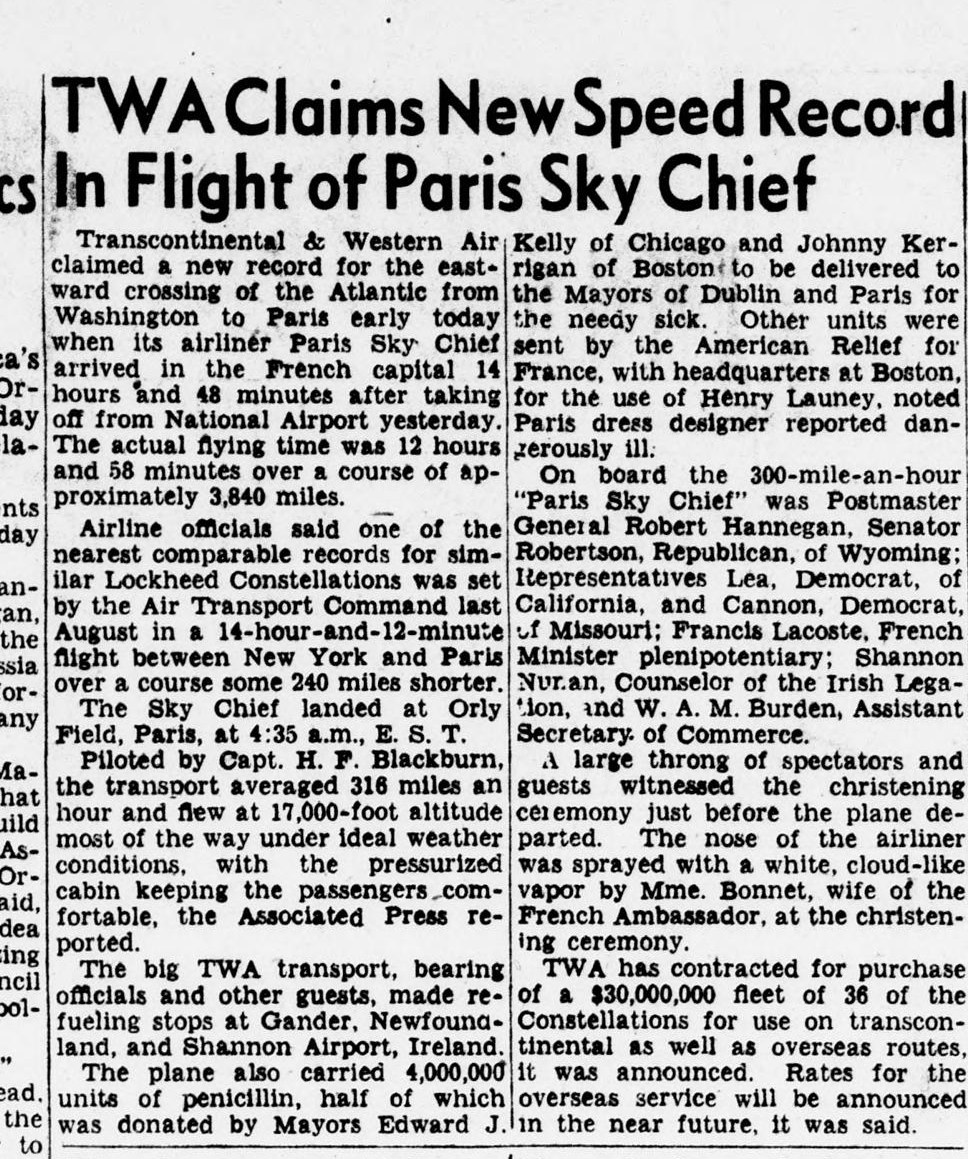
The Evening Star, December 4, 1945, ran the numbers under the headline “TWA Claims New Speed Record In Flight of Paris Sky Chief.”
Transcontinental Western Air claimed a new record for the eastward crossing of the Atlantic from Washington to Paris early today when its airliner Paris Sky Chief arrived in the French capital 14 hours and 48 minutes after taking off from National Airport yesterday. The actual flying time was 12 hours and 58 minutes over a course of approximately 3,840 miles.
The Sky Chief touched down at Orly Field at 4:35 a.m. Eastern time. Capt. H. F. Blackburn held it at 17,000 feet for most of the way, averaging 316 miles an hour in what the wire report called ideal weather, the pressurized cabin keeping everyone comfortable. A TWA shakedown flight earlier that week had already covered the distance in 14 hours and 18 minutes of air time.
The pilot who lived in Fairlington
Here is the part that turns this from an aviation footnote into a DC story. The man at the controls, Capt. Harold Frederic “Hal” Blackburn, lived right across the river in Fairlington, Virginia.
And yes, he was a war flyer. Blackburn earned his Army Air Corps wings in 1930 and joined TWA in the mid-1930s. When the country went to war, he flew military transport across the Atlantic for TWA’s Intercontinental Division, the wartime operation the airline ran under contract to the Air Transport Command. He rose to manage that division.
The records still show it. An Air Transport Command crew manifest catches him on October 20, 1943, bringing a seven-man crew into La Guardia from Prestwick, Scotland, listed simply as Capt. Hal F. Blackburn, age 41.
In other words, the calm voice that set a transatlantic record on December 3, 1945 had spent the war years hauling men and materiel across an ocean for the Army. The Paris run was the peacetime version of a job he already knew cold. He kept flying for TWA until he retired in 1962.
But in the Washington of 1946, Blackburn became famous for something closer to home. On June 14, 1946, the Washington Post named him “Ideal Washington Father of 1946.” The winning entry came from inside his own house.
Harold Frederic Blackburn, 45, who is “aces high” to his 11-year-old son, has been named Ideal Washington Father of 1946. The Post newsroom judges had to deliberate among many entries, each excellent in its own way, before making their choice of this year’s Ideal Dad. Robert (Bob) Blackburn, who wrote the winning letter, idolizes his father.
A transatlantic record-setter at work, and “aces high” at home in Fairlington. You could not script it better.
From proving flight to real service
The December run was a proving flight, a grand preview that carried officials and invited guests rather than fare-paying passengers. Ticketed passenger service followed in February 1946, and it too began in Washington.
The Washington Post, February 4, 1946, reported that one of TWA’s 300-mile-an-hour Constellations would take off from Washington National Airport “shortly before noon” the next day, inaugurating the first commercial air service between the United States and Paris, again captained by Blackburn. The fare from Washington to Paris was set at $375.
Six passengers boarded at National. This time the Constellation was a different airframe, a sister ship called the “Star of Paris” (registration NC86511), not the Paris Sky Chief. It flew up to La Guardia for a big send-off, then crossed the Atlantic and landed at Orly on February 6 after 16 hours and 21 minutes.
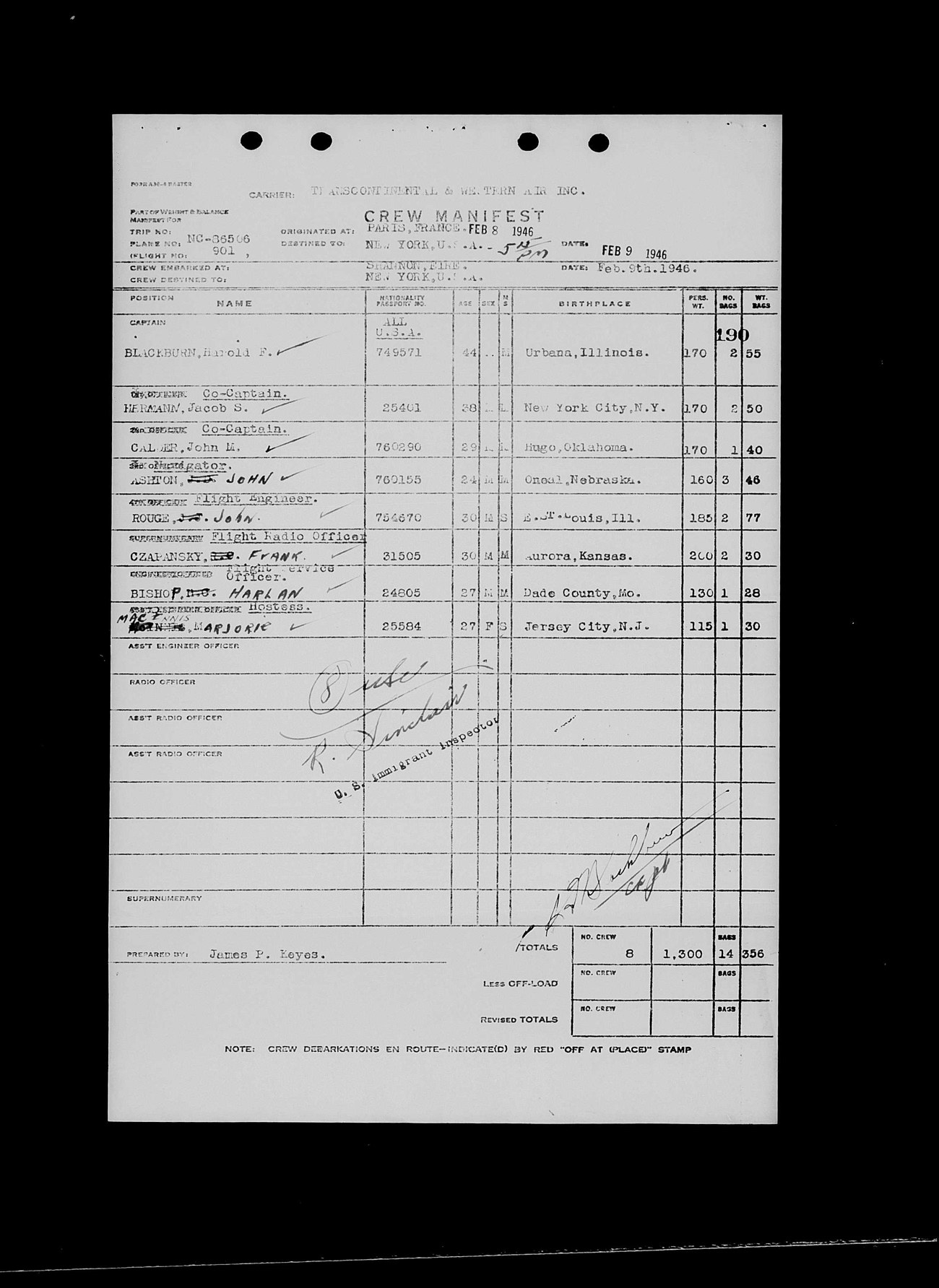
Blackburn brought the inaugural service home, too. A surviving crew immigration manifest records his Constellation arriving in New York from Paris on February 9, 1946, with the crew boarding at Shannon for the final leg. The captain is listed as Harold F. Blackburn, 44, born Urbana, Illinois, carrying the same passport number, 749571, he had taken across the North Atlantic for the Army in 1943.
Regular daily Washington-to-Paris Constellation service was inaugurated about a month later, in March 1946.
The airplane, and a sad coda
The star of the show was the Lockheed L-049 Constellation, designed under Kelly Johnson, the airplane TWA sold to the public as a “luxury liner of the skyways.” Its pressurized cabin and transoceanic range made the one-day hop to Paris possible in the first place. And like so much of that December afternoon, it was a veteran. The civilian Connie was a made-over C-69, the military transport Lockheed had built for the Army, now wearing an airline’s paint.
The “Paris Sky Chief” itself, registration NC86505, did not have a long life. Renamed the Star of Cairo within the year, it crashed near Shannon, Ireland, on December 28, 1946, a little over a year after its Washington triumph.
But on that December afternoon in 1945, with a band playing and the Postmaster General buckling in, the airplane did something Washington had never seen. It turned the ocean into a day trip, and it started the journey from a runway on the Potomac.
We dug this one up with help from AI and checked it against the original records below. Here’s how we use AI.