
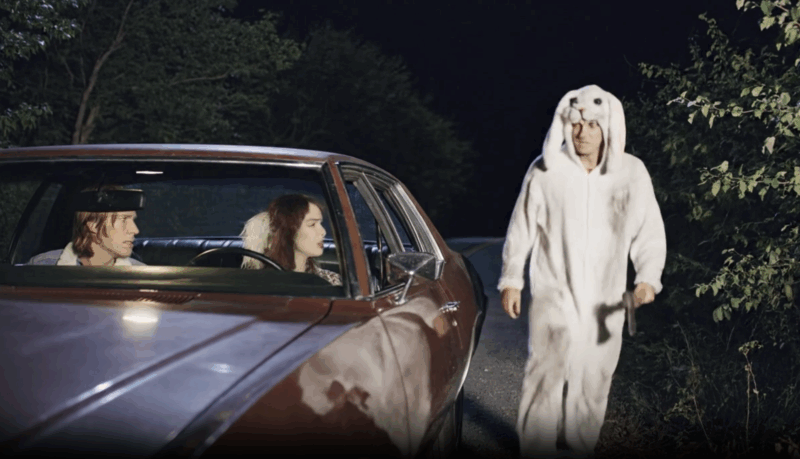
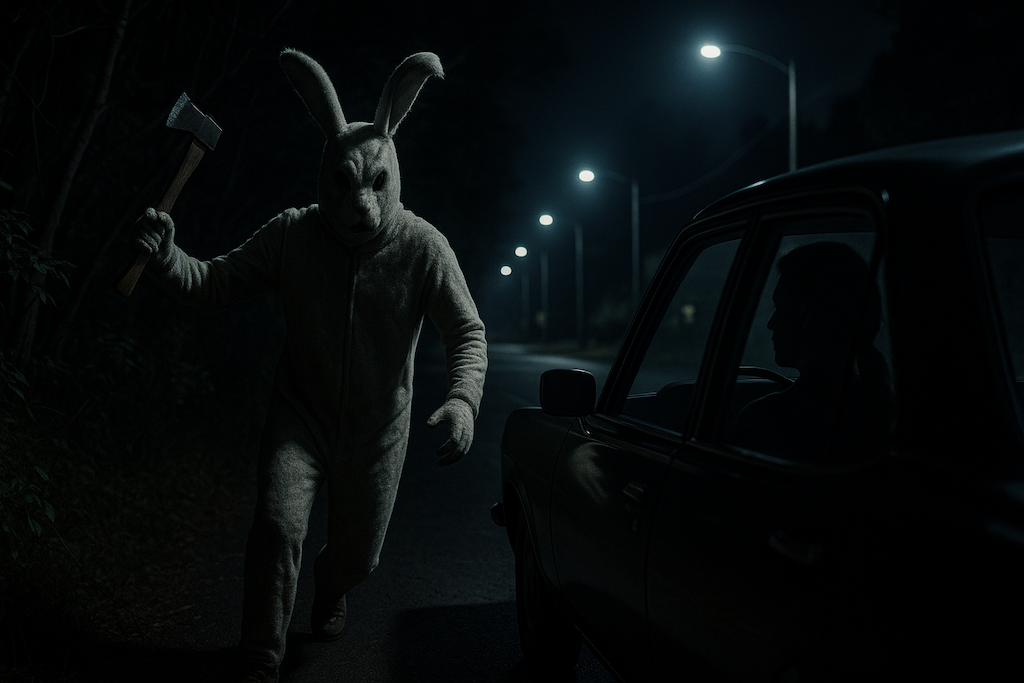
Fairfax County police said yesterday they are looking for a man who likes to wear a “white bunny rabbit costume” and throw hatchets through car windows. Honest.
That’s exactly how the Washington Post reported the story on October 22, 1970, with the kind of deadpan absurdity that only comes from documenting something truly bizarre. But what happened over two weeks in October 1970 wasn’t just strange news. It was the birth of one of Northern Virginia’s most enduring urban legends.
The man they were searching for would become known as the Bunny Man, and his story has captivated the DC area for more than fifty years. Generations of teenagers have driven to the infamous “Bunny Man Bridge” in Fairfax County, hoping to catch a glimpse of an axe-wielding figure in a rabbit suit. What most don’t know is that the Bunny Man was never seen at that bridge. The real story is both more mundane and more unsettling than the legend suggests.
Where Is the Bunny Man Bridge and What Actually Happened There?
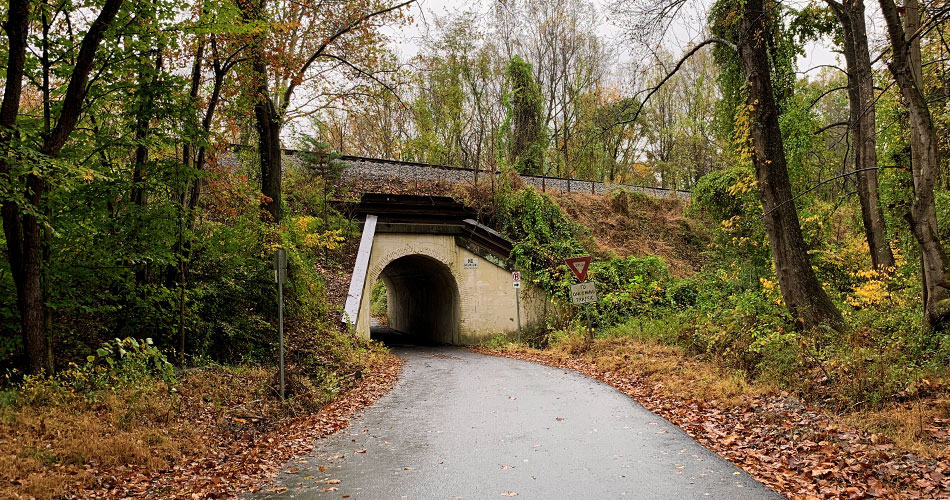
The bridge everyone associates with the Bunny Man story is the Colchester Overpass near Fairfax Station, officially called the Fairfax Station Bridge but now known to Google Maps as the “Bunny Man Bridge.” It’s a single-lane concrete tunnel where railroad tracks pass over Colchester Road. The problem? The Bunny Man was never actually spotted there.
The real events happened six miles away on Guinea Road in Burke, Virginia. Two documented incidents, two weeks apart, involving a man in a white suit with rabbit ears who had serious issues with people he considered trespassers.
Is the Bunny Man Real? The October 18, 1970 Incident
The first encounter was reported by Air Force Academy Cadet Robert Bennett. Shortly after midnight on Sunday, October 18, 1970, Bennett and his fiancée were sitting in a car on the 5400 block of Guinea Road. They had just attended an Air Force-Navy football game and were visiting Bennett’s uncle, who lived across the street from where they parked.
According to the Washington Post’s account, a man dressed in “a white suit with long bunny ears” ran from nearby bushes and shouted at them. The confrontation escalated quickly:
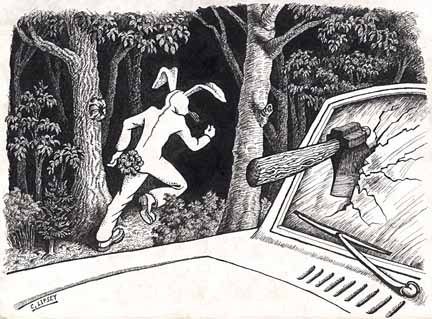
“You’re on private property and I have your tag number,” the figure yelled before throwing a wooden-handled hatchet through the right front car window. As soon as he threw the hatchet, the “rabbit” skipped off into the night, police said.
Bennett and his fiancée weren’t injured, but they were left with a shattered window and a very real hatchet on their car floor. The police took the weapon as evidence, though it would prove to be their only concrete clue in the case.
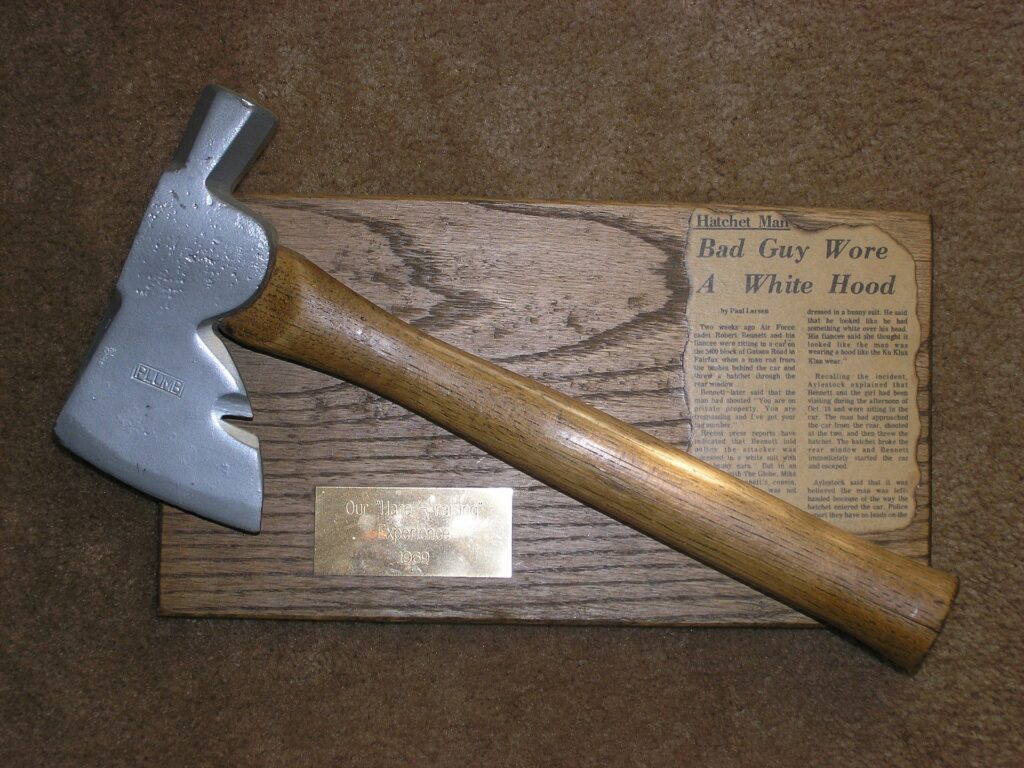
The Bunny Man Reappears: October 29, 1970
Less than two weeks later, the Washington Post ran another story with the headline “The ‘Rabbit’ Reappears.” This time, the location was 5307 Guinea Road, just a block away from the first incident.
Paul Phillips, a private security guard working for a construction company, encountered a man in what was described as a “furry rabbit suit with two long ears” on Thursday night. Phillips found the figure chopping away at a roof support on a new, unoccupied house with an ax.
When Phillips approached the intruder, the confrontation turned threatening:
“All you people trespass around here,” Phillips said the “rabbit” told him as he whacked eight gashes in the pole. “If you don’t get out of here, I’m going to bust you on the head.”
Phillips said he walked back to his car to get his handgun, but the “rabbit,” carrying the long-handled ax, ran off into the woods. The security guard described the man as about 5-feet-8, 160 pounds, and appearing to be in his early 20s. His suit was described as gray, black and white.
Bunny Man Virginia Sightings Multiply Across the Region
What happened next shows how quickly a local incident can spiral into regional hysteria. By November 6, 1970, the Washington Post was reporting that “The bunny man, the elusive figure who hurled his hatchet in the windshield of an occupied car two weeks ago in Fairfax County, was reported seen at least 50 times yesterday, police said.”
The sightings had spread beyond Fairfax County into Washington, DC, Maryland, and Prince George’s County. Metropolitan police received numerous calls from people claiming to have seen “the bunny man, a man dressed as a rabbit, in various sections of Northeast or Southeast Washington.” However, police were unable to confirm any of these reports.
In Prince George’s County, three children in Seat Pleasant told their mother, Cornelia Wedge, that they had seen “this man on the street with this bunny rabbit suit on with a hatchet.” It was the third reported sighting in the area within two weeks.
The Investigation That Never Solved the Mystery
Fairfax County police opened investigations into both Guinea Road incidents, but they were ultimately unable to identify the Bunny Man. They had physical evidence (the hatchet), witness descriptions, and a specific geographic area, but the case went cold. Police dropped the investigation the following spring.
The failure to solve the case left room for speculation and myth-making. Some theorized that the Bunny Man was a local property owner upset about rapid suburban development in the area. Both incidents involved complaints about trespassing, and Guinea Road was transitioning from rural farmland to suburban housing developments in 1970.
The timing and location support this theory. The construction site where Phillips encountered the figure was part of the wave of development transforming Fairfax County from rural to suburban. The Bunny Man’s consistent message about trespassing suggests someone who felt his territory was being invaded by outsiders and developers.
How a Bridge Became Part of the Legend
The Colchester Overpass became associated with the Bunny Man story despite having no connection to the original 1970 incidents. The bridge was simply a local teenage hangout spot that provided the perfect creepy backdrop for a growing urban legend. Its isolated location, dark tunnel, and the fact that it was built in 1906 gave it an appropriately ominous atmosphere for ghost stories.
Over the decades, the legend evolved far beyond the original police reports. Stories emerged of escaped asylum patients, murdered children, and bodies hanging from the bridge. None of these elements appear in any historical records or newspaper accounts from 1970.
The transformation shows how urban legends adapt and grow. The specific, documented events on Guinea Road were too mundane for a proper legend. A property dispute between a local man and suburban developers doesn’t have the same staying power as a story about an axe-wielding maniac haunting a bridge.
The Bunny Man Today: From Police Reports to Tourist Destination
Today, the Colchester Overpass has become a genuine tourist destination. During Halloween 2011, local authorities had to set up traffic checkpoints because over 200 people, some from as far as Pennsylvania, tried to visit the bridge in a single night. The location even has its own brewery now. Bunnyman Brewing opened on Guinea Road, just a few miles from where the original incidents occurred.
The legend has inspired rock operas, horror films, and even art installations. In 2016, a quilter named Donna DeSoto created a Bunny Man quilt featuring the bridge and a menacing rabbit figure adapted from a Bigfoot pattern. She found the subject matter so unsettling that she admitted she would never sleep under her own creation.
Meanwhile, the real locations where Robert Bennett and Paul Phillips encountered their hatchet-wielding intruder have been largely forgotten. The houses on Guinea Road are still there, now part of a bustling suburban corridor. Bennett’s uncle’s house, where the first incident occurred, sits quietly across from where a frightened young couple once had their car window shattered by a very real hatchet.
The Enduring Mystery of the Bunny Man’s Identity
More than fifty years later, the Bunny Man’s identity remains unknown. If he was indeed in his early 20s in 1970, as Paul Phillips estimated, he could still be alive today. The case was never officially closed, and no one has ever come forward to confess or provide information about the incidents.
The original police reports describe someone who was clearly angry about perceived trespassing and development in his area. His choice of costume suggests either someone with a deeply disturbed psychological state or someone deliberately trying to create fear and confusion. The fact that he targeted both couples in cars and construction workers suggests a broader hostility toward outsiders in what he considered his territory.
The Bunny Man legend demonstrates how quickly documented reality can transform into enduring folklore. Two specific incidents, carefully recorded by police and reported by the Washington Post, became the foundation for decades of stories about haunted bridges and supernatural encounters. It’s a pattern the DC area knows well — just across the Potomac, the Maryland Goatman followed a remarkably similar path from scattered sightings to enduring legend.
But the most unsettling aspect of the Bunny Man story isn’t the legend that grew up around it. It’s the fact that somewhere in the Northern Virginia suburbs, a man once put on a rabbit costume, armed himself with a hatchet, and terrorized his neighbors for reasons that remain a mystery. The costume came off, the hatchet was put away, and he disappeared back into ordinary life, leaving behind only two police reports and fifty years of questions.
The real Bunny Man wasn’t a supernatural entity haunting a bridge. He was a very human mystery that was never solved.
The DC area has a long bench of regional legends. Long before either the Bunny Man or the Goatman, three rocks in the Potomac near Key Bridge gathered their own curse — a Native American legend says they emit a slow bell-like tone before someone nearby is about to drown.