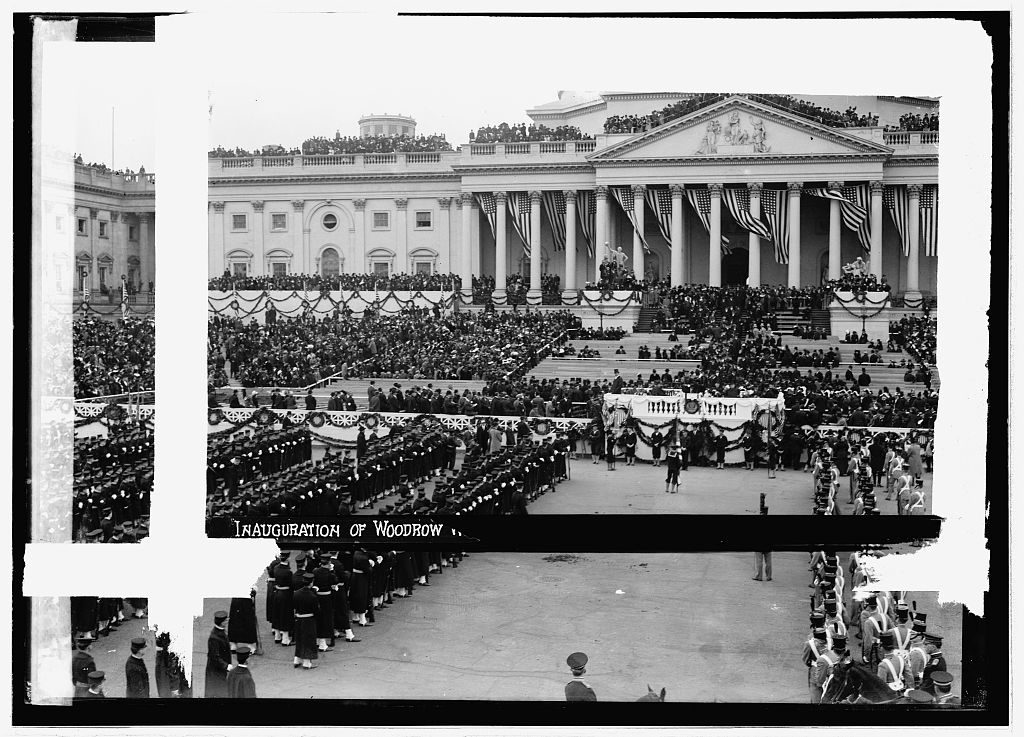
Woodrow Wilson did not have an inaugural ball. He thought one was unseemly for the solemn occasion, and he made it stick. The Library of Congress flags the cancellation as a one-off in the record, the first inaugural ball suspended since 1853. The rooms that would have been crowded on the night of March 4, 1913, were empty.
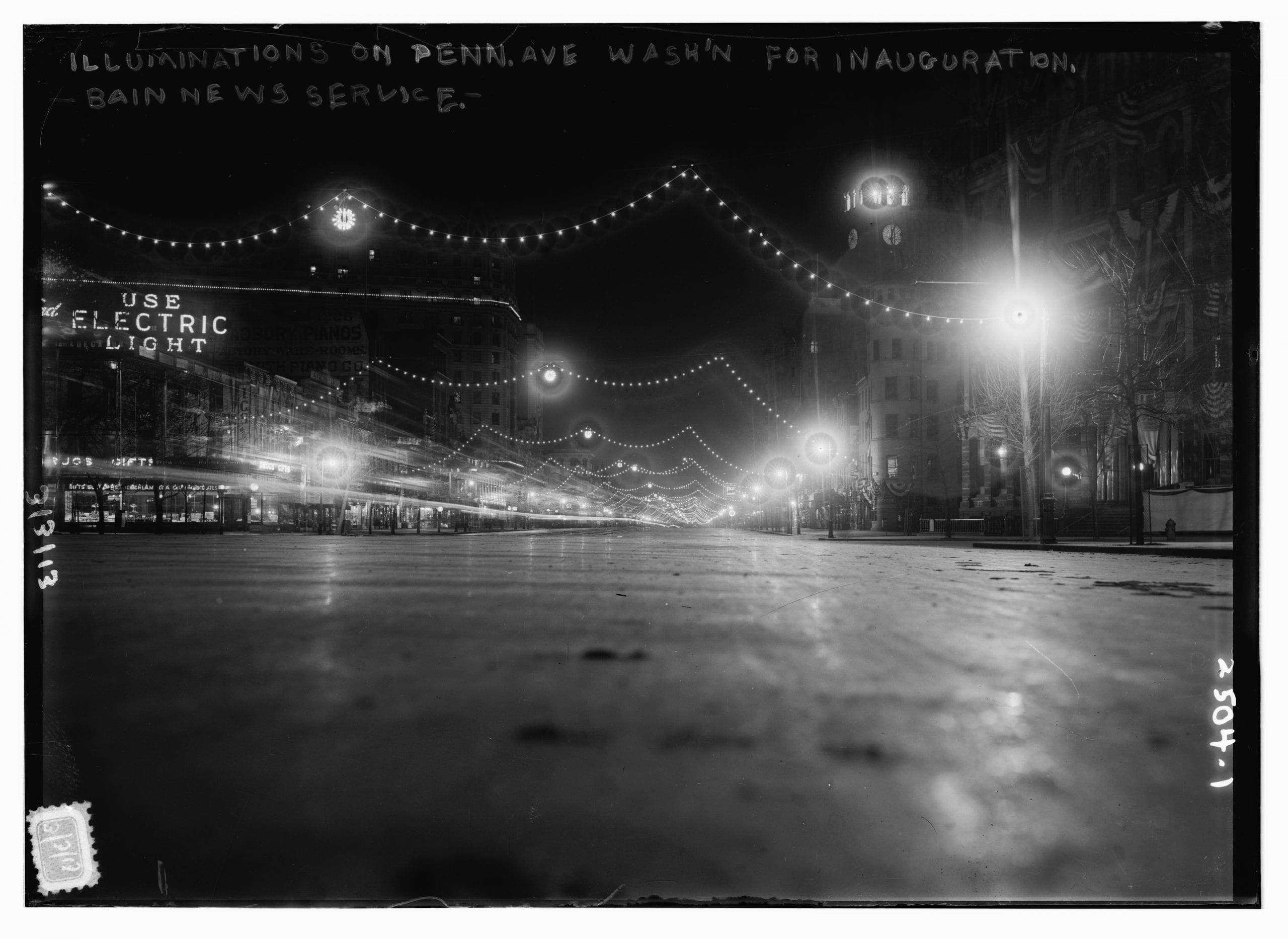
The Avenue was not. Pennsylvania Avenue had been lit up since Sunday night, was lit up the night of the inauguration itself, and would light up again on Wednesday for the visitors still in town. With no ball, the lit Avenue was the show.
What the Sunday-night warm-up looked like
The Evening Star sent a reporter out on Sunday, March 2, the night of the city’s dress rehearsal. The piece ran the next day on page 22 under the headline “Pennsylvania Avenue Brightly Illuminated, Inauguration Crowds Greeted by Blaze of Electricity for Many Squares.”
The lights went on at 6:30. They stayed on until midnight.
Roughly nine or ten thousand electric bulbs were strung across the roadway in festoons, with rosettes of red, white, and blue lights hanging from their centers, from the Peace Monument at the Capitol end of the Avenue all the way to 17th Street. As many incandescent lamps again were burning on the public buildings and stores on either side. The brightest stretch, by the Star‘s count, ran between 6th and 11th, through the heart of the parade route.
The Court of Honor
Directly opposite the White House, the inaugural committee had built a temporary architectural setting it called the Court of Honor. By night it was the centerpiece. Tall evergreens at the court were strung with colored electric lamps. “Magazines of electric lights” cast a bluish haze on the lower halves of the court’s statues. The Peace Monument at the foot of Capitol Hill had been rigged as a fountain: a strong jet of water played from the top, falling as colored spray under red, green, and yellow box lights.
From the roof of the Raleigh Hotel, a searchlight was trained on the Washington Monument. The Star liked the effect. The obelisk’s high apex caught the beam and, as the paper put it, “stood out against the dark night sky in solemn magnificence.”
A 3,000-bulb soldier on the Avenue
The set piece on the Avenue itself was an animated electric sign on the roof of the Central National Bank, at the northwest corner of Pennsylvania and 7th NW. The Potomac Electric Power Company had built it, and the Star described it in the days leading up to the inauguration. Thirty-five feet tall, forty-two feet long. Four figures of soldiers performing the manual of arms, running through parade rest, order arms, carry arms, present arms, and shoulder arms. The soldiers then vanished and the sign spelled out a tagline for the Potomac Electric Power Company. A Westinghouse motor flasher, built to a custom design, drove the motion. Over three thousand bulbs, said the Star, “in order to obtain the artistic and spectacular effects.”
March 4
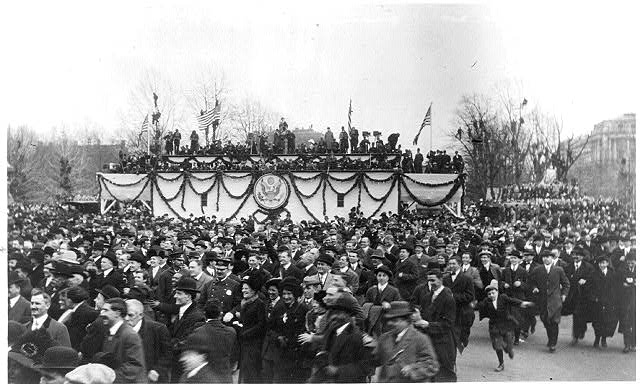
Wilson took the oath from Chief Justice Edward D. White on the east portico of the Capitol on March 4. The parade afterwards ran more than thirteen miles long, with over fifty thousand marchers under Major General Leonard Wood. By every account it was a daylight event.
The interesting hours were the ones after.
“Avenue illumination will continue tonight”
The morning after the inauguration, the Evening Star led page one with a headline running across two decks: “Wilson Pleased With Inaugural” over “Avenue Illumination Will Continue Tonight.” Secretary Tumulty spoke for the President at the White House. More than pleased. William Corcoran Eustis, the chairman of the inaugural committee, gave the credit for the whole production to his subcommittees.
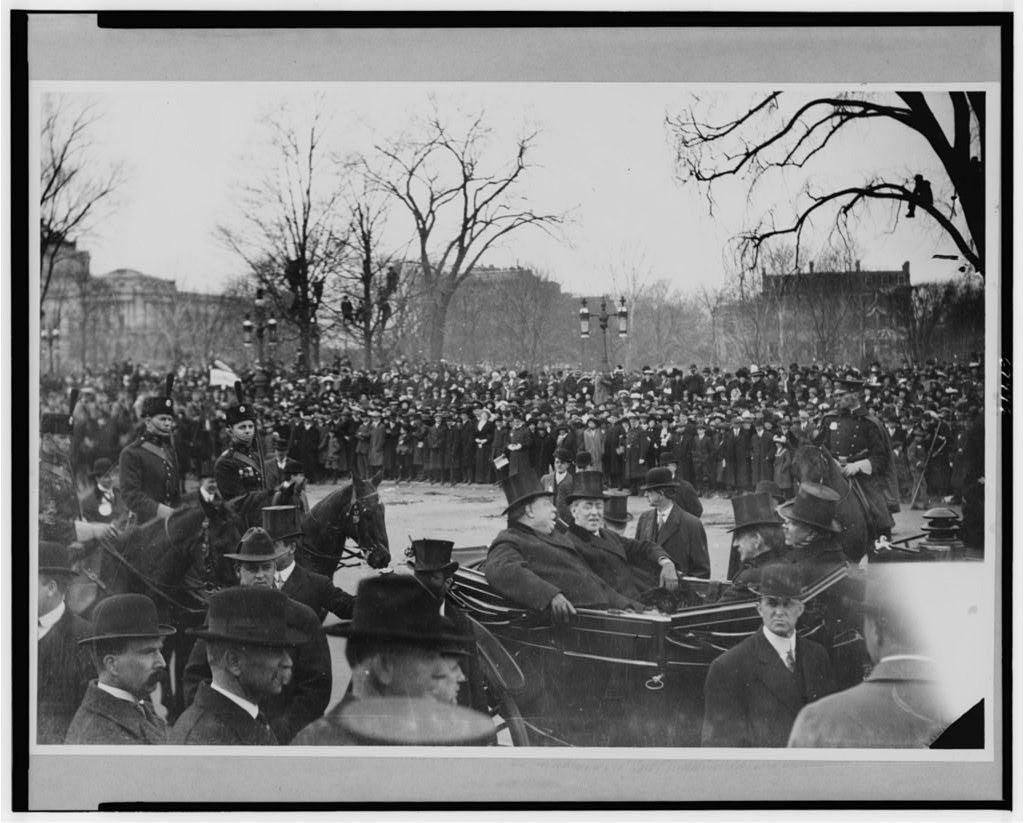
And then there was the practical business of taking it all down. The illumination would go on once more that night, Wednesday, for the inaugural visitors still in the city. A Thursday encore was on the table. William F. Gude, who had chaired the illumination committee, was conferring with Eustis about it. But the workmen had orders to begin dismantling the Court of Honor and the Lafayette Square stand at seven Thursday morning. By the time the lights would have come on again, there would be nothing left to light.
Oh, I just want to step right into that . . .
This is also the street that the Women Suffragettes marched on the day before the inauguration. The National Women’s Party (NWP) decided to hold the parade that day because it was the same day Wilson came to Washington. The NWP wanted to pull the attention from Wilson’s arrival to the issue of women having the vote. They succeeded because most of the people who would attended his arrival were at the parade instead.