
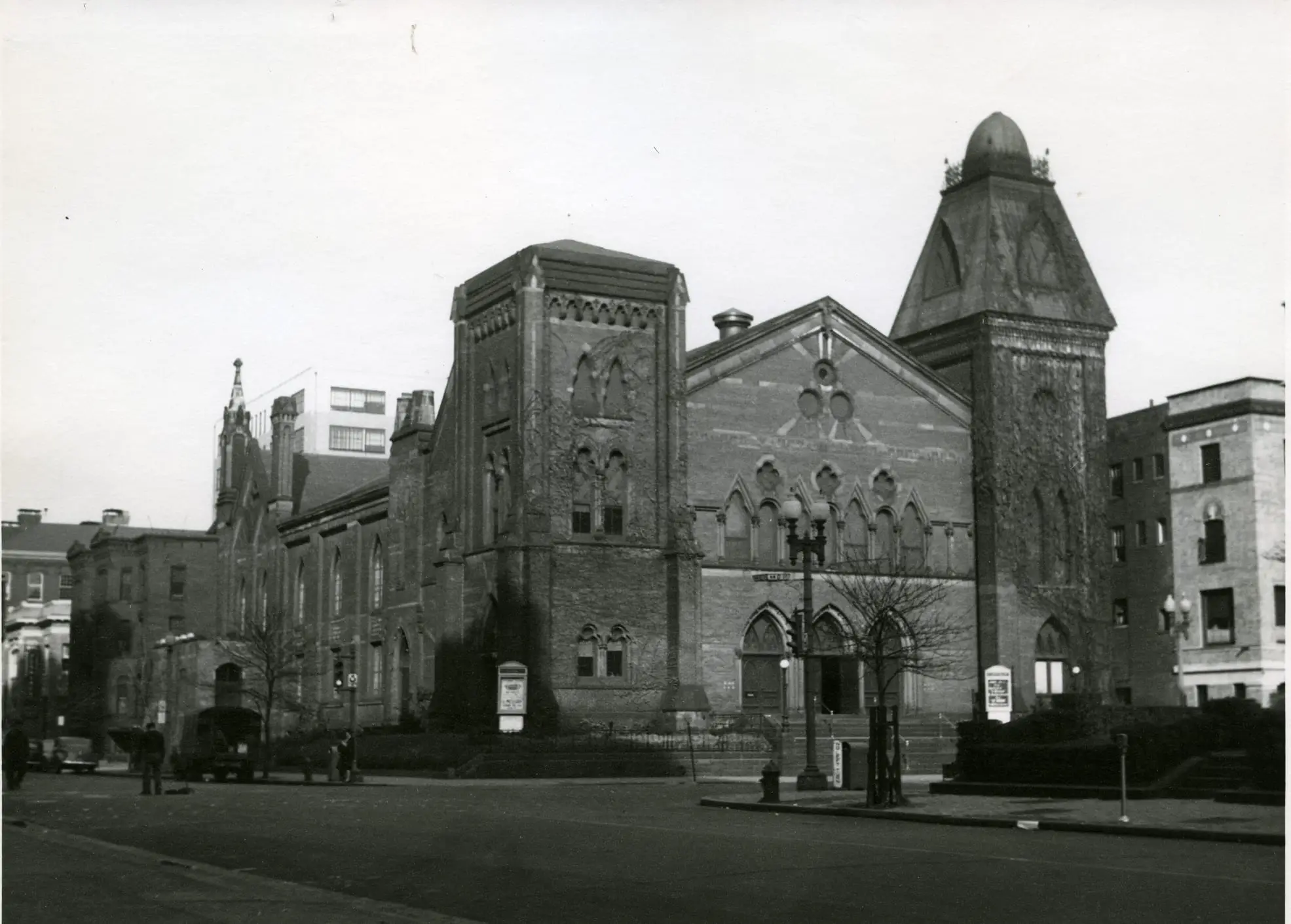
This is the First Congregational Church, photographed at 10th and G Streets NW in 1946. Twin asymmetric towers, a rose window in the gable, ivy climbing the brick. Thirteen more years and it will be gone.
The congregation that built it had been in Washington just three years when they laid the cornerstone in 1866. They were abolitionists in a southern city. They conceived what would become Howard University from these pews. Their architect, Henry Robinson Searle, designed both this church and the first buildings on the Howard campus a mile and a half north.
Then in the summer of 1959, wreckers took it down.
A Northern Church in a Southern City
Washington in 1861 had fifty-six churches and 90,000 people. About 2,000 of them were federal employees. Two earlier attempts to plant a Congregational church in the District had failed “because of local antagonism,” as the church’s centennial historian Everett O. Alldredge put it. Congregationalism was identified with New England, and New England was identified with abolition. In a city that still ran a slave market within living memory, that was not a selling point.
The Civil War changed the math. By 1865 Washington had 150,000 residents and 6,000 federal employees, many of them northerners who had come with Abraham Lincoln and stayed for the war. On September 17, 1865, the Rev. Charles B. Boynton, a recently hired Naval Academy historian with ties to the Vine Street Congregational Church of Cincinnati, preached the first worship service of what would become the First Congregational Society at a small Unitarian church at 6th and D.
Two months later, on November 15, 1865, one hundred and four persons were formally recognized as a Congregational Church by a convened council.
One of the first things they did was send a committee to the White House. On October 23, eighteen members visited President Andrew Johnson and presented a resolution asking him to proclaim a day of national thanksgiving “for the suppression of the rebellion, the destruction of slavery, and the restoration of peace within all our borders.” Johnson proclaimed it.
Architect Searle Gets the Job
The Building Committee was organized in February 1866. It had seven members, all with engineering or construction experience. Only two architects submitted plans.
The Committee chose Henry Robinson Searle, a Vermont-born, Rochester-trained architect who had arrived in Washington that same year. Searle was 30 years old. His design featured a large gallery carried without internal pillars, so that every seat in the auditorium had an unobstructed view of the platform. The main body was 80 by 143 feet on the outside. The main auditorium measured 76 by 90 feet and rose 33 feet to the ceiling. Two towers flanked the G Street front. The whole thing was to be done in plain brick with light stone trim.
Excavation began June 23, 1866. On October 4, the cornerstone was laid with Major General Oliver O. Howard giving the main address. Howard was the Freedmen’s Bureau Commissioner, a West Point graduate who had lost his right arm at Fair Oaks, and a founding member of the congregation.
Then, on July 2, 1867, at three in the morning, a tornado blew down the west wall. Rebuilding cost $3,000.
The original estimate for the building, including an organ, tower spire, a great bell, and various embellishments, was $90,775. When the contractor turned the building over on May 12, 1868, the bill had reached $103,182. The organ, the tower spire, the bell, and most of the embellishments had been deferred. Strip those $16,000 in deferred items out, and what started as a $74,775 estimate came in at $103,182.
That’s an overrun of nearly 40 percent, with less to show for it than promised.
The House Chamber Becomes a Sanctuary
While the church was under construction, the congregation needed somewhere big enough to worship. Schuyler Colfax, Speaker of the House, gave them the run of the House of Representatives chamber on Sundays.
From December 8, 1867 through May 5, 1868, Dr. Boynton preached in the House. The centennial history claims an audience of nearly 2,000 every Sunday and calls it “the largest Protestant Sabbath audience then in the United States.”
The first service in the new 10th and G building was held Sunday, May 5, 1868. Architect Searle, the centennial history notes, “was greatly flattered by the number of other architects who came from other cities in the following weeks to see the lighting and ventilating system, to check on acoustics, and admire the gallery.”
The Church That Launched a University
The founding generation of First Congregational did not think small.
At an early church meeting, the Rev. Benjamin F. Morris reported on an examination he had sat in on that same day: half a dozen Black men studying theology at something called the “Wayland Institute,” taught by a single teacher. Morris said he was astonished by how much they had accomplished with so little. He thought they deserved better.
The idea that started there, in the rented rooms of a congregation that didn’t yet have its own building, became Senate Bill 253 of the 39th Congress. Senator Samuel Pomeroy of Kansas introduced it on April 6, 1866. Senator Morrill of Maine reported it out of committee on May 2. President Andrew Johnson signed it into law on January 31, 1867. The bill created a university. Its trustees included General O. O. Howard, for whom it was named.
Searle, the architect of First Congregational, was retained to design the first buildings at Howard University. The church and the school rose together through 1867 and 1868.
A Black and White Congregation in a Segregated City
From the first day, the First Congregational covenant committed to Black and white membership on equal terms. In a city that was still, in every practical sense, a Southern city, this was not abstract.
Howard himself, in the summer of 1867, enrolled a group of Black children, most of them from the immediate neighborhood, in the Sunday School. Dr. Boynton, the pastor, cut his vacation short and came back to Washington to argue with Howard about it. The compromise: children already enrolled could stay; no new ones. Howard would shortly be soliciting First Congregational funds from churches where he spoke about the Freedmen’s Bureau, stressing, in the Alldredge history’s phrase, “the fact that in First Church there would be no distinction of race.” Boynton didn’t last. Howard did.
The Rev. Jeremiah Rankin, who arrived in 1869, was more comfortable with an integrated congregation. Later, he remembered:
Frederick Douglass was often here; B. K. Bruce and John M. Langston, Professors Mitchell and Gregory with their families, were regular attendants.
B. K. Bruce was the second Black U.S. senator. John M. Langston was dean of Howard’s law school and the first Black congressman from Virginia. Frederick Douglass lived in Anacostia and spoke often from this platform. On one Forefathers’ Day, according to Rankin, the speakers included Senator Patterson of New Hampshire, Judge Poland of Vermont, Senator Pomeroy of Kansas, and Douglass, “Senator at large.”
Douglass used the occasion to talk about “his Pilgrim Fathers, who landed in Virginia.” Rankin’s reminiscence notes dryly that “so we got, not only the lights but the shadows of the occasion.”
A Sunday Evening in 1939
The Bert Sheldon 1946 photograph shows a church near the end of its long middle period. Dr. Howard Stone Anderson had been pastor since October 1936. The building’s structural problems were already documented: a Secret Service colonel and the D.C. Engineer Commissioner had reported in 1924 that the unsupported balcony was weakening under the weight of the audiences Dr. Jason Noble Pierce had been drawing. Nothing had been done.
Seven years before Sheldon made his 1946 photograph, a Farm Security Administration photographer had stopped at the same church and taken this:
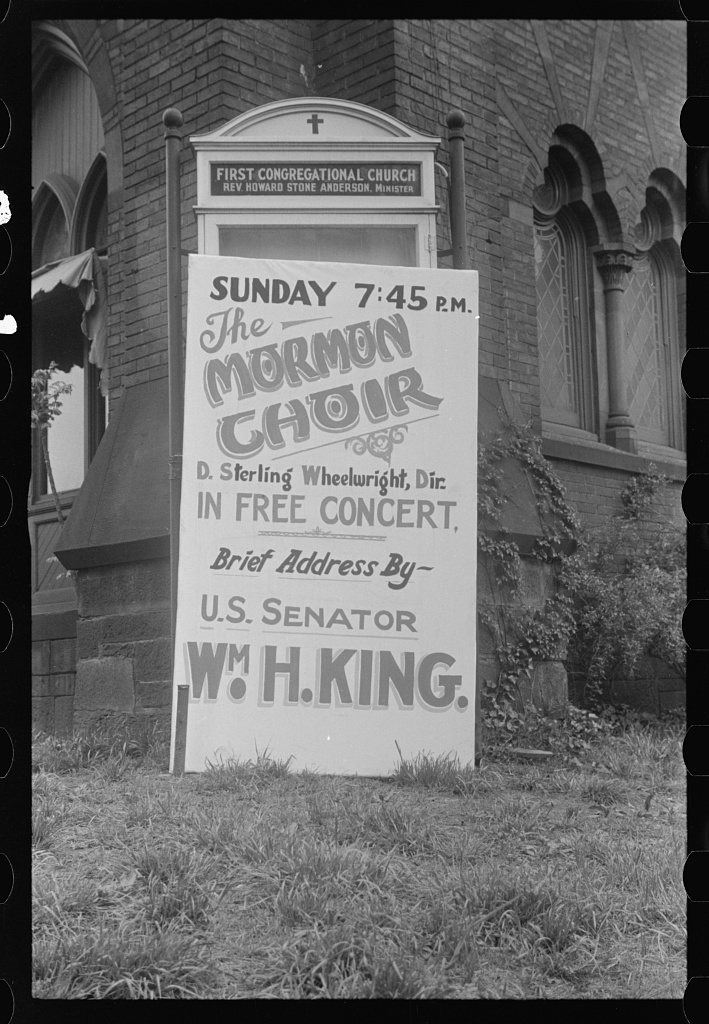
The hand-painted sandwich sign advertises a free Sunday evening concert by “THE MORMON CHOIR, D. Sterling Wheelwright, Dir.” and a brief address by “U.S. Senator Wm. H. King.” King was a four-term Utah Democrat, and through the Gothic tracery in the background you can just make out the 1868 stonework.
First Congregational in the 1930s was hosting Senate addresses and Mormon choirs on Sunday evenings. That is the kind of church it had always been: a downtown pulpit with a national reach, pulling in whoever was interesting and letting them talk.
Milestone Sunday
By the mid-1950s the building was beyond repair. The Board of Trustees recommended selling the property and moving the congregation to a suburb, which was what most inner-city churches of the period were doing. The membership voted them down.
The final services in the 1868 building were held Sunday, June 28, 1959. The centennial history, written six years later, calls it “Milestone Sunday.” The music was magnificent. The ceremony was moving. Wreckers arrived that summer. Ground-breaking for a new building on the same lot took place on Sunday, September 13, 1959.
That 1961 replacement would itself be torn down in the early 2000s, and the current mixed-use church by Tod Williams Billie Tsien Architects opened on the corner in January 2012, carrying the congregation into its third building on a single downtown lot.
Three buildings, one corner. The abolitionist founders who talked President Andrew Johnson into a Thanksgiving proclamation, pitched Congress on what became Howard University, and filled the House of Representatives chamber with 2,000 worshippers on Sunday mornings would probably be pleased that their descendants rebuilt twice rather than leaving for Bethesda.
The Searle church in the 1946 photograph is the one that connects the founding to the present. It stood through the Reconstruction, the Jim Crow decades, two world wars, and the beginning of the civil rights era. Frederick Douglass sat in its pews. B. K. Bruce and John M. Langston sat in its pews. Then the timbers started to give, and the congregation chose to stay anyway.
You can see the corner today from the Metro Center platform. The building has changed three times. The address hasn’t moved.