
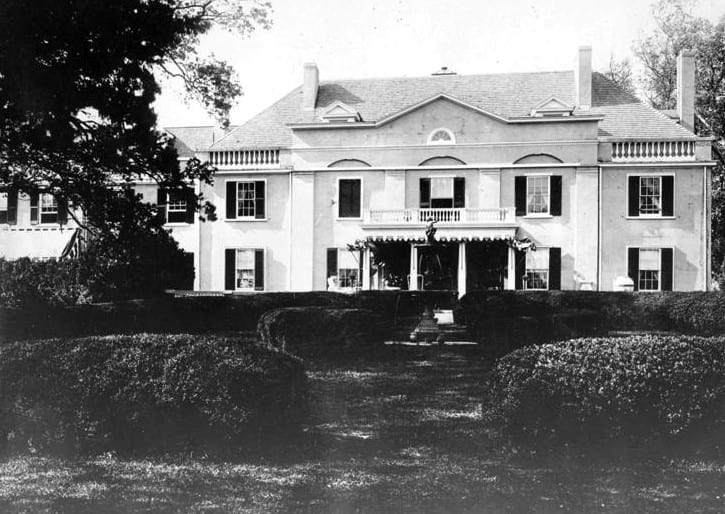
For four decades, the most famous cursed gemstone in America lived on a hilltop above Wisconsin Avenue NW. Evalyn Walsh McLean kept the Hope Diamond at Friendship, the McLean family estate north of Glover Park, and by the often-repeated society stories about her she was happy to put it on her Great Dane’s collar to entertain guests.
The estate covered 75 acres. It had an 18-hole golf course, a cast iron swimming pool, tennis courts, stables, and Italian gardens. President Warren Harding was a frequent guest.
By the end of 1942, all of it was gone.
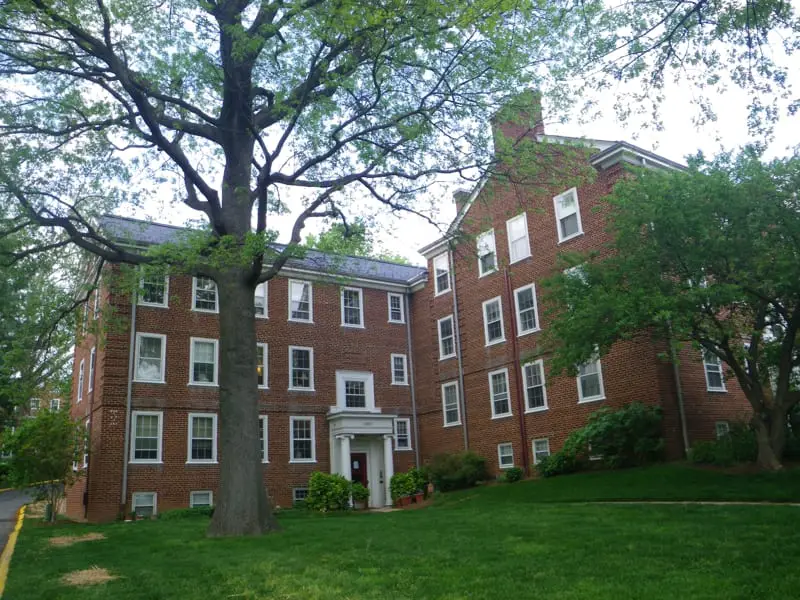
In its place rose McLean Gardens: 31 red brick apartment buildings, 9 dormitories, an administration block, and a multi-purpose Commons. Federal housing for 3,500 wartime workers who had nowhere else to live.
The Friendship mansion was demolished. The golf course was paved over. The Hope Diamond moved downtown.
Today that same 43 acres on Wisconsin Avenue is a condominium community, anchored by a Target store at the south end and the surviving 31 apartment buildings to the north. The arc from Gilded Age mansion to wartime barracks to middle-class condos sits on one piece of ground, and the layers are still visible if you look.
The McLean estate: Friendship on Wisconsin Avenue
John Roll McLean (1848-1916) was a Cincinnati newspaperman who got rich and got richer. His father, Washington McLean, owned and published the Cincinnati Enquirer until his death in 1890. John inherited the Enquirer and in 1905 bought a controlling interest in the Washington Post. He had also been a part owner of the Cincinnati Reds.
In 1898, John McLean purchased 75 acres above Wisconsin Avenue, then called Tenleytown Road, to build a summer retreat away from the heat of downtown. He commissioned architect John Russell Pope, the same architect who would later design the Jefferson Memorial, to design a Georgian revival house named “Friendship.”
His neighbors on this stretch of upper Northwest included Charles Glover (whose name still marks Glover Park just down the hill) and brewer Christian Heurich.
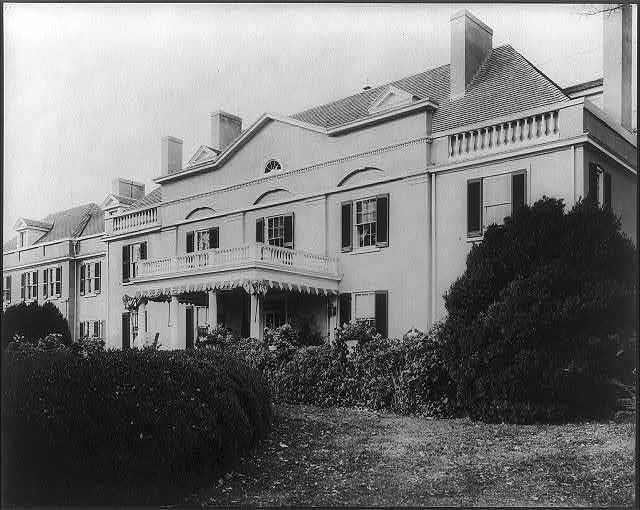
The estate eventually included an 18-hole golf course with sod imported from Switzerland, a cast iron swimming pool, tennis courts, stables, and Italian gardens. Frances Benjamin Johnston photographed the place for the McLeans; her images are now at the Library of Congress.
When John McLean died in 1916, the estate passed to his son Edward, called Ned, and Ned’s wife Evalyn Walsh McLean. Evalyn was the daughter of Thomas Walsh, the Colorado mining magnate who had discovered the Camp Bird Mine. The Walsh-McLean union joined two of the largest fortunes in Washington.

It was Evalyn who put Friendship into newspaper society columns. She had bought the Star of the East, a roughly 95-carat pear-shaped diamond, in 1908, and in 1911 she paid Pierre Cartier for the 45½-carat blue diamond known as the Hope. The Hope price she recalled in her 1936 memoir as $154,000; Cartier records show $180,000. She wore it constantly.
Her best friend was First Lady Florence Harding. When Florence’s husband died in office in 1923, Evalyn was at her side.
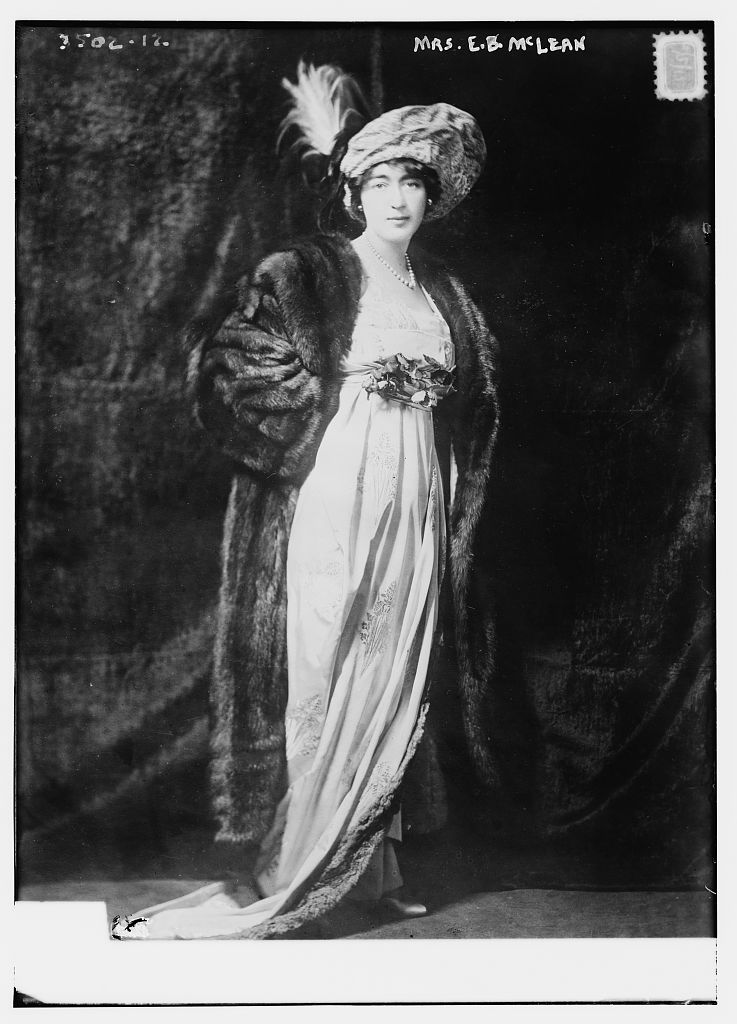
The McLeans were extravagant in a way that defined the 1920s and then could not survive the 1930s. Ned slid into alcoholism and was declared insane. Evalyn lost two of her four children. By 1933 she had also lost the Washington Post, sold at auction to Eugene Meyer.
Ned died in 1941. Under John McLean’s trust, Friendship did not pass to Evalyn. It passed to a federal buyer at exactly the moment the federal government needed land.
Defense Homes Corporation buys the property
The trust sold Friendship to Defense Homes Corporation in 1941 for $1 million.
Defense Homes was a federally chartered company set up to build housing for the war workers flooding Washington. The District’s population had jumped by hundreds of thousands as War, Navy, and the new federal agencies hired clerks and analysts. Most of the new workers were women, recruited out of small towns into government jobs at salaries that did not stretch to a Northwest rowhouse.
The Friendship mansion came down in 1942. So did the golf course.
But the construction crews preserved what they could of the old estate. The stone wall along Wisconsin Avenue stayed. So did statuary that had been used in the front fountain. Several thousand rose bushes, miles of box hedges, and dozens of magnolia trees were dug up, held aside, and replanted around the new apartment buildings after construction.
Forty-one buildings went up in 1942 and 1943. The roster: 31 apartment buildings, 9 dormitory buildings, 1 administration building.
Inside the apartment blocks were 720 units: 85 efficiencies, 397 one-bedrooms, and 238 two-bedrooms. The dormitories held 1,184 rooms, 1,025 singles and 159 doubles. Total capacity around 3,500 residents.
The choice to build garden apartments rather than barracks was deliberate. Defense Homes wanted these workers to stay put, and that meant living rooms, kitchens, dining rooms, and four closets per one-bedroom apartment, not bunks.
Red brick. Hipped roofs. Slate-roofed Commons buildings clustered as a town center. Even with wartime rationing, the builders sourced quality materials and appliances.
The residence halls were named for army bases: Aberdeen, Benning, Chanute, Devens, Eustis, Frankford, Gadsden, Hancock, Jefferson.
Efficiency apartments rented for $60 a month. One-bedrooms went for $72.50. Two-bedrooms ran $85. A single dorm room cost $8 a week.
“Middletown, U.S.A.”
The waiting list was brutal. A board reviewed every application.
Tenants had to be doing war work. They could not have lived in Washington for more than a year. No more than 20 percent of residents could work for any single federal agency. To qualify for a dorm room, your income had to fall below $2,600 a year.
Applicants wrote heartrending letters. The Washington Post covered McLean Gardens as a phenomenon. The August 15, 1943 Post called it “Middletown, U.S.A.”:
Middletown, U.S.A., has gone big time. Such is McLean Gardens, aristocrat of all war housing developments, ten million dollars worth of city-within-a-city just off Wisconsin Avenue, N.W. The folks back in Evanston and El Paso wouldn’t believe it if they had heard that Johnny and his wife were living in a small town right in the Nation’s Capital. But to 3,500 people installed in territory that was once among Washington’s swankiest estates, McLean Gardens is precisely that, and more.
One Army captain quoted in the same piece summed it up: “I just have one regret about this place. I’m being transferred next week, and I can’t take McLean Gardens with me.”
The Commons building had a cafeteria, a beauty parlor, and a community hall that hosted dances, card parties, movies, and tenant meetings. In 1943 a day nursery opened for the working mothers, staffed by volunteers from American Women’s Services. There was one telephone for every 40 to 50 apartments until July 1946, when residents finally got their own lines.
From defense housing to middle-class apartments
Private interests took over in 1948. McLean Gardens never lost its tenants. As Washington shed its overnight wartime population and slid back into a normal federal capital, the apartments kept filling with the same kind of people: government clerks, junior officers, schoolteachers, students. The dorms eventually went to single professionals.
A balanced mix took shape over the next two decades. Families, retirees, students, single working women, a few diplomats. The 43-acre property worked as a self-contained community in a way that almost nothing else in DC did.
Rent was affordable. The buildings, designed for war, turned out to age into middle-class apartments without much difficulty.
The same wartime pressure that produced McLean Gardens reshaped the rest of the region. In 1942 the District began renaming Conduit Road MacArthur Boulevard.
By the late 1960s the boilers, electrical systems, and roofs at McLean Gardens were aging out. The buildings were 25 years old, originally designed as temporary housing. The owners started thinking about the land underneath them rather than the buildings on top.
The embassy plan, the demolition, and the tenant fight
CBI-Fairmac Corp. bought McLean Gardens in 1972. The Chicago-based developer had already converted Fairlington Villages in Arlington and saw the Wisconsin Avenue site the same way.
The first move was demolition. The 9 dormitory buildings along the Wisconsin Avenue frontage came down in 1974 and 1975. Only the Commons was spared. The plan was to clear the site for redevelopment, and the dorms had the worst plumbing and the most exposure to traffic noise.
Then in August 1975, CBI-Fairmac went public with the redevelopment plan. The Washington Post covered it on August 6:
The owners of McLean Gardens announced plans yesterday to demolish the 723-unit moderate-income housing complex in Northwest Washington and replace it with an elaborate $150 million diplomatic enclave of embassies, chanceries, apartments, shops and international boutiques.
The math, as outlined by CBI-Fairmac’s attorney R. Robert Linowes: foreign governments would spend $100 million on their embassies, and CBI-Fairmac would put up $50 million for 650 to 700 units of upper-income housing. The moderate-rent tenants would be cleared out.
The proposal landed badly. Residents had already watched the dormitories fall and were not interested in losing the rest. Cleveland Park and the surrounding neighborhoods opposed the embassy enclave on planning grounds. The plan stalled.
CBI-Fairmac shifted tactics. In 1978 the company put the entire complex up for sale and notified tenants the rental era was over. California builder Dwight W. Mize signed a contract to buy the place for $30 million and convert the 723 units to $45,000-to-$75,000 condominiums.
The timing was exquisite. The DC Council had just passed the Rental Housing Conversion and Sale Act, giving tenant associations the right of first refusal on any building sold for conversion. The McLean Gardens Residents Association invoked it. Within three months the residents had assembled financing, the Arthur Rubloff Company of Chicago, and Continental Bank of Illinois, and signed their own contract.
The two contracts went to court. The settlement, hammered out in an all-night negotiating session between attorneys for Mize and the tenants, ran 18 pages. The tenants would pay Mize $2.25 million to walk away. They closed on the property in September 1979 for what was, at the time, the largest tenant-led buyout in Washington history.
The condo conversion began in 1980. The Partnership renovated the apartments and started selling units, and the first phase moved fast.
The second phase opened into a collapsing real estate market and climbing interest rates. By mid-1982 Continental Bank brought in Stein & Company of Chicago to finish the job. New landscaping, a swimming pool, a bathhouse.
The original 31 apartment buildings became the McLean Gardens Condominium. They are still standing.
What McLean Gardens looks like today
Walk along Wisconsin Avenue between Porter Street and Rodman Street and the stone wall John McLean built in 1898 is still there, the same one Defense Homes left in place when it tore down the mansion. Some of the original Friendship statuary survives in the front fountain. The magnolias replanted in 1943 are now 80 years old.
The 31 red brick buildings are the same buildings the war workers moved into in 1943. Inside, the floor plans are mostly intact: a living room, a bedroom, a kitchen, four closets. The Commons survives as a community center. The original dormitory frontage on Wisconsin Avenue is gone, replaced in the 1980s and after by a Target, a parking lot, and the rental section called Vaughan Place.
The Hope Diamond moved on. Harry Winston bought Evalyn’s entire jewelry collection in 1949, in a court-ordered estate sale to pay off her debts. Winston donated the Hope to the Smithsonian in 1958. It is on display there now, three Metro stops from where it used to sit on the McLean dining room table.
The McLeans’ other Washington address, the Walsh-McLean mansion on Massachusetts Avenue built by Evalyn’s father, still stands as the embassy of Indonesia.
Friendship is harder to see. But it is still there, under the brick.
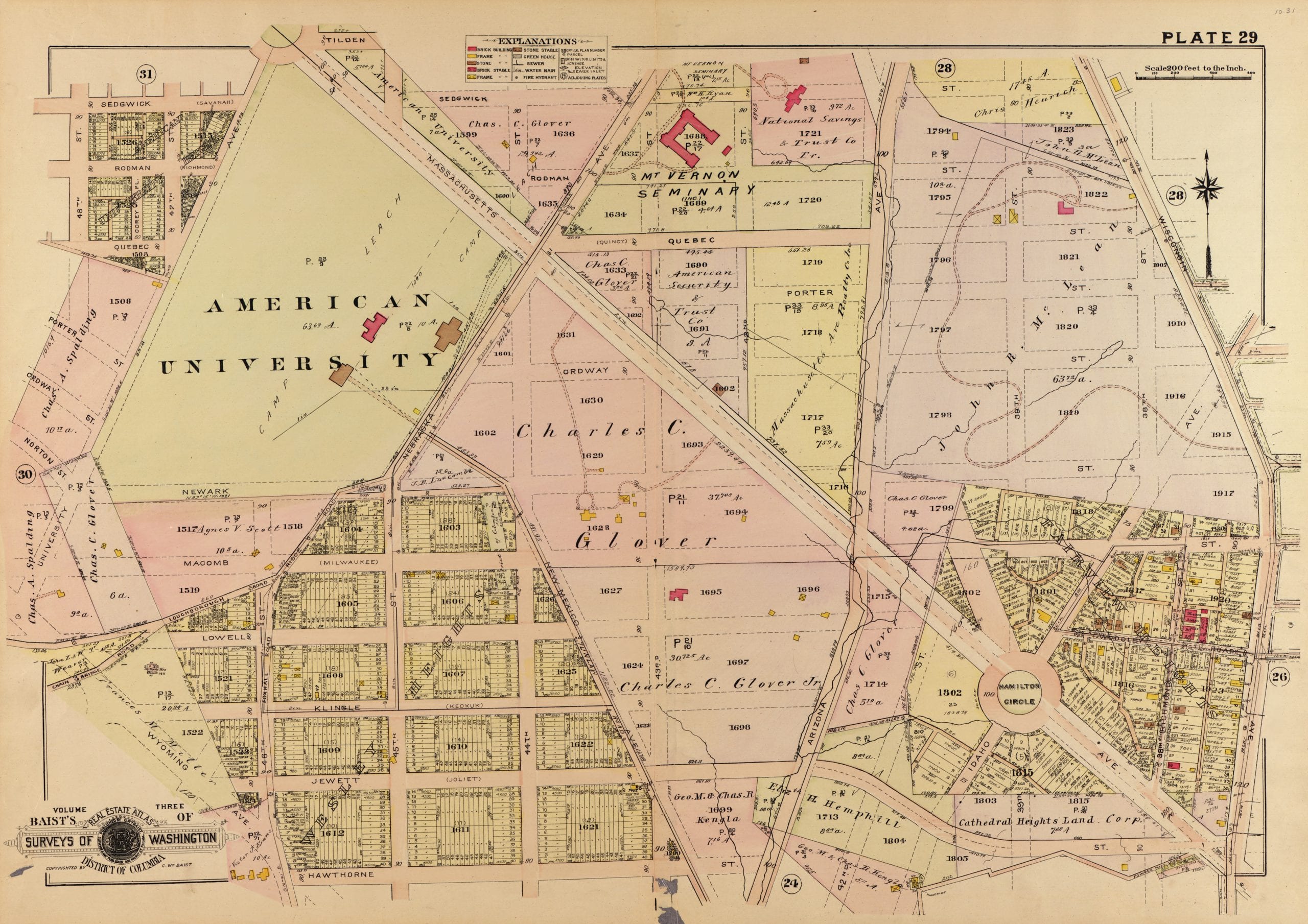
The map shows the nonexistent Hamilton Circle at the intersection of Mass. and Idaho Avenues.
Tom, another great map and photos. I am especially intrigued by 1) Hamilton Circle, which appears to be in existence on the map but is not there today, and 2) Arizona Avenue – also not even close to the map location today?!
Great question … sounds like something for me to look into
The origin of “Friendship” as the name for the McLean property and a much larger area goes back to the early 1700s. A 3,000+ acre holding was granted to Colonel Thomas Addison and James Stoddert. The property extended from, roughly, Georgetown to Tenleytown. Addison and Stoddert named it “Friendship” in honor of their friendship. The name survives in the “Friendship Heights” neighborhood north of Tenleytown.