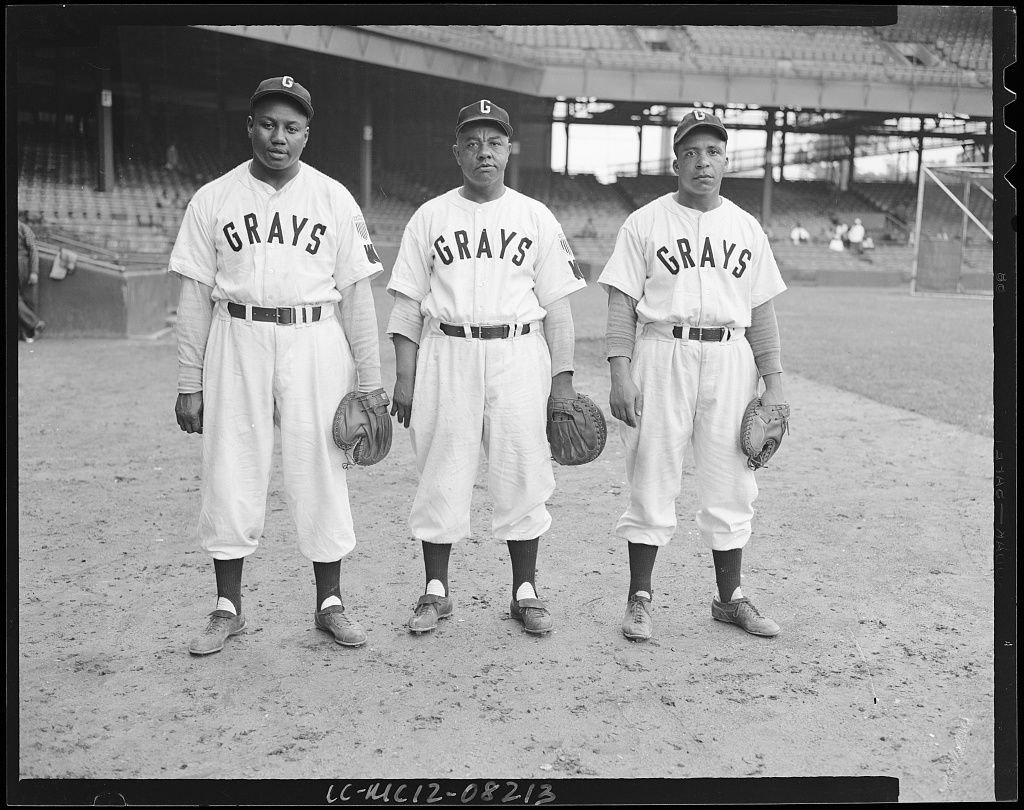
On January 9, 1947, a Washington photojournalist named Robert H. McNeill walked out to Griffith Stadium and took a photograph of Josh Gibson standing on the field. Gibson is in his Washington Homestead Grays uniform, arms at his sides, looking straight into the camera. He is 35 years old.
Eleven days later, he was dead.
The cause was cerebral apoplexy, what we’d call a stroke today. The contributing cause was bronchitis. He died at home in Pittsburgh in the early hours of January 20, 1947. His 16-year-old twins, Helen and Josh Jr., were still in school at Schenley High School. He was 35 years old.
The Library of Congress holds McNeill’s photographs now, donated as part of the Robert H. McNeill Family Collection. McNeill spent decades documenting African American life in Washington and he was there, camera in hand, for some of the last images ever taken of Josh Gibson. You can view and download them at loc.gov, free to use, no restrictions.
Here is the number you need to understand about Josh Gibson in Washington.
In 1943, Gibson played a stretch of games at Griffith Stadium and hit 14 home runs. That same season, the entire Washington Senators lineup hit 21 home runs at Griffith Stadium all year.
The Senators were a major league franchise. They played in the ballpark named for their owner, Clark Griffith. Josh Gibson was locked out of their league by the color line.
One man, hitting against opposing Negro League pitching, came within seven home runs of matching what an entire American League roster produced in a full season at their own park.
Joe Bostic of the New York Amsterdam News put it plainly in his obituary for Gibson, published January 25, 1947. The headline read: “DON’T PITCH TO GIBSON IN A PINCH.” Bostic had watched Gibson play at Griffith Stadium for years. He knew what he’d seen.
Gibson was born on December 21, 1911, in Buena Vista, Georgia. He joined the Homestead Grays in 1930 at 18 years old. By the time he was in his late 20s, he was regarded across both the Negro Leagues and the mainstream baseball press as the finest catcher alive.
People called him “the Black Babe Ruth.” That framing is worth pushing back on. Ruth was a great player. But calling Gibson a version of someone else implies he was derivative, when the reality ran the other direction. The Pittsburgh Courier, in a 1957 retrospective, put his lifetime batting average at .347. He hit .393 in 1945. He batted .331 in 1946, his final season, and led the Negro National League in home runs both years.
Those are not the numbers of a comparison. Those are the numbers of an argument.
The Washington Homestead Grays were, by the early 1940s, Washington’s team in everything but official record.
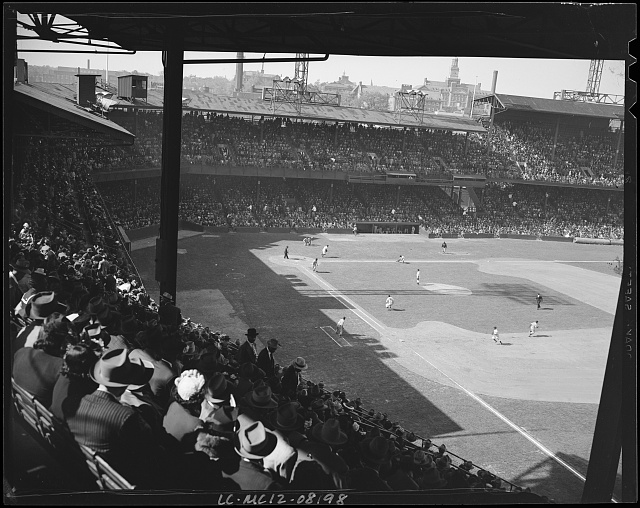
The Grays had split their home schedule between Pittsburgh and Washington since the late 1930s. Clark Griffith invited them to use Griffith Stadium when the Senators were on the road. This was good business for Griffith. The Grays drew enormous crowds from Washington’s Black community, crowds that sometimes matched or exceeded the Senators’ attendance figures. Griffith liked the gate receipts.
He also liked Josh Gibson. Bostic’s Amsterdam News obituary records that Griffith invited Gibson to his office, praised his abilities, and marveled at what he did at the plate. The stadium at Georgia Avenue and W Street NW was, in every practical sense, Gibson’s home ballpark.
Washington’s Black residents claimed the Grays as their own. The Afro-American covered every game. Fans turned out on summer nights to watch them play. And Gibson, hitting home runs off the left field wall and onto Georgia Avenue, was the reason.
Griffith praised him. He did not sign him.
Jackie Robinson took the field for the Brooklyn Dodgers on April 15, 1947. The color barrier in Major League Baseball fell that spring. Josh Gibson died on January 20, 1947. He missed it by 85 days.
The Washington Post ran the news the following day. The headline: “Josh Gibson, Star Catcher of the Washington Homestead Grays, Dies.” Even in death, the paper called him Washington’s catcher. The city claimed him at the end with the same ease it had spent years denying him a spot on the Senators roster.
The final years were hard. In January 1943, Gibson was admitted to St. Francis Hospital in Pittsburgh after a mental breakdown. He was 31 years old and had been playing professional baseball since he was a teenager. The Pittsburgh Courier reported the hospitalization on January 9, 1943.
He recovered. He kept playing. But in June 1943, he was arrested and brought to Gallinger Municipal Hospital in Washington, D.C., after another episode. Gallinger served the District’s poorest residents for decades; it’s now Howard University Hospital, at 2041 Georgia Avenue NW. The Afro-American covered the incident.
He recovered from that too. He hit .393 in 1945. He led the league in home runs.
Whatever was happening in his mind during those years, it did not stop him from being the best player on the field. It just didn’t register in the box scores that major league scouts were reading.
He died on a Monday. Bostic’s Amsterdam News piece ran the following Saturday and devoted three full columns to what Gibson had been:
He could hit in the pinch. He could hit in the early innings. He could hit when the chips were down and when they weren’t. He was a natural. He was the perfect ballplayer.
The Pittsburgh Courier called him “Greatest Catcher in Baseball.” The Washington Post gave him two paragraphs in the sports section and called him Washington’s catcher.
Gibson was survived by his wife and his twins, Helen and Josh Jr., age 16, students at Schenley High School in Pittsburgh.
The Baseball Hall of Fame inducted Josh Gibson in 1972, one of the first Negro Leagues players honored. That was 25 years after his death.
Griffith Stadium stood at Georgia Avenue NW and W Street NW until it was demolished in 1965. Howard University Hospital now occupies the site. If you drive past it today, there is nothing on the building to tell you that Josh Gibson played here, that he hit home runs here that an entire American League roster spent a season trying to match.
The Washington Post told you what you need to know on January 21, 1947. They called him the star catcher of the Washington Homestead Grays.
Washington’s catcher. He just never got to be the Senators’.
Photos: Robert H. McNeill, January 9, 1947, Griffith Stadium, Washington, D.C. Library of Congress, Prints and Photographs Division, Robert H. McNeill Family Collection. No known restrictions on publication.
Some of our stories are researched and written with help from AI, and checked by a person before they run. Here’s how we use AI.