
Before he became the general who answered a Nazi surrender demand with a single word, Anthony McAuliffe was an Eastern High School kid.
Class of 1916. A boy from Washington who walked these Capitol Hill halls, then went off to West Point, and three decades later found himself surrounded at Bastogne in the worst winter of World War II. When the Germans sent a formal demand that he give up the town, McAuliffe wrote back one word: “Nuts!”
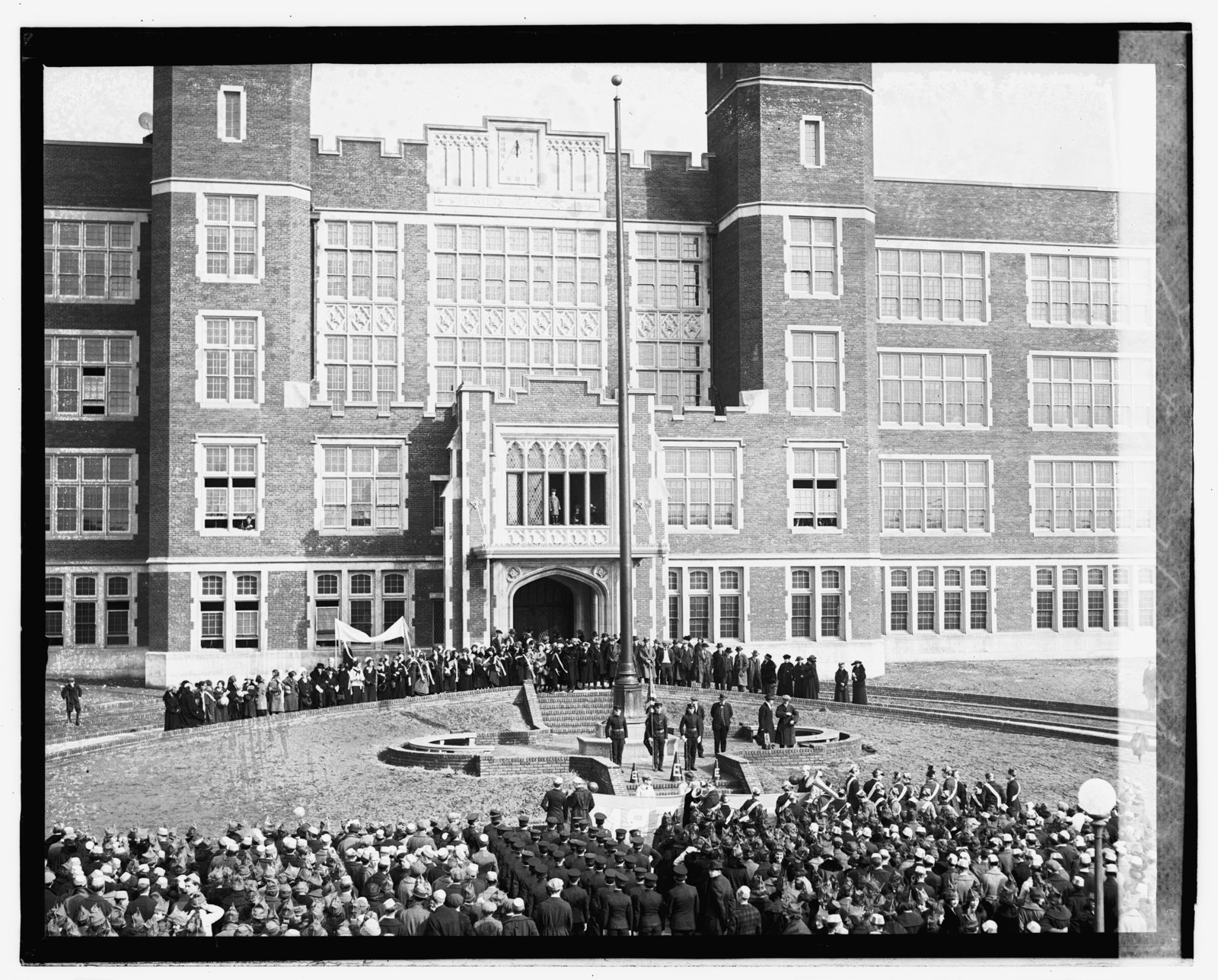
That is the kind of alumnus Eastern produces. And the building that turned out McAuliffe still stands at 1700 East Capitol Street NE, a red brick Gothic fortress that has anchored the eastern end of Capitol Hill for more than a century. Locals have called it “the Pride of Capitol Hill” for almost as long. Here is how it earned the name.
From a borrowed classroom to Eastern High
Eastern did not begin as the grand pile you see today. It started in 1890 as a high school for Capitol Hill, meeting at first inside the Peabody School, a building that already belonged to somebody else.
Within a couple of years it had its own name, Eastern High School, and settled into a building at 7th and C Streets SE. Its first class graduated in 1897.
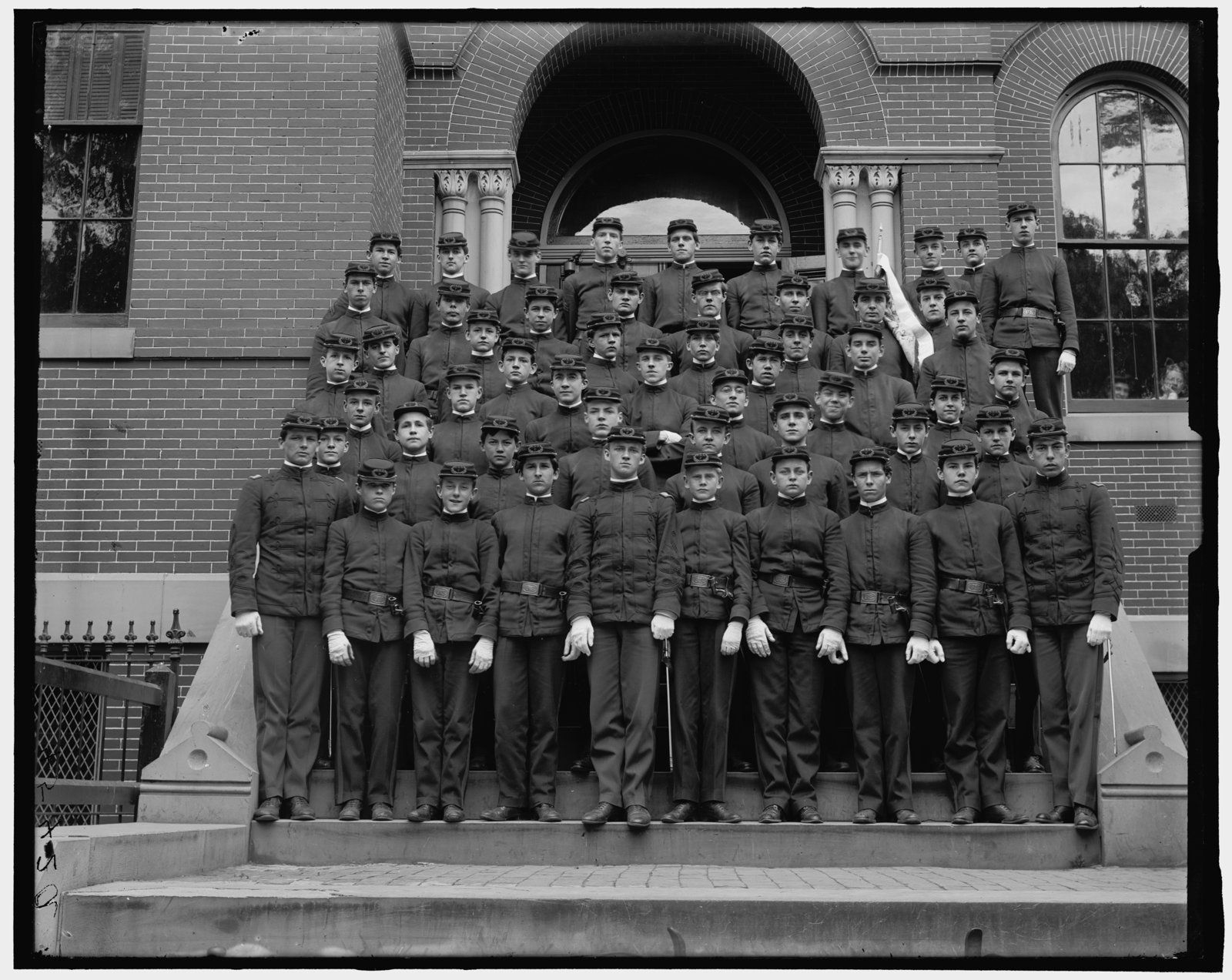
For the next thirty years, that 7th Street building was Eastern. The cadet corps drilled out front. The football and track teams made their names. Then the building started to come apart at the seams.
The fight to build a new Eastern
A federal Schoolhouse Commission studied the District’s schools around 1908 and singled out Eastern as a problem. The 7th Street building was running at double its intended enrollment and was poorly suited to high school work, the commission found. It should be replaced with something bigger, built further east as Capitol Hill kept growing that way.
Getting there took fifteen years. The city settled on the site at 17th and East Capitol, but America’s entry into World War I delayed the money and construction stalled.
When the new building finally took shape, it came with a brawl. “Plans Balk School,” ran a 1921 Washington Post headline. The next year the Evening Star followed with “Firetrap Charges Denied” and “Assails Eastern High Auditorium,” as critics went after the design and officials pushed back.
The arguing, as it turned out, produced something worth the trouble.
Snowden Ashford’s last Gothic gamble
The man who designed Eastern was Snowden Ashford, a native Washingtonian and the District’s first municipal architect. Ashford spent his career building public schools, and he had a weakness for the romantic styles, Collegiate Gothic and Elizabethan, the kind of architecture that made a city schoolhouse look like an Oxford college.
That weakness got him into fights. The Commission of Fine Arts wanted DC’s schools done in restrained Colonial Revival, which it felt better reflected the capital’s history. Ashford ignored them and kept building his Gothic piles anyway, including the original Dunbar High School, since demolished and replaced more than once in Dunbar’s long building saga.
Eastern was his last stand. He finished the designs in 1921 and resigned the same year, leaving his successor Albert L. Harris to oversee construction by the Charles H. Tompkins Company. When the doors opened in 1923, Eastern became the last public school in the District ever built in the Collegiate Gothic style.
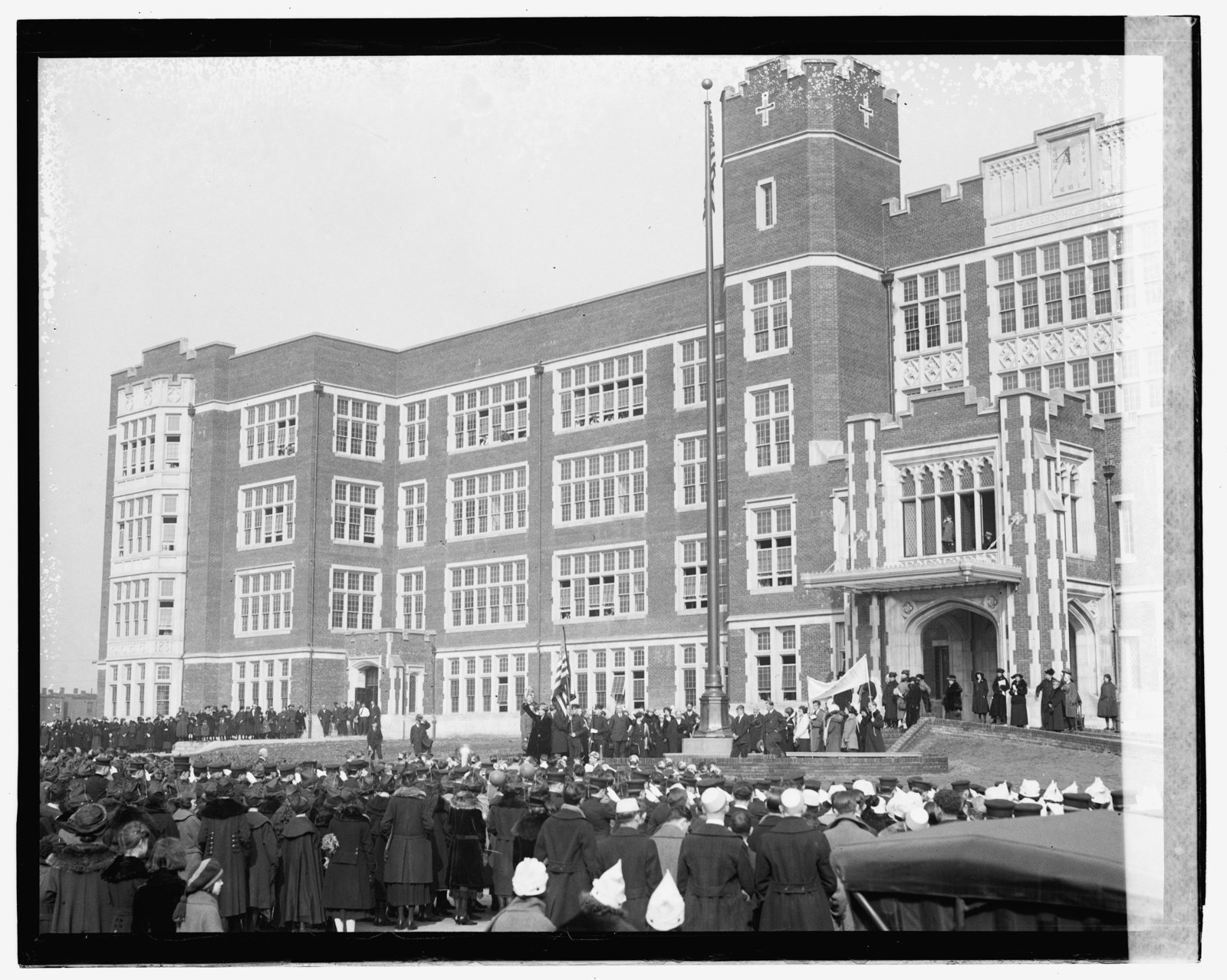
And what a building it is. Four stories of red brick and limestone in a sweeping five-part plan, with a turreted central pavilion, long window-banked wings, and a two-story porte-cochère framing a Tudor-arched front door. Above the entrance, a limestone panel holds a sundial marked 1923, flanked by two crenellated towers. The thing was built to impress fifteen-year-olds, and it did.
A palace for teenagers
Inside, the new Eastern was a marvel of what Progressive-era educators thought a school should be. It opened with roughly 100 classrooms, laboratories, and shops, plus an auditorium seating 1,400 with a film projector and a “cycloramic dome” for stage lighting. Eastern’s 1923 production of A Midsummer Night’s Dream used that dome to conjure a moonlit forest.
Principal Charles R. Hart, who ran the school from 1918 to 1945 and shepherded it into the new building, laid out the philosophy plainly:
The welfare of the individual as a member of a democratic society is the fundamental basis of our philosophy. This implies not only development of personality but also preparation for the assumption of the privileges and responsibility of citizenship.
Out front, the Alumni Association installed a bronze memorial flagstaff on June 14, 1923, honoring Eastern students who had died in the Spanish-American War and World War I. The design was by Katherine Harris and produced at Tiffany Studios in New York. Even the flagpole had a pedigree.
The school filled up almost immediately. About 1,100 students moved in, into a building meant for 1,800, and within a decade even that was not enough. By 1934 Eastern was straining toward 3,000, and the school system had to redirect kids living east of the Anacostia River to the new Anacostia High to relieve the crush.
A football stadium went up behind the school in 1925. The Evening Star called it the “Pride of Eastern High School.” The name stuck, and over time it stretched to cover the whole place.
The roll call
McAuliffe was not a fluke. Eastern’s graduates fill an improbable stretch of the twentieth century.
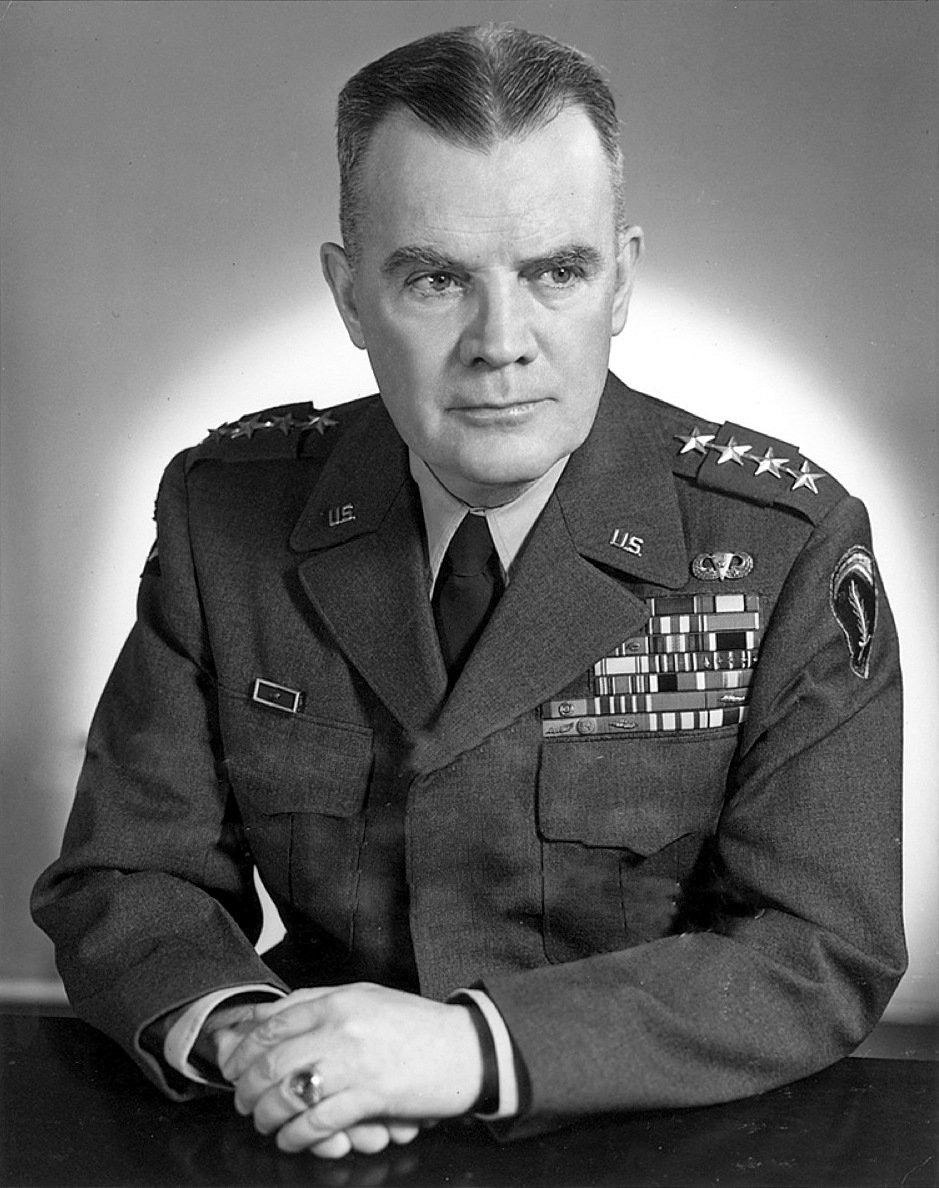
Stephen Early, class of 1907, became Franklin Roosevelt’s press secretary, the first person to hold the job in its modern form. Rabbi Alexander Goode, class of 1929, was one of the Four Chaplains who gave away their life jackets and went down with the troopship Dorchester in 1943.
Alvin Graves, class of 1927, worked on the Manhattan Project. Earle Wheeler, class of 1928, rose to chairman of the Joint Chiefs of Staff during Vietnam. Bennett Champ Clark, class of 1908, became a United States senator from Missouri.
The list keeps going, and it does not stay in the past. Gail Cobb, who attended Eastern, became the first female police officer in the United States killed in the line of duty. Franklin McCain, class of 1959, sat down at a Woolworth’s lunch counter in Greensboro in 1960 as one of the Greensboro Four and helped light the sit-in movement. And if you have ever heard a DJ shout “Let me clear my throat,” that was DJ Kool, an Eastern alum.
Desegregation and a new Eastern
From its founding straight through to the 1950s, Eastern was a white school. That ended in 1954, when the Supreme Court ruled in Bolling v. Sharpe that segregation in DC’s schools was unconstitutional. That fall, the first Black students transferred in from Cardozo and Spingarn, and Eastern’s Black enrollment stood at 1.4 percent.
Within ten years it was 99 percent. The neighborhood changed, the school changed, and Eastern became one of the anchors of Black Capitol Hill. In 1964 Madison W. Tignor became its first African-American principal. In 1968, students who wanted a curriculum that reflected their own history organized the Modern Strivers and founded a Freedom School for off-campus classes in Black history and culture.
Then there was the music. Eastern’s choir, under Dr. Joyce Garrett, sang for presidents and took a silver medal at an international youth music festival in Vienna in 1988. The Blue and White Marching Machine carried the school’s name to presidential inaugurations. A 1984 arson fire gutted the gymnasium and did about a million dollars in damage, but the school kept going.
Still standing, still the pride
The building you walk past today is the same one McAuliffe knew, restored rather than replaced. A $77 million modernization re-inaugurated the school in August 2010, rehabbing the old auditorium and the courtyards. The next year, Eastern reopened under a new model, taking in one fresh grade at a time until the first class of the new Eastern graduated in 2015. It became an International Baccalaureate school along the way.
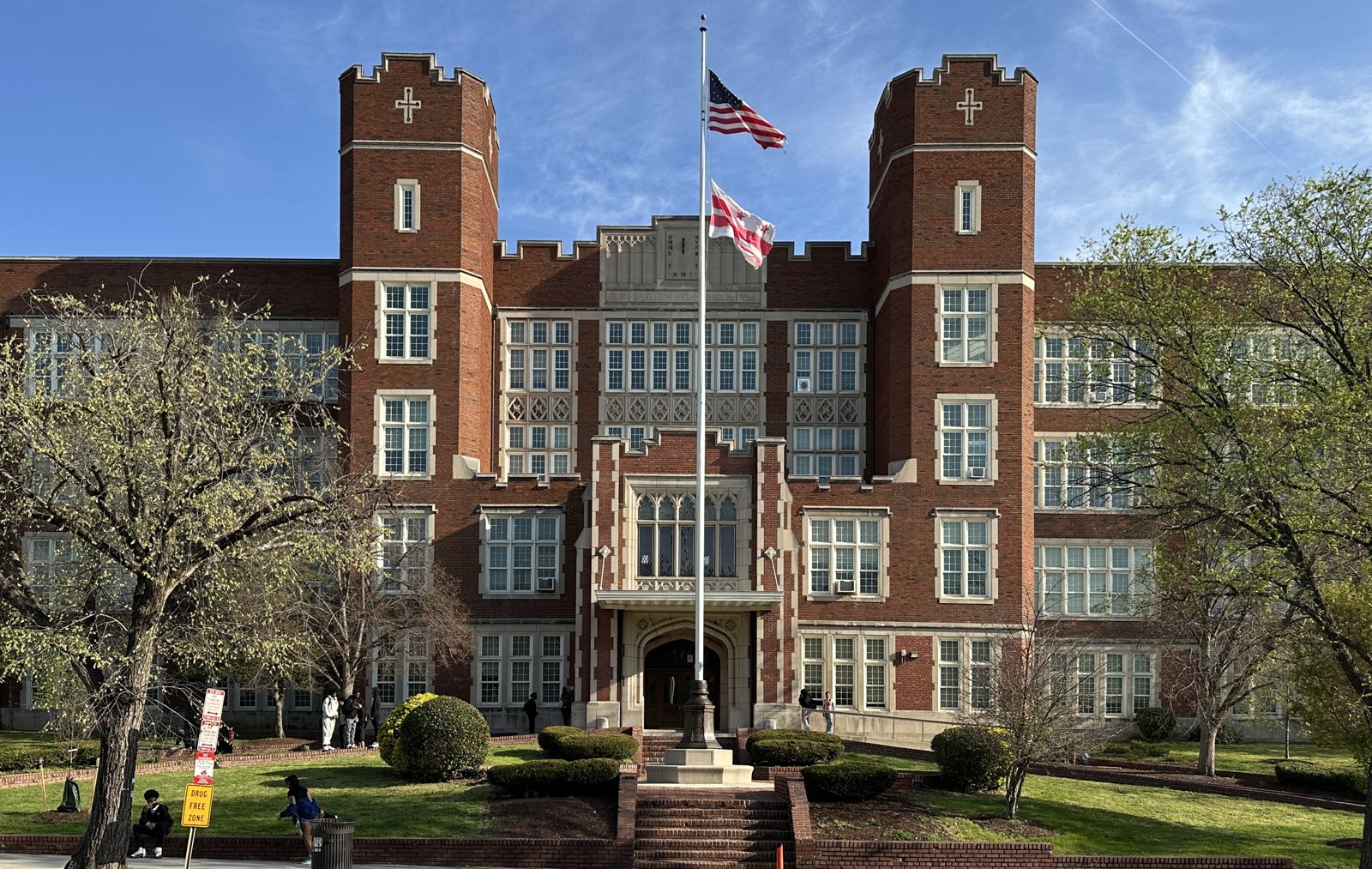
In 2023, as Eastern turned 100, the building was designated a historic landmark and added to the National Register of Historic Places. East Capitol Street still runs past its front lawn and out toward the old D.C. Stadium, later RFK. The sundial over the door still reads 1923.
A century in, the Pride of Capitol Hill still has the address.
My father went to Eastern High School, and before that, he went to Holy Comforter Not far from Eastern. He didn’t graduate from Eastern, he had to go to work and help the family when his mother died. I went to Holy Comforter too, and even had a couple nuns that my father had. Very “Old School Teaching” then too. Real strict, but also very loving at the same time. My father was a very smart man, and he became a photo engraver in the early days of his life, and finally went back to the Washington Post and worked there until around 1977-79? He helped the Post get the very first Fax (type) color photo in the newspaper. It came from Texas to Washington. Really big deal in the day. My father never spoke of Eastern much, but I know he loved it, and I believe that, he had always wished he could have graduated from there. He had a hard life as a child, but raised 7 children that all graduated from high school, and some even further. We had a good life because of him, and to this day, I have never met anyone like him, and I’m sure I never will.
PS He also help his father by being the “Ice Delivery Boy” on the Ice Wagon. He delivered Ice and took care of their horse too.
Someone posted their yearbook from Eastern High School in the District of Columbia and it was from either 1955 or 56 and I just typed in my deceased husband’s name in and this yearbook popped up online. I was able to show his grown daughter a photo of her father who was killed when she was just 8 years old. Now I cannot locate this yearbook and wondered if there was a way to access it once again. My husband’s name was Homer Tilden Allen. Any help would be more then appreciated.
Eastern will always be known as the school that started the riot at the 1962 city championship football game at DC Stadium.
Someone posted a yearbook on line from either 1955 or 1956. I found my deceased husbands graduation photo for his daughter who was 8 years old when her dad was killed on his way to work by a hit and run driver. I would love to purchase a copy of this yearbook if any knows how I can do this please let me know. His name was Homer Tilden Allen. He was 26 when he died. Thanks for any help
Carol Darling
cdgrafics@msn.com
Great article about Eastern High School. If my family had stayed in S.E., where I was born and raised until mid-1956, I probably would have graduated from Anacostia. We moved to Rockville where my parents could afford a home, and my life changed. However, in 1963, when I landed a motor-messenger job with C&P Telephone, one of my daily delights was to drive by Eastern High School and get lost in reverie about my years in D.C. Eastern was a terrific institution and the article was fun to read. Thank you for publishing it.
As I am reading this post, I have in front of me my mother’s “The Punch and Judy -1936”, which my brother just discovered in her belongings. It has a lot of photos to complement this article. But more amazing to me is “In the Ninth Inning” because the pitcher mentioned – Wahler – has to be my grandfather or great-uncle. My family lived in Congress Heights and the year is too early for my dad, who went to Eastern in the late ’20s.
There was no High School in Congress Heights but my dad and uncles played ball on the Congress Heights Athletic Club teams.
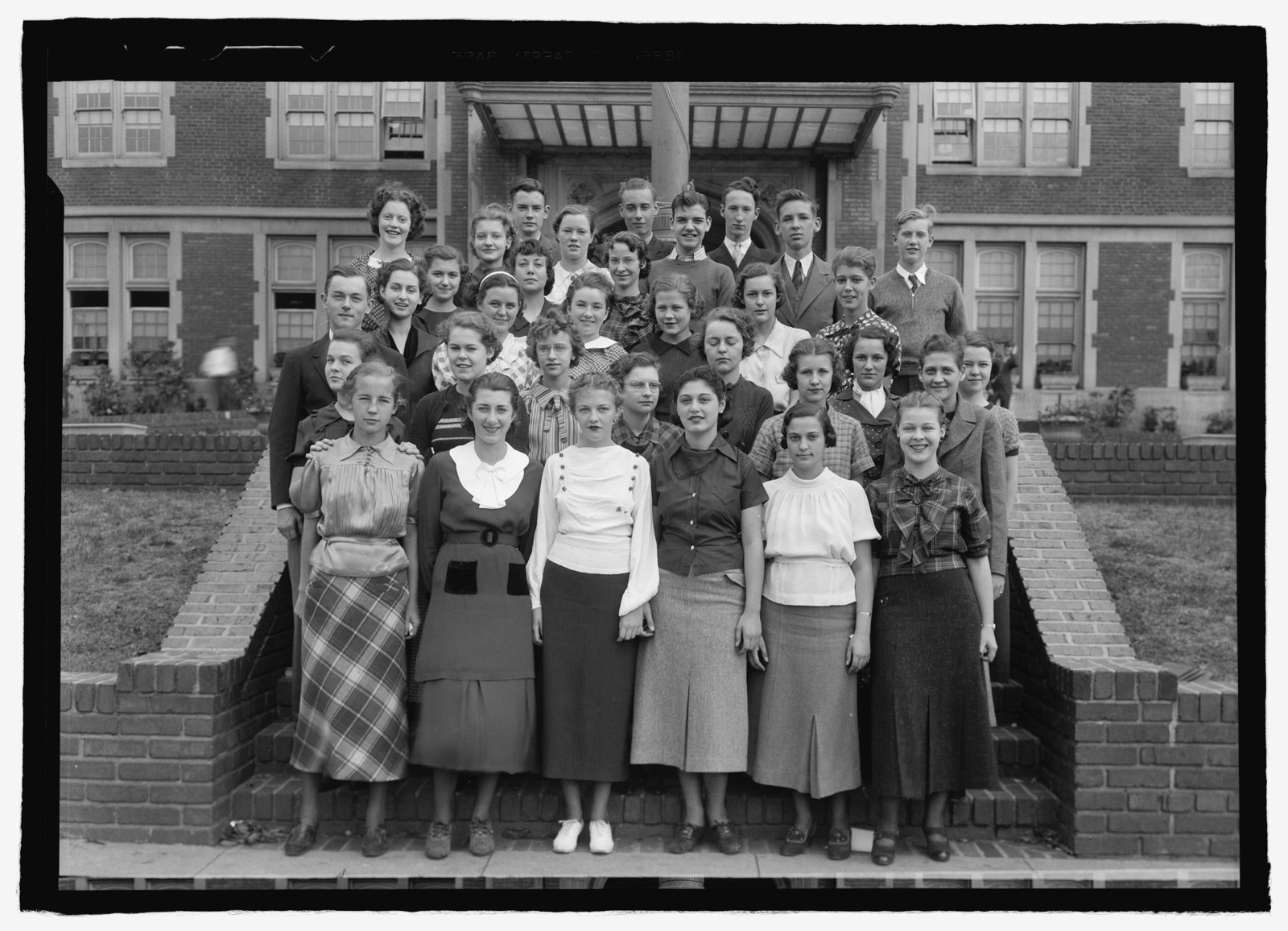
FYI: In the last photo in this article, The VERY tall student on the right is Noble Barnes. Quite a colorful character. He was a former Redskins Band director. He passed away in Feb. 2010. Here is a link to his obituary: http://www.mundenfuneralhome.net/notices/Noble-Barnes