
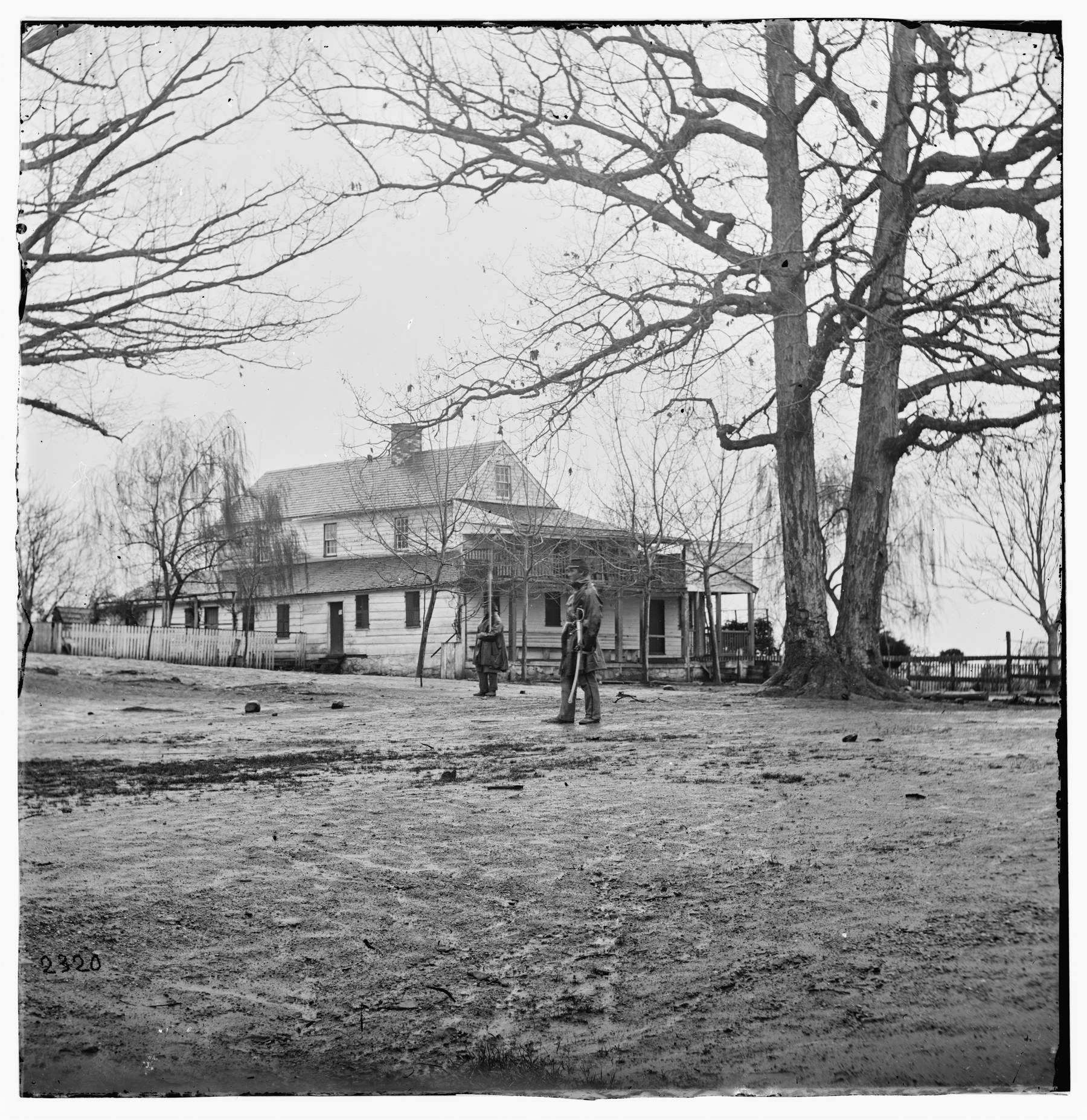
The man who owned the land that became Seven Corners earned part of his $500 by guiding Union soldiers during the First Battle of Bull Run.
His name was Frederick Foote. He bought 33 acres in Fairfax County after the Civil War and left them to his children with a stipulation: the land could never be sold. His heirs held it for 88 years. When a Fairfax County court finally broke that promise in 1953, the price was $750,000.
This is the story behind that strip mall at the confusing intersection.
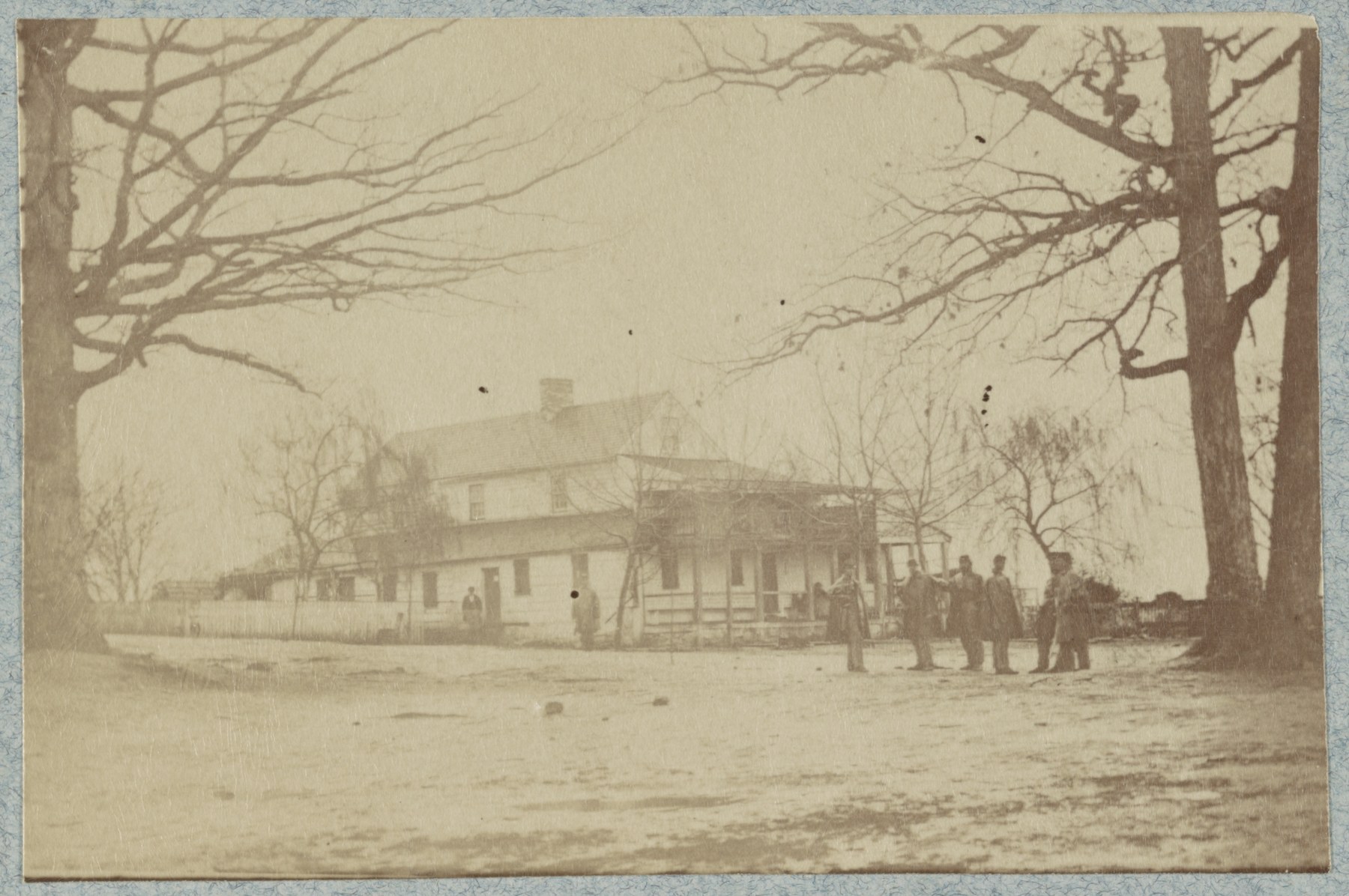
Born Into Slavery in Fairfax County
According to Cathy Taylor’s Historic Falls Church, Foote was born around 1815 in Fairfax County. He was sold six times. He had children born into bondage.
He married Margaret Carter on January 24th, 1864, at Falls Church — a legal, church-sanctioned ceremony, notable because the war wasn’t over yet.
Fifteen months later, it was.
How He Earned the $500
After emancipation, Foote accumulated money three ways. The Washington Post reported it on February 26th, 1953, nearly a century after the fact: he sold wood, worked on the C&O Canal, and served as a guide for Union forces during the First Battle of Bull Run on July 21st, 1861.
That last one is worth sitting with. Bull Run was the battle where overconfident Union troops broke and retreated to Washington in a panic. Foote was guiding the army that was fighting, at least in principle, for his freedom. Whether he was still enslaved at the time or had already made his way to Union lines, the 1953 article doesn’t say.
By around 1865, he had $500. He used it to buy 33 acres at the intersection of Leesburg Pike and what is now Arlington Boulevard.
The Will
In a will dated 1880, Foote stipulated that the land “could never be sold or leased.” He left it to his five children.
The Foote family held those 33 acres through the turn of the century, through World War I, through the Depression, through World War II. The surrounding area slowly suburbanized. The Foote land sat largely undeveloped, legally bound by what the old man had written.
For decades, nobody could touch it.
The Tax Bill
Then came the reassessment.
Prior to 1951, property taxes on the land ran $358 a year. After a reassessment, the annual bill jumped to over $3,000. For heirs living on unproductive land, that was untenable.
Three of the surviving heirs sought court relief in December 1952: Mrs. Margarette Foote Jackson, 65, a Census Bureau employee living in Washington; and her siblings Frank C. Foote, 76, and Mrs. Virginia Foote Jackson, 83, both of whom still lived on the property. A fourth heir, Forrest D. Foote, had already conveyed his interest to Margarette.
Judge Paul E. Brown of the Fairfax Circuit Court broke the will — dissolving the restriction Frederick Foote had written into it 72 years earlier — and appointed commissioners to receive offers.
One offer came back.
The Son Who Came Back from the Dead
The fifth heir was a problem.
One of Foote’s children had disappeared in 1912. The reasons, according to Jet magazine’s reporting in May 1953, were marital. He simply left. After 26 years with no word, a court declared him legally dead in 1938.
His name was Joseph Foote. He had been born in 1890, which made him 22 when he vanished.
He was living in Cleveland, Ohio, when he read about the land sale in an Ohio newspaper.
He wasn’t dead.
A Virginia judge subsequently declared him “legally undead,” and Joseph Foote received his share of the $750,000.
The New Name and the New Owners
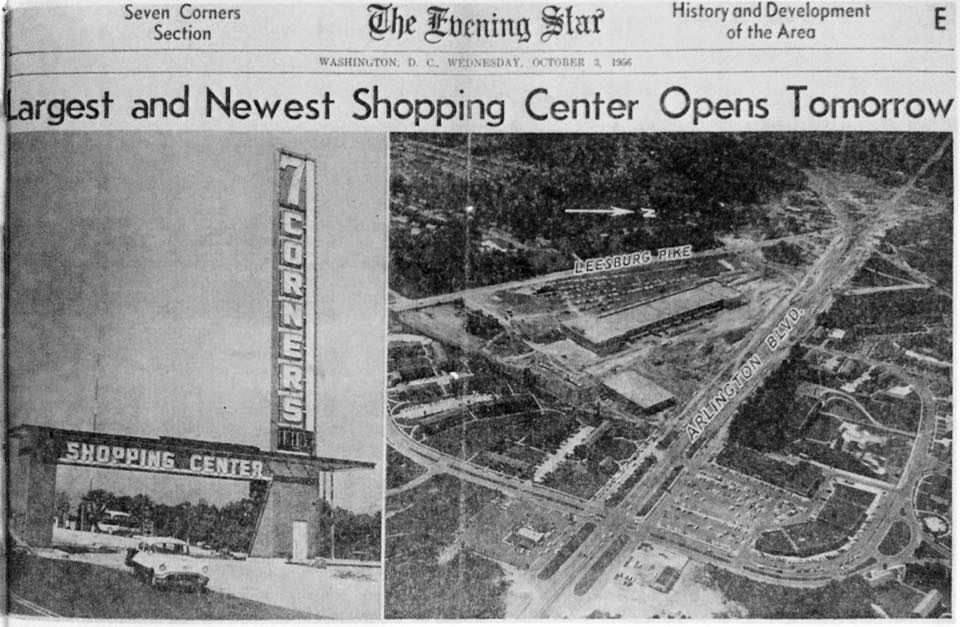
The Lynne Investment Corporation, a Washington firm run by Garfield I. Kass and Irving D. Berger, purchased the 33 acres for $750,000 — contingent on the land being rezoned commercial. At the time of the sale, only 7 of the 33 acres had commercial zoning. The rest was suburban residential.
The rezoning came through. Construction started in June 1955.
The area was still called Fort Buffalo in some references — named for a Union fortification the 21st New York Infantry had built there in October 1862. The name Seven Corners had arrived only recently, when the construction of Lee Memorial Boulevard created the chaotic multi-road intersection that still defeats GPS-confident drivers today.
The Mall
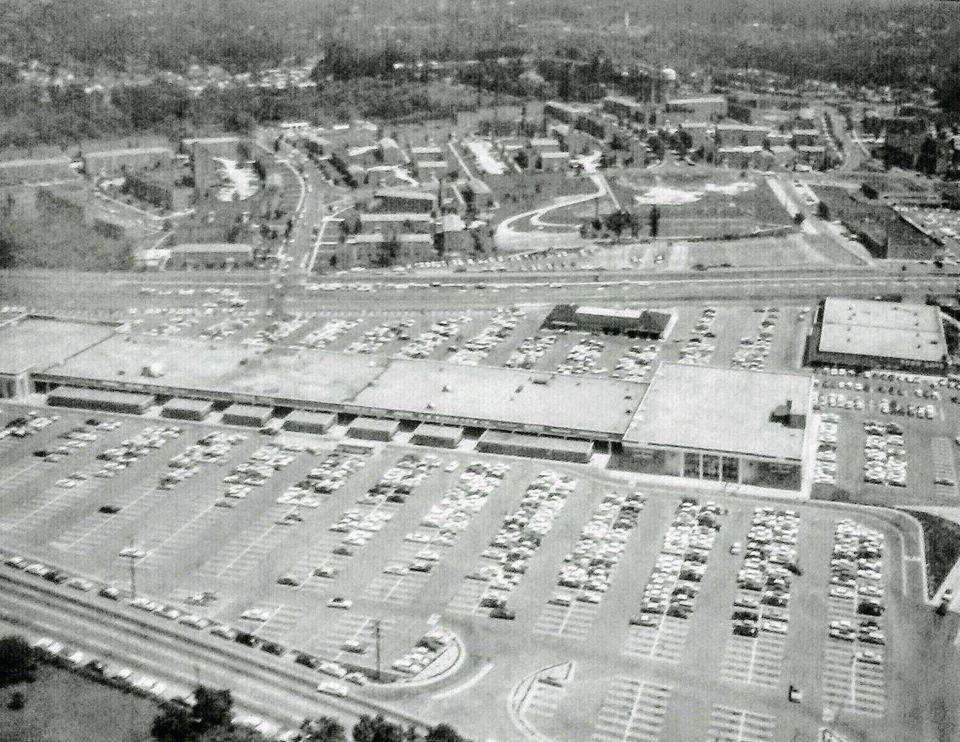
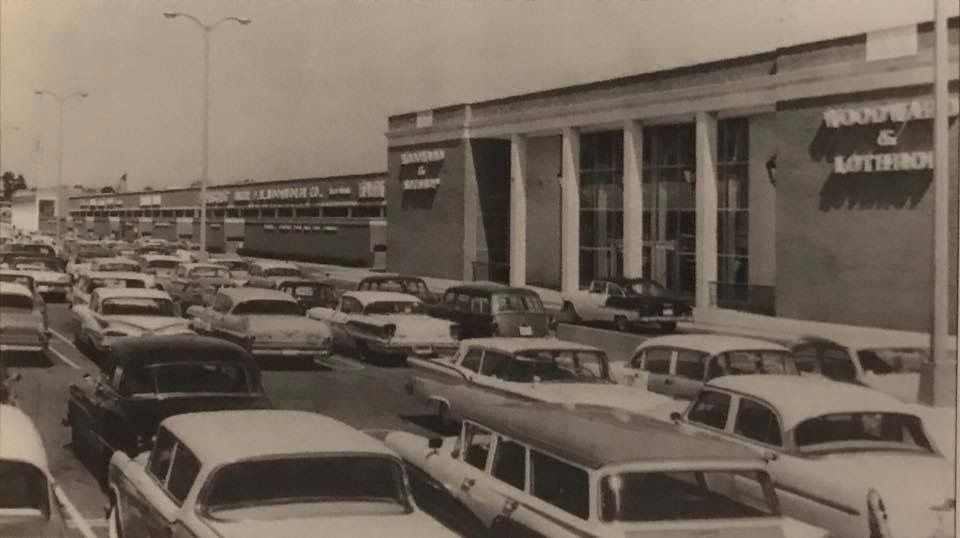
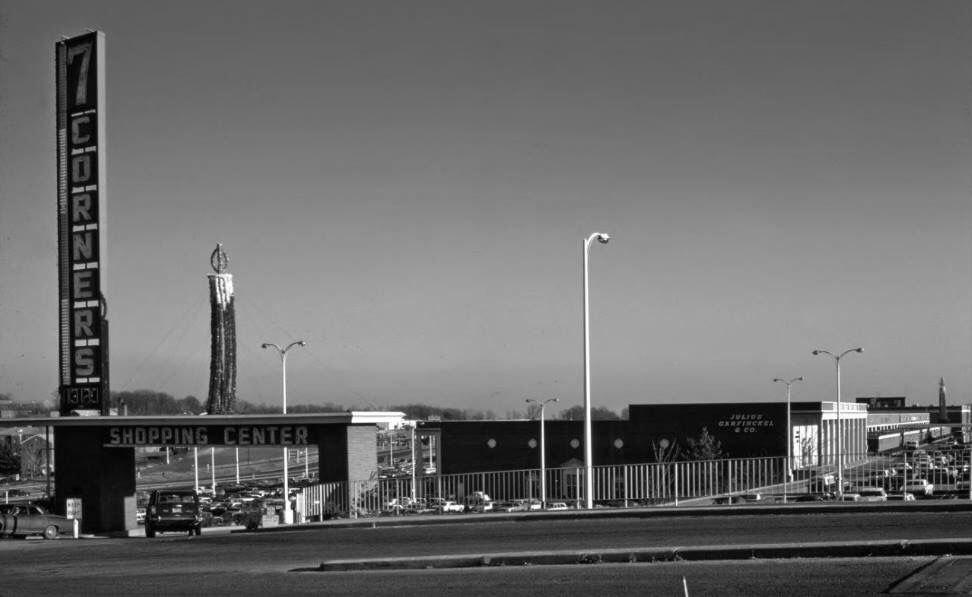
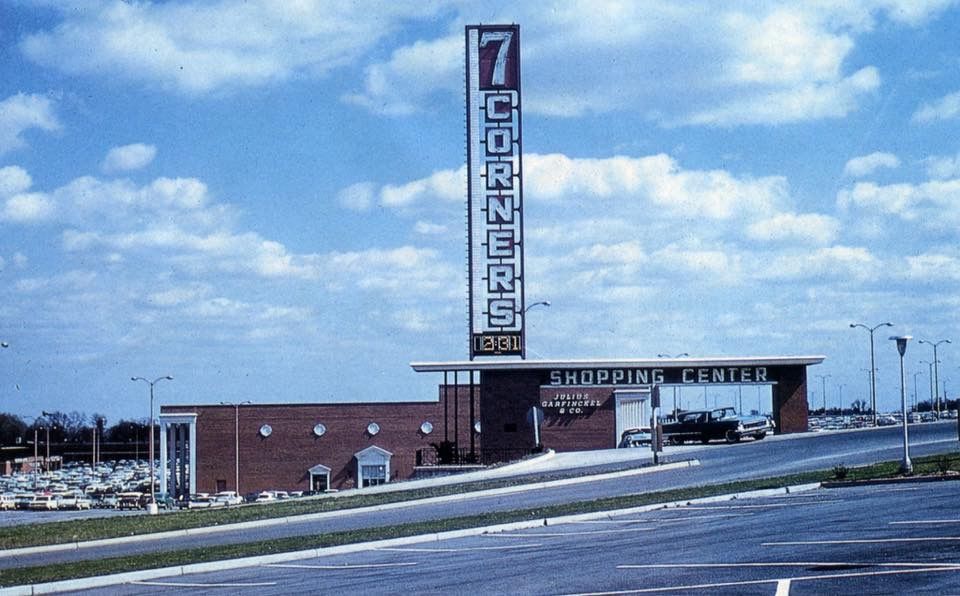
Seven Corners Shopping Center opened on October 4th, 1956. The first three tenants — Woodward & Lothrop, Joseph R. Harris, and Franklin Simon — had actually opened two weeks earlier, on September 20th. The formal opening, with Julius Garfinckel & Co. cutting the ribbon on its three-level, 71,000-square-foot flagship, came in October.
Forty-five stores. 600,000 square feet. $25 million to build. The first major regional shopping center in suburban Washington and the largest in Virginia at the time.
The design was open-air and split-level across the hillside, with covered promenades connecting the anchors and a service tunnel running underneath. Woodward & Lothrop’s anchor space ran 128,000 square feet. An S&W Cafeteria — the first in Northern Virginia — opened that November.
For about a decade, Seven Corners had Northern Virginia to itself. Then Tysons Corner Center opened in July 1968. Westminster Investing enclosed the mall between 1971 and 1972, converting it from open-air to indoor, hoping to compete.
The Long Decline
Julius Garfinckel & Co. filed for Chapter 11 bankruptcy on June 21st, 1990, and closed. Raleigh’s followed in 1992. Woodward & Lothrop closed in November 1995. With all three major anchors gone, the center was finished as a mall.
Saul Centers of Bethesda acquired the property and began tearing it down. The Woodward & Lothrop building came down in October 1996. What replaced the mall was a big-box power center: Home Depot, Barnes & Noble, Ross Dress for Less, Best Buy. The parking lot where escalators once carried shoppers between levels is now where you load plywood into your car.
On October 14th, 2002, that parking lot became a Beltway sniper crime scene. Linda Franklin, 47, an FBI intelligence analyst, was shot and killed while loading packages into her car outside the Home Depot. She and her husband had been buying supplies for a move into a new home. She was the ninth victim of John Allen Muhammad and Lee Boyd Malvo.
Today the property is managed by Saul Centers. Home Depot is still there. Ross Dress for Less occupies the former Garfinckel’s building. Giant Food, Michaels.
Frederick Foote paid $500 for those 33 acres in 1865. His will said it could never be sold. It took 72 years, rising taxes, a judge, and a man declared legally dead in Ohio to break that.
The parking lot is what it is.
Fascinating! Wonder if the proceeds of the sale went to the family? I assume the two children that were still living there had to leave once Lynne Investment took it over.
And I wonder what else the Lynne Investment Corp developed back in the day.
Can’t wait to see what else you find out about Seven Corners!
To add a little perspective: $750,000 in 1953 is about $6.5 million in today’s dollars.
And a little more on the remarkable Mr. Foote. Found this reference in “New Perspectives on the Civil War: Myths and Realities of the National Conflict” (via Google Books: http://books.google.com/books?id=RomkO-x6ajIC)
“Legal, church-sanctioned weddings were sought by slave couples who escaped to Union lines. They formally renewed their marriage vows with the words ’till death do us part.’ One newspaper announces, ‘Married at Falls Church, Alexandria, Sunday evening, January 24th, 1864, by Rev. J.R. Johnson, missionary of the American Missionary Association, Mr. Frederick Foote and Miss Margaret Carter. Frederick has been six times sold as a slave. He has buried one wife, has six children in slavery, and now owns more than thirty aces of land. He thinks, and we think, too, that he can take care of himself and his family.'” (From Ervin L. Jordan Jr.’s essay, “Mirrors beyond Memories: Afro-Virginias and the Civil War” in a 2002 Roman & Littlefield edition, p. 161)
Also this, from a Oct. 3, 1956, Washington Post story on Seven Corners:
“Foote was born in 1800 on the historic Ravensworth Farm near Burke, Va. He earned the $500 to buy the land at Seven Corners by selling wood, working on the C&O Canal and serving as a guide for Union forces during the first Battle of Bull Run.”
Quite a life!
Great find! Thanks for sharing
Rich: The family did indeed get the money. It even led to a remarkable reunion when a long-lost brother who’d been declared dead years before reappeared. He wrote to his family after reading about the deal in an Ohio newspaper. Once a Virginia judge declared him legally undead, the brother got his portion, too.
Someone once said, “Money is relative. The more money you have, the more relatives you have.” It looks like this was the case here with the ‘long-lost brother.’
Quite a few Foote’s still reside in Alex. Va. today.
I met a man long ago that would go dove hunting across Rt.50 from the Foote property (Montgomery Ward, now Target) The Foote family though friendly, would not allow nonfamily hunting on their property.
At that time there was a gas station and a general store that became a ‘tool rental’ and now a car wash on the upper Rt.7 side. It was countryside.
Love this story. When was this?
Thank you for sharing the worth of the land when sold compared to today’s prices..
It is my understanding that @ the beginning of the Civil War, the Confederates painted logs black and set them up as “cannons” facing Washington, DC. Spies discovered them, and the Yankees took over what became 7 Corners (I counted them as a youth).
There is a Ft. Foote park in Alexandria. Used to be a Civil war fort. Was Fred Foote owned by the person the park is named after?
A long long time ago.