
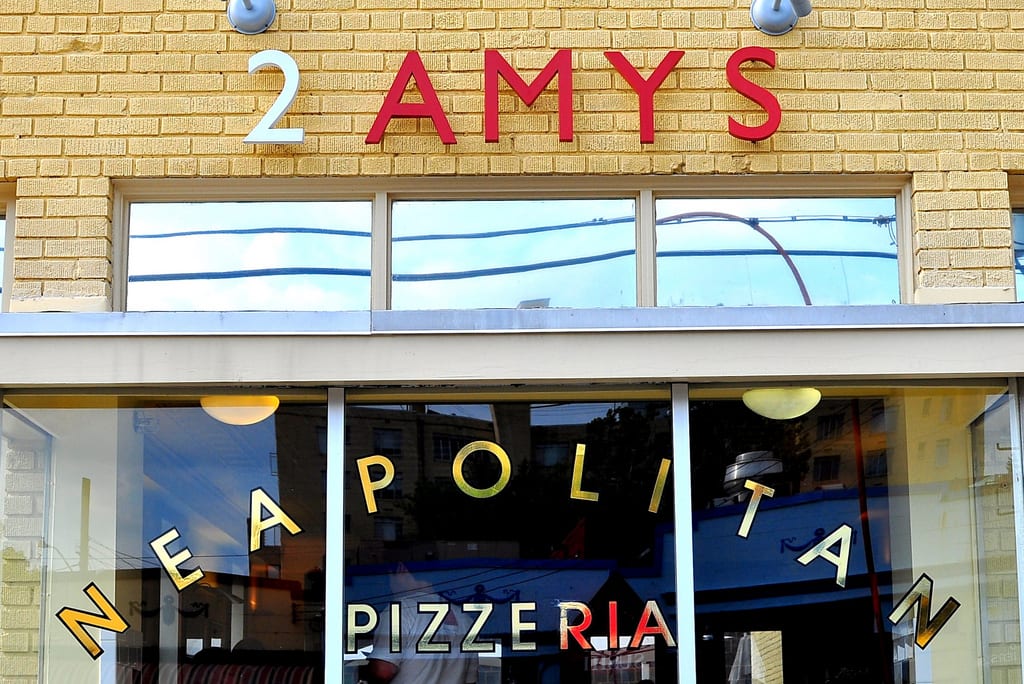
Before Peter Pastan was firing wood-oven pizzas at 3715 Macomb Street NW, the same little brick building on the Cleveland Park edge was hosting a New York transplant who specialized in scalps, a radio repairman who went bust in the Depression, and a shoe shop where senators and the Carter family sent their loafers.
Pastan opened 2 Amys in September 2001, naming it for his wife Amy and his partner’s wife Amy Morgan. Seventy-five years before he flipped the sign on the door, the same address was a beauty shop. Seventy years before that, the lot was still farmland on the streetcar suburb’s western edge.
The building was a small piece of Washington’s twenties commercial buildup, and the people who passed through it stayed for stretches measured in decades. Here’s what was at 3715 Macomb Street NW before the wood oven showed up.
A 1920s shopfront on Wisconsin Avenue’s streetcar edge
The corner where Macomb Street meets Wisconsin Avenue is one of the seams of Northwest DC. North of Macomb, the Cleveland Park Historic District takes over. South of Macomb, it’s Cathedral Heights, with the Washington National Cathedral rising one block away. The 3700 block of Macomb itself sits just outside the historic district’s western boundary, which the National Register nomination form draws cleanly along Wisconsin Avenue.
That edge is where the commerce went. The Cleveland Park nomination form, the official document that got the neighborhood on the National Register in 1987, describes how the residential streets filled in first, between 1894 and 1912, and how the retail buildings followed a decade later. “Most apartments, retail and commercial buildings were constructed between 1920 and the early 1940s,” the nomination explains, “as home building began to taper off.” Streetcar service along Wisconsin Avenue had started back in 1890, around the same time the neighborhood we now call Cleveland Park took its name from a sitting president. By the early twenties, the wires were carrying enough traffic that one-story shopfronts and small mixed-use blocks made economic sense.
3715 Macomb Street NW was built right in the middle of that wave, in 1926. Two stories, brick, a few thousand square feet, the kind of unassuming streetcar-suburb commercial building that filled in across upper Northwest in a five-year stretch. Property records put it at around 3,870 square feet. The Cleveland Park nomination notes that “The retail/commercial district between Macomb and Porter on both sides of [Connecticut Avenue is] a concentration of commercial buildings exemplifying changing attitudes during the 1920’s.” Three blocks east, on Connecticut Avenue, the same forces were producing the Park and Shop, the strip mall that some scholars credit as the earliest of its kind on the East Coast. The block at 3715 Macomb was the Wisconsin Avenue analog. The same type of building, the same era, the same purpose. Modest space, modest rents, neighborhood tenants.
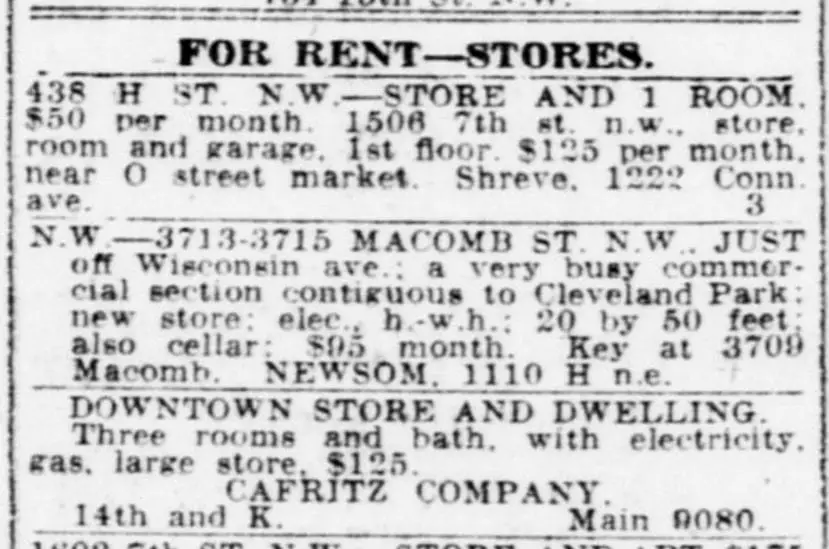
The earliest ad we have for the storefront went out around 1925, when shopfront space on this strip rented for about ninety-five dollars a month. Translate that to today’s money and you’re well under a thousand and a half. A century’s worth of rent inflation later, 2 Amys is the only tenant the building has had for nearly a quarter century straight. That’s not the typical pattern. The earlier tenants cycled.
Mrs. Leapley and the Macomb Beauty Shoppe (1927)
The first tenant we can pin down by name was a beauty parlor. The Macomb Beauty Shoppe ran a full-column ad in the Washington Post on May 6th, 1927, pitching an “expert lady barber, formerly of New York,” who offered facials and was billed as a scalp specialist. The proprietor’s name was Mrs. Leapley.
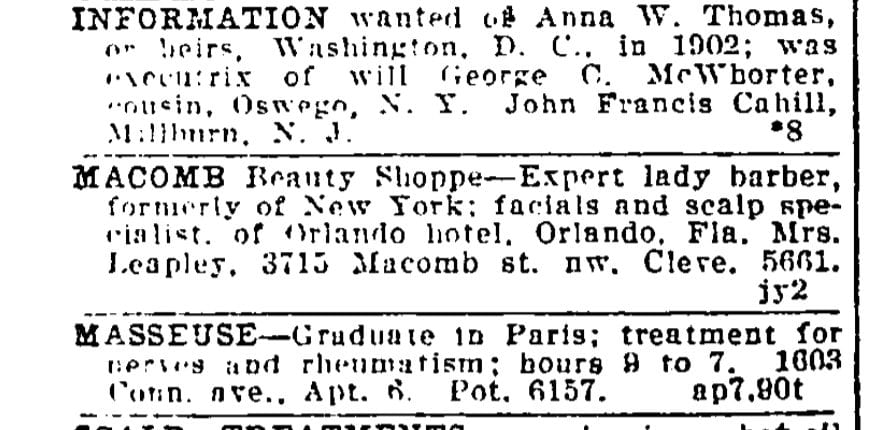
She also bought a lot of ad space in the Washington Daily News that year. The Library of Congress’s Chronicling America archive returns more than fifty hits for the phrase “Macomb Beauty Shoppe” in 1927 alone, all in the Washington Daily News, on dates running from April through August. That’s an aggressive weekly cadence for a small neighborhood shop. Mrs. Leapley clearly understood what 1920s newspaper advertising could do for a fresh storefront.
The pitch leaned hard on the New York biography. In 1927 Washington, an “expert lady barber, formerly of New York” was a credential. The local market for women’s haircuts and facials was thinner here than in midtown Manhattan, and the city was a long way from being the dining-and-grooming capital it has since become. The same year Mrs. Leapley was running her ads, the neighborhood up the hill was still being marketed to home buyers as the new edge of comfortable Northwest, the streetcar-suburb experiment that began going up around the Cleveland Park name three decades earlier. A New York stylist running her own shop on a streetcar-line storefront was a small status play.
The Macomb Beauty Shoppe seems to have run for a few years and then disappeared from the city directories. By the early thirties, the storefront had turned over.
Raymor Battery & Radio Service, bankrupt 1935
The next tenant we can document was a small electronics shop. Raymor Battery & Radio Service was the kind of business that proliferated across American towns in the late twenties and early thirties: a back-of-the-store outfit selling tube radios and replacement batteries, and repairing both. Raymond Morrison ran it.
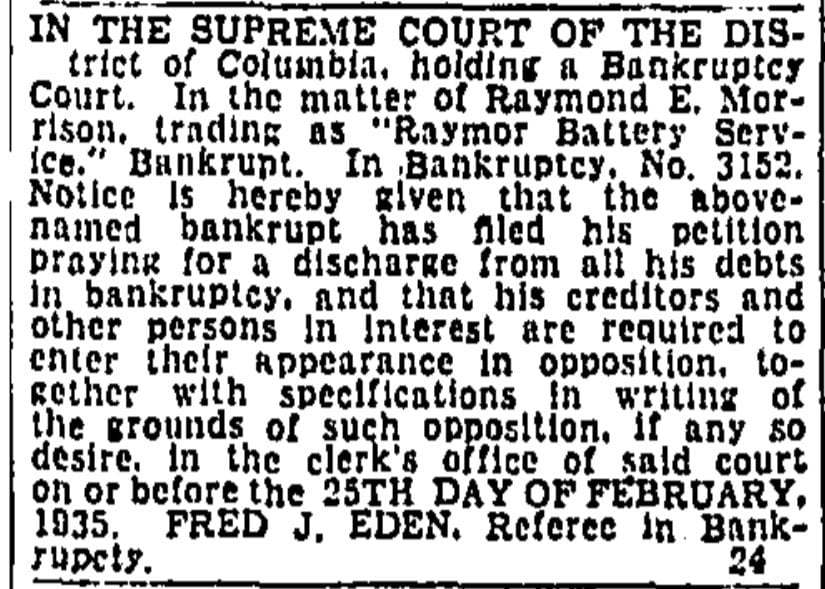
Morrison didn’t make it through the Depression. The Washington Post ran a bankruptcy notice for the business in 1935. That’s the last we hear of Raymor.
It’s tempting to read more into a single bankruptcy notice than the document supports. We don’t know how many years Morrison was actually in the storefront. We don’t know whether the shop made it through the 1929 crash and limped along until 1935, or whether it opened in the early thirties and folded fast. What the notice tells us, plainly, is that by 1935 the radio shop was done. And the storefront was open for the next tenant.
There’s a stretch in the chronology, roughly the late thirties through the early sixties, where the documentary record at 3715 Macomb is patchy. The street city directories from the era still exist at the DC Public Library’s Washingtoniana collection, and the Cleveland Park neighborhood went on living its commercial-strip life through the war years and the postwar boom. It’s a research thread worth chasing later. For now, the next named tenant we can confirm is the one that defines the storefront’s middle decades.
The Modern Shoe Shop and Ernie Rivers
By the late 1960s, the address had become a neighborhood shoe-repair shop. Modern Shoe Shop sold shoes, but the reason people went there was the cobbler at the back. Ernie Rivers worked the resoling bench at Modern Shoe Shop from the late sixties forward, and by the time the Washington Post wrote him up in 1983 he was something close to a Washington institution.
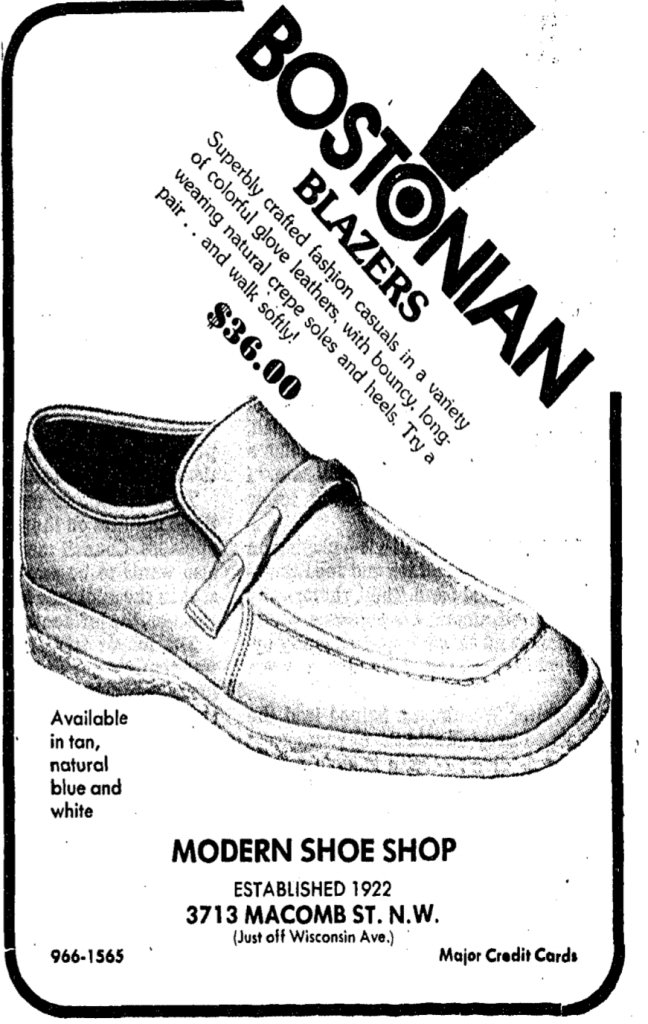
The Modern Shoe Shop ads from the 1970s have the upper-Northwest neighborhood-business voice that anyone who grew up in Cleveland Park, Glover Park, or McLean Gardens will recognize. It was the same neighborhood that filled the Uptown Theater for opening nights and lined up at the Park and Shop on Saturdays. Small shop. Long hours. The kind of place you walked your dog past on a Saturday morning and dropped off your work shoes on the way out.
On August 11th, 1983, the Washington Post ran a full feature on the shop. The hook was Rivers. The shop was officially run by the storefront’s owners, but the story was about the cobbler at the back and the clientele he had built up over fifteen years of careful, unhurried resoling. Customers who couldn’t get a callback from a U.S. senator in a week could leave their loafers with Ernie Rivers and get them back, restitched, that Friday.
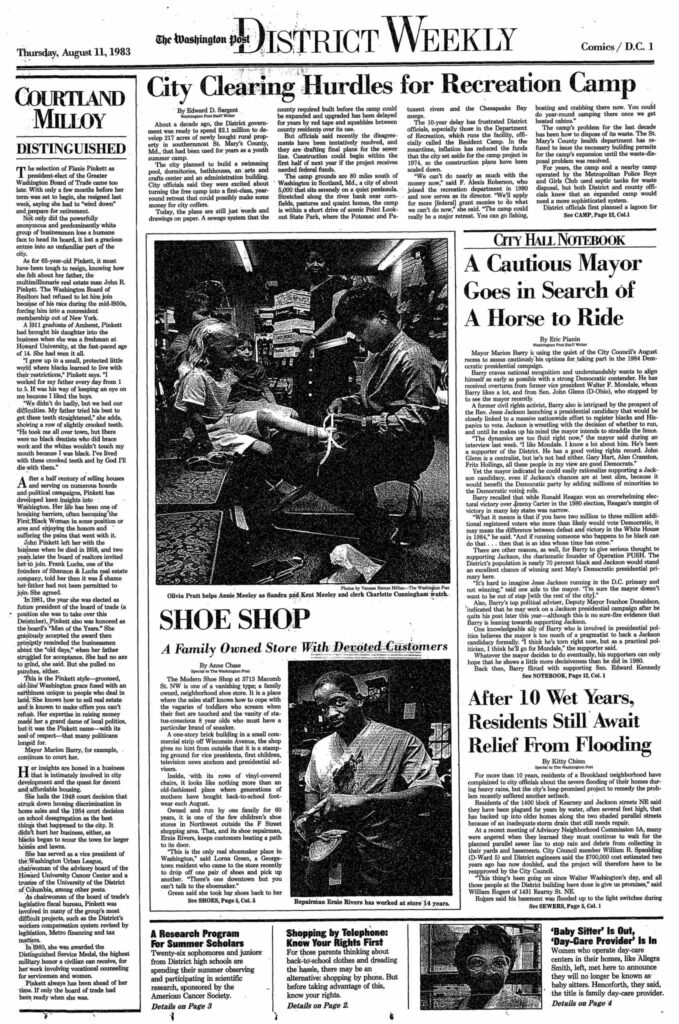
The customer list, the part of the 1983 article that the neighborhood remembered, ran long. Senators. Government officials. The piece named Robert Kennedy’s children among the regulars. Amy Carter, who was thirteen when her father left the White House and would have been about sixteen when the Washington Post wrote the story, was on the list. The point of the article wasn’t celebrity. The point was that an unassuming shoe shop on a quiet block had become the cobbler of choice for an entire layer of official Washington, the kind of place a senator’s wife learned about from a neighbor and then never went anywhere else. (The neighborhood was no stranger to senators in any case. A decade before the article ran, Cleveland Park had been the scene of one of the more harrowing news stories in DC senate history: the January 1973 shooting of Senator John Stennis outside his Cedar Parkway home.)
Modern Shoe Shop kept going through the late eighties and into the nineties. Exactly when Rivers stopped resoling shoes at 3715, and when the shop itself locked up, isn’t pinned down in the public record. What we know is that by the late 1990s the storefront was available, and a chef who’d already run two well-regarded restaurants downtown was looking for a neighborhood spot.
Peter Pastan, the certification from Naples, and the Sunday morning phone call
Peter Pastan had built his Washington reputation downtown. He opened the Italian restaurant Obelisk on P Street in Dupont Circle in 1987 and made it into one of the city’s most quietly respected dining rooms. In 1991, with Ruth Gresser, he opened the pizzeria next door, Pizzeria Paradiso. Ten years later he sold his stake in Paradiso and went looking for a neighborhood corner where he could build a different kind of pizza place.
He found 3715 Macomb. The space had the right bones for a pizza oven, the right neighborhood for a casual family-and-couples room, and a long-empty shopfront available on reasonable terms. Pastan opened 2 Amys in September 2001 with chef-partner Tim Giamette, who had worked as a sous at Obelisk. The two Amys in the name were Amy Pastan and Amy Morgan, the wives in their lives. Giamette stayed at the helm of the kitchen until his death in May 2009 at fifty.
The kitchen aimed for one specific target: a Naples-style pizza, true to the wood-oven-and-buffalo-mozzarella tradition that the Associazione Verace Pizza Napoletana had been certifying out of Italy since the mid-1980s. Pastan applied for the certification and got it. At the time, only a handful of restaurants outside Italy held it.
The neighborhood took to 2 Amys fast. By the time the Washington Post had reviewed it three or four times, the pattern was established: lines on a Tuesday night, a children’s menu that actually got eaten, and a wine list that gave the room more weight than the pizza-place exterior suggested. Across Wisconsin Avenue, the ugly midcentury Giant Food that had anchored the block since the 1940s kept on doing its quiet work until the wrecking ball arrived for the Cathedral Commons redevelopment in 2013.
Then came the morning that nearly ended the run. On Sunday, July 8th, 2018, a basement pipe burst. Pastan picked up the phone, which he told WTOP a few months later he never does on a Sunday morning because nothing good ever comes of it. By the time he made it to the restaurant, the basement was filling fast. “It was really impressive how quickly it filled up,” he said. The flood destroyed the equipment, ruined the wine inventory, and forced a three-month closure. 2 Amys reopened at the end of September 2018 with a new oven floor, a re-tuned wine list, and a small piece of art in the bathroom made from the labels of the destroyed bottles.
Almost eight years on from the flood, and twenty-five years on from opening, the restaurant is still at 3715 Macomb. Same brick storefront. Same plot of upper Northwest that ran beauty-shop ads in 1927 and shoe-repair ads in the 1970s.
What’s still there
The wood oven sits roughly where Mrs. Leapley’s facial chair would have been in 1927, and not far from where Ernie Rivers had his cobbler’s bench in 1983. The building is still 1926 brick, still two stories, still the same Northwest plot that filled in once the Wisconsin Avenue streetcar made the trip worth making.
A century of small businesses, one storefront. The next time you’re folding a margherita in half on a Tuesday night, you can mentally place a 1927 lady barber, a 1935 radio repairman, and a senator’s shoeshine all in the same room.