
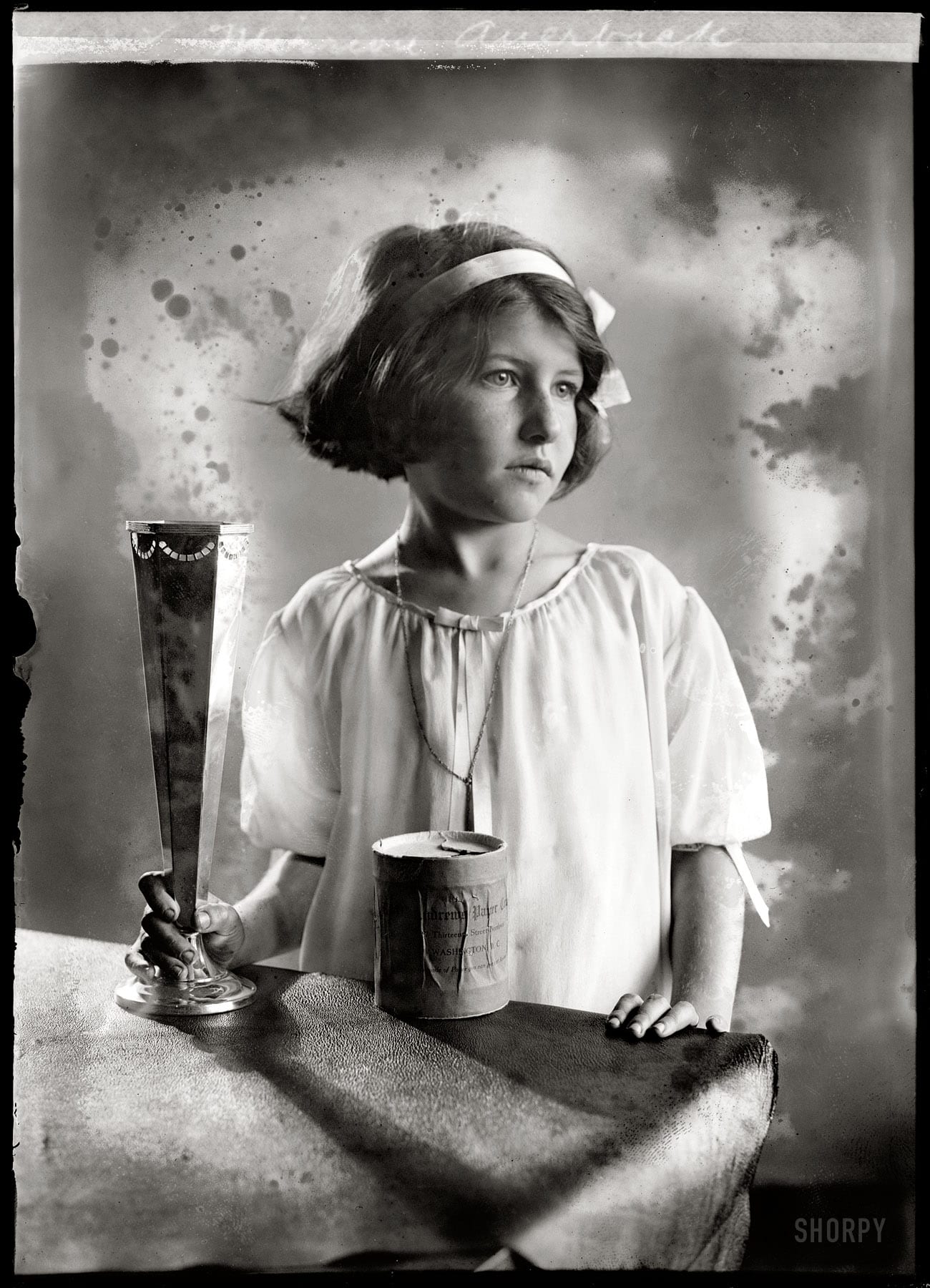
She is twelve years old, dressed in a white frock, holding what looks like a small chalice. A sash crosses her chest. Her hands, even at twelve, look like hands that have done something. The National Photo Company set up its glass plate in Washington, DC sometime in 1924 and made her sit very still.
The girl in the photograph is Miriam Auerbach. The picture would sit in the Library of Congress for the rest of the twentieth century with nothing attached to it but her name and a date.
Then in 2009 her son saw it on Shorpy and wrote in.
The Family Behind the Photograph
Miriam was born in Washington in 1912, in a house her grandfather had built. Her mother, Edna, had grown up in another house her own grandfather had built. By the time Miriam was twelve, the Auerbachs were already a third- or fourth-generation Washington family on the maternal line. That is the part of the city’s Jewish history nobody writes down: the families that were here before everyone else was here.
Her father was Joseph Auerbach, a clothing merchant. The 2012 version of this post said he had arrived in the United States from Germany in 1906, and the family memory may well be right about the year he naturalized or remarried into the business. But Evening Star advertisements show a Joseph Auerbach clothing shop running at 623 Pennsylvania Avenue NW and at the corner of 4th and G NW from at least November 1903. One ad from November 27, 1903 trumpeted a new line under the headline “The Joseph Auerbach Clothing Has Already Won Prominence,” noting that “the name has so long been associated with what is best in men’s wear.” Whether that was Miriam’s father at twenty-three or an older Joseph Auerbach he later took over from, the store was already a Washington fixture before the 1924 photograph was made.
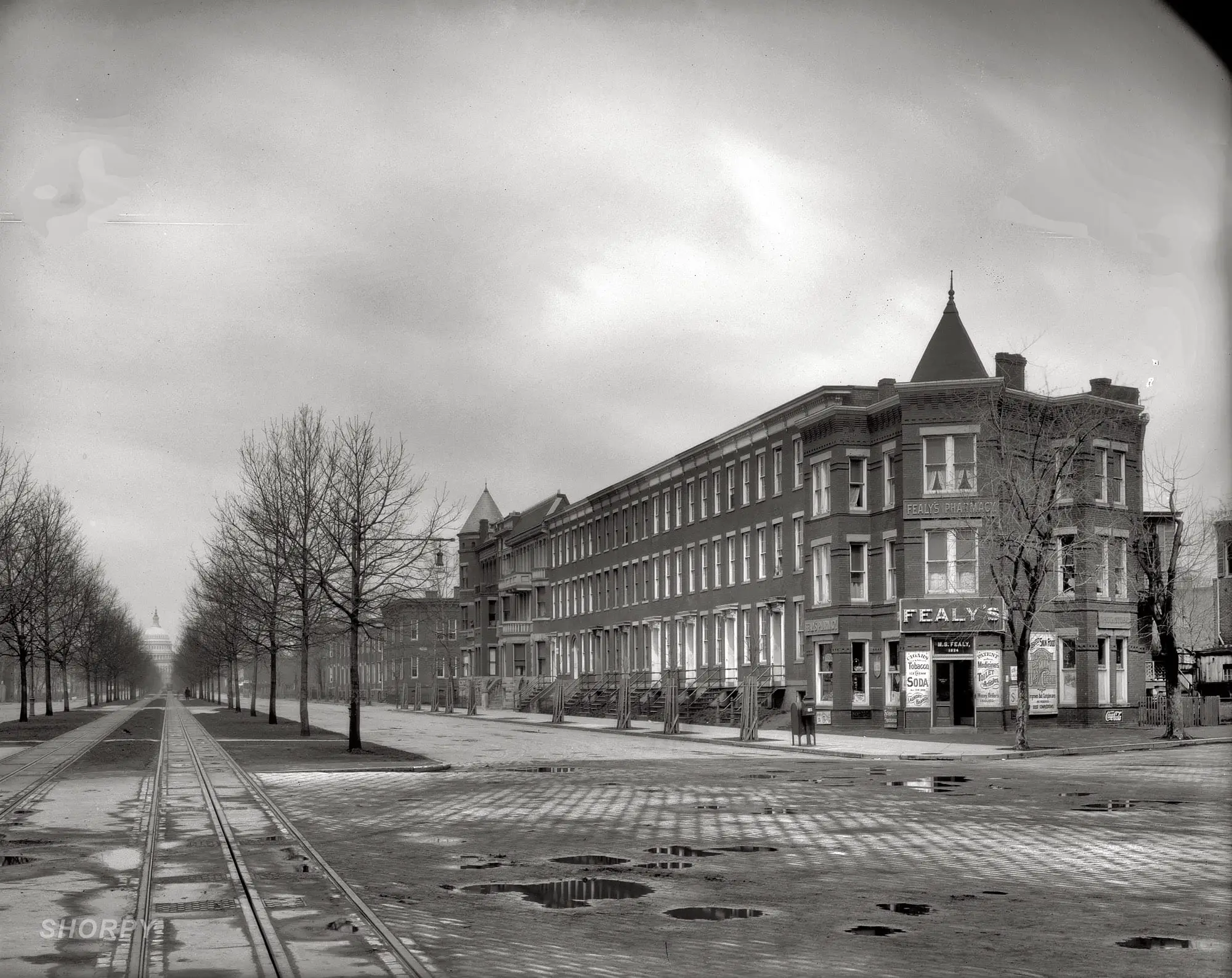
The address mattered. The 600 block of Pennsylvania Avenue NW in the 1900s was the heart of Washington’s downtown retail strip, the stretch between the Treasury and the Capitol that drew in clerks and congressmen and shop girls. Joseph Auerbach was on a block with S. Kann, Sons & Co.; W. B. Moses & Sons; Saks & Co.; and W. H. McKnew. Every coat and hat advertised in the Evening Star on a Sunday in 1906 was within four blocks of his door.
He married Edna in 1919. The 2012 post describes her as “almost 20 years his junior,” which would put Joseph well into his forties at the wedding and Edna in her twenties. Miriam arrived in 1912, which means either the dates in the family story are slightly off or there is a chapter of Joseph’s life still missing from the public record. Her younger brother, Joseph Jr., followed.
Growing Up at 1810 R Street
The family lived at 1810 R Street NW, just west of Dupont Circle. The 1924 photograph caught Miriam at the moment in childhood when she was already old enough to be entrusted with something heavy and small enough to look unsteady doing it. One viewer who studied the original glass negative noticed a paper label or sash that suggested an award from a charity drive sponsored by the R. P. Andrews Paper Company. The paper company’s headquarters at 727 13th Street NW was about a half-mile walk from her father’s store. Whatever she had won, it was big enough that the National Photo Company sent a photographer.
The R Street block where she grew up is still there, but the Auerbach house is not. By the 1950s the 1800 block of R Street NW had begun to fill with the kind of mid-rise apartment buildings that swallowed entire townhouse rows across Dupont Circle. The Cairo Hotel two blocks south had already, decades earlier, scared the city into the 1899 height law that capped buildings on residential blocks. That law saved the scale of the neighborhood but did not save individual houses. The Auerbach grandfather’s house went somewhere in those transitional decades.
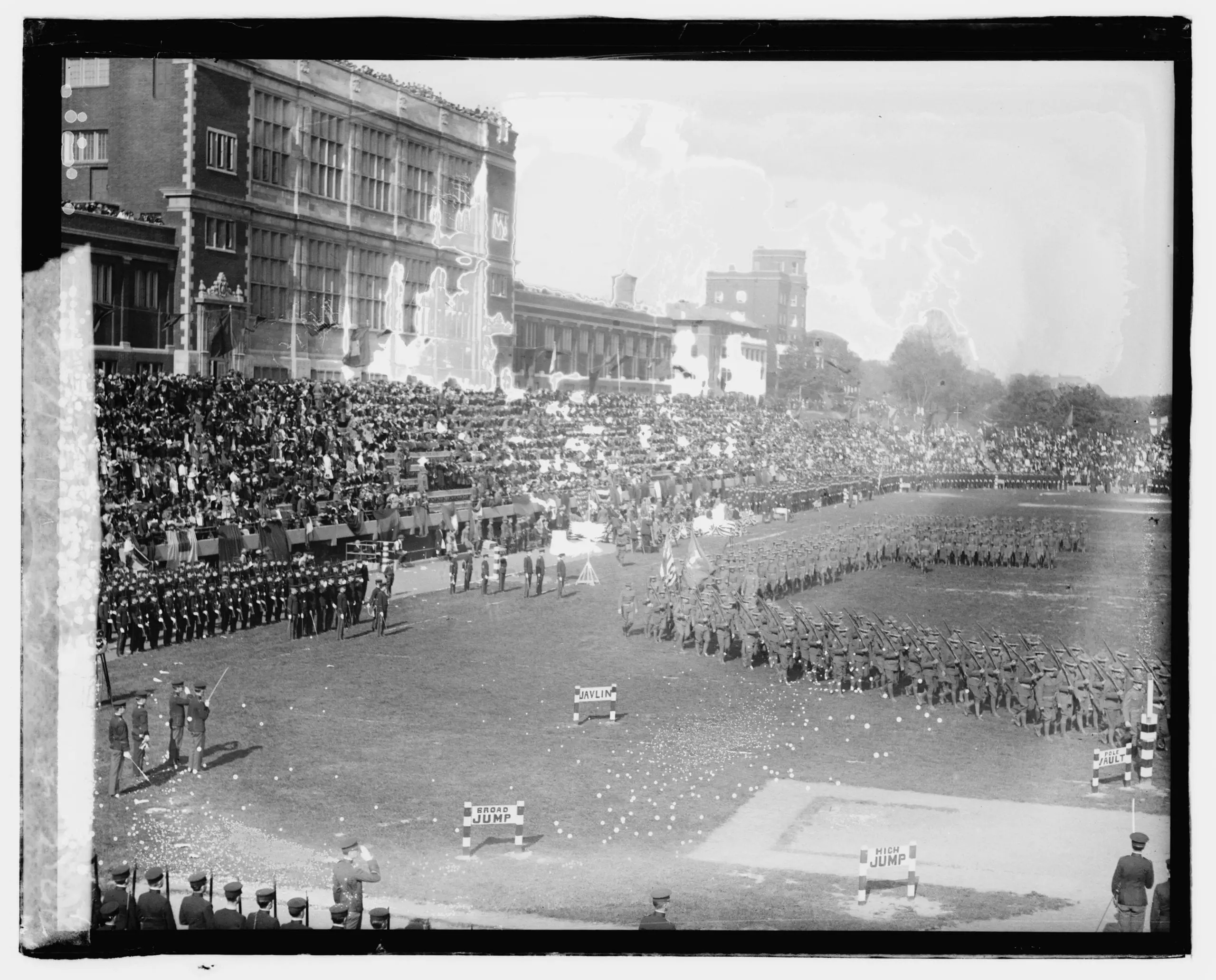
Miriam went to the old Central High School, the Beaux-Arts schoolhouse at 13th and Clifton Streets NW. The building had opened in 1916; by the late 1920s, when Miriam walked through its doors, it was a kind of academic flagship for the city’s striving second-generation kids. The school would become Cardozo Senior High School after 1950, when the original Central students moved out and Cardozo’s students moved in. The girl in the 1924 photograph would have known the building only by its old name.
French Teacher, Then Realtor
The obituary in the Washington Post on April 18, 1978 covers the part of her life the photograph never could:
Miriam Auerbach Wolf, 65, a retired real estate executive and the first woman to become a life member of the “Million-Dollar Sales Club” of the Washington Board of Realtors, died of cancer Sunday at her home in Bethesda. Mrs. Wolf began her real estate career in 1957. At the time of her retirement in 1976 for reasons of health, she was associate manager for Legum & Berber. She was the recipient of several awards from the Board of Realtors for her residential transactions.
Read that paragraph slowly. She did not start in real estate until she was forty-four years old. Before that she had been a French teacher at Georgetown Day School in the 1950s, the school that had only just been founded as the first racially integrated school in Washington. She married Alexander Wolf Jr. somewhere along the way. She raised three sons.
Then she sold a house, and then she sold another one, and then in 1976 she had to retire because she was dying, and they put a plaque on her work.
The Million-Dollar Sales Club was the Washington Board of Realtors’ way of marking residential brokers who had pushed a million dollars in transactions through the books in a calendar year. In a market where a Bethesda starter colonial cost around $20,000 in the late 1950s and a substantial Chevy Chase house cost around $35,000, a million dollars meant moving roughly thirty to fifty houses, one family at a time. Doing it every year for long enough to become a life member, in an industry that had been almost exclusively male, was the kind of distinction the Post eventually retired in 1993 after complaints that it had lost its meaning. In Miriam’s time it had not lost its meaning. She was the first woman who held it for keeps.

Her firm, Legum & Berber, was a Bethesda-anchored residential brokerage in the era when Washington was spilling north into Maryland and the suburban subdivisions were filling up almost faster than anyone could pour the slab. May 18, 1957 was a Saturday. The Washington Post real-estate section that day was a wall of advertisements for new Bethesda houses, sectional sofas optional, two-car garage included. That is the market Miriam stepped into. By 1976 she had outlasted most of the firms named in those ads.
The Other Half of the Job
The obituary did not stop at the real-estate work.
In addition to her business activities, Mrs. Wolf was founding president of the Montgomery County chapter of the National Council of Jewish Women. She was also the first president of the Montgomery County Thrift Shop, the proceeds of which benefit various charities. During the Eisenhower Administration she served on the advisory committee of the President’s Council on the Handicapped.
The National Council of Jewish Women had been founded in Chicago in 1893. Its chapters across the country handled refugee resettlement, voting drives, school reform, and the everyday civic work of women who were not invited to the men’s clubs. The Montgomery County chapter was Miriam’s project, built in the same postwar years she was selling houses to the families it would eventually serve. The DC Jewish community center at 16th and Q had been the institutional anchor for decades; Miriam’s chapter was the suburban successor. The thrift shop was her fundraising engine for it. Eisenhower’s advisory committee on the handicapped was where the work crossed over into national policy.
The picture this paints is of a woman doing every shift in town. Selling residential real estate full time. Founding a women’s-rights chapter on the side. Running a charity store at the same time. Sitting on a federal advisory committee on top of it. None of which the National Photo Company could have known on the morning in 1924 when it set up its lights.
Bethesda, 1978
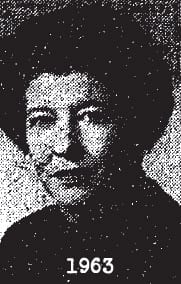
She died on Sunday, April 16, 1978, at her home in Bethesda. The cancer had moved fast enough that she had retired only two years earlier. The Post ran her obituary two days later, with the 1963 portrait we still show alongside it.
Her survivors were her husband, Alexander Wolf Jr.; her three sons, Alexander III in Sykesville, John in Baltimore, and Christopher in Bethesda; and one grandchild.
The youngest of those sons, Christopher Wolf, went on to a four-decade legal career at Hogan Lovells and now serves as president of the Lillian and Albert Small Capital Jewish Museum on F Street NW. He talks publicly about being a fourth-generation Washingtonian. The other three generations on his mother’s side ran from Joseph Auerbach’s clothing store on Pennsylvania Avenue, back through whoever built the house at 1810 R Street NW, and back again to whoever built the house Edna grew up in. It is one of the longer continuous Jewish-Washington threads in the city, and it threads through this twelve-year-old girl in a white dress.
In November 2009, Christopher Wolf wrote a comment under the photograph on Shorpy. He thanked the site for posting his mother as a child. He noted that his own granddaughter, then seventeen, was also named Miriam. Three Miriams now, across a century.
She knew, somehow, when she was twelve.
Some of our stories are researched and written with help from AI, and checked by a person before they run. Here’s how we use AI.