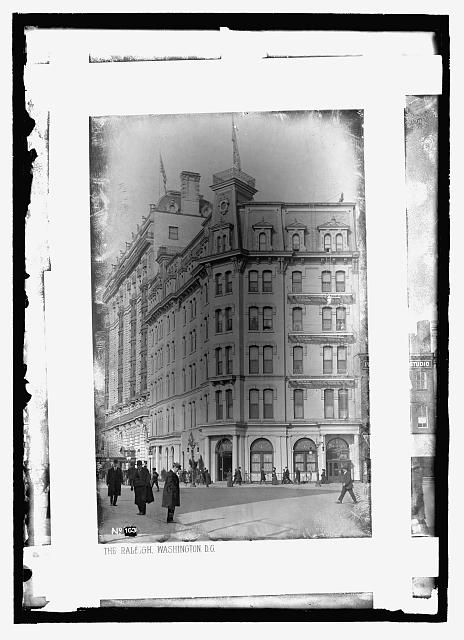

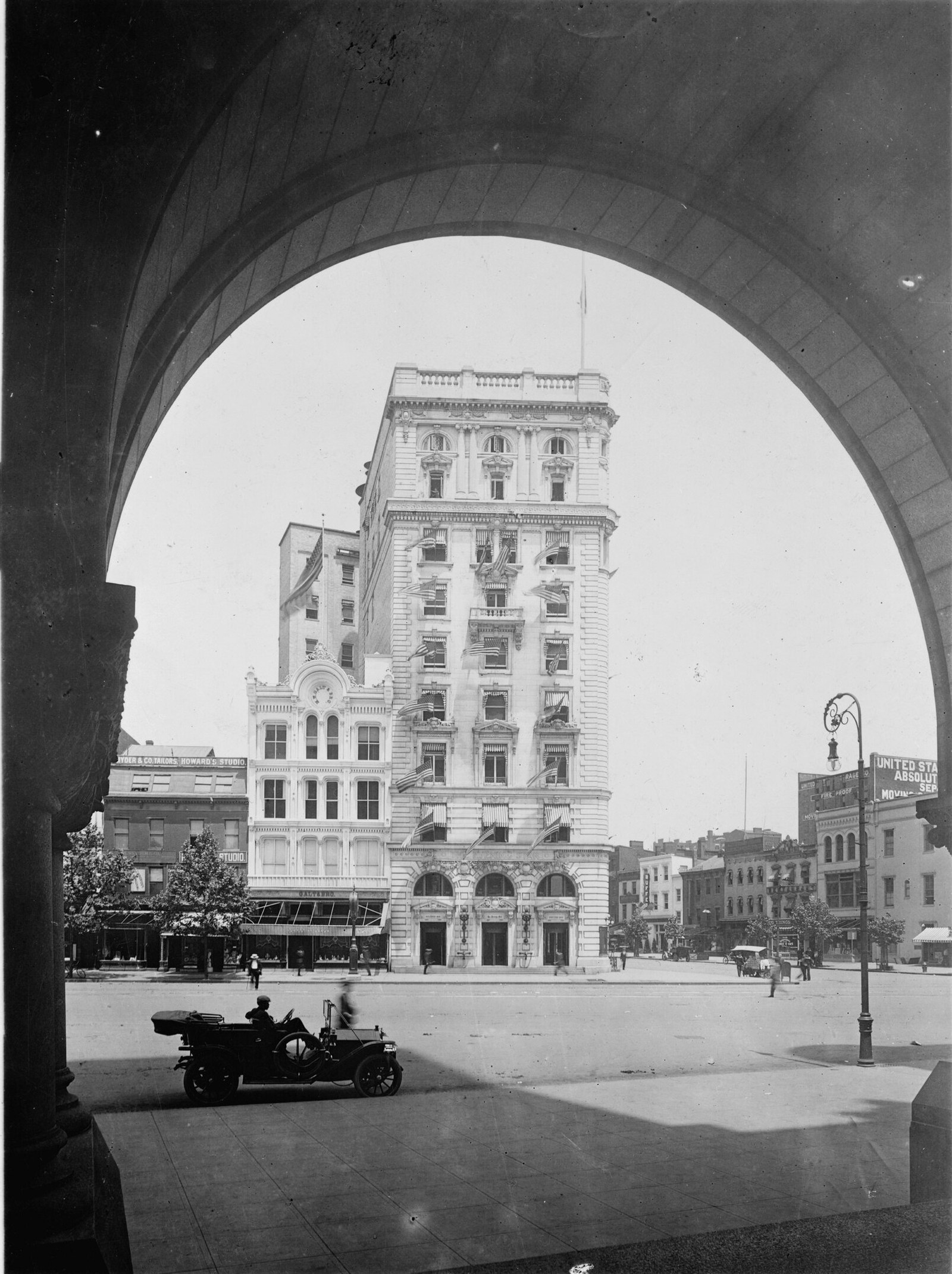
On the night of June 29, 1900, crowds gathered on the corners of 11th Street and Pennsylvania Avenue to stare at a new white marble tower lit up in every window. Inside, the Evening Star was giving every newspaperman in Washington the grand tour of its new home.
That building still stands at 1101 Pennsylvania Avenue NW. It’s the Evening Star Building, home of the paper generations of Washingtonians simply called the Star, and later the Washington Star. The paper published from December 16, 1852, until August 7, 1981.
The paper is gone. The building isn’t.
The next afternoon, June 30, 1900, the Star described its own open house.
While The Star was entertaining its guests there were constant groups around the entrances and windows peering through to secure glimpses of the beautiful interior and watching the animated throngs within. On the opposite sides of Pennsylvania avenue and 11th street were additional crowds who enjoyed the effective picture of the tall white mass whose chaste beauty was heightened by the gleam of electric effulgence that poured from every window with effect that was fairy-like.
It was the conscientious opinion of every one that paid the visit last night that The Evening Star building, for the purposes of publishing a great afternoon daily, is not equaled by any other building in the world.
Not exactly modest. But the Star had been building toward this for nearly fifty years.
The Washington Star Before the Marble Building
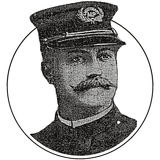
Capt. Joseph Borrows Tate, a printer and militia officer, launched The Daily Evening Star as a four-page paper on December 16, 1852. He promised a paper “free from party trammels and sectarian influences,” which was a real pitch in a city full of party organs.
Tate sold out within six months. By 1854 William Douglass Wallach owned the paper outright, and he carried it through the Civil War as a Union paper in a Southern-leaning town. Its coverage the day after Lincoln was shot is a time capsule.
In 1867 three men bought the Star: Crosby S. Noyes, Samuel H. Kauffmann and George W. Adams. Their families would own it for more than a century.
In 1881 the paper moved to the northwest corner of 11th Street and Pennsylvania Avenue. It painted its name right across the front.

Marsh & Peter’s Marble Tower, Built 1899 to 1900
Once the company had pieced together enough land on the corner, it hired two young Washington architects, William J. Marsh and Walter G. Peter. According to the Star, they spent ten months on the plans. Every block of exterior marble was drawn, sized to a sixteenth of an inch, lettered and numbered before it left the quarry.
The George A. Fuller Company of Chicago got the contract. Crews tore down the old Star building and two neighbors between April 12 and April 22, 1899, then drove 375 Virginia pine piles down through blue clay to hardpan.
The steel frame went up between September 20 and November 28, 1899. It drew an audience.
Little furnaces containing seething fires were employed, and the forgemen would place in them rivets, and as each became white hot would seize it with a pair of pincers and throw it deftly many feet, over heads of workmen and through interlocking beams, to where the riveters were at work. Here would be a keen-eyed workman with a nail keg. In this would be caught the molten rivet.
It was the most interesting game of pitch and catch Washington had ever seen, and multitudes of people day after day watched its countless innings.
The last marble went in on January 27, 1900, and the roof was done March 22. The Star moved in on July 1, 1900.
The paper measured its new home at a bit over 55 feet on Pennsylvania Avenue and 126 feet on 11th Street, nine stories and 130 feet tall. The style was French Renaissance in the Star’s words, Beaux-Arts in today’s: smooth white marble on a steel frame, with carved balconies and a balustrade on top.

Inside, the business office was lined with Pavonazzo marble from the Carrara quarries in Italy. The Star planned seven murals by Frederick Dielman about the making of a modern newspaper for the arches overhead.
Upstairs, pneumatic tubes connected every editor’s desk to the composing room. That one system alone cost $6,000. The Associated Press took the second floor.
The building still announces itself over the Pennsylvania Avenue doors: “Founded 1852” on one side, “Erected 1899” on the other.

The Star at Its Peak
Samuel Kauffmann died in 1906 and Crosby Noyes in 1908. Their sons and grandsons kept running the place, with Frank B. Noyes, the officer the architects had worked with most, as president.
The marble tower filled up fast. In 1918 the Star added a 10-story annex behind it along 11th Street for more presses and composing room space. The paper was proud enough of the whole operation to print a cutaway drawing of its building in 1922.
For the first half of the 20th century the Star was Washington’s dominant paper. That started to change in 1954, when the Washington Post bought the morning Times-Herald and pulled ahead in circulation.
In 1959 the Star left Pennsylvania Avenue for a new five-story printing plant at 225 Virginia Avenue SE, next to the planned I-395 freeway.
How the Washington Star Died in 1981
The decline took about twenty years. In 1972 the Star bought the Washington Daily News, and the masthead went through several names before settling on the Washington Star.
In 1975 Texas banker Joe L. Allbritton paid $28.5 million for the three families’ shares. Three years later he sold the paper to Time Inc. for $20 million.
Time poured more than $80 million into the Star. It didn’t work. The last issue came out on August 7, 1981, after 128 years.
What’s at 1101 Pennsylvania Ave NW Today
The old building became rented office space after 1959. According to John DeFerrari of Streets of Washington, the marble business office and the Dielman murals were lost in later remodelings.
The 1918 annex was still standing when the Historic American Buildings Survey photographed it in January 1987. It came down soon after.

Skidmore, Owings & Merrill restored the original and built a large new addition in its place, finished in 1989. The developer, Metropolitan Partnership, puts the job at $45 million and 280,000 square feet, built for the Jonathan Woodner Company of New York.
The building has stayed valuable. In 2010 TIAA-CREF bought it for $180 million, according to the Washington Business Journal.
Today it’s offices upstairs and Fogo de Chão on the ground floor. The Old Post Office still faces it across the avenue. The building has been a DC landmark since November 8, 1964, and is part of the Pennsylvania Avenue National Historic Site.

The Star set its last type more than forty years ago. The marble it bragged about in 1900 is still on the corner.
We dug this one up with help from AI and checked it against the original records below. Here’s how we use AI.
On the AtlasNewSee where this happened1101 Pennsylvania Ave NW38.8954° N · 77.0274° W