

Sylvia Altman was only 10 when she entered Central High School in February 1924. The young pianist lived at 612 Otis Place NW, and her younger brothers were musicians too. Decades later, one of those brothers, Julian, would be revealed as the possessor of a Stradivarius stolen from Carnegie Hall.
We came across Sylvia’s story in the Washington Post of February 10th, 1924. The newspaper was impressed with more than her schoolwork, as you can see from the account below.
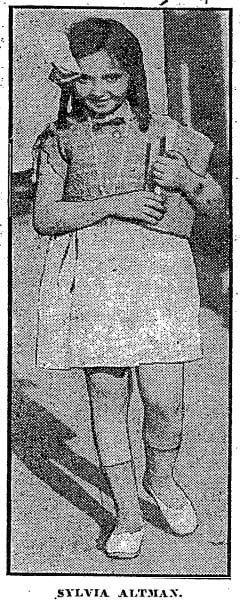
A 10-year-old student in high school! She is Sylvia Altman, daughter of Mr. and Mrs. J. Altman, 612 Otis place northwest. The girl will not be 11 years old until June, and she entered Central high school February 1.
Besides being able to enter high school she is an accomplished musician and expects to make her debut in this art the latter part of this month also at Central High school.
When she graduated from the Park View school January 31, her report card showed that she stood “excellent” in every subject.
She was born in Buffalo and came to this city with her parents several years ago. When 12 months old Sylvia had shown no inclination to walk, but one day while her mother was in the kitchen the baby pulled herself up on her feet and without trouble of any kind, walked into the kitchen, almost throwing her mother into a panic.
When 14 months old she began to talk and soon had a vocabulary of nearly 100 words. At 18 1/2 months she expressed her thoughts in full sentences, using a vocabulary of about 300 words. Her school education began when she was 3 years old, in the kindergarten. At the age of 3 1/2 years Sylvia was able to read the first and second readers used in the public schools.
…
From early childhood she has been fond of reading. Fairy tales were her favorites at first, but as years went on she changed her reading to more serious literature. At the age of 7 years she had read nearly 700 books. Her favorite authors at present are Shakespeare, Charles Dickens and Booth Tarkington. “They present so much of real life that one can’t help liking them,” she declared.
The 1924 article continues …
The mental strength of the young lady seems to grow with her years. At the age of 9 years she took an intelligence test, which showed that she had the mental ability of high school students entering the third year of their course.
In music she has shown unusual ability. She is attending Washington College of Music five times a week for piano instruction, harmony, composition, ear training and history of music. She intends going to college when her high school course is complete.
Though busy with her studies, she finds time to help her mother in house work and to play. She assists her two younger brothers, Julius, aged 8 years, who, having skipped the 1 B and 2 B grades, is in the 4 B grade and who has completed a year’s course in violin study in three months, and Elmer, 6 years old, who is in the second grade. She is fond of the “movies” and plays with dolls. She weighs five and one-quarters pounds over normal.
That’s where the report introduces her younger brothers. It called the violinist Julius in 1924, but the 1931 profile below calls him Julian, which is the name you’ll see in the story of the missing Stradivarius.
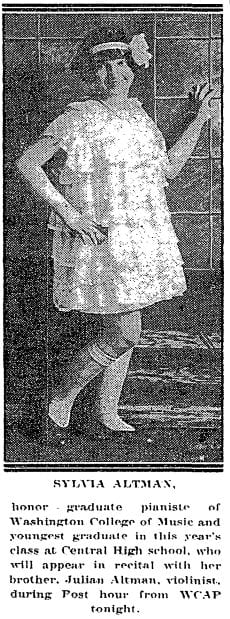
As the Post would report seven years later, Sylvia graduated from Central High School at 13 and went on to New York University. Pretty impressive.
Sylvia and her brothers went on to musical success as a trio. The Post wrote about the family on July 19th, 1931.
The July 1931 profile below described her as NYU’s youngest graduate and said she had finished “last June.” Its ages need a little caution: the 1924 account says she would turn 11 that June, which would make her 18 in July 1931, while the later article calls her 17. We have kept the newspaper’s wording below.
Genius is the word to apply to a 17-year-old girl and her two young brothers, originally of Washington, who are earning fame on the radio and in the New York musical world.
The three, Sylvia Altman, 17 years old, pianist; Julian, 15 years old, violinist, and Elmer, 13 1/2 years old, are visiting Mrs. Sophie Simon, of 1116 Seventh street northwest.
Sylvia graduated from the Park View School at the age of 10 and from Central at 13 and graduated from New York University last June with honors. She is the youngest person to graduate from the university. She was one of the first children ever to broadcast, starting at the age of 10, making her debut over Station WCAP here. At the university she directed her studies toward a bachelor of science degree and majored in psychology, music and English. She recently was awarded a Phi Beta Kappa key.
Her musical education has covered eight years. During this time she has won a number of scholarships. She is studying music at present with Ernest Hutcheson, dean of the Julliard Musical Foundation. She is well known to audiences who tune in on “The Children’s Hour,” “Toddy Party,” “Empire Builders” and “Universal Series.” She played the part of Tilly Toddy for 39 weeks and was a piano soloist in the Gold Medal Trio in “The Children’s Hour.”
She has been received by Presidents Coolidge and Hoover and has been a congressional guest of honor at a luncheon in the National Capital. She has a large number of medals and trophies and a Steinway grand piano as a gift.
Julian, who has the distinction of being the youngest high school graduate in New York City, completed the four-year course at Haaren High School this year, with a gold medal for excellence in music. He has won six gold medals as first prize for his musical ability. He is an outstanding athlete, having won medals in swimming, running, jumping and boxing. He also won a prize for his work in amateur photography.
Julian, a member of the WJZ Gold Medal Trio, has been broadcasting with his sister for several years, as well as filling musical arrangements in company with Milton J. Gross, of the National Broadcasting Co. Sylvia and Julian appeared in Keith’s vaudeville.
Elmer, who is studying the cello, takes part in the following radio programs: “The Lady Next Door,” “The Children’s Hour,” “Uncle Don” and “The Adventures of Helen and Mary.”
The children live in New York with their mother, Mrs. Jeanette Altman, at Gainsborough Studios, 222 Central Park South.
These have to be some of the most accomplished children you’ve ever read about. Makes you feel like you haven’t really done that much with your life.

Julian Altman and the Missing Stradivarius
The 1931 Post profile leaves the family with scholarships, radio appearances and a Steinway grand piano. The later court record takes us to a very different part of Julian’s life.
That record is Hall v. Schoenwetter, a family fight over Julian’s estate that a Connecticut trial court decided in 1995 and the Connecticut Supreme Court took up in 1996. The 1995 trial decision describes Julian playing at the Georgetown Inn and the Jefferson Hotel when he met Marcelle Hall, his future wife, in Washington.
According to the Supreme Court’s opinion, their relationship began sometime after 1970. Over the years that followed, he played the violin at recitals, concerts, restaurants and hotels without telling her it was the Stradivarius stolen from Bronislaw Huberman, known as the Gibson.
The Carnegie Hall Theft
In 1936, Bronislaw Huberman’s 1713 Stradivarius disappeared from his dressing room while he was performing at Carnegie Hall. Lloyd’s of London paid his insurance claim and became the legal owner of the missing instrument. The police never solved the crime.
The secret came out as Julian lay dying in 1985. According to Hall’s testimony, he told her to look between the violin case and its protective canvas cover. There she found newspaper accounts of the 1936 theft and a copy of The Strad with a passage about the missing instrument highlighted.
When Hall asked how he had acquired it, Julian gave different answers, according to the Connecticut Supreme Court’s 1996 opinion. One account was that he had bought it for $100 from a friend who stole it. Another was that he had stolen it himself, with his mother involved in the plan.
Headlines over the years have called it a deathbed confession, and Hall said Julian was the thief. But the Supreme Court majority noted that the trial court had made no specific finding that he had stolen the violin. His possession of it was established; exactly how he obtained it remained disputed.
The Finder’s Fee
After Julian died, Hall had the violin authenticated and negotiated its return to Lloyd’s. The 1996 opinion says the violin was sold for $1.2 million in February 1988, and that Lloyd’s paid Hall a finder’s fee of $263,475.75 later that month. Hall was in charge of settling Julian’s estate, and she left the fee out of her report of what the estate held.
That omission led to the lawsuit. Julian’s daughter, Sherry Altman Schoenwetter, who was Hall’s stepdaughter, challenged Hall’s report, and the Connecticut Supreme Court ruled that the fee belonged in Julian’s estate. The case concerned who was entitled to the money, rather than a criminal prosecution for the Carnegie Hall theft.
The violin’s musical life continued after its recovery. Tarisio’s history traces it through Norbert Brainin of the Amadeus Quartet to Joshua Bell, who acquired it in 2001.
What the Court Record Says About Sylvia
Sylvia also appears in the dispute because Julian’s will named her, along with Hall and his daughter, to split the rest of his estate equally. Hall’s testimony, reproduced in the 1995 trial decision, described Sylvia as ill and “poverty-stricken.”
Hall said Sylvia’s “beautiful Steinway piano was going through the floorboards of her house.” It is a painful description to read alongside the Post profile, but it comes from one participant in a family dispute. It does not give us a complete account of Sylvia’s later life.
Hall testified that she kept the secret partly out of compassion for Sylvia, because she “could not put on her shoulders the fact that her mother” was a crook. The trial decision questioned that account, pointing to a June 30, 1990 letter in which, the court wrote, Hall said Sylvia had known all along about her mother and Julian’s scheme. We cannot use that testimony to settle Sylvia’s role, or to sum up her entire life.
The 1924 newspaper story gives us something more immediate: a girl from Otis Place entering high school, studying piano and helping her younger brothers. She was fond of the movies and still played with dolls, even while the Post was marveling at her reading Shakespeare.
Lost Washington stories, in your inbox.
The newest story, plus a few from the archive.
Free. Unsubscribe anytime.
AI assisted with source checking and editing. The featured photograph was reconstructed with AI from the 1931 Washington Post scan; the original remains in the article. Here’s how we use AI.Suggest a correction