
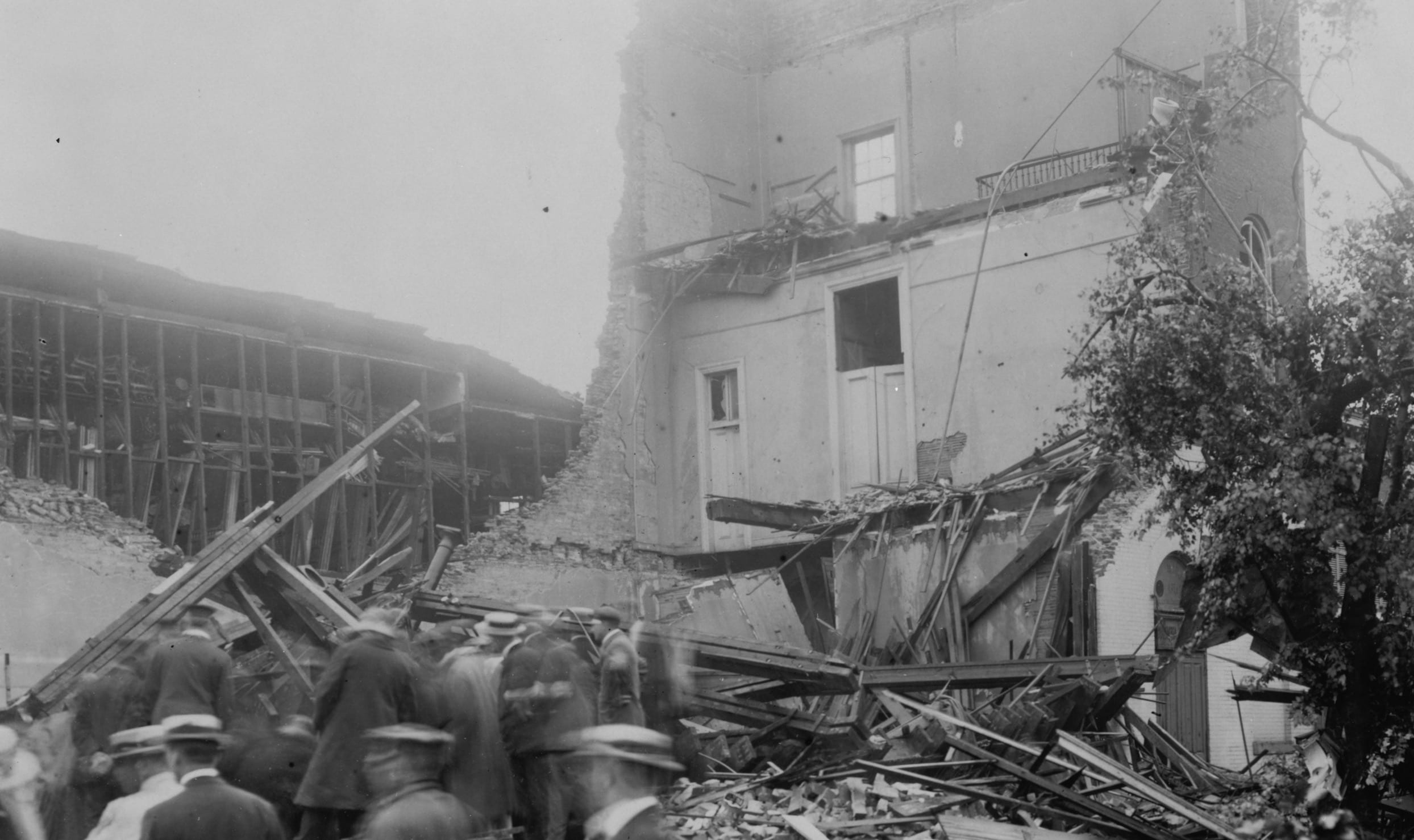
It started as a waterspout.
On the afternoon of November 17, 1927, a funnel dropped over the Potomac just below Alexandria, touched the water, and came ashore as a tornado. Twenty-some minutes later it was gone. In between it cut a path of about fifteen miles, across Old Town, the Navy Yard, and Capitol Hill, and wrecked or damaged around 150 houses in the District alone.
It is still the most destructive tornado on Washington’s books.
The strangest part is the body count. One.
We dug up the contemporary coverage, and the afternoon is wilder than any summary. Here is how it went.
A black cloud in the southwest
The Alexandria Gazette caught the first minutes from the ground.
It was about 2:30 o’clock when the “twister” hit. It was done so suddenly that few realized what had happened. A black cloud was seen in the southwest. It appeared to come lower and lower. There was a high wind which seemed to increase its velocity every second and the cloud apparently came closer to the earth.
Tornadoes were almost unheard of here, and nobody had a warning. Broadcast meteorology was still a dream, and a funnel that forms and dies inside half an hour leaves no time for one anyway.
Later tornado catalogs rate the storm an F2, with winds estimated near 125 miles an hour. The instruments at the Anacostia naval station put a hard number on it: a gale clocked at ninety-two miles an hour, and a barometer that dropped 0.46 of an inch almost instantly at 2:31, the moment the core came through.
Across the river to the Navy Yard
From Alexandria the tornado swung back over the Potomac and into Anacostia, where it tore the roof off a barracks and flattened a hangar at the naval air station with seven airplanes inside it. Then it crossed the Anacostia River and went straight over the Washington Navy Yard.
We found a contemporary account in The New York Times that lays out the path.
A tornado hit the Naval Air Station and the Washington Navy Yard immediately after 2:30 o’clock, wrecking hangars and planes at the former, damaging twenty buildings, including the commandant’s house, a historic building occupied for more than a century, and causing a loss of $300,000 to both naval plants.
The weather instruments in the observatory at the Anacostia Air Station recorded a gale of ninety-two miles an hour during the height of the storm and a drop of 0.46 in the barometer almost instantaneously at 2:31 o’clock, when the fury of the tornado struck.
The tornado appears to have been wholly local, having started in the Potomac River with a waterspout, just below Alexandria. It swept over the latter, five miles south of Washington, a place rich in associations of George Washington; headed across the river to the Naval Air Station, passed directly over the Navy Yard, swept a narrow path to Fifteenth and East Capitol Streets, crossing Benning Road near Eighteenth Street, and did some damage at Hyattsville and Bladensburg, Maryland towns, five miles northeast of the capital.
The commandant’s house had stood at the Navy Yard since the early 1800s. The storm took twenty buildings around it and kept moving north.
Up through Capitol Hill
The funnel ran north up Eighth Street SE, bent toward Fourteenth Street near Lincoln Park, and chewed through the blocks east of the Capitol before heading for Kingman Park and the Maryland line. St. Cyprian’s Catholic Church, near Lincoln Park, took serious damage. So did rows of brick houses that are still standing today.
The Washington Post described the scene the next morning.
Through its mile wide path, the twister strode like a giant, crushing entire blocks of houses, picking others up and tossing them about, nudging over automobiles until they capsized, and then skipping around like a giant gone mad. Its erratic course was a scene of devastation, scores of buildings left roofless, others left without walls, and still others standing jagged in the pouring rain, entire sides ripped out.
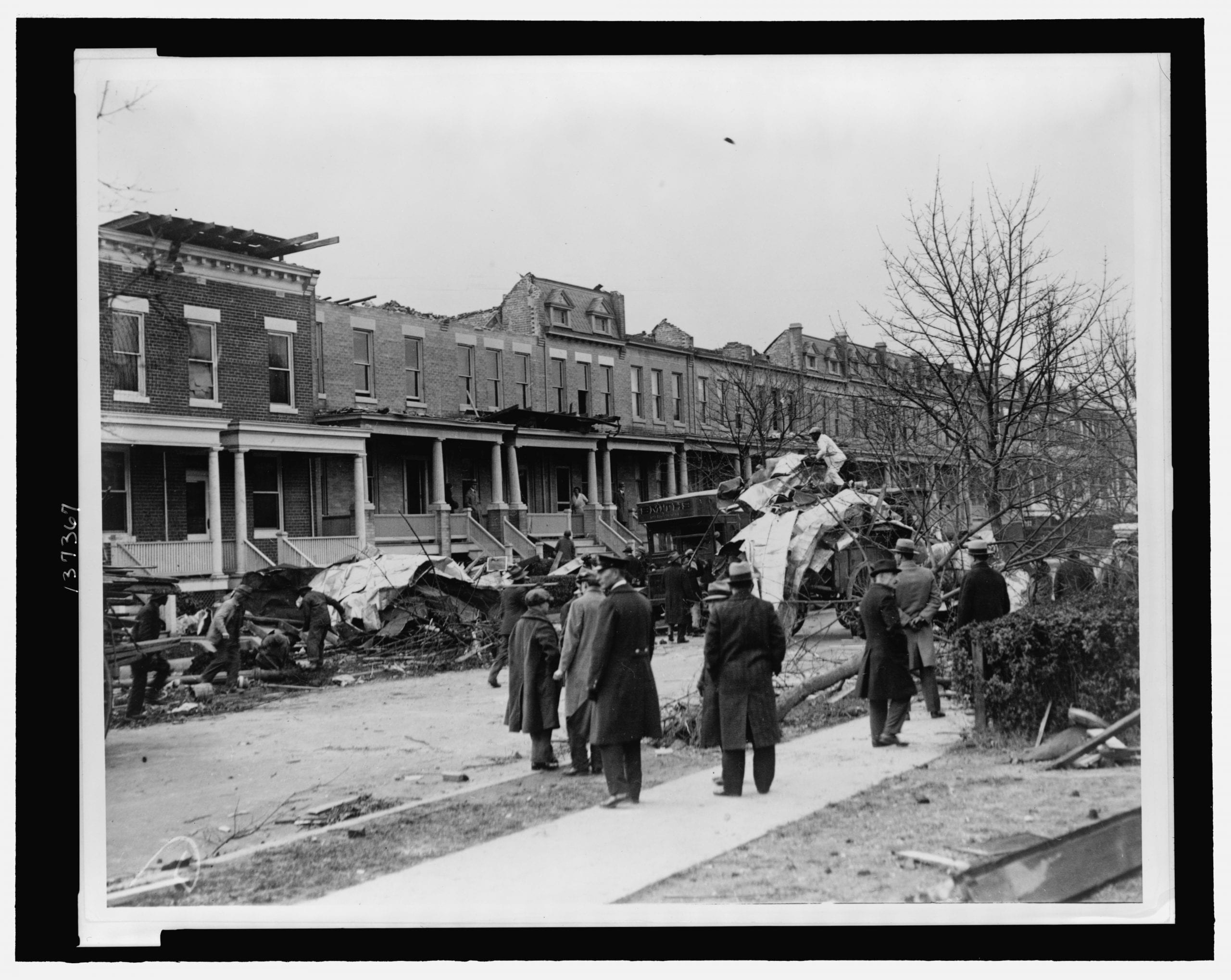
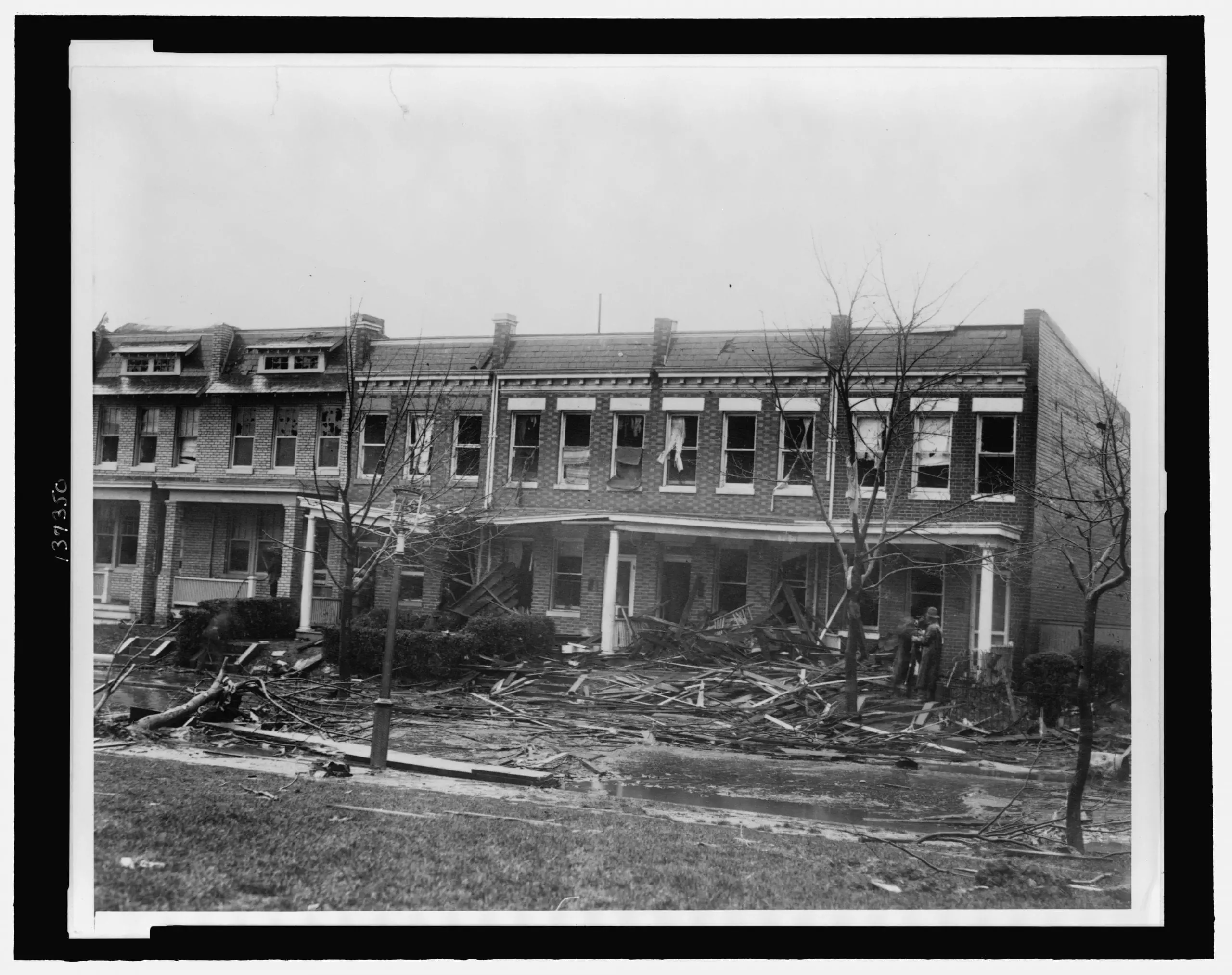
One dead, hundreds hurt
For all that wreckage, the storm killed exactly one person, struck by lightning while crossing a bridge. Forty-nine others were hurt in the District, and the Post ran its front-page count under the headline “One Dead, Hundreds Hurt and Homeless.” Dozens of families along the track, through Capitol Hill and out into the Maryland suburbs, were left without a roof.
The hours after were their own kind of awful.
Over all of the wreckage hovered hundreds of persons, seeking frantically for members of their families or friends who might possibly be buried in the piles of stone, brick, lumber and tin which had once been their homes.
Rumors of long death lists ran through the city, and police stations, hospitals, and newspaper offices were besieged into the night by people checking on relatives. The rumors kept turning out to be wrong. One death was the whole of it.
That was luck, and the city knew it. Less than six years earlier a heavy snow had caved in the roof of the Knickerbocker Theatre and killed ninety-eight people in a single evening. A tornado through a dense residential corridor could have been far worse than a collapsed movie house. It simply was not.
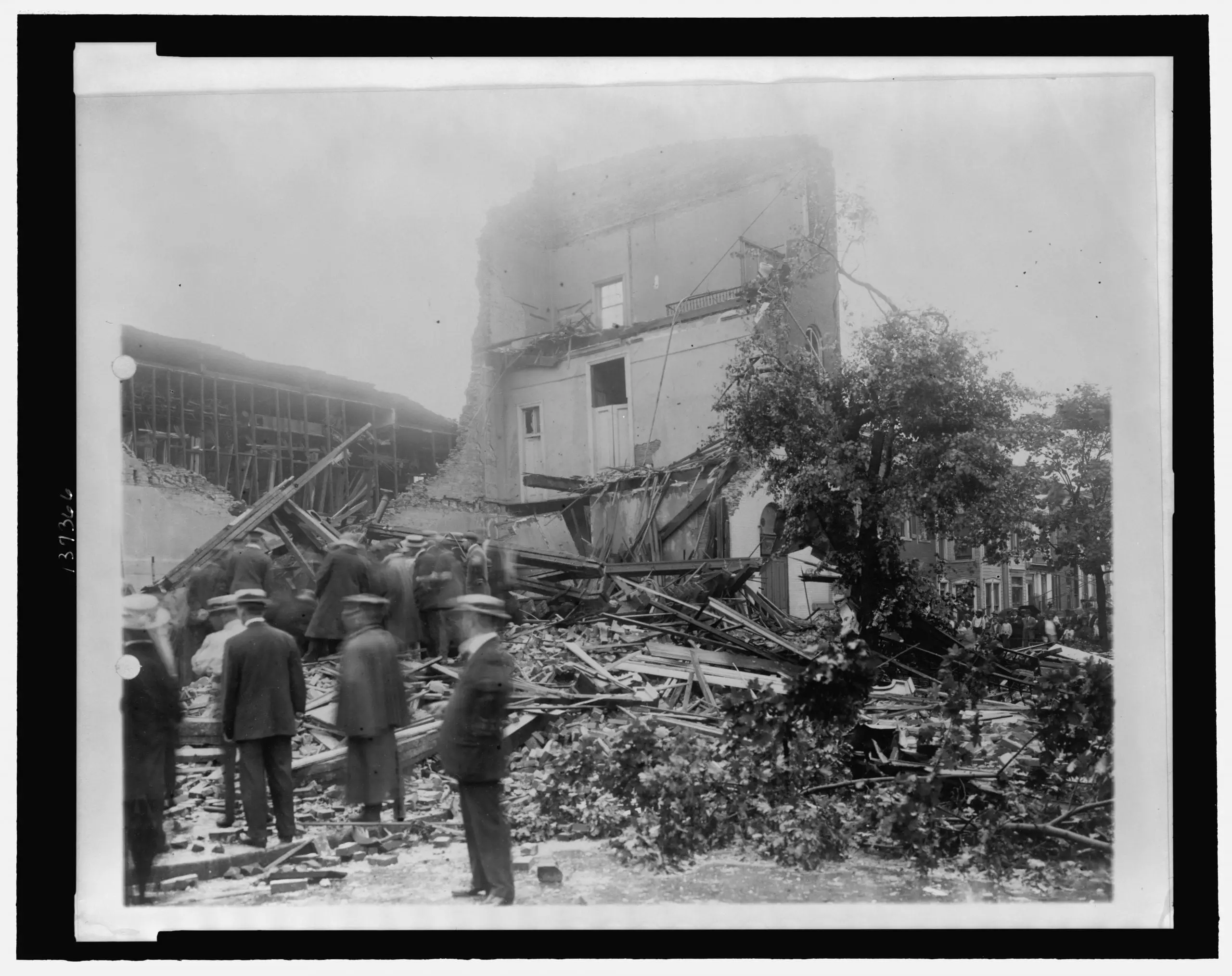
Damage came to about $1 million, more than $18 million in today’s dollars. The cleanup started fast. By the next morning the Post was already running a front-page story headlined “City Speeds Work of Restoring Area Swept by Storm.”
What’s there now
You can walk the path. The houses on the 1300 block of A Street NE still stand, and so does the row at 1216 to 1226 C Street SE. Look up at the cornice lines on a few of them and you can still pick out the patched brick from where the storm tore the roofs away.
People live in those houses today with no idea a waterspout once came up out of the Potomac, crossed two rivers, and tried to take the block.
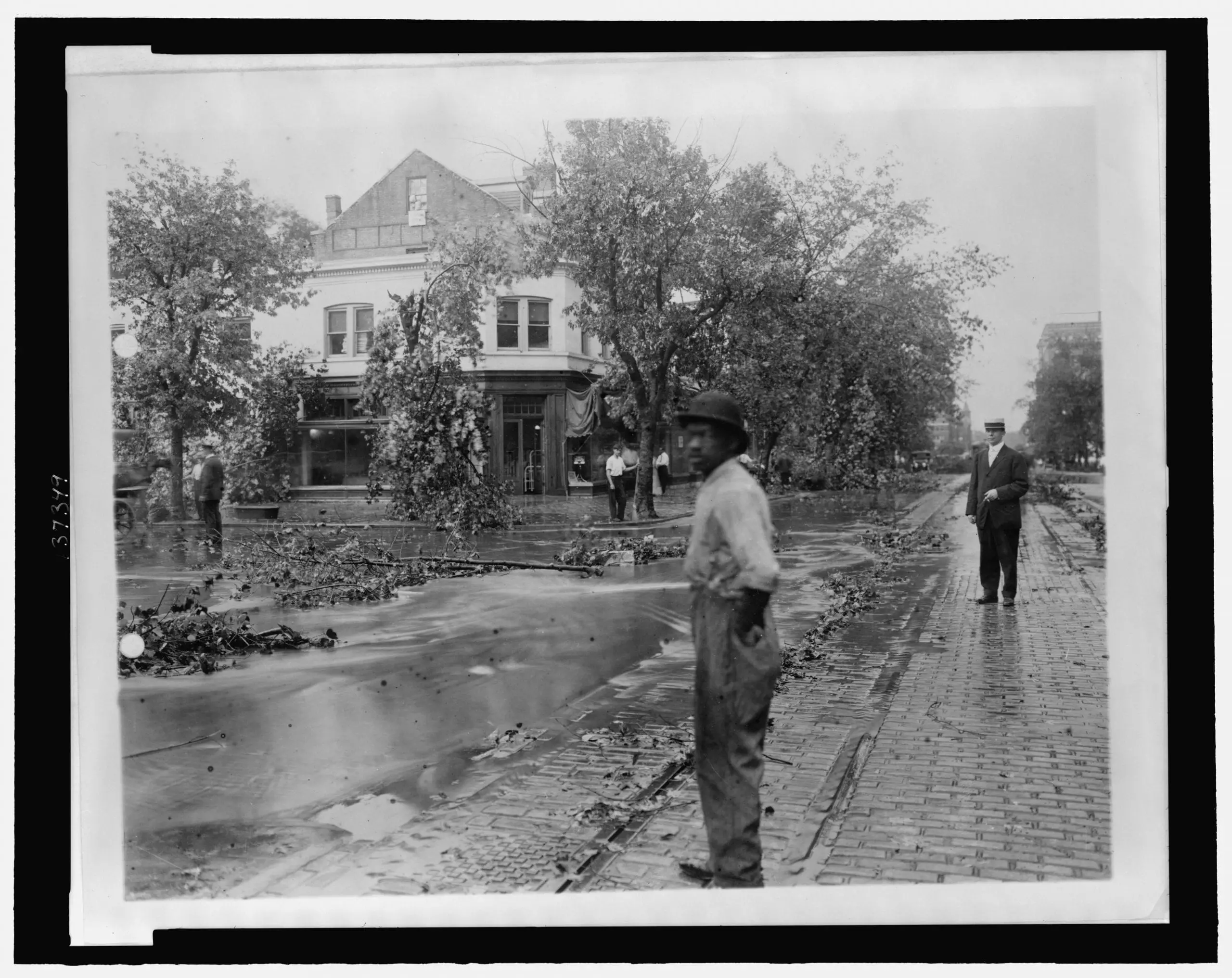
Note that the bottom two photos are from a different storm–the tornado of July 30, 1913.
My cousins’ house is pictured in the A Street photo
I know I have seen this tornado addressed somewhere before and I remember because it was so close to the house I live in currently. I can’t find what I remember but I did find:
http://www.washingtonian.com/blogs/capitalcomment/local-news/four-photos-from-the-worst-tornado-that-ever-hit-dc.php
http://docs.lib.noaa.gov/rescue/mwr/055/mwr-055-05-0227.pdf
A-ha. Now I remember. You did a post on the 1913 storm and BF Saul Building – and I replied with a link to the following.
http://www.washingtonpost.com/blogs/capital-weather-gang/wp/2013/07/30/possible-tornado-struck-d-c-and-the-white-house-100-years-ago-photos/
Of course it made it to Shorpy. http://www.shorpy.com/node/7165
My mother and aunt lived with their parents, Langhorn & Maud DeMent Shearer on N Payne St when the 1927 tornado struck. The Shearers owned a store; they lived above it. They lost everything in the tornado. My mother was about six years old and said she remembered walking down the street and the fronts being torn off of the homes. It reminded her of dollhouses, where one could look directly into the interior. All of Langhorn’s papers were lost – his debtors never re-paid him. They had no insurance and were basically bankrupt. The family never recovered financially during the depression. They moved to a one bedroom apartment in Takoma Park, MD.