
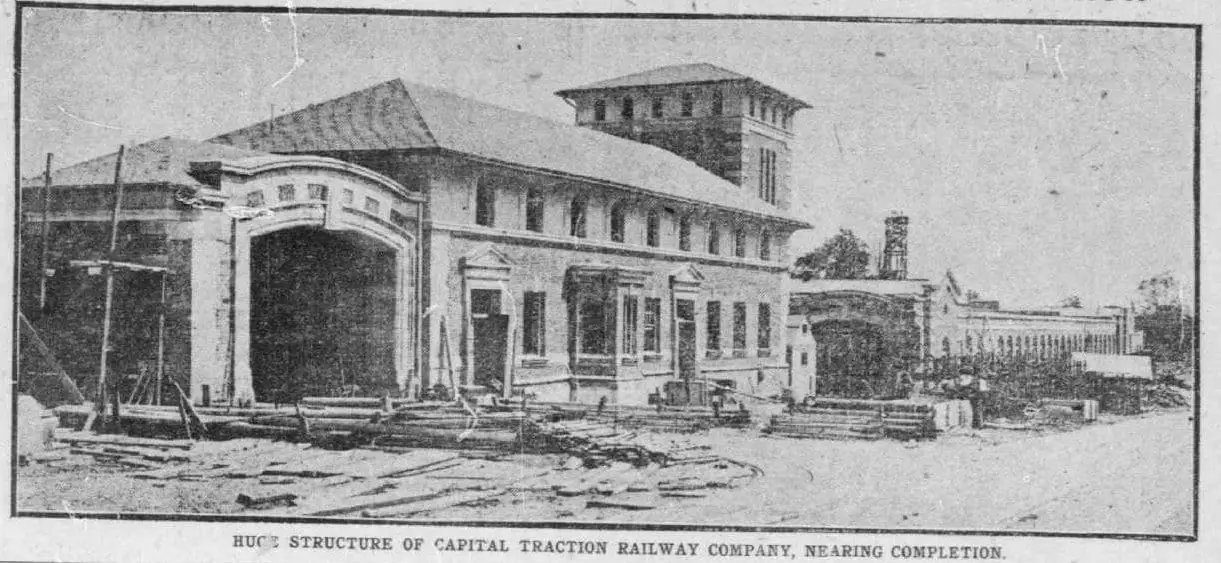
If you have driven up 14th Street NW through Petworth, you have passed it. A long brick building near Decatur Street with a square tower and tall arched openings, sitting on the corner like a transplanted Italian villa.
For most of the last century it was a bus garage. That is not what it was built for.
It went up in 1906 and 1907 to hold streetcars. More than 250 of them. And in 2023, crews demolished almost the entire thing, leaving only that 14th Street face standing.
That face is the part everyone has always seen. It is also the only part being saved.
Equal to any building of its kind in this country
We dug up a great article in the Washington Times from June 2nd, 1907, when the building was still going up.
From the modest car sheds on Florida avenue that formerly housed the cars of the Fourteenth street branch of the Capital Traction Company to the huge structure now nearing completion at the extension of the line near Brightwood is a vast step, but it plainly tells the story of the tremendous increase of travel and the wonderful building up of the section traversed by the line.
The building, which is 538 feet long by 208 feet wide, covers nearly two and one-half acres of ground and will accommodate more than 250 cars, which, if placed in a straight line, would cover fully two miles, reaching from the Treasury building to the present car barns at Fourteenth street and Park road.
The construction is absolutely fireproof, the roof and columns being of re-enforced concrete, while the interior is divided by sectional walls of brick so that in case of fire it could be contained within one section and travel proceed without interruption. There are two turn tables, and the conduits, or pit, on which the cars runs [sic], are so arranged that the plows need not be disconnected when being moved in and out of the building.
Extensive repair shops are a part of the arrangements, so that it will be possible to build an entire car in the company’s building.
At the north end of the structure are the rooms for the offices of the company, together with conductors and motormen’s recreation rooms, handsomely fitted.
The exterior is of light brick and white stone trimmings, and the architecture, while pleasing in effect, might well be designated as belonging to the “practical modern school,” especially adapted for the uses intended.
Wood, Donn & Deming were the architects, while the construction work has been carried on by Richardson & Burgess. The cost will reach fully $250,000, and when entirely completed will be equal to any building of its kind in this country.
Two and a half acres. A line of cars that would have stretched two miles, from the Treasury all the way back to the old barn at 14th and Park Road.
The price tag was $250,000. In today’s money that is more than $8 million, and they spent it on a place to park trolleys.
The line that built the neighborhood
The barn was not really about the cars. It was about the land north of it.
Around the turn of the century, the Capital Traction Company pushed its 14th Street line past the old terminus at Park Road and ran it north toward Colorado Avenue. The track opened up farmland and orchards that had been a long, slow ride from downtown.
Petworth, Brightwood, and what we now call 16th Street Heights filled in behind the rails. The “modest car sheds on Florida avenue” the Times mentioned could not handle the traffic anymore.
So the company built something enormous to handle the surge, and to advertise it.
A villa for streetcars
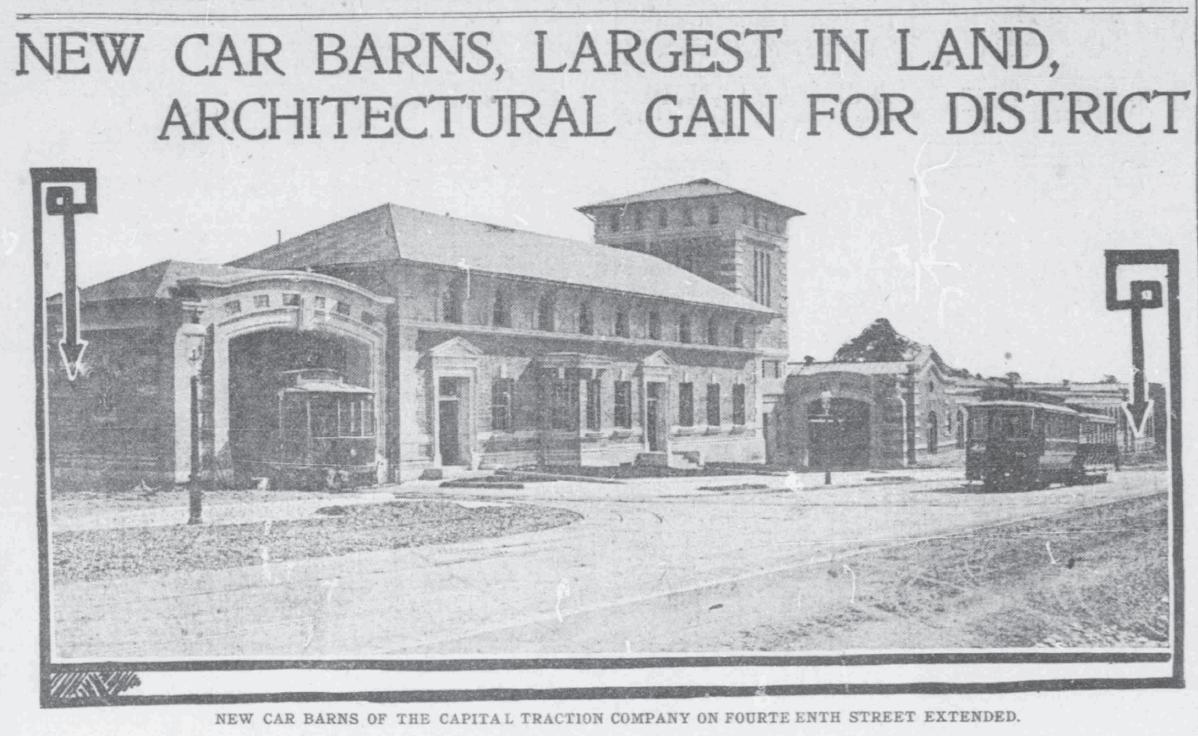
Here is the part that gets me. The streetcar company hired one of the best architecture firms in the city and asked them to make a garage look like a country estate.
Wood, Donn & Deming were not garage people. The same firm designed the Union Trust Building, the first bank high-rise in Washington, and in that very year of 1907 they were at work on the Masonic temple at 13th and New York Avenue that is now the National Museum of Women in the Arts.
For the car barn they reached for the Italian Renaissance. The 14th Street front got a tower, a long arcade of windows, big arched openings for the cars, and stone keystones and quoins. The Capital Traction Company wanted the building to fit in with the houses going up around it, and to make the new neighborhood look like a place worth moving to.
It worked. The barn was treated as an architectural gain for the District, not an eyesore to hide.
How the cars actually ran
That line in the 1907 article about “the conduits, or pit, on which the cars runs” points to one of the strangest things about old Washington.
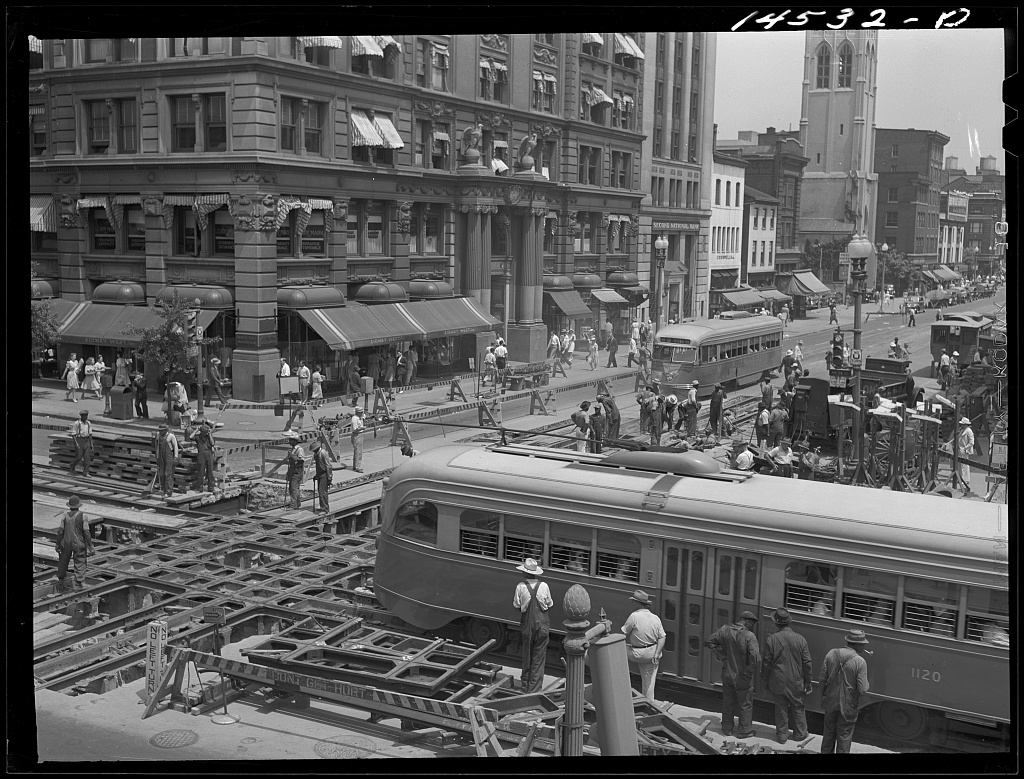
DC streetcars did not run on overhead wires downtown. Congress had banned them in the old city, deciding that a web of trolley wires would be ugly over the federal capital. So the cars drew their power from underground.
Between the rails ran a narrow slot. Each car dropped a steel arm called a plow down through that slot into a buried conduit, where it slid along electric rails and picked up current. Where the underground system met the overhead-wire territory farther out, crews called “pitmen” worked in pits to attach or pull the plow on every passing car.
The system was clever and a constant headache. It was also expensive, which is part of why the company built its repair shop big enough to assemble a whole streetcar from scratch.
We have written about another piece of this vanished machine, the abandoned Capital Traction powerhouse that once fed current to the whole system.
The last car
You know how this story ends, because there are no streetcars in Washington anymore.
After a 1955 strike, the company changed hands and became DC Transit, with a mandate to rip out the rails and switch to buses. The end came early on Sunday, January 28th, 1962. The final scheduled run left 14th and Colorado at 2:17 in the morning, packed with railfans and drunk college kids, and pulled into the Navy Yard barn for the last time.
By that afternoon, workers were already tearing the tracks out of 14th Street.
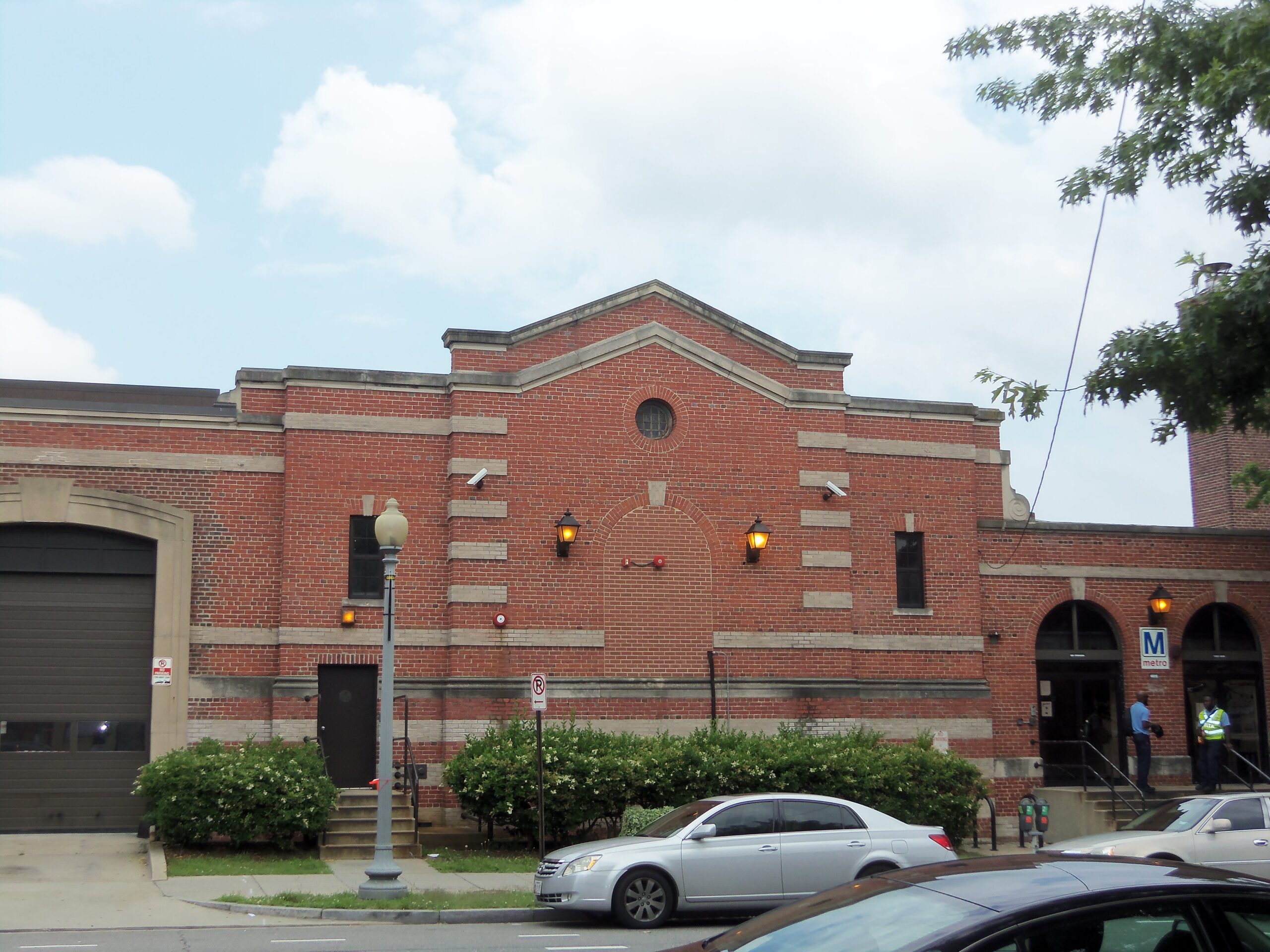
The Decatur Street barn had seen it coming for decades. Buses had been parking in its basement since 1926, and the building was fully converted to a bus garage in 1959. Under Metro it became the Northern Bus Garage, the name generations of riders have known it by.

What’s there now
For a building that started as a streetcar barn, it has had a long life. It is one of only seven of the roughly thirty car barns the city once had still standing, and the only one still used to move people.
In 2013 it was added to the National Register of Historic Places. Then Metro closed it in 2019, and in 2023 the wreckers took down everything except that 14th Street facade.
A new all-electric bus garage is rising behind the old wall now, nearly 600,000 square feet, with retail space, a community room, and the historic tower and front restored. Metro expects to finish around 2027.
The streetcars are long gone. The villa they hid behind is still on the corner, about to start its third century of moving Washington around.
If you like this corner of the city, take a look at our rare 1907 map of the area around Brightwood and the 1936 Capital Transit map that shows just how far the streetcars once reached.
We dug this one up with help from AI and checked it against the original records below. Here’s how we use AI.