
This is a great Harris & Ewing find. Sometime between May 1918 and April 1919, members of the U.S. Senate Military Affairs Committee gathered in Washington and crowded around a Signal Corps handset to listen as Colonel C. C. Culver radioed orders to a pilot in the air. A senator from Wyoming, standing on the ground, could pick up a phone and talk to a man in flight overhead.
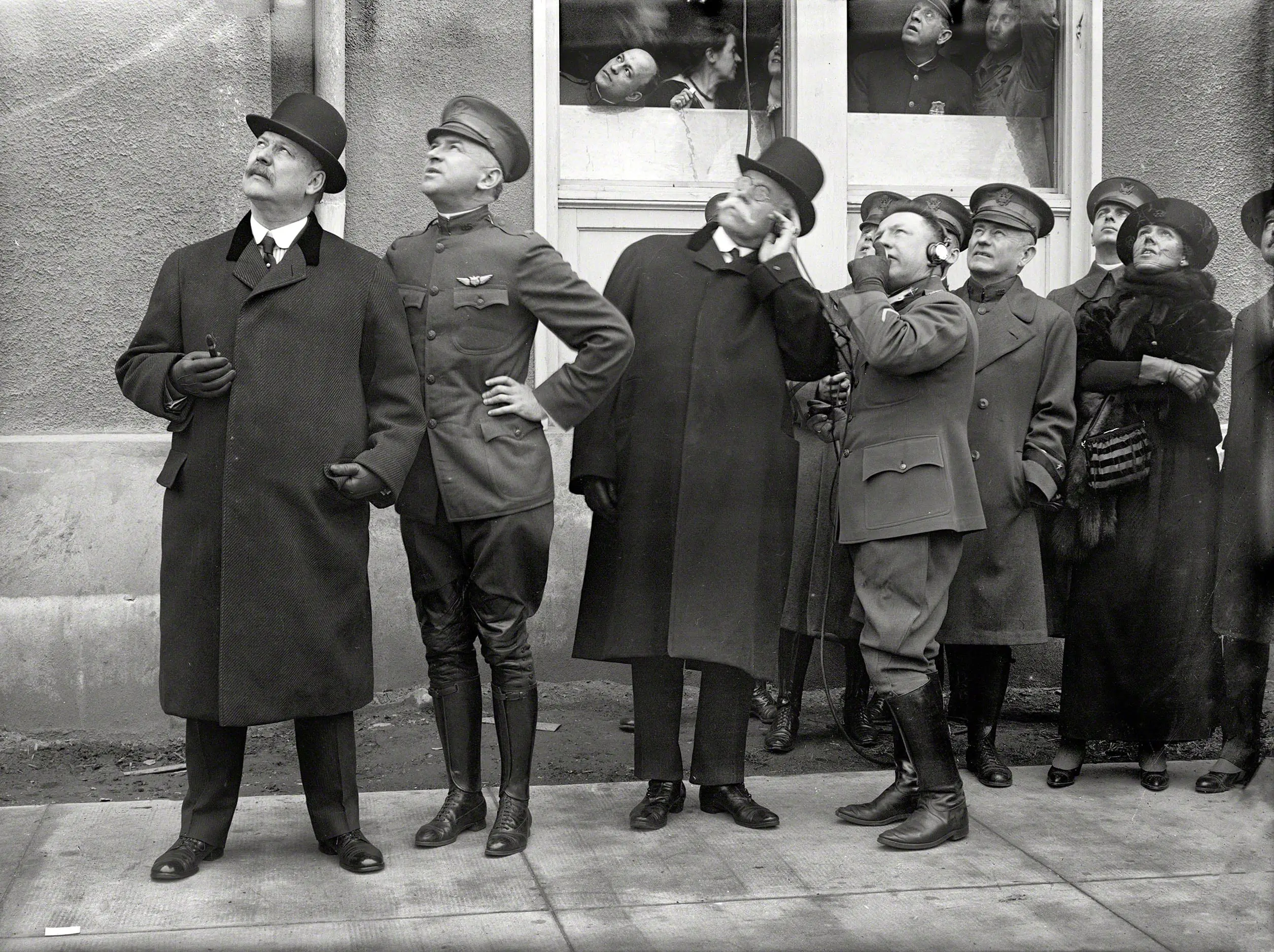
The Library of Congress filed the original print under this caption:
Members of the Senate military affairs committee at a demonstration of the improved radiotelephone. Col. C. C. Culver is telephoning orders, Senator Francis E. Warren is listening in. Next to him is Maj. Maurice R. Connolly, a former member of Congress, and on the left, Senator John W. Weeks. Back of Colonel Culver is Maj. Gen. William L. Kenly, chief of aeronautics.
Each of those five men is worth a paragraph.
Colonel C. C. Culver ran the Signal Corps program the Army called Airplane Radio Development. On the day Harris & Ewing took this photograph he was demonstrating the latest iteration of a radiotelephone the Signal Corps had been refining with AT&T since 1917.
Senator Francis E. Warren of Wyoming, the man at Culver’s elbow listening in, was the longest-serving sitting member of the U.S. Senate at this point. He had won the Medal of Honor at Port Hudson in 1863 as a 19-year-old Massachusetts private, moved west after the war, and become Wyoming’s first state governor in 1890. He held a Senate seat almost continuously from 1890 until his death in 1929.
Major Maurice Connolly, standing next to Warren, is the most quietly interesting figure in the frame. Connolly was a one-term Democratic congressman from Iowa’s 3rd district. After losing a 1914 Senate race he gave up on politics, enlisted when the U.S. entered World War I, earned his pilot’s wings, and rose to major in the Aviation Section of the Signal Corps. He and Fiorello La Guardia, later the mayor of New York City, were the only former U.S. congressmen to fly in the war. After the November 1918 armistice, Connolly was assigned to Washington to serve directly under General Kenly. He was killed in 1921 in an Air Service crash near Indian Head, Maryland.
Senator John W. Weeks of Massachusetts, on the left, went on to serve as Secretary of War under both Warren G. Harding and Calvin Coolidge, from 1921 to 1925.
Major General William L. Kenly, just behind Culver, was Director of Military Aeronautics from May 1918 to April 1919 and, briefly, the first head of the U.S. Army Air Service. Kenly’s eleven-month tenure is what dates this photograph. The picture had to have been taken inside that window, and Connolly’s posting to Washington after the armistice points to the back half of it, somewhere between November 1918 and April 1919.
The handset in Culver’s grip is the actual story.
In May 1917, Major General George O. Squier of the Signal Corps walked into AT&T’s labs and asked the company to build a radio that could carry the human voice from the ground to an aircraft and back, with a working range of about 2,000 yards. By the Fourth of July of that same year, AT&T engineers had two-way voice working between a pilot and the ground at Langley Field in Virginia. It was the first time the U.S. military had voice in the air.
Production lagged combat. Only a small number of these AT&T sets actually reached pilots in France before the war ended in November 1918, and the equipment stayed mostly stateside through the early 1920s. But the proof of concept was already in hand by the time this picture was taken, and demonstrations like the one in the Harris & Ewing frame were how the Signal Corps kept Senate appropriations flowing. Hand a Wyoming senator a phone, let him hear a pilot’s voice in his ear, and the next budget hearing goes a little smoother.
This is such a great shot.